Swing-Away Under-Desk Headphone Hook
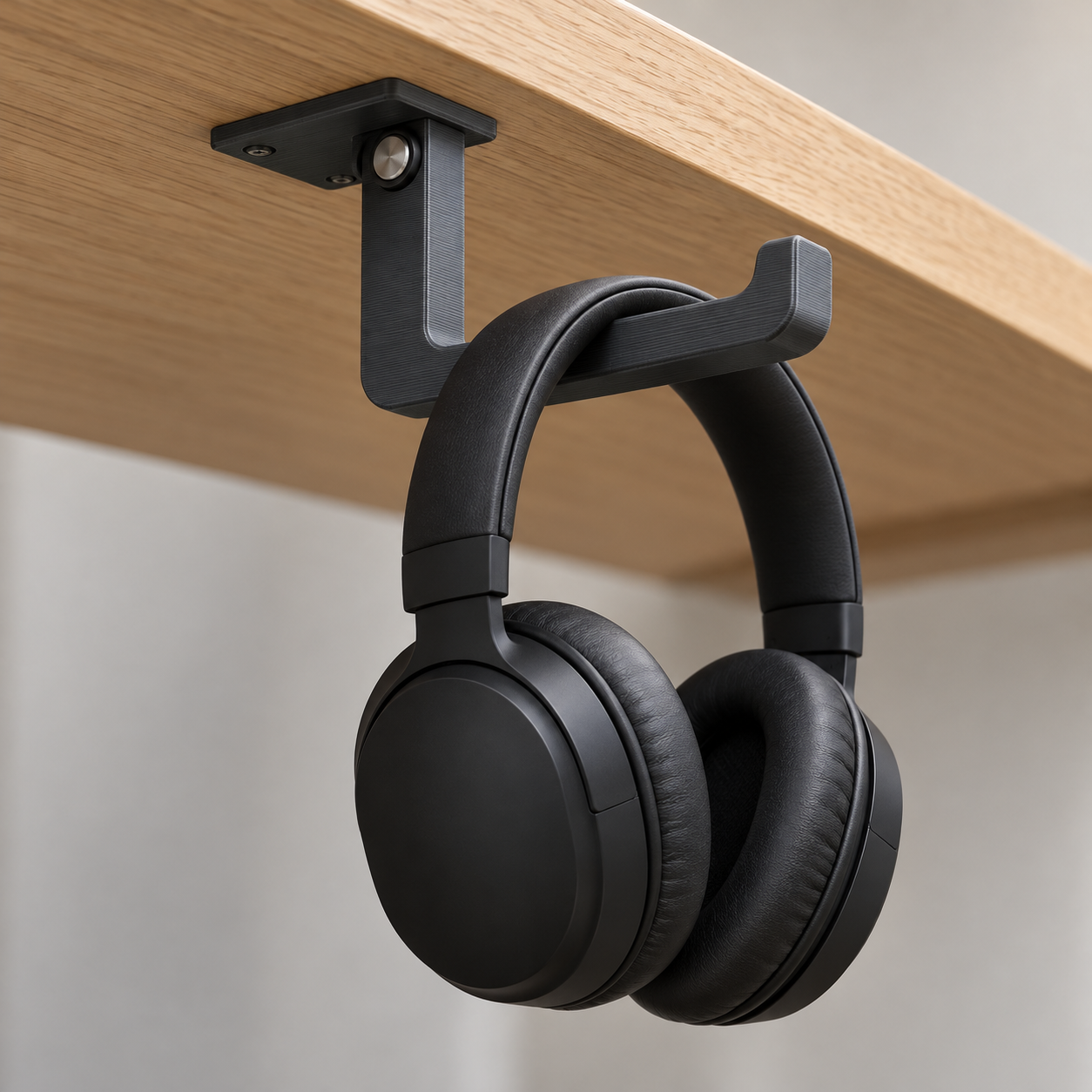
An under-desk headphone hook that clicks out past the desk edge when you want your headset and swings back under the desk, out of your knees' way, when you don't.
Swing-Away Under-Desk Headphone Hook
An under-desk headphone hook that clicks out past the desk edge when you want your headset and swings back under the desk, out of your knees' way, when you don't.
Date: 2026-10-10 Category: Desk and Tech Modeling difficulty: Intermediate Estimated print: ~2.3 h total · ~45 g PETG (estimate) Suggested price: $14–$22 printed · $4 digital file (estimate) Status: Concept
Description
Two printed parts and one bolt. A flat plate, 80 × 40 mm, screws to the underside of the desk about 30 mm back from the front edge. An L-shaped arm hangs from it on an M5 pivot: the arm drops 60 mm, then runs 100 mm forward and ends in a 12 mm upturned tip. The headband rests on that horizontal run, so the ear cups hang below the desk.
The arm turns on a vertical axis and clicks into three positions. Straight out, the tip is 120 mm from the pivot, about 90 mm past the desk edge. Swung 90° left or right, it lies parallel to the edge and tucks under the desk. A printed bump on the arm drops into shallow dimples on the plate's boss at each position. The bolt runs up into a lock nut trapped in the plate, so you set the click stiffness with a hex key from below and the arm can't unscrew itself.
There's a 4.5 mm notch in the tip for parking a headset cable. In charcoal PETG it looks like a plain bracket, which is the point; nobody wants a sculpture under their desk.
Why it sells
Under-desk headphone hooks are a busy file category, which tells you people keep looking for one. Printables alone has an under-desk hook updated in July 2025 (Printables 1358891), a tape-mounted holder with two side arms and a centre pillar (Printables 1438749), a hanger/stand/hook combination (Printables 1164879) and a clamp-on hook sold in several variants (Printables 664262). All3DP keeps a roundup of headphone stand files (All3DP). On the selling side, Creality's guide to products worth printing for sale lists headphone stands as a desk-clutter fix (Creality), and Hyper3D's 2026 Etsy list counts tech accessories among the steady sellers (Hyper3D).
Every hook I found is fixed. It sticks out under the desk edge all day, right where knees and chair arms go. This one folds away.
Who buys it
PC gamers, streamers and people working from home with an over-ear headset and a desk that's already full. It's a cheap desk upgrade or a stocking-stuffer for someone who games. They find it on Etsy and Amazon by searching "under desk headphone hook" or "headset holder".
Design overview
- Two printed parts: a screw-on mount plate and an L-shaped arm.
- The arm swings on a vertical M5 pivot with click stops at straight out, 90° left and 90° right. Folding away is the feature the listed hooks don't have.
- The lock nut sits trapped in a hex pocket in the plate's desk face, so it can't spin and can't drop out.
- The 84 mm saddle between the drop and the tip takes one large gaming headset or two slim ones.
- 12 mm upturned tip with a 4.5 mm cable notch.
- Arm prints on its side so the layers run along the L and carry the bending load.
Dimensions
| Measurement | Value (mm) | Notes |
|---|---|---|
| Overall width (X) | 160 | Arm straight out: plate back edge (−40) to arm tip (+120) |
| Overall depth (Y) | 40 | Plate width; arm is 24 |
| Overall height (Z) | 71 | Desk underside to arm bottom: plate 8 + boss 3 + arm 60 |
| Wall thickness | 8 | Plate, arm tab, stem and horizontal run are all 8 thick |
| Mount plate | 80 × 40 × 8 | Corner R 6 |
| Pivot boss | Ø24 × 3 | Centred on the pivot axis |
| Pivot hole | Ø5.3 | Plate and arm |
| Nut pocket | 8.3 AF hex × 5 deep | Opens on the desk face |
| Mounting screw holes | Ø4.5, countersink Ø9 × 90° | At x = ±30 on the plate |
| Detent radius | 8 | Dimples at 0°, +90°, −90° |
| Dimple | Ø3.2 sphere, 1.0 deep | Mouth Ø2.97 |
| Detent bump | Ø3 sphere cap, 0.8 tall | On the arm tab top face |
| Arm width (Y) | 24 | Whole arm |
| Arm tab | 32 × 24 × 8 | x −12 to 20 from the pivot axis |
| Drop (stem) | 8 × 24 × 60 | x 20 to 28 |
| Horizontal run | 100 × 24 × 8 | x 20 to 120, bottom 60 below tab top |
| Saddle length | 84 | Clear length between stem and tip, x 28 to 112 |
| Tip | 8 × 24 × 12 | Rises 12 above the run |
| Cable notch | 4.5 wide × 6 deep | Centred in the tip |
| Reach past pivot | 120 | ~90 past the desk edge with the plate's pivot 30 back from the edge |
Parts list
| Part | Qty | Material | Size X×Y×Z (mm) | Print orientation | Supports |
|---|---|---|---|---|---|
| Mount plate | 1 | PETG | 80 × 40 × 11 | Desk face down, boss up | none |
| Swing arm | 1 | PETG | 132 × 24 × 60.8 | Lying on its side (a 132 × 60 face down) | none |
Hardware and non-printed parts
- M5 × 20 mm socket head cap screw (ISO 4762) ×1, the pivot
- M5 nylon-insert lock nut (DIN 985, 8 mm across flats, 5 mm tall) ×1
- M5 flat washer (DIN 125, 10 mm OD, 1 mm thick) ×1, under the bolt head
- #8 × 5/8 in (4.2 × 16 mm) flat-head wood screws ×2, for desks at least 18 mm thick
Fits and tolerances
- Bolt ↔ plate and arm pivot holes (sliding/rotating): Ø5 shank in a Ø5.3 hole, 0.15 mm per side. That's tighter than the usual 0.2 because the arm turns on the shank and any extra slop shows up as wobble at the 120 mm tip.
- Lock nut ↔ hex pocket (press): 8.0 AF nut in an 8.3 AF pocket, 0.15 mm per side. Enough to press in by thumb and stop it spinning while you tighten from below.
- Arm tab ↔ plate boss (detent, face contact): flat faces bear on each other. The 0.8 mm bump drops into a 1.0 mm dimple, so it seats fully and the faces stay in contact. The lock nut's preload sets the click force.
- Wood screws ↔ plate holes (clearance): 4.2 mm screw in a 4.5 mm hole, 0.15 mm per side.
Modeling guide
Each part has its own origin.
Mount plate. Origin at the centre of the desk face (the face that touches the desk; it sits on the print bed). +X points toward the front edge of the desk, +Y along the desk edge, +Z away from the desk.
- Sketch on XY a rectangle 80 × 40 centred on the origin, corner R 6. Extrude 8.
- Sketch on the top face (z = 8) a Ø24 circle at the origin. Extrude 3, to z = 11.
- Cut a Ø5.3 hole at the origin through everything (z 0 to 11).
- Sketch on XY a hexagon, 8.3 across flats, centred on the origin with two flats parallel to X. Cut from z = 0 to z = 5.
- Cut Ø4.5 holes through at (30, 0) and (−30, 0). Add a 90° countersink, Ø9 at the z = 8 face.
- Detent dimples: on the boss top (z = 11), subtract three Ø3.2 spheres centred at z = 11.6 at (8, 0), (0, 8) and (0, −8). Each leaves a 1.0 deep dimple.
- Chamfer the bottom outer edge 0.5 (against elephant's foot). Fillet the plate's top outer edges and the boss's top edge R 1.
Swing arm. Origin on the pivot axis at the tab's top face (the face that touches the boss). +X runs along the arm toward the tip, +Y across the arm, +Z up toward the desk. The arm is modeled upright as used and printed lying on its −Y face.
- Sketch the L profile on the XZ plane as one closed shape: tab x −12 to 20, z −8 to 0; stem x 20 to 28, z −60 to 0; run x 20 to 120, z −60 to −52; tip x 112 to 120, z −52 to −40.
- Extrude the profile symmetrically 24 (y −12 to 12).
- Fillet the profile corners: inside corner where the stem meets the run, at (28, −52), R 8; outside bottom corner at (20, −60), R 12; inside corner under the tab at (20, −8), R 4.
- Cut the Ø5.3 pivot hole along Z at the origin through the tab (z −8 to 0). Make it a teardrop with its 45° point toward +Y so it prints round lying on its side.
- Detent bump: add a Ø3 sphere centred at (8, 0, −0.7) and keep the part above z = 0. That leaves a cap 0.8 tall.
- Chamfer the tab's two vertical edges at x = −12 by 3.
- Cable notch: cut a slot y −2.25 to 2.25, z −46 to −40, through the tip (x 112 to 120).
- Fillet the top long edges of the run, x 28 to 112, R 2. Fillet the tip's top edges R 3. Leave the faces at y = ±12 sharp so the bed side stays flat.
Print settings
| Setting | Value |
|---|---|
| Material | PETG |
| Nozzle | 0.4 mm |
| Layer height | 0.2 mm |
| Walls / perimeters | 4 |
| Infill | 40% gyroid |
| Supports | None |
| Brim / adhesion | 5 mm brim on the arm (tall, narrow footprint); none on the plate |
| Notes | The arm stands 24 mm tall on its side with a 132 × 60 footprint, so a brim keeps the tip from lifting. Glue stick or textured PEI so PETG releases. |
Assembly
- Press the lock nut into the hex pocket on the plate's desk face, nylon ring facing the desk (away from the bolt).
- Hold the plate against the underside of the desk with +X toward you and the pivot about 30 mm back from the front edge. Drive the two wood screws.
- Put the washer on the bolt and push the bolt up through the arm's pivot hole, entering from the bottom of the tab.
- Thread the bolt into the trapped nut with a 4 mm hex key until the arm clicks firmly between stops but still turns by hand. About a quarter turn past snug is usually right.
- Swing the arm out, hang the headset on the run, and swing it back under the desk when you're done.
Variants and upsells
- Tape mount: a plate without screw holes for a 70 × 35 mm patch of 3M VHB 5952, for renters and glass desks.
- Double arm: a 160 mm run with two saddles for a two-headset household.
- Controller tip: swap the upturned tip for a 40 mm wide padded fork that holds a game controller.
- TPU saddle sleeve: a 1.2 mm TPU slip-on cover for the run, so a leather headband doesn't take marks.
- Colour packs: black, white and grey, matching most desk setups.
Selling and distribution
Etsy suits the printed version; buyers want it in the mail with the screws and bolt included. MakerWorld and Printables suit the file, but there are many free under-desk hooks, so a $4 file has to lead with the swing-away move: a short clip of it folding under the desk is the first image, not a still. Pricing: about 45 g PETG and 2.3 h of machine time, plus roughly a dollar of hardware (estimate), puts cost well under $3; $14–$22 leaves room for Etsy fees and a padded envelope. Sell both. License the file CC BY-NC with a paid commercial tier for print sellers.
Listing keywords: under desk headphone hook, headset holder, swing away headphone hanger, gaming headset hook, desk headphone mount, folding headphone holder, under desk organizer, gamer desk accessory, headphone hanger screw mount, desk setup gift, PC gaming accessory.
Risks and IP notes
- The arm is a lever; a heavy yank on the headset loads the tab at the pivot. Mitigation: 4 perimeters, 40% infill, PETG, and a listing limit of 600 g on the hook.
- Click stops wear soft over months of use. Mitigation: the nut is adjustable; tell buyers to snug it a few degrees when the click fades.
- Thin desks. #8 × 5/8 in screws need at least 18 mm of desk. Mitigation: offer the tape-mount plate and say so in the listing.
- Crowded file category with free competition. Mitigation: sell the print with hardware, and lead every listing with the fold-away motion.
- IP check. Search design patents for "pivoting headphone hanger" and "swivel headset holder" before listing. Never name headset brands in titles or tags.
Resource links
- Under desk headphone hook (Printables 1358891) — a fixed under-desk hook, updated July 2025
- Headphone Holder – Simple & Strong Mount (Printables 1438749) — tape-mounted holder with two side arms and a centre pillar
- Under desk headphones hanger/stand/hook (Printables 1164879) — combined hanger, stand and hook
- Desk Headphones Hook, multiple variants (Printables 664262) — clamp-on hook in several variants
- Best headphone stand 3D print files (All3DP) — roundup of popular headphone stand files
- Best-selling 3D printed products to make and sell (Creality) — lists headphone stands as a desk-clutter product worth selling
- 15 Best Selling 3D Printed Items on Etsy (Hyper3D) — 2026 guide naming tech accessories among steady Etsy sellers
More from 3D Print Designs