Twist Set — Polygon Planter Series, Piece 01: Pentagon
The first piece of a collectible run of twisted polygon planters whose matching drip saucers key together into one tidy windowsill row, so each new piece adds to a set instead of another stray pot.
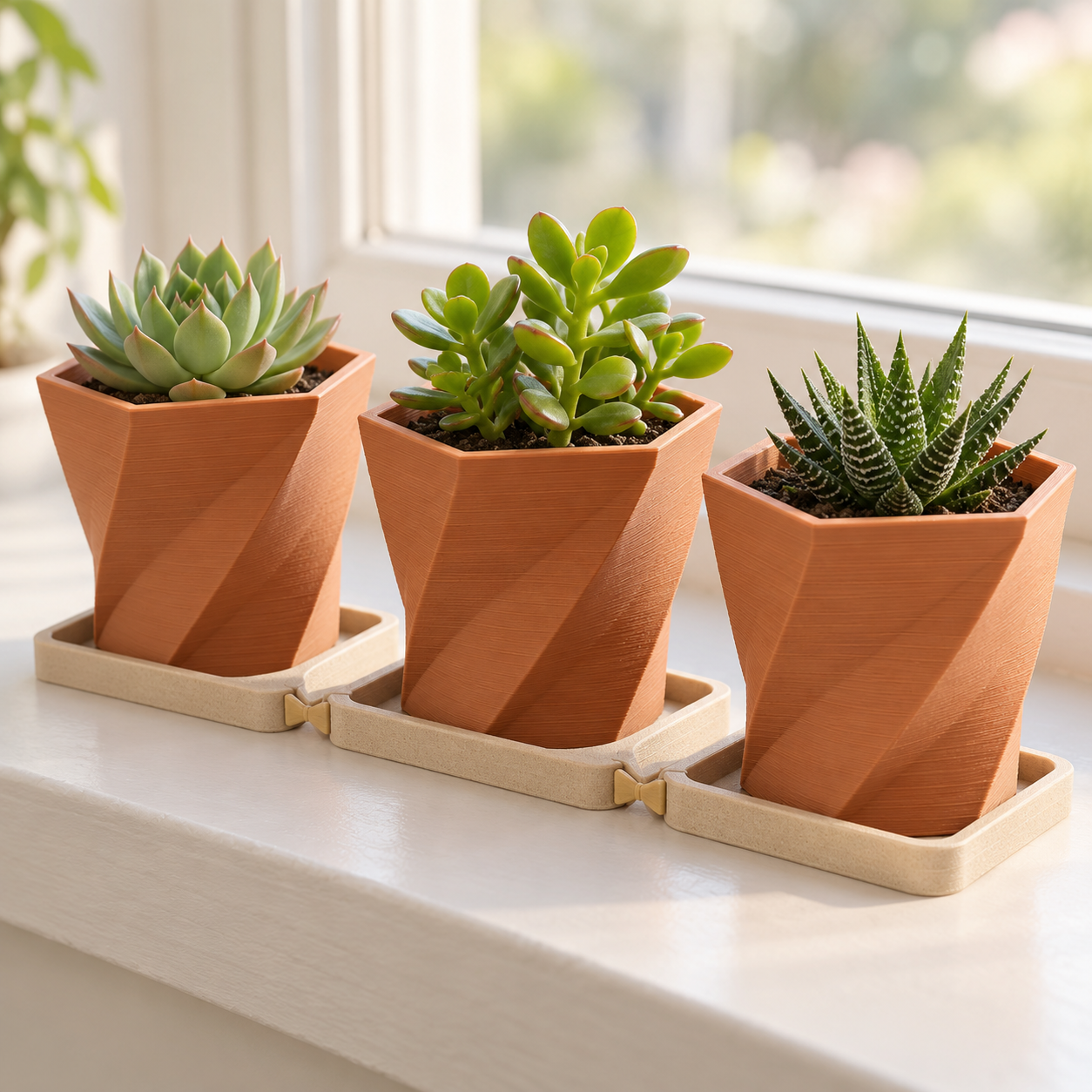
Twist Set — Polygon Planter Series, Piece 01: Pentagon
The first piece of a collectible run of twisted polygon planters whose matching drip saucers key together into one tidy windowsill row, so each new piece adds to a set instead of another stray pot.
Date: 2026-10-10 Category: Art and Decor Modeling difficulty: Intermediate Estimated print: ~7.1 h total · ~137 g PETG (estimate) Suggested price: $24–$34 printed set · $5 digital file (estimate) Status: Concept
Description
A five-sided planter 100 mm tall. Its walls twist 36° from base to rim, half the angle between two corners, and flare from a 45 mm corner radius at the bottom to 52 mm at the top, so the corners trace shallow spirals up the pot. The wall is 2.4 mm thick, the floor 3 mm, and six holes drain into a square saucer underneath.
The saucer is the series part. Every piece in the run uses the same 110 × 110 mm saucer. Each has a dovetail slot in the middle of its left and right sides, and a small printed bowtie key drops into the slots of two saucers sitting side by side and holds them together. Buy three pieces, get a locked row of three planters 330 mm long that moves along the sill as one.
Six low ribs on the saucer floor lift the pot 4 mm, so it never sits in its own runoff. In matte terracotta with a sand saucer it reads as ceramic from a few feet away. Up close the layer lines show, and on a twisted pot they look deliberate.
Why it sells
Planters are one of the categories print sellers keep naming. Creality's guide to products worth printing for sale lists succulent planters and minimalist plant pots among the most popular printed home décor, and says unique designs sell better than generic ones (Creality). RankHero's January 2026 keyword data for "3d printed planter" shows about 2,400 monthly searches, 18,613 competing Etsy listings, and a median price of $20, with 41% of listings between $10 and $25 (RankHero). Twisted low-poly pots are a proven look: the designer GreenformGoods sells twisting pentagonal and spiral geometric planter files on Thangs and says its models have passed 1,300 sales on its Etsy shop (Thangs: Twisting Low Poly Geometric Planter, Thangs: Geometric Low-Poly Spiral Planter). Drainage trays are now expected; the same designer sells a starburst planter with a drainage tray (Thangs), and Etsy listings advertise removable base trays (Etsy listing 1809276314).
Every planter I found sells as a one-off. Nothing links them, so there's no reason for a buyer to come back for the next shape. Twist Set gives them one.
Who buys it
Houseplant owners with a windowsill of succulents, herbs or cuttings, and people buying a gift for one. The series angle also suits collectors who like a set: a piece a month for a plant-lover is an easy recurring gift. They shop Etsy and craft fairs, searching "geometric planter", "succulent pot with drainage" and "modern planter set".
Design overview
- Regular pentagon, 100 tall, twisted 36° and flared from 45 to 52 mm corner radius.
- 2.4 mm walls and a 3 mm floor with a Ø10 centre drain and five Ø5 drains.
- Shared 110 × 110 × 14 saucer with six 4 mm standoff ribs.
- Dovetail slots on both sides of every saucer and a separate bowtie key. The linking saucer is the feature no listed planter has, and the reason a buyer comes back for piece 02.
- Every piece in the series has the same height, saucer and corner radii; only the side count and twist change (twist = 180° ÷ sides).
- Prints with no supports; the steepest overhang on the twisted walls is about 20° from vertical (estimate).
Dimensions
| Measurement | Value (mm) | Notes |
|---|---|---|
| Overall width (X) | 110 | Saucer |
| Overall depth (Y) | 110 | Saucer |
| Overall height (Z) | 106.4 | Pot on the ribs: 6.4 + 100 |
| Wall thickness | 2.4 | Pot walls (measured normal to the faces), saucer walls and floor |
| Pot height | 100 | |
| Pot corner radius, bottom | 45 | Pentagon circumradius at z = 0 |
| Pot corner radius, top | 52 | Pentagon circumradius at z = 100 |
| Pot twist | 36 | Degrees, counter-clockwise seen from above |
| Pot floor | 3 | |
| Centre drain | Ø10 | |
| Corner drains | Ø5 ×5 | On a 24 radius, one toward each bottom corner |
| Pot bounding box | 99.2 × 98.3 × 100 | Measured across all twisted slices |
| Saucer | 110 × 110 × 14 | Corner R 10 |
| Saucer inner pocket | 105.2 × 105.2 × 11.6 | Corner R 7.6 |
| Standoff ribs | 2 wide × 4 tall, r 12 to 40 | Six, at 30°, 90°, 150°, 210°, 270°, 330° |
| Link pillars | 8 × 30 × 14 | Solid blocks at x 47 to 55 and −55 to −47 |
| Dovetail slot | 12.4 at face → 17.4 at 6 deep | Floor at z = 2.4, open at top |
| Bowtie key | 11.6 × 16.83 × 11.2 | Waist 12.0 |
Parts list
| Part | Qty | Material | Size X×Y×Z (mm) | Print orientation | Supports |
|---|---|---|---|---|---|
| Twisted pentagon pot | 1 | PETG | 99.2 × 98.3 × 100 | Upright, floor down | none |
| Linking drip saucer | 1 | PETG | 110 × 110 × 14 | Upright, floor down | none |
| Bowtie link key | 1 | PETG | 11.6 × 16.83 × 11.2 | Flat, either large face down | none |
Hardware and non-printed parts
None — fully printed. One key ships with each piece; a row of N saucers uses N − 1 keys.
Fits and tolerances
- Bowtie key ↔ saucer dovetail slots (sliding): the key is the slot outline offset inward 0.2 mm per side. It drops in from above and stops on the slot floor at z = 2.4. Its top sits 0.4 below the saucer rim.
- Saucer ↔ saucer (butt joint): the side faces touch. The key is 11.6 long against 12 of combined slot depth, leaving 0.2 at each slot's back wall so the faces close fully.
- Pot ↔ saucer (loose, resting): the pot sits free on the ribs. At the height of the saucer rim the pot's corners reach a 45.5 radius, 1.5 clear of the link pillars' inner faces at 47 whichever way the pot is turned.
Modeling guide
Each part has its own origin at the centre of its bottom face, with +Z up. X and Y are the saucer's side directions; the link slots are on ±X.
Pot
- Sketch on XY a regular pentagon with circumradius 45, centred on the origin, with one vertex on +Y. Its vertices are (0, 45), (−42.80, 13.91), (−26.45, −36.41), (26.45, −36.41), (42.80, 13.91).
- Extrude 100 with a linear twist of 36° counter-clockwise seen from above and a linear scale of 52/45 = 1.1556 to the top. In OpenSCAD:
linear_extrude(height=100, twist=-36, scale=52/45) rotate(90) circle(r=45, $fn=5);. In Fusion or Onshape, loft from the bottom pentagon to a top pentagon of circumradius 52 rotated +36° at z = 100, with a straight centre-line rail so the twist is even. - Make the cavity the same way: a pentagon of circumradius 42.03 (45 − 2.4 ÷ cos 36°) with the same rotation and twist, scale 49.03/42.03 = 1.1666, extruded 100. Subtract it only above z = 3 (intersect the cavity with the slab z 3 to 100.1 before subtracting). This leaves the 3 mm floor.
- Cut the centre drain Ø10 through the floor at the origin.
- Cut five Ø5 drains through the floor at radius 24, at 90°, 162°, 234°, 306° and 18°, one toward each bottom corner.
- Chamfer the bottom outer edge 0.6. Break the rim edges with a 0.4 fillet.
Saucer
- Sketch on XY a square 110 × 110 centred on the origin, corner R 10. Extrude 14.
- Cut the pocket: square 105.2 × 105.2, corner R 7.6, from z 2.4 to 14.
- Add the link pillars: blocks x 47 to 55, y −15 to 15, z 0 to 14, and the mirror at x −55 to −47. Union.
- Cut the dovetail slot in the +X pillar: on XY, a trapezoid with corners (55, −6.2), (55, 6.2), (49, 8.7), (49, −8.7). Cut from z 2.4 to 14. Mirror to −X. The 2 mm wall left behind each slot (x 47 to 49) keeps tray water out of the slot.
- Add six ribs: 2 wide, running radially from r 12 to r 40, from z 2.4 to 6.4, centred on 30°, 90°, 150°, 210°, 270° and 330°. Fillet their top edges R 0.5.
- Chamfer the bottom outer edge 0.6.
Bowtie key
- Sketch on XY a six-sided bowtie centred on the origin: (−5.8, −8.415), (0, −6.0), (5.8, −8.415), (5.8, 8.415), (0, 6.0), (−5.8, 8.415). This is the two slot outlines placed mouth to mouth, offset 0.2 inward.
- Extrude 11.2. Chamfer all top and bottom edges 0.3 so it drops in easily.
Print settings
| Setting | Value |
|---|---|
| Material | PETG (holds up to wet soil and sun better than PLA) |
| Nozzle | 0.4 mm |
| Layer height | 0.2 mm |
| Walls / perimeters | 3 |
| Infill | 15% gyroid |
| Supports | None |
| Brim / adhesion | None; glue stick on smooth PEI so PETG releases |
| Notes | Print the key in the saucer colour. Turn on "seam: sharpest corner" so the seam hides in a pot corner. For a two-tone look, print the saucer in a lighter colour than the pot. |
Assembly
- Set the saucers side by side with their slots facing each other.
- Drop a bowtie key into each pair of facing slots.
- Put each pot on its saucer, any rotation.
- Pot the plant over a coffee filter or mesh square if the soil is fine, so it doesn't wash through the drains.
Variants and upsells
- The series: each piece keeps the 100 mm height, the 45/52 mm corner radii and the saucer, and changes only the side count, with twist = 180° ÷ sides. Piece 02 hexagon (30°), Piece 03 heptagon (25.7°), Piece 04 octagon (22.5°), Piece 05 square (45°), Piece 06 triangle (60°, corner radius raised to 52/60 so it still holds a 3 in nursery pot).
- End caps: a half-saucer bookend with a key slot on one side only, for a row that ends in a clean shape.
- Sizes: a 70 mm "mini" run on an 80 mm saucer for small succulents, and a 140 mm run that still fits the 220 mm bed.
- Colour sets: terracotta, sage, sand and charcoal; sell the first three pieces as a starter set at a pack price.
Selling and distribution
Etsy is the main channel for the printed set, and craft fairs, where the linked row sells itself on the table. Sell one piece per listing and a three-piece starter bundle. Pricing: about 137 g PETG and 7 h of machine time per piece (estimate); at $24–$34 it sits a little above the $20 median for printed planters, which the matching saucer and the series earn. Release one piece a month on MakerWorld or Cults3D as files at $5 each, and a season bundle of all six at $20. License the files CC BY-NC with a commercial tier for print sellers, since this is the kind of design farms like to resell.
Listing keywords: geometric planter, twisted planter, succulent pot with drainage, modern planter set, low poly planter, pentagon planter, planter with saucer, windowsill planter, collectible planter series, plant lover gift, 3D printed plant pot.
Risks and IP notes
- PETG strings on the twisted walls and leaves blobs at the corners. Mitigation: tune retraction before production, and use the sharpest-corner seam so marks land in the creases.
- Water creeping into the key slots. Mitigation: the 2 mm wall behind each slot keeps it dry; tell buyers not to fill the saucer past the ribs.
- Crowded category on price. RankHero counts over 18,000 listings. Mitigation: sell the linked set and the series, not one pot against $10 competitors.
- Similar twisted pots exist. Mitigation: the pentagon twist here is a plain parametric extrusion, not a copy of a listed mesh. Don't use other shops' photos, names or terms like "GreenformGoods-style" in listings.
- Design patents on modular or linking planters. Mitigation: search USPTO and EUIPO for "interlocking planter tray" before launch.
Resource links
- Best-selling 3D printed products to make and sell (Creality) — succulent planters and plant pots among the most popular printed décor
- 3d printed planter keyword overview (RankHero) — monthly searches, Etsy listing count and price spread, January 2026
- Twisting Low Poly Geometric Planter (Thangs, GreenformGoods) — twisted pentagonal planter file from a shop reporting 1,300+ Etsy sales
- Geometric Low-Poly Spiral Planter (Thangs, GreenformGoods) — spiral geometric planter file
- Geometric Starburst Planter with Drainage Tray (Thangs, GreenformGoods) — planter sold with a matching drainage tray
- 3D Printed Planter: Modern Home Decor with Drainage Tray (Etsy 1809276314) — printed planter listing with a drainage tray
More from 3D Print Designs