⚡ Energy Industry Briefing
Brent climbed above $106/bbl and WTI to $94.72 as Iranian officials told Reuters they would intensify tanker attacks in the Strait of Hormuz, seven-plus months after shipping disruptions began…
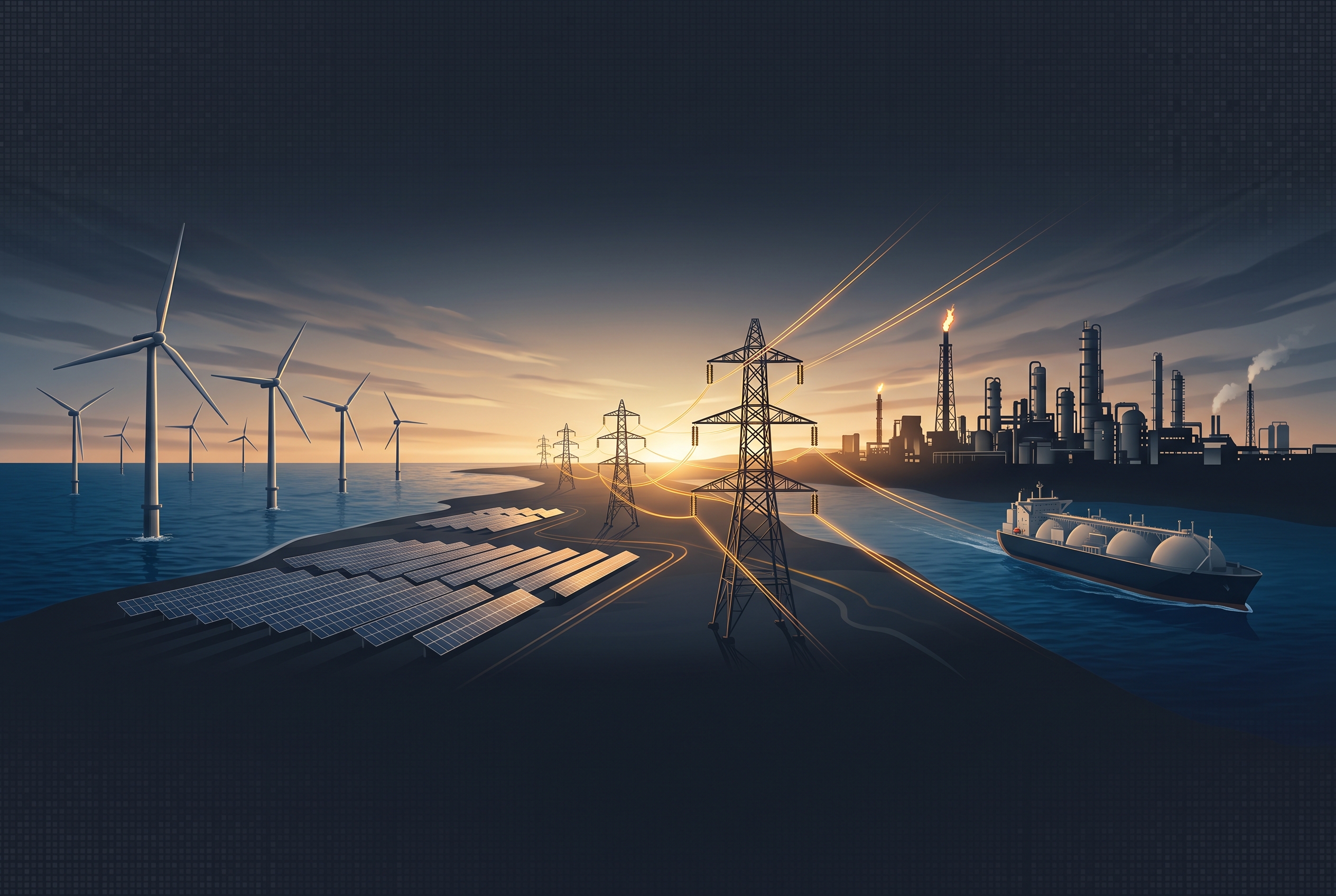
⚡ Energy Industry Briefing
Coverage period: 2026-10-07 to 2026-10-14 (last 7 days) Published: 2026-10-14 · 09:00 ET
1. Executive Summary
Five biggest energy stories worldwide
- Brent climbed above $106/bbl and WTI to ~$94.72 as Iranian officials told Reuters they would intensify tanker attacks in the Strait of Hormuz, seven-plus months after shipping disruptions began (OilPrice).
- Houthi missiles struck Saudi Aramco's administrative headquarters in Dhahran, with limited fire reported and Saudi air defenses intercepting a ballistic missile aimed at the city (OilPrice).
- Middle East LNG supply remains largely stranded post-Iran war; Oman overtook the United States as India's single largest LNG supplier in September as European buyers absorbed US cargoes (OilPrice LNG markets · Oman/India).
- OPEC projected global oil demand growth of 2.6 million bpd in 2027 — up from about 200,000 bpd in 2026 — partly driven by expected inventory rebuilding (OilPrice).
- Taiwan agreed to invest up to $4.4 billion in the Alaska LNG megaproject and to buy 30% of its output for 20 years, a major de-risking step for a project still awaiting construction (OilPrice).
Three biggest US energy stories
- Google and Constellation Energy signed a 20-year PPA supporting $4.3 billion of uprates at 11 PJM nuclear units, adding 890 MW by end-2032 (POWER Magazine · Canary Media).
- FERC rejected most of PJM's large-load interconnection/curtailment plan as intruding on state jurisdiction, while approving Duke Energy Carolinas' large-load transmission rules despite cost-shift concerns (Utility Dive PJM · Utility Dive Duke).
- The Interior Department moved to re-evaluate a key approval for the operating, $6.2 billion Revolution Wind project even as federal agencies advanced Arctic drilling by bypassing NEPA reviews (Canary Media · CleanTechnica).
Biggest market-moving events
- Hormuz escalation lifted Brent above $106 and WTI to ~$94.72 (OilPrice).
- Record tanker freight rates stranded heavy crude in the Americas, splitting the Atlantic/Pacific heavy-barrel market into oversupply and shortage (OilPrice).
- US gasoline prices rose 7.1% in September, feeding a September CPI forecast of ~0.5–0.6% month-over-month (OilPrice gasoline · OilPrice CPI).
- FERC's twin large-load rulings reshape how data centers and other big loads connect and pay across PJM and the Carolinas.
Biggest technology breakthroughs
- Princeton modeling suggested a lower-energy route to fusion ignition by reversing the traditional compress-then-heat sequence for plasma (OilPrice).
- EPRI found energy storage system failures fell 98% between 2018 and 2025, though "early-vintage" systems may need retrofits (Utility Dive).
- Qcells outlined plans for what it calls the world's first large-scale tandem (perovskite-on-silicon) solar factory (Canary Media).
Biggest policy developments
- FERC's rejection of PJM's large-load plan and approval of Duke's tariff model set competing precedents for who pays for load growth.
- The Trump administration extended greenhouse-gas reporting deadlines for power plants, waived NEPA reviews for Arctic oil drilling, floated Greenland exploration, and revisited Revolution Wind's permit.
- The EU reached an agreement with China to halve imports of Chinese-made plug-in hybrids into Europe (CleanTechnica).
What Matters Most The dominant theme of the week is the persistence and widening economic reach of the Hormuz disruption. More than seven months after the Iran war choked roughly a fifth of global LNG flows and disrupted crude transit, Middle East gas exports have not meaningfully recovered, tanker rates are at record highs, and Asian buyers are being outbid by Europe for US cargoes. That single logistical bottleneck is now transmitting directly into crude prices above $106, US gasoline-driven inflation, heavy-crude dislocations in the Americas, and OPEC's unusually large 2027 demand-recovery forecast. The second-order effect — surging power demand from data centers colliding with constrained supply and contested cost allocation — is why FERC's large-load rulings this week carry outsized significance for utilities, hyperscalers, and ratepayers alike.
2. Top Global Energy Stories
Brent tops $106 as Iran threatens intensified tanker attacks
- Source: OilPrice · link
- What happened: Crude moved higher after Iranian officials told Reuters that the country's forces plan to further intensify strikes on tankers in the Strait of Hormuz using new tactics. Brent traded at $106.37/bbl and WTI at $94.72/bbl. Israeli media reported that Prime Minister Benjamin Netanyahu asked President Trump to resume bombing Iran, adding to the risk premium. The move extends a rally driven by shipping disruption in the world's most important oil chokepoint.
- Why it matters:
- Hormuz carries a large share of seaborne crude and LNG; any credible threat to transit keeps a structural risk premium in prices.
- Refining and freight economics, not just crude, are being repriced — see record tanker rates below.
- Sustained $100-plus crude feeds directly into headline inflation and central-bank calculus.
- Who benefits / who loses: Producers outside the conflict zone (US shale, Guyana, Brazil, Norway) benefit from higher realizations; refiners with non-Middle East crude slates gain an advantage. Import-dependent consumers in Asia, Europe, and the US lose at the pump; tanker owners gain through record rates while charterers pay.
- What to watch next: Whether attacks actually escalate against vessels, any US or Israeli military response, and OPEC+ signaling on spare capacity.
- Long-term implications: A durable risk premium on Hormuz transit accelerates diversification of supply routes and supplier portfolios, and strengthens the case for strategic stockpiles and domestic production.
Houthi missiles hit Saudi Aramco headquarters in Dhahran
- Source: OilPrice · link
- What happened: Aramco's administrative building in Dhahran, eastern Saudi Arabia, was struck during Houthi attacks on Tuesday night and Wednesday morning. Limited fire was reported. Saudi forces continued intercepting missiles directed at Dhahran and Riyadh, and a ballistic missile aimed at Dhahran was intercepted and destroyed, according to Major General Turki Al-Maliki.
- Why it matters:
- Administrative rather than production infrastructure was hit, but the strike signals reach into the Kingdom's core energy campus.
- Escalation raises the tail risk of damage to export terminals, processing, or pipelines.
- It reinforces the geopolitical premium already embedded in crude.
- Who benefits / who loses: Saudi Arabia bears security and insurance costs; competing exporters may capture incremental market share if Saudi logistics are disrupted. Asian and European refiners relying on Arab grades face supply uncertainty.
- What to watch next: Whether attacks continue, whether production or export facilities are targeted, and any changes to Saudi export loadings.
- Long-term implications: Persistent drone and missile threats raise the cost of Gulf operations and could accelerate investment in redundancy, air defense, and alternative export routing.
Stranded Middle East LNG upends global gas markets; Oman tops India's supplier list
- Source: OilPrice · LNG markets · Oman/India
- What happened: Seven and a half months after the Iran war choked Hormuz shipments, Middle East LNG exports have not recovered meaningfully; only occasional cargoes are squeezing through a chokepoint that previously handled roughly a fifth of global LNG supply. In September, Oman displaced the United States as India's single largest LNG supplier, with European buyers competing aggressively for US spot cargoes amid historically low EU storage levels ahead of winter.
- Why it matters:
- Roughly one-fifth of global LNG supply remains effectively offline, tightening a market that was expected to be long.
- Atlantic-Pacific arbitrage has shifted in Europe's favor, redirecting US cargoes away from Asia.
- Low EU storage entering winter leaves Europe exposed to weather-driven price spikes.
- Who benefits / who loses: US LNG exporters and Oman gain pricing power; European utilities secure supply at higher cost; Indian and other Asian buyers lose on price. Shipping owners benefit from longer, costlier routes.
- What to watch next: EU storage trajectories and winter weather, whether Gulf cargoes resume, and US export terminal utilization.
- Long-term implications: Buyers are likely to accelerate contract diversification away from the Gulf and toward the US, Africa, and the Americas — a multi-year portfolio shift.
OPEC forecasts 2.6 million bpd demand growth in 2027
- Source: OilPrice · link
- What happened: OPEC projected 2027 global oil demand growth of 2.6 million bpd, versus about 200,000 bpd in 2026, lifting average world demand from 105.7 million bpd in 2026 to 108.3 million bpd. The group revised its 2027 forecast higher this month while nudging down its 2026 estimate. OPEC attributed a meaningful share of the jump to expected inventory rebuilding rather than underlying consumption growth.
- Why it matters:
- The forecast implies a materially tighter 2027 balance if supply does not keep pace.
- Inventory restocking as a demand driver introduces forecast volatility tied to macro conditions rather than end-use.
- It sets the baseline for OPEC+ quota debates.
- Who benefits / who loses: Producers gain a supportive narrative for higher prices; consumers and refiners face higher feedstock costs if the forecast holds. Analysts who see softer demand may question the restocking assumption.
- What to watch next: Whether other forecasters (IEA, EIA) converge on similar 2027 numbers, and OPEC+ quota decisions.
- Long-term implications: If realized, demand growth of this magnitude would delay the transition narrative in oil markets and increase pressure to add upstream capacity.
Record tanker rates strand heavy crude in the Americas; Guyana nears 1 million bpd
- Source: OilPrice · tanker rates · Guyana
- What happened: The Middle East crisis has driven tanker rates to all-time highs and created a vessel shortage, tipping heavy crude markets in North and South America into oversupply while Asia and Europe face shortages of heavy grades. Canada produces over 5 million bpd, about 4 million bpd of which flows to US refineries, and Venezuelan output has risen. Separately, Guyana is set to surpass 1 million bpd of crude exports for the first time in December, with a preliminary schedule of 33 million barrels and the first Uaru grade cargo loading December 11–12.
- Why it matters:
- Freight, not crude availability, has become the binding constraint — a classic wartime logistics dislocation.
- US Gulf Coast refiners configured for heavy crude may benefit from discounted Americas barrels; Asian refiners lose.
- Guyana's milestone cements a new, non-OPEC supply pillar.
- Who benefits / who loses: US and Canadian heavy producers benefit from regional demand; Venezuelan sellers gain; Asian and European refiners dependent on imported heavy grades pay more. Shipowners with available tonnage earn record rates.
- What to watch next: December Guyanese loading schedules and Uaru grade acceptance at refineries, plus any freight normalization.
- Long-term implications: Freight shocks of this scale incentivize shorter-haul sourcing and could reshape crude trade flows for years.
Taiwan commits up to $4.4 billion to Alaska LNG
- Source: OilPrice · link
- What happened: Taiwan agreed to invest up to $4.4 billion in the Alaska LNG project and to purchase 30% of its output over 20 years. The project, which has not yet been built, includes a gas pipeline to an export terminal. The commitments were announced during a presidential rally in Alaska and separately confirmed by Taiwan.
- Why it matters:
- Long-term offtake and equity from a major Asian buyer materially de-risks a capital-intensive greenfield megaproject.
- It advances US ambitions to supply Asian allies from non-Gulf, non-Hormuz-exposed routes.
- Alaskan gas has historically been difficult to commercialize; buyer commitments are the key hurdle.
- Who benefits / who loses: Alaska, US exporters, and Taiwanese buyers seeking supply security benefit; competing suppliers (Qatar, Australia, US Gulf Coast) face added competition. Existing Gulf suppliers lose a share of Asia's growth.
- What to watch next: Additional offtake agreements, a final investment decision, pipeline permitting, and cost estimates.
- Long-term implications: A supply corridor from North America to East Asia reinforces the shift toward contract-backed, geopolitically diversified LNG trade.
Google and Constellation back $4.3 billion of nuclear uprates
- Source: POWER Magazine · link · Canary Media · link
- What happened: Google and Constellation Energy signed a 20-year power purchase agreement supporting $4.3 billion of upgrades at 11 nuclear units across PJM, adding 890 MW of capacity from existing reactors by end-2032. The deal follows a stated federal goal of adding 5 GW of carbon-free nuclear capacity by 2029 without building new reactors. It is the largest nuclear operator in the US pairing with a hyperscaler for long-dated clean firm power.
- Why it matters:
- Uprates are faster and cheaper than new-build reactors and require no new siting.
- It demonstrates a bankable model for data-center clean-firm procurement.
- It relieves some — but only some — of the supply pressure driving large-load interconnection disputes.
- Who benefits / who loses: Constellation gains long-term revenue and capital support; Google secures firm low-carbon power. Ratepayers may gain if uprates are funded off existing baseload; competitors in gas generation face a firmer clean alternative for hyperscalers.
- What to watch next: NRC approvals, upgrade schedules, and further corporate nuclear PPAs.
- Long-term implications: Power-purchase-backed uprates could become the template for extending the life and output of the existing nuclear fleet.
FERC splits on large loads: rejects PJM plan, approves Duke tariff
- Source: Utility Dive · PJM · Duke
- What happened: FERC rejected most of PJM Interconnection's plan to curtail large loads lacking matching new generation, finding it intruded on state jurisdiction and appeared discriminatory. Separately, FERC approved Duke Energy Carolinas' large-load transmission rules, with Commissioner David Rosner saying the proposal offers "meaningful, if imperfect, new protections" while warning that consumer protections are "inadequate across the country."
- Why it matters:
- These rulings set the ground rules for how data centers and other large loads connect and who absorbs network costs.
- Rejection signals that curtailment-based approaches face legal risk; tariff-based cost allocation gets a qualified green light.
- Cost-shift concerns are now explicitly on the record.
- Who benefits / who loses: Hyperscalers and large industrial loads gain clarity on connection pathways; existing ratepayers may face cost-shift risk that regulators say remains under-protected. Utilities with large-load growth gain tariff certainty.
- What to watch next: Follow-on PJM filings, state commission actions, and any further FERC rulemaking on large-load cost allocation.
- Long-term implications: As data-center load becomes the dominant US demand-growth driver, jurisdictional fights over interconnection costs will shape utility capex and consumer bills for a decade.
US policy blitz: offshore wind permit review, Arctic NEPA waiver, emissions reporting delay, Greenland
- Source: Canary Media · Revolution Wind · CleanTechnica · Arctic NEPA · EPA deadline · OilPrice · Greenland
- What happened: The Interior Department said it wants to re-evaluate a key approval for Revolution Wind, a $6.2 billion project already operating. The administration announced it would abandon NEPA environmental reviews to permit Arctic oil and gas exploration, drawing criticism from the Sierra Club. The EPA again extended the deadline for power plants to report greenhouse-gas emissions, from March 2026 to October. President Trump separately said "massive" oil, gas, and minerals exploration would begin in Greenland, following a September US–Denmark–Greenland Arctic security agreement that reaffirmed Danish sovereignty.
- Why it matters:
- Permitting reversibility for operating assets increases perceived regulatory risk across the sector.
- NEPA waivers for Arctic drilling may lower project timelines but invite litigation.
- Reporting delays reduce public emissions data quality at a time when policy is contested.
- Who benefits / who loses: Oil and gas developers gain faster permitting; offshore wind developers and their financiers absorb heightened risk. Emissions-data users, investors using ESG screens, and environmental groups lose transparency.
- What to watch next: Litigation on Arctic permits, Revolution Wind's operational status, and Greenland's investment framework.
- Long-term implications: Regulatory uncertainty itself becomes a cost of capital factor, potentially widening the spread between fossil and renewable project hurdle rates.
US gasoline jump drives September inflation test
- Source: OilPrice · gasoline/CPI · Wall Street view
- What happened: US gasoline prices rose 7.1% in September, with the national daily average at $4.3413 per gallon, per AAA; diesel also remains elevated. Economists polled by Reuters expected headline September CPI of 0.6% month-over-month, while a separate OilPrice summary cited expectations of 0.5% m-o-m and 3.6–3.7% year-over-year headline inflation, with core CPI seen as more contained.
- Why it matters:
- Energy is again the swing factor in headline inflation even as core pressures moderate.
- This constrains the Fed's room to slow or reverse rate moves.
- High pump prices shape consumer sentiment ahead of midterms.
- Who benefits / who loses: Refiners and marketers capture stronger cracks; consumers and rate-sensitive sectors lose. EV adoption economics improve relative to gasoline.
- What to watch next: The actual September CPI print, diesel trends, and any policy response to fuel prices.
- Long-term implications: Repeated energy-driven inflation episodes reinforce interest in electrification and fuel diversification as macroeconomic hedges.
3. Regional Analysis
North America
- FERC's twin large-load rulings — rejecting PJM's curtailment plan and approving Duke's tariff framework — establish the regulatory terrain for data-center-driven load growth, with cost-shift risk to existing ratepayers explicitly flagged by Commissioner Rosner.
- Utility supply additions continue: We Energies filed an engineering plan for a 750 MW gas plant at the Fox Energy Center in Wisconsin, while Clearway began construction on the 650 MW Swan solar project in Missouri under a 20-year PPA and Tesla advanced a 450 MW Arizona solar-plus-storage project with roughly 90% of output contracted.
- Grid stress is dual-sourced: PG&E warned of expanded public-safety shutoffs across two dozen-plus California counties amid fire weather, and utilities in the Southeast continued restoring service after Hurricane Isaias, which peaked at about 950,000 outages; FPL said underground lines performed eight times better than overhead.
- State-level politics are increasingly material to energy: solar interests are spending to flip the Georgia Public Utility Commission, a clean-energy super PAC named its midterm target list, and California's electricity affordability gap — double the national average — is drawing reform proposals.
- The Dominion–NextEra merger hearing focused on rates and data-center load, with legislators questioning utility commitments under the Virginia Clean Economy Act — a signal that large utility consolidation will be judged on affordability.
Europe
- The EU reached an agreement with China to halve imports of Chinese-made plug-in hybrids, extending tariff logic that previously applied only to battery-electric vehicles (CleanTechnica).
- Rules-of-origin enforcement under the EU–UK Trade and Cooperation Agreement is being contested, with battery local-content requirements framed as the test case for the "Made in EU" agenda (CleanTechnica).
- Consumer-facing charging and flexibility services expanded: Mercedes-Benz launched bidirectional charging in Germany, allowing EV owners to earn payments for grid supply, starting with households without rooftop PV.
- Distributed generation business models are evolving: Emaldo-backed Modi Energy launched a zero-upfront solar-plus-battery offer in Denmark with a guaranteed 20% bill reduction funded via power and flexibility markets.
- Policy friction points remain — the EU's hydrogen refueling mandate under AFIR is criticized as building stations ahead of truck demand, following South Korea's experience, while shipping decarbonization debates focus on the ETS maritime mechanism and an estimated €15 billion of support between 2028 and 2040.
Middle East & OPEC
- OPEC's 2.6 million bpd 2027 demand-growth forecast — against just 200,000 bpd in 2026 — sets a bullish marker partly dependent on inventory rebuilding rather than end-use consumption.
- Physical security risk is escalating: Aramco's Dhahran headquarters was struck by Houthi attacks, with limited fire reported and missile interceptions continuing around Dhahran and Riyadh.
- Saudi crude marketing continues apace despite the conflict: Aramco's newest Chinese joint-venture refinery received its first cargo of Arab crude ahead of start-up, with no commercial operations timeline given.
- Gulf gas export logistics remain impaired; occasional LNG cargoes are transiting Hormuz, but volumes are far below pre-war norms, leaving roughly a fifth of global LNG supply effectively sidelined.
- Oman's rise to India's top LNG supplier in September illustrates how intra-regional suppliers are capturing Asian demand that US cargoes would otherwise serve.
Asia-Pacific
- Taiwan's up-to-$4.4 billion investment and 30%-of-output, 20-year offtake commitment to Alaska LNG is the week's most significant Asian supply-security move.
- India's downstream and manufacturing build-out continues: Oswal Pumps plans a $48 million, 1.2 GW TOPCon solar cell plant in Haryana with commercial production targeted for April 2028, with output earmarked for captive module manufacturing.
- China's EV export posture is shifting: Beijing announced it will cut the export tax rebate on EVs next year, while Tesla's China sales fell 11.9% through the first nine months even as Giga Shanghai exports more than doubled to 361,972 units (Electrek).
- Australian plug-in penetration reached 33% of September deliveries — 24% BEV and 9% PHEV — even as Hyundai shelved its IONIQ 3 launch there, citing an inability to compete with low-priced Chinese EVs on landed cost.
- Chinese OEMs continue global expansion: Geely confirmed a Canadian market entry with first sales in 2027, and AITO set a fall 2027 European launch with four luxury SUVs.
Russia & Eurasia
- The Middle Corridor/TRIPP route — an approximately 40-kilometer Armenian segment intended as the shortest link in the corridor — remains unimplemented more than a year after the Washington agreement, with the principal obstacles identified as external, notably Russian and Iranian resistance.
- Analysis: Continued Hormuz disruption raises the strategic value of overland Eurasian trade routes, but implementation bottlenecks suggest corridor capacity will not meaningfully offset maritime risk in the near term.
Latin America
- Guyana is poised to exceed 1 million bpd of crude exports for the first time in December, with 33 million barrels scheduled and the new Uaru grade debuting December 11–12 — a structural addition to non-OPEC supply.
- Venezuelan production has moved higher, contributing to the heavy-crude oversupply building in the Americas as record tanker rates leave barrels stranded.
- Brazil's battery-swapping ecosystem is maturing commercially: Vammo surpassed 10 million battery swaps, more than 10,000 active riders, and reached EBITDA profitability as it prepares to expand beyond São Paulo.
4. Oil Markets
- Brent tops $106 as Hormuz risk re-escalates. Brent crude traded at $106.37/bbl and WTI at $94.72/bbl after Iranian officials told Reuters their forces planned to further intensify strikes on tankers in the Strait of Hormuz using new tactics; Israeli media also reported that Prime Minister Netanyahu asked President Trump to resume bombing Iran. (OilPrice)
- Record tanker rates are breaking the heavy-crude market. Shipping costs at all-time highs and a vessel shortage have left heavy grades oversupplied in the Americas while Asia and Europe face shortages. Canada produces more than 5 million bpd, roughly 4 million bpd of which flows to U.S. refineries, and Venezuelan output has also risen. Analysis: logistics, not geology, is now the binding constraint on heavy-crude pricing — a dynamic that favors coastal U.S. refiners with pipeline access and penalizes Asian heavy-crude buyers. (OilPrice)
- OPEC models a sharp 2027 rebound — but composition matters. OPEC forecasts global demand growth of 2.6 million bpd in 2027, versus just 200,000 bpd in 2026, lifting average demand from 105.7 million bpd to 108.3 million bpd. The group attributes a large share of the jump to inventory rebuilding rather than end-use consumption, even as it trimmed this year's growth estimate. (OilPrice)
- Pump prices feed the inflation debate. U.S. gasoline rose 7.1% last month, with the AAA national average at $4.3413/gal; diesel remains elevated. Economists are split on September CPI — one Reuters poll points to +0.6% month-over-month, while a separate survey expects +0.5% m/m and 3.6%–3.7% y/y, with core inflation seen moderating. The divergence is a reminder that energy pass-through into headline inflation is the key swing factor for rate expectations. (OilPrice)
- Guyana crosses the 1 million bpd export threshold. December's preliminary loading schedule totals 33 million barrels (~1.06 million bpd) — a first for the country — with the inaugural cargo of the new Uaru grade set for December 11–12. Analysis: this is meaningful non-OPEC supply growth arriving into a market already stressed by Middle East risk. (OilPrice)
- Permian associated gas stays a margin drag. Waha Hub spot prices stayed below zero for a record 90 consecutive days before turning positive on June 16, averaging minus $2.19/MMBtu for the year to that point — a persistent headwind for Permian producers even as four of five highlighted shale names posted record second-quarter results. (OilPrice)
5. Natural Gas & LNG
- Oman displaced the U.S. as India's top LNG supplier in September. European buyers, facing historically low EU storage ahead of winter, snapped up U.S. cargoes on favorable arbitrage economics, redirecting flexible American supply away from Asia. Analysis: this is the clearest evidence yet that Atlantic and Pacific gas markets remain tightly coupled through U.S. liquefaction capacity — and that Europe is willing to outbid Asia. (OilPrice)
- Middle East LNG supply remains structurally impaired. Roughly seven and a half months after the Iran war choked flows through the Strait of Hormuz, Middle East LNG exports have not meaningfully recovered; sporadic cargoes are insufficient to offset the loss of a chokepoint that previously handled about one-fifth of global LNG. (OilPrice)
- Taiwan anchors Alaska LNG. Taiwan agreed to invest up to $4.4 billion in the Alaska LNG project and to buy 30% of its output over 20 years. The facility and its feeder pipeline have not yet been built — meaning this is an offtake commitment, not a completed project, and final investment decision risk remains. Analysis: a 20-year, sovereign-backed offtake is precisely the de-risking structure U.S. greenfield LNG has struggled to assemble. (OilPrice)
- EIA sees a split winter bill. Lower natural gas and propane prices should reduce winter energy expenditures for roughly half of U.S. households heating with those fuels, while higher electricity and heating-oil prices push costs up for the rest. (EIA)
- New gas-fired capacity advances in Wisconsin. We Energies filed an engineering plan with state regulators for a 750-MW natural gas plant at the existing Fox Energy Center site in Wrightstown. (POWER Magazine)
6. Power & Electricity
- FERC rejects most of PJM's large-load interconnection plan. The Commission found PJM's approach to curtailing large loads without matching new generation intrudes on state jurisdiction and appears discriminatory — a significant rebuke to the grid operator as it tries to manage data-center-driven demand growth. (Utility Dive)
- But FERC approved Duke Energy Carolinas' large-load tariff. Commissioner David Rosner called the proposal "meaningful, if imperfect" new protections, warning that consumer protections are "inadequate across the country" and that further Commission action may be needed. Analysis: the two rulings together signal FERC is willing to let utilities experiment with cost-allocation rules, but will police plans that shift large-load costs onto ratepayers or usurp states. (Utility Dive)
- Hurricane Isaias restoration continues. About 160,000 customers remained without power in the Southeast entering the third day of recovery, from a peak of roughly 950,000. Utilities credited grid modernization for limiting outages; Florida Power & Light said underground lines performed eight times better than overhead. (Utility Dive)
- Wildfire risk triggers more California shutoffs. PG&E warned of additional public safety power shutoffs potentially affecting more than two dozen counties, mostly in northern and central California, continuing through Saturday. (Utility Dive)
- Dominion–NextEra merger hearing centers on rates and data centers. Regulators and legislators pressed the utilities on cost allocation and large-load growth, with Virginia Del. Irene Shin describing an executive's testimony on the Virginia Clean Economy Act as "shocking." (Utility Dive)
- Affordability is becoming the central U.S. power issue. California electricity prices run roughly double the national average, driven substantially — but not exclusively — by wildfire costs, according to analysts at GridLab and Energy Innovation. Separately, power-sector trade association leaders publicly converged on the "who pays for data centers" question as the industry's defining near-term challenge. (Utility Dive · POWER Magazine)
7. Renewables & Clean Energy
- Clearway starts 650-MW Missouri solar build. The Swan Energy Center is sited on formerly strip-mined land in Bates County, backed by a 20-year power purchase agreement; financing has closed. It is Clearway's first Missouri project and an example of brownfield reuse for utility-scale solar. (POWER Magazine)
- Tesla's Arizona solar-plus-storage project advances. A 450-MW solar farm with a large battery system is under construction, with roughly 90% of expected output already contracted — a sign that merchant solar risk in strong markets is being absorbed by offtakers. (Electrek)
- U.S. offshore wind takes another hit. The Interior Department wants to reevaluate a key approval for Revolution Wind, a $6.2 billion project that is already operating — extending policy risk from future leases into assets that have already been financed and built. (Canary Media)
- Europe tests zero-upfront residential solar-plus-storage. Emaldo-backed Modi Energy will install, own and operate rooftop solar and home batteries for Danish households at no upfront cost, funding a guaranteed 20% bill reduction through optimization and power/flexibility market participation. Analysis: this shifts residential energy from a capex purchase to a service contract — an attractive model where retail power prices are high and flexibility markets pay. (pv magazine)
- Indian solar manufacturing expands upstream. Oswal Pumps will invest $48 million in a 1.2-GW TOPCon cell plant in Karnal, Haryana, targeting commercial production by April 2028, with all output earmarked for its own module assembly. (pv magazine)
- Next-generation module and reliability research matures. Qcells is pursuing what would be the world's first large-scale tandem (silicon-plus-perovskite) solar factory; separately, Spanish researchers found utility-scale bifacial modules can underperform nominal bifaciality ratings by up to 15%, and Trina Solar proposed a new classification for reversible versus irreversible UV-induced degradation in TOPCon cells. (Canary Media · pv magazine)
8. Nuclear
- Google and Constellation sign a 20-year nuclear uprate PPA. The agreement supports $4.3 billion of upgrades across 11 nuclear units in PJM, adding 890 MW of capacity from existing reactors by the end of 2032 — no new reactors required. Analysis: uprates are the fastest, lowest-permitting-risk path to new carbon-free firm capacity, and hyperscaler credit is what makes the economics work. (POWER Magazine · Canary Media)
- U.S. policy goal of +5 GW carbon-free by 2029 gets closer. The administration's target explicitly does not depend on deploying new reactors; the Constellation–Google deal is framed as a demonstration of the uprate pathway. (Canary Media)
- Siting friction is the emerging constraint. A proposed nuclear-powered data center in Carbon County, Utah — a coal-transition community — faces local opposition, illustrating that even "clean firm" projects run into land-use and community-consent hurdles. (Canary Media)
- Interconnection queues make on-site and uprate options attractive. Over 2,060 GW of generation and storage sits in U.S. interconnection queues, with the typical project now waiting almost five years versus about two years in 2008 — context that explains utility interest in advanced nuclear and brownfield capacity. (POWER Magazine)
9. Energy Technology & Innovation
- Grid-scale battery reliability has improved dramatically. EPRI analysis found energy storage system failures fell 98% between 2018 and 2025 amid technology and project-design improvements — though "early-vintage" systems may require retrofits. Analysis: this materially strengthens the case for storage as firm capacity, but fleet heterogeneity means O&M budgets will diverge sharply between old and new assets. (Utility Dive)
- Vehicle-to-home and bidirectional charging cross from pilot to product. Tesla enabled V2H on U.S.-built Model 3 and Model Y vehicles produced on or after October 1, 2026 (some earlier builds may qualify); Mercedes-Benz launched a bidirectional charging service in Germany that pays EV owners for grid exports, initially targeting households without rooftop solar; and Europe's EV4EU trial has completed. Unico also launched a 330-kW bidirectional inverter made in the U.S. (CleanTechnica · pv magazine · pv magazine)
- A lower-energy theoretical route to fusion. Princeton researchers' new modeling suggests heating plasma before compression — reversing the traditional order of operations — could be a significantly more energy-efficient path to ignition. This is a modeling result, not an experimental demonstration, and should be treated as an early-stage signal. (OilPrice)
- Hydrogen infrastructure buildout faces a demand-timing trap. Europe is deploying hydrogen refueling stations under the Alternative Fuels Infrastructure Regulation — mandated at intervals of no more than 200 km along major corridors by 2030 — before a large hydrogen truck market exists, echoing South Korea's underutilized station network. (CleanTechnica)
- Heat-pump demand survives the loss of federal incentives. Shipments stayed strong in the first half of 2026 and the technology is on track to match or exceed its best year, according to the Building Decarbonization Coalition. Panasonic also launched R454C air-to-water residential heat pumps in 3, 5, 7 and 9 kW capacities. (Canary Media · pv magazine)
10. Policy, Regulation & Geopolitics
- EPA again extends power-plant greenhouse gas reporting deadlines. The deadline, originally set for March 2026, was pushed to October as the agency works to finalize a related proposal — reducing near-term visibility into utility emissions. (CleanTechnica)
- Arctic leasing moves ahead without NEPA review. The Bureau of Land Management said it will abandon National Environmental Policy Act reviews to accelerate oil and gas exploration in Arctic ecosystems, drawing sharp criticism from the Sierra Club. Analysis: waiving NEPA shortens timelines but concentrates legal risk into subsequent litigation. (CleanTechnica)
- Greenland exploration plans announced. President Trump said "massive" oil, gas and minerals exploration will soon begin in Greenland, claiming enormous readily available oil resources. This follows a September U.S.–Denmark–Greenland agreement on Arctic and North Atlantic defense that reaffirmed Danish sovereignty. No independent resource estimate or drilling timetable was disclosed — treat the resource claim as unverified. (OilPrice)
- EU and China agree to halve Chinese plug-in hybrid imports. The deal addresses a gap left when the EU imposed tariffs on Chinese battery-electric vehicles but not PHEVs. Separately, the EU is reportedly close to loosening EV rules for the third time in two years, and EU–UK rules-of-origin for batteries remain under debate. (CleanTechnica · Electrek · CleanTechnica)
- China to cut its EV export tax rebate next year — a move that would raise the landed cost of Chinese EVs abroad and affect export-heavy producers such as Tesla's Shanghai plant. (Electrek)
- Subnational politics increasingly decide energy outcomes. Nine states will elect utility regulators in November, with Georgia among the few where party control of a public utility commission could flip; a clean-energy super PAC has published its target list ahead of the midterms; and federal green-bank funding has been frozen, forcing community lenders to scale back. (Canary Media · Canary Media)
11. Corporate & Deals
- Constellation–Google: a 20-year PPA underpinning $4.3 billion of nuclear uprates and 890 MW of new capacity at 11 PJM reactors by 2032. Analysis: hyperscalers are now the anchor offtakers for firm clean generation, effectively substituting for utility rate-base financing. (POWER Magazine)
- Taiwan–Alaska LNG: up to $4.4 billion of investment plus a 20-year commitment for 30% of project output — a major de-risking event for a project still awaiting construction. (OilPrice)
- LS Power closed Fund VI with roughly $6 billion in commitments — oversubscribed and fully allocated against its hard cap by July, indicating continued institutional appetite for power and energy infrastructure. (POWER Magazine)
- Dominion–NextEra merger faces ratepayer scrutiny at a Virginia hearing, where data-center load growth and cost allocation dominated the discussion. (Utility Dive)
- Tesla's quarter was carried by everything except its flagship models. Q3 "Other Models" deliveries fell 48% y/y to 8,295 — the lowest since 2021, and almost entirely Cybertrucks, implying an annualized pace near 30,000 units on a line planned for 250,000. In China, nine-month sales fell 11.9% to 381,088 while Shanghai exports more than doubled to 361,972 vehicles, and Tesla paused Model 3 Premium orders in Canada, citing exhausted Chinese-EV import quota (though government data shows 33,069 of 49,000 permits still available). (Electrek · Electrek · Electrek)
- Other notable corporate moves: Waymo raised $5 billion to fund further driverless expansion; Rivian's spun-out Mind Robotics hired former Tesla and Ford EV chief Doug Field as president after raising more than $1 billion in under a year; BYD built its 150,000th new-energy commercial vehicle; and Volkswagen Group has taken nearly 150,000 orders for its entry-level Electric Urban Car Family. (CleanTechnica · Electrek · Electrek · Electrek)
12. Commodities & Critical Minerals
- Greenland's mineral potential re-enters the conversation alongside oil and gas, with the U.S. president claiming readily available resources. No grade, tonnage, licensing round or independent resource assessment was provided — this remains a political assertion rather than an investable data point. (OilPrice)
- Battery chemistry diversification continues at the consumer edge. Bluetti brought a 900 Wh sodium-ion portable power station back at an exclusive $665 low, while the new Smart #2 two-seater uses a 35.8 kWh LFP pack. Analysis: sodium-ion and LFP adoption in lower-energy-density applications reduces cobalt and nickel intensity — the structural bear case for those specific raw materials — though the articles provide no commodity pricing to quantify it. (Electrek · Electrek)
- Swapping reduces total battery demand versus fast-charging fleets. NIO completed 1.2 million battery swaps in a single week, a scale that its advocates argue requires fewer cells per vehicle served — a relevant input for lithium demand modeling, though the articles do not present a quantified comparison. (Electrek)
- Solar recycling economics are a materials story. Italian researchers found removing module backsheets before thermal recycling keeps titanium dioxide out of recovered material and cuts particulate emissions by over one-third, but raises propane consumption by about 20% — a direct trade-off between recovered-material purity and process energy. (pv magazine)
13. Climate & Emissions
- U.S. power-sector emissions transparency is thinning. The EPA's second extension of greenhouse gas reporting deadlines for large emitters delays the data investors and regulators use to track utility decarbonization progress. (CleanTechnica)
- Hurricane Isaias is the 2026 Atlantic season's first hurricane and caused Gulf Coast production shut-ins alongside roughly 950,000 peak power outages — a reminder that physical climate risk now flows directly into both commodity supply and utility cost recovery. (CleanTechnica · Utility Dive)
- Wildfire costs are reshaping California's affordability debate. Wildfire risk is driving pre-emptive grid shutoffs and is described by analysts as a major — though not sole — driver of electricity prices at roughly twice the national average. (Utility Dive)
- EU shipping decarbonization support takes shape. The ETS's proposed SMAP mechanism is estimated to channel around €15 billion between 2028 and 2040 toward green e-fuels and clean propulsion in maritime transport. (CleanTechnica)
- Subsidy reform is the missing lever in nature protection. Governments spend hundreds of billions annually on bioenergy and other forest-harming subsidies, against an estimated $900 billion per year cost to protect nature — a gap increasingly cited in climate-finance discussions. (CleanTechnica)
- EV displacement of oil demand is now measurable. Ember analysis estimates EV fleets displaced roughly $20 billion of crude consumption between March and August, giving oil-importing economies material breathing room during the Hormuz crisis. (Electrek)
14. Data Snapshot
Energy Prices This Week
| Commodity | Level | Weekly Change | Note |
|---|---|---|---|
| Brent crude | $106.37/bbl | Not disclosed | Elevated on Hormuz tanker-attack threats |
| WTI crude | $94.72/bbl | Not disclosed | Same driver |
| U.S. retail gasoline | $4.3413/gal | +7.1% (prior month) | AAA daily national average |
| Waha Hub natural gas | ~ -$2.19/MMBtu (avg, YTD to mid-June) | Not disclosed | Record 90 straight days below zero |
Major Deals & Investments
| Companies | Type | Value | Summary |
|---|---|---|---|
| Taiwan / Alaska LNG | Investment + offtake | Up to $4.4B | 30% of output purchased over 20 years; project not yet built |
| Google / Constellation | 20-year PPA | $4.3B program | Backs +890 MW of uprates at 11 PJM reactors by 2032 |
| LS Power | Fund close (Fund VI) | ~$6B | Oversubscribed; fully allocated by July |
| Waymo | Equity raise | $5B | Funds further driverless expansion |
| Oswal Pumps | Manufacturing capex | $48M | 1.2 GW TOPCon cell plant, Haryana, India |
| Clearway Energy Group | Project financing | See source | 650-MW Swan solar with 20-year PPA |
Notable Projects & Capacity
| Project | Type | Location | Status |
|---|---|---|---|
| Alaska LNG | LNG export + pipeline | Alaska | Not yet built; Taiwan committed |
| Constellation uprates | Nuclear (existing units) | 11 PJM units | +890 MW targeted by end-2032 |
| Swan Energy Center | Solar, 650 MW | Bates County, MO | Construction started |
| Fox Energy Center | Gas-fired, 750 MW | Wrightstown, WI | Engineering plan filed |
| Tesla Arizona solar + storage | Solar, 450 MW + battery | Arizona | Under construction; ~90% output contracted |
| Oswal TOPCon plant | Solar cells, 1.2 GW | Karnal, Haryana, India | Production targeted April 2028 |
| Revolution Wind | Offshore wind, $6.2B | U.S. East Coast | Operating; federal approval under reevaluation |
15. What to Watch Next Week
- U.S. September CPI release (Oct 14): gasoline's 7.1% monthly rise makes energy the key upside risk to headline inflation and to rate expectations.
- Tesla Roadster event, Thursday Oct 15, 7:55 pm CT: after nine years of delays, the unveiling tests whether Tesla's product pipeline can still generate demand momentum.
- Third-quarter earnings season for shale and integrated oils: Waha Hub weakness and heavy-crude logistics costs should show up in realizations and differentials.
- PG&E public safety power shutoffs through Saturday (Oct 17): watch for scope, duration, and any liability or reliability fallout.
- Hurricane Isaias restoration: continued outage restoration across the Southeast and any further Gulf production interruptions.
- FERC and PJM next steps on large-load interconnection: after rejecting most of PJM's plan, the Commission's revised approach will set the template for data-center cost allocation nationally.
- November elections for utility regulators in nine states: Georgia is among the few where party control of a public utility commission could flip, directly affecting rate and resource decisions.
- European gas storage entering winter: historically low EU inventories are pulling U.S. LNG cargoes away from Asia; watch arbitrage and JKM–TTF spreads.
- Alaska LNG commercial milestones: following Taiwan's commitment, look for additional offtake agreements needed to reach FID.
- Guyana's December loading schedule and first Uaru cargo (Dec 11–12): confirms whether the country sustains exports above 1 million bpd.
- EU policy calendar: implementation of the China PHEV agreement, the AFIR review, a possible bloc-wide vote on Tesla's driver-assistance system as early as December, and China's EV export rebate cut taking effect next year.
- Greenland and Arctic follow-through: any concrete licensing, drilling timetables, or legal challenges to the NEPA waiver for Arctic exploration.
Sources
- Oil Prices Climb Above $106 as Iran Threatens More Tanker Attacks — https://oilprice.com/Latest-Energy-News/World-News/Oil-Prices-Climb-Above-106-as-Iran-Threatens-More-Tanker-Attacks.html
- Rising Gasoline Prices Fuel Fresh Inflation Fears in the U.S. — https://oilprice.com/Latest-Energy-News/World-News/Rising-Gasoline-Prices-Fuel-Fresh-Inflation-Fears-in-the-US.html
- Record Tanker Rates Leave Heavy Crude Stranded in the Americas — https://oilprice.com/Energy/Crude-Oil/Record-Tanker-Rates-Leave-Heavy-Crude-Stranded-in-the-Americas.html
- OPEC Sees Oil Demand Growth Surging to 2.6 Million Bpd in 2027 — https://oilprice.com/Latest-Energy-News/World-News/OPEC-Sees-Oil-Demand-Growth-Surging-to-26-Million-Bpd-in-2027.html
- Guyana Oil Exports Set to Surpass 1 Million Barrels per Day — https://oilprice.com/Energy/Crude-Oil/Guyana-Oil-Exports-Set-to-Surpass-1-Million-Barrels-per-Day-for-First-Time.html
- Five Shale Stocks to Watch Before Third-Quarter Earnings — https://oilprice.com/Energy/Energy-General/Five-Shale-Stocks-to-Watch-Before-Third-Quarter-Earnings.html
- Oman Overtakes U.S. as India's Top LNG Supplier in September — https://oilprice.com/Latest-Energy-News/World-News/Oman-Overtakes-US-as-Indias-Top-LNG-Supplier-in-September.html
- Stranded Middle East LNG Supply Upends Gas Markets — https://oilprice.com/Energy/Natural-Gas/Stranded-Middle-East-LNG-Supply-Upends-Gas-Markets.html
- Taiwan Commits Up to $4.4 Billion to Alaska LNG Megaproject — https://oilprice.com/Latest-Energy-News/World-News/Taiwan-Commits-Up-to-44-Billion-to-Alaska-LNG-Megaproject.html
- Trump Announces "Massive" Greenland Oil Exploration Plans — https://oilprice.com/Latest-Energy-News/World-News/Trump-Announces-Massive-Greenland-Oil-Exploration-Plans.html
- Mixed outlook for energy expenditures this winter — https://www.eia.gov/todayinenergy/detail.php?id=68264
- We Energies Unveils Plan for New 750-MW Gas-Fired Plant in Wisconsin — https://www.powermag.com/we-energies-unveils-plan-for-new-750-mw-gas-fired-plant-in-wisconsin/
- Google Deal Backs 890 MW of Constellation Nuclear Uprates at 11 PJM Reactors — https://www.powermag.com/google-deal-backs-890-mw-of-constellation-nuclear-uprates-at-11-pjm-reactors/
- Constellation and Google go in on nuclear uprates — https://www.canarymedia.com/articles/nuclear/constellation-google-nuclear-uprates
- How Advanced Nuclear Can Expand Utility Options — https://www.powermag.com/how-advanced-nuclear-can-expand-utility-options/
- FERC rejects most of PJM's large load interconnection plan — https://www.utilitydive.com/news/ferc-pjm-large-load-interconnection-iras-byonc/832716/
- FERC approves Duke large load transmission rules despite cost-shift concerns — https://www.utilitydive.com/news/ferc-duke-energy-large-load-tariff-nitsa/832847/
- Hurricane Isaias recovery enters third day — https://www.utilitydive.com/news/isaias-recovery-enters-third-day-120k-remain-without-power/832698/
- PG&E warns of more shutoffs as fire conditions threaten California grid — https://www.utilitydive.com/news/california-iso-planned-shutoffs-heat-wave-wind/832865/
- Battery system failures fell 98% in 7 years — https://www.utilitydive.com/news/battery-system-failures-fell-98-in-7-years-but-older-systems-need-special/832882/
- Clearway Starts Construction of 650-MW Solar Facility in Missouri — https://www.powermag.com/clearway-starts-construction-of-650-mw-solar-facility-in-missouri/
- LS Power Closes Funding Round With $6 Billion in Commitments — https://www.powermag.com/ls-power-closes-funding-round-with-6-billion-in-commitments/
More from News