HexDock Modular Wall Panel System
A honeycomb of interlocking wall tiles with a twist-lock port in every face, so a hook, a shelf, or a cable clip snaps into any tile in the cluster without tools, and the whole layout grows or…
HexDock Modular Wall Panel System
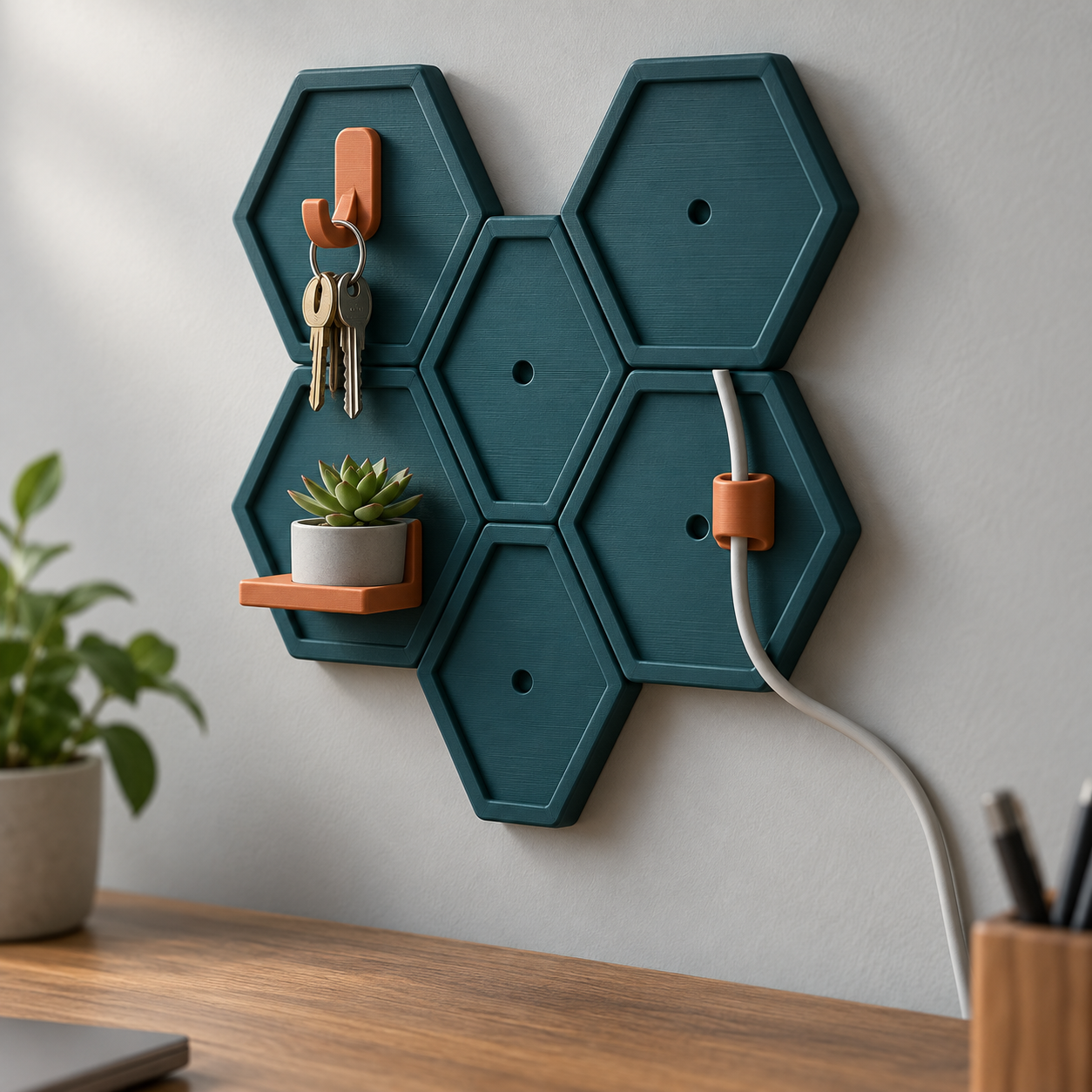
A honeycomb of interlocking wall tiles with a twist-lock port in every face, so a hook, a shelf, or a cable clip snaps into any tile in the cluster without tools, and the whole layout grows or rearranges as your wall does.
Date: 2026-09-28 Category: Organization and Storage Modeling difficulty: Advanced Estimated print: ~11 h total · ~290 g PETG (estimate) Suggested price: $35–$50 printed starter kit · $9 digital file (estimate) Status: Concept
Description
HexDock is a wall-mounted honeycomb of hexagonal tiles, each screwed directly to the wall and locked edge-to-edge to its neighbors with a small printed dowel pin. Every tile carries one twist-lock port in the center of its face — the same port on every tile, so any accessory clips into any tile in the cluster. A wall hook, a small shelf ledge, and a cable-loop clip are included as the starter accessory family, and the port is documented so more accessories can be designed against it later.
The tiles themselves do the structural work. Their raised honeycomb rim hides the two mounting screws and stiffens the panel so a cluster stays flat against the wall instead of flexing at the corners, and the edge-lock pins keep adjacent tiles aligned so the honeycomb pattern stays crisp as it's built out one tile at a time.
It reads as a wall feature on its own, screws visible only if you look for them, before a single accessory is clipped in — most buyers start with a small cluster near a desk or entryway and add tiles as they find more to hang.
Why it sells
Modular wall organization is one of the fastest-moving categories in the hobby right now. MultiBuild's MultiBoard system — a 25 mm-grid modular wall panel with snap-in hooks, shelves, and bins — has 50,000+ active makers and is ranked #1 most popular on Thangs, with a stated load rating up to 46 kg per panel. Hexagon-specific takes on the same idea are already established: the Hexa-Board wall organizer and the Hexagonal Pegboard on Printables both frame hex tiles as a decorative pegboard alternative, Cults3D's pegboard accessory collection runs to 160 designs, and Etsy sellers like Trellis Modular Wall Organizer are actively selling finished pegboard-alternative panels rather than just files.
What's missing from the hex-tile designs specifically is a shared, tool-free mounting standard for accessories — most hex pegboard files ship as a flat tile plus a handful of matched hooks with no reusable port, so every new accessory needs its own edge geometry. HexDock's twist-lock port is that missing standard.
Who buys it
Someone setting up a home office, a craft nook, or a small-apartment entryway who wants a wall system that looks intentional rather than utilitarian, and who will keep buying or printing more tiles and accessories as their setup changes — the desk-organizer roundup at XDA profiles exactly this buyer, someone assembling a wall or desk system piece by piece rather than buying one fixed organizer.
Design overview
- One hex tile design, flat-to-flat 150 mm, that tiles edge-to-edge in any honeycomb layout the wall allows
- A raised honeycomb rim that hides both mounting screws and stiffens the panel against flexing
- A single twist-lock port at the center of every tile — the reusable feature that lets one accessory family fit the whole cluster, unlike the fixed-hook hex designs already on Printables and Cults3D
- Edge-lock dowel pins that key adjacent tiles together so a multi-tile cluster stays flush without glue
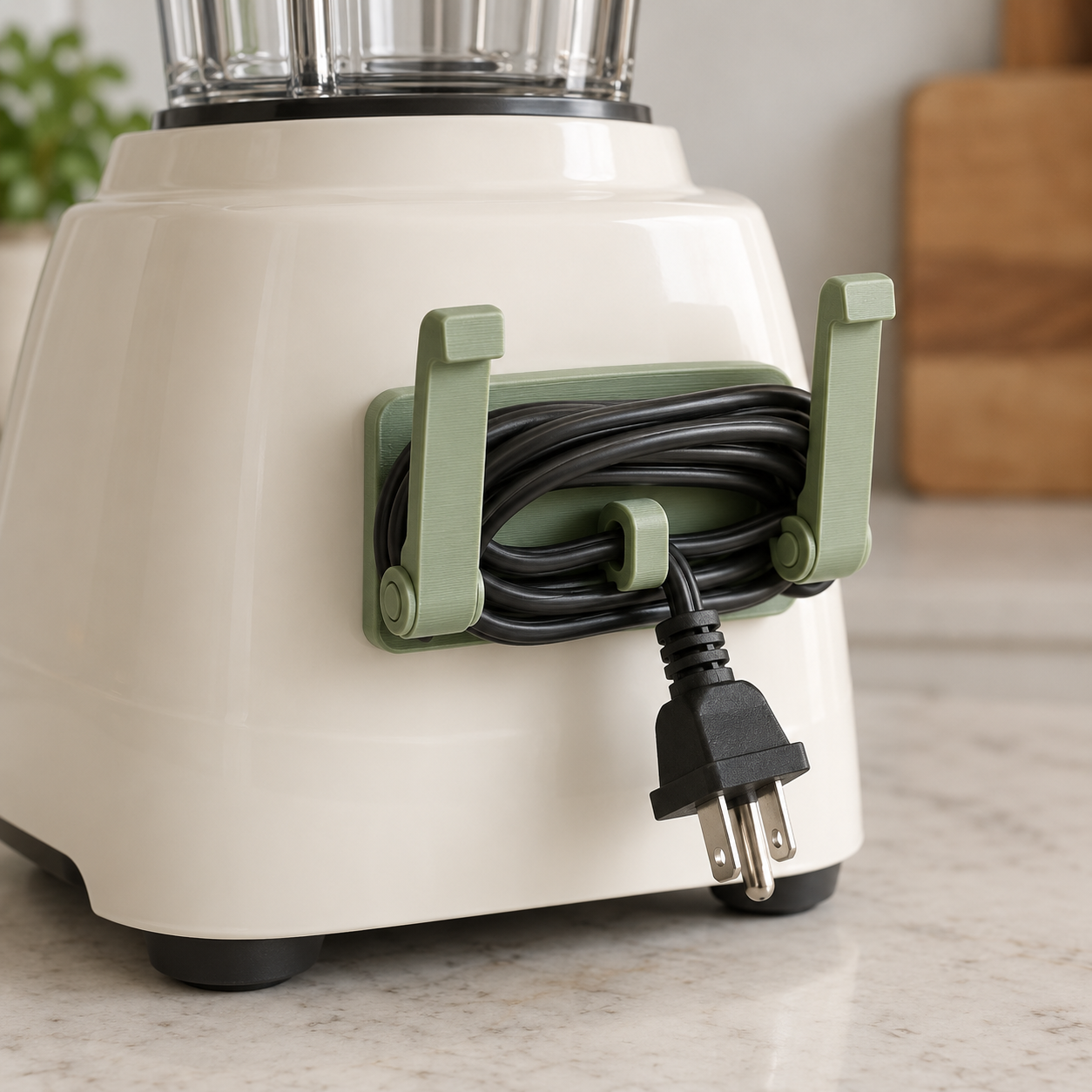
- Three starter accessories on the same twist shank: a wall hook, a small shelf ledge, and a cable-loop clip
- Every part prints flat with no supports
Dimensions
| Measurement | Value (mm) | Notes |
|---|---|---|
| Tile flat-to-flat | 150 | across flats |
| Tile point-to-point | 173.2 | across corners |
| Tile base thickness | 6 | field area |
| Tile rim height (added) | 4 | total 10 mm at the rim |
| Rim width | 8 | inward from each edge |
| Mounting boss hole | 4.5 diameter | ×2 per tile, at opposite vertices, 173.2 mm apart |
| Mounting screw countersink | 8 diameter × 3 deep | flush M4 screw head |
| Edge-lock pin hole | 3.4 diameter × 4 deep | one per edge midpoint, ×6 per tile |
| Twist-lock port counterbore | 26 diameter × 2 deep | front face |
| Twist-lock port main bore | 16.2 diameter | through remaining 4 mm |
| Twist-lock retaining lip | 2 radial × 2 axial | ×2, 90° arcs, 180° apart, at back of bore |
Parts list
| Part | Qty | Material | Size X×Y×Z (mm) | Print orientation | Supports |
|---|---|---|---|---|---|
| Hex tile | 6 | PETG | 173.2 × 150 × 10 | flat, front face down | none |
| Edge-lock pin | 8 | PLA | 3 diameter × 8 | standing on end | none |
| Wall hook accessory | 1 | PETG | 20 × 65 × 10 | flat, paddle face down, boss up | none |
| Shelf ledge accessory | 1 | PETG | 90 × 64 × 30 | ledge flat on bed, riser vertical | minimal: under the horizontal boss at the riser top |
| Cable-loop clip accessory | 1 | PETG | 28 × 54 × 10 | flat, paddle face down, boss up | none |
Hardware and non-printed parts
- 12 × M4 × 40 mm wood screw (2 per tile) — drives into a wall stud
- 12 × 4 mm plastic drywall anchor — use in place of a screw-only fix where a tile doesn't land on a stud
Fits and tolerances
- Edge-lock pin → tile edge hole (sliding fit): pin 3.0 mm diameter into a 3.4 mm hole, 0.2 mm clearance per side, so the pin seats by hand and the tile can still be pried off the wall for rearranging.
- Accessory shank → tile port (twist-lock / bayonet): shank 16.0 mm diameter into a 16.2 mm bore, 0.1 mm clearance per side; the shank's two tabs pass through the port's two 90° gaps on insertion, then a 45° twist engages the tabs under the retaining lips.
- Mounting screw → boss hole: 4.5 mm clearance hole for an M4 screw shaft, no printed thread.
Modeling guide
Origin: center of the hex tile's front face. +X horizontal, +Y vertical (in the plane of the wall), +Z out of the wall toward the viewer.
Hex tile
- Sketch a regular hexagon on the XY plane at Z = 0, flat-to-flat 150 mm (circumradius 86.6 mm), vertices at 30°, 90°, 150°, 210°, 270°, 330°.
- Extrude −Z 6 mm to form the base panel.
- Offset the hexagon's outline inward 8 mm to define the rim's inner edge, and extrude the ring between the two outlines −Z an additional 4 mm (total 10 mm at the rim).
- At the vertices closest to (0, 86.6) and (0, −86.6), sketch two circles 4.5 mm diameter through the full 10 mm thickness, with an 8 mm × 3 mm deep countersink on the front face.
- At the midpoint of each of the 6 edges, sketch a circle 3.4 mm diameter, cut 4 mm deep into the edge (centered on the rim's mid-height) to form the edge-lock pin holes.
- At the tile center, sketch a circle 26 mm diameter, cut 2 mm deep (counterbore) into the front face.
- Concentric with it, sketch a circle 16.2 mm diameter, cut through the remaining 4 mm of the base.
- In the last 2 mm of that bore (nearest the back face), add two 90° arc ribs projecting 2 mm radially inward, 180° apart, to form the retaining lips.
- Fillet all outer tile edges, radius 1.5 mm.
Accessory shank (shared base for all three accessories)
- Sketch a circle 16.0 mm diameter on a plane; extrude 4 mm to form the plain shaft.
- On the shaft's far end, add two wing tabs: 80° arc segments, 180° apart, projecting 3 mm radially beyond the 16 mm shaft (22 mm tab OD), 2 mm thick.
- Build the accessory-specific geometry (hook arm, shelf ledge, or cable loop) off the shank's back face, on the paddle described below. The shank's axis becomes the horizontal "into the wall" direction once mounted, so anything drawn in the paddle's own plane hangs flat and parallel to the wall.
Wall hook (a flat paddle, parallel to the wall when mounted): from the shank's back face, sketch a paddle 20 mm wide, extending 40 mm in the paddle's local −Y ("down") direction, 4 mm thick. At the bottom end, sweep the profile through an 8 mm-radius curl back up 15 mm to form the hook's retaining lip. Print flat, paddle face down on the bed, with the shank boss standing proud on top — no overhangs.
Cable-loop clip (also a flat paddle): from the shank's back face, sketch a 10 mm-wide stem extending 10 mm in local −Y, then sweep a 4 mm-diameter round profile through a C-shaped loop, 20 mm inner diameter, leaving a 6 mm opening gap for snap-in. Print flat the same way as the hook.
Shelf ledge (an L-bracket — the ledge must sit horizontal, so it needs a real bend, unlike the hook and clip): from the shank's back face, sketch a vertical riser 20 mm wide × 20 mm tall × 4 mm thick, in the same plane as the shank boss. At the riser's bottom edge, bend 90° into a horizontal ledge platform, 90 mm wide × 60 mm deep × 4 mm thick, extending outward (away from the wall). Add a 5 mm tall lip along the ledge's outer front edge. Print with the ledge platform flat on the bed and the riser standing vertically along the ledge's back edge; the shank boss cantilevers horizontally from the top of the riser and needs a short support bridge underneath it.
Edge-lock pin: sketch a circle 3.0 mm diameter, extrude 8 mm, chamfer both ends 0.5 mm × 45°.
Print settings
| Setting | Value |
|---|---|
| Material | PETG (tiles and accessories), PLA (edge-lock pins) |
| Nozzle | 0.4 mm |
| Layer height | 0.2 mm |
| Walls / perimeters | 3 |
| Infill | 20% gyroid (tiles), 30% grid (accessories) |
| Supports | none, except minimal under the shelf accessory's cantilever arm |
| Brim / adhesion | brim 5 mm on tiles |
| Notes | print tiles front-face-down so the rim forms the print's base layer |
Assembly
- Mark tile positions on the wall in the chosen honeycomb layout, using the tile's 173.2 mm point-to-point spacing as the pitch.
- Screw the first tile to the wall through its two boss holes.
- Slide an edge-lock pin into the mounted tile's edge hole where the next tile will meet it, then position and screw the next tile so the pin seats in its matching edge hole.
- Repeat until the cluster is complete.
- Insert an accessory's shank into any tile's center port, tabs aligned with the port's gaps, and twist 45° to lock.
Variants and upsells
- Tile count and layout are open — sell a 3-tile starter, a 6-tile kit (this spec), or a 12-tile "wall" pack.
- Additional accessories against the same twist-lock port: a pen cup, a small planter mount, a charging-cable dock — each only needs the shared shank geometry.
- A tile variant with a flush blank face (no port) for pure honeycomb wall texture between functional tiles.
- Color-matched tile sets for buyers who want the honeycomb to read as decor first, storage second.
Selling and distribution
MakerWorld and Printables are the right home for the tile and pin files, since that's where the comparable hex-pegboard and MultiBoard-style designs already draw traffic; list the assembled starter kit (6 tiles, 8 pins, 3 accessories, screws) on Etsy for buyers who want it ready to mount. Price the printed kit at $35–$50, covering roughly $6 of PETG/PLA and 11 hours of machine time plus margin for hardware and packaging; price the digital file at $9 since it's a build-your-own-layout system, not a single fixed object. License the tile and shank geometry under a share-alike-friendly license (free personal use, commercial print-and-sell allowed) to encourage community-designed accessories against the same port, the way MultiBoard's ecosystem grew.
Listing keywords: modular wall organizer, hexagon wall panel, pegboard alternative, honeycomb wall storage, 3D printed wall hooks, tool-free wall mount, twist-lock accessory system, office wall organizer, desk wall storage, hex tile shelf.
Risks and IP notes
- Overhang risk: the shelf accessory's 30 mm cantilever arm needs light support or a strong bridge setting; call this out in the print instructions.
- Load risk: the twist-lock port is rated for light accessories (hook, small shelf, cable clip); don't market it for heavy tool storage the way MultiBoard's screw-mounted system is rated for.
- Market risk: hex pegboard tiles are a crowded free-file category; the twist-lock port family is the differentiator and needs to be the lead image, not the honeycomb shape alone.
- IP check: "hexagon wall organizer" and "modular pegboard" are generic product categories across the sources reviewed; keep HexDock's port geometry and rim profile distinct from MultiBoard's screw/grid system and from the specific hex designs on Printables and Cults3D.
Resource links
- MultiBuild — modular 3D-printed organization system — 50,000+ active makers, #1 on Thangs, evidence for demand in modular wall organization
- Hexa-Board Wall Organizer — a comparable hex wall panel project write-up
- Hexagonal Pegboard — Printables — an existing hex pegboard alternative
- Trellis Modular Wall Organizer — Etsy — a finished-print pegboard-alternative listing, showing this sells as a physical product, not just a file
- Pegboard 3D printing collection — Cults3D — 160 designs, showing category depth
- 5 3D printed organizers that actually solved my desk chaos — XDA — profiles the piece-by-piece wall/desk organizer buyer
More from 3D Print Designs