Alpine Landforms Chess Set with Contour Relief Board
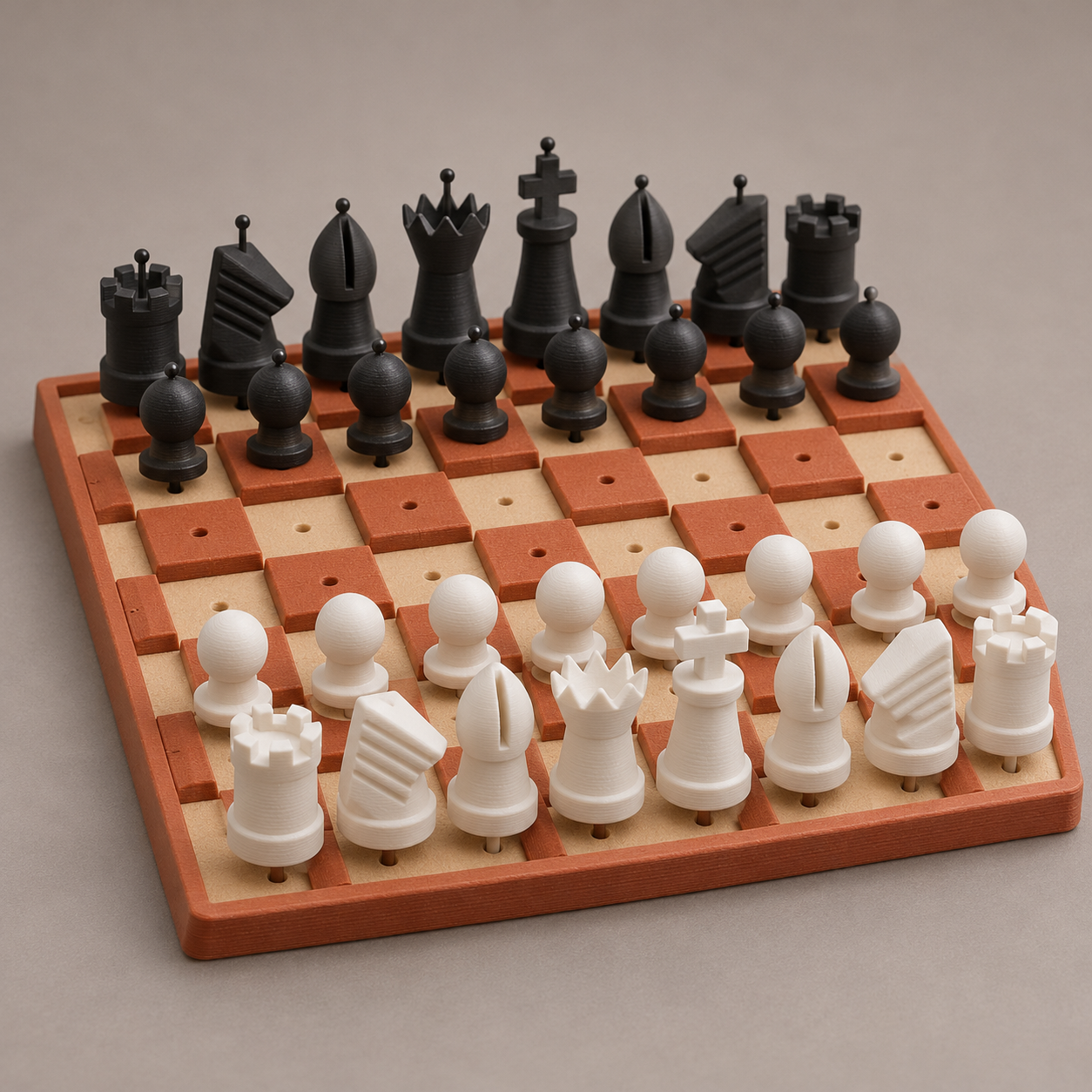
A chess army that is a mountain range: each piece is a different named alpine landform, and the board sits inside a stepped contour border like a relief map.
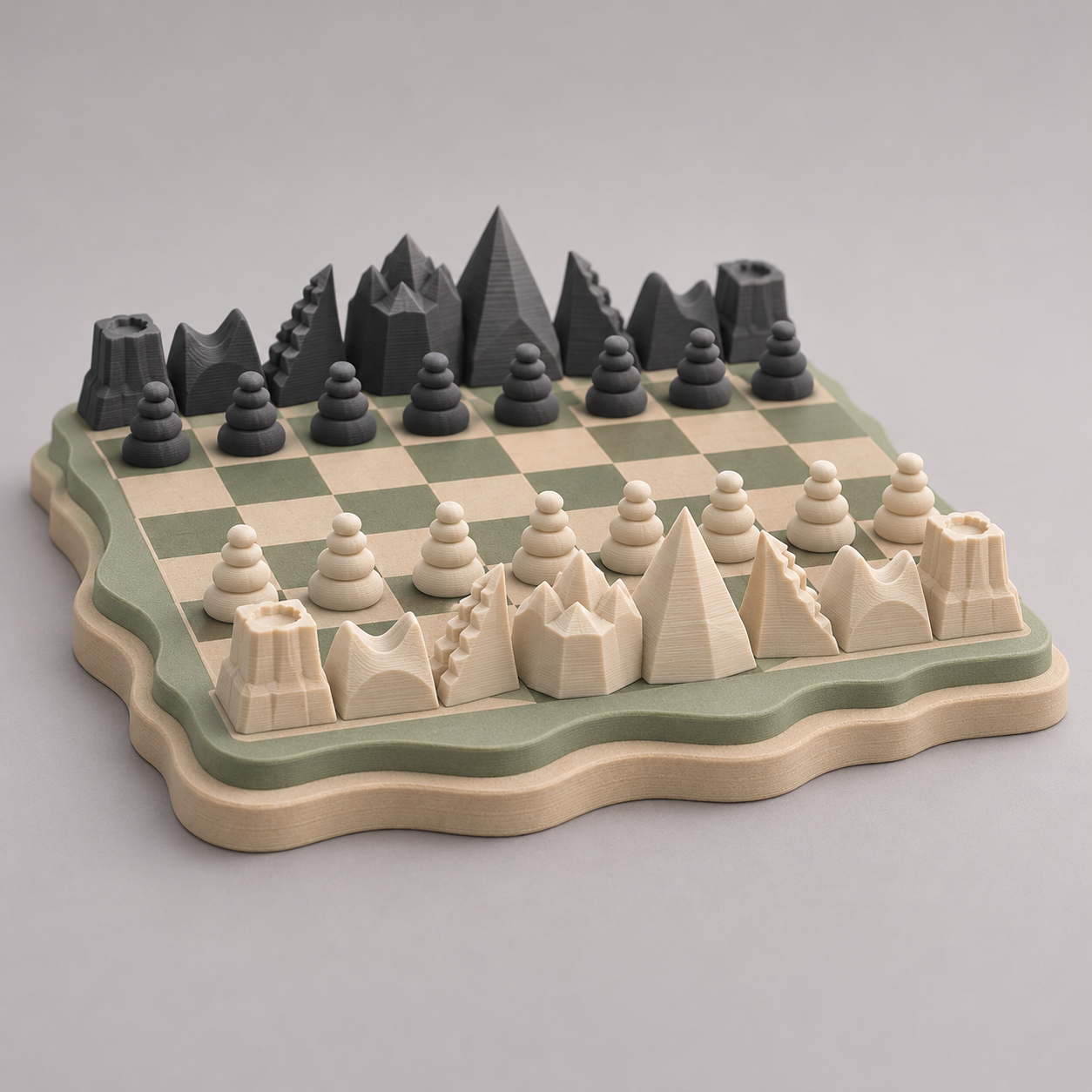
Alpine Landforms Chess Set with Contour Relief Board
A chess army that is a mountain range: each piece is a different named alpine landform, and the board sits inside a stepped contour border like a relief map.
Date: 2026-11-12 Category: Art and Decor Modeling difficulty: Beginner Estimated print: ~32 h total · ~240 g PLA (estimate) Suggested price: $60–$110 printed · $8 digital file (estimate) Status: Concept
Description
The set takes its form language from glaciated mountains. The king is a horn, a four-faced peak like the Matterhorn, with concave faces. The queen is a massif: a six-sided central peak with three lower summits around it. The rook is a butte, a square tower with a small crater lake pocket in its top. The bishop is an arête, a knife-edge ridge with notched teeth, set on the diagonal. The knight is a col, a saddle between a tall and a short summit. The pawn is a cairn, four stacked stones.
The board is a single 216 × 216 mm print. The 200 mm playing field has 25 mm squares, the light ones raised 0.8 mm so one colour change prints them. Around it a border climbs in two 3 mm steps, so the board reads like a contour relief in section, the way the owner's landscape maps do.
Every piece stands on a 3 mm plinth. Proportions follow the FIDE rule that a base is 40 to 50 percent of the piece height, and the heights step down in the usual order. Nothing in the set refers to a game franchise or a team.
Why it sells
This is an art piece chosen on taste, so no sales figures are offered. Its inspiration is landscape form and design history. The pyramidal peak page and Britannica's horn entry describe the shapes glaciers leave: horns with several faces, and the arêtes between cirques. The Bauhaus Model XVI chess set of 1924 is the precedent for letting a piece's form carry a meaning related to its movement. This set borrows that habit of thought, not any shape from it.
The gap: abstract and geometric sets are common, but I did not find one whose pieces are a vocabulary of named landforms. The existing Strata set in this library uses stacked rock layers; this one uses summits.
Who buys it
People who like mountains and relief maps, geology fans, gift buyers for climbers and hikers, and chess players who want a display set. Sold as a printed set on Etsy and craft markets, and as a file on Printables and MakerWorld.
Design overview
- The surprise: each piece is a different named landform, so the set reads as a mountain range and the glossary is the legend.
- Heights 28 / 34 / 38 / 42 / 46 / 52 mm (P / R / N / B / Q / K), plinths Ø14 to Ø21 on 25 mm squares.
- The bishop's blade is turned 45° to the board, mapping its diagonal move onto its form; the rook's faces are square to the board.
- Board 216 × 216 × 14 mm with two 3 mm contour steps around the field; light squares raised 0.8 mm.
- Concave cirque scoops on the king's faces lean out by less than 20°, so they need no support.
- All 12 piece types are single-material PLA and print in under an hour each with no supports.
Dimensions
| Measurement | Value (mm) | Notes |
|---|---|---|
| Board width (X) | 216 | 4 + 4 border each side, 200 field |
| Board depth (Y) | 216 | |
| Board height (Z) | 14 | outer ring top |
| Dark square level | 8 | z |
| Light square level | 8.8 | raised 0.8 |
| Border ring 1 top | 11 | x 4 to 8 |
| Border ring 2 top | 14 | x 0 to 4 |
| Square size | 25 | 8 × 8 |
| Plinth height | 3 | all pieces |
| Piece base Ø (K/Q/B/N/R/P) | 21 / 20 / 19 / 19 / 17 / 14 | 40–50 % of height |
| Piece height (K/Q/B/N/R/P) | 52 / 46 / 42 / 38 / 34 / 28 | |
| Bishop blade thickness | 5 | turned 45° |
| Knight thickness | 10 | X |
| Rook crater | 6 | 6 × 6 × 4 deep |
Parts list
| Part | Qty | Material | Size X×Y×Z (mm) | Print orientation | Supports |
|---|---|---|---|---|---|
| Contour relief board | 1 | PLA | 216 × 216 × 14 | underside face down | none |
| King (the Horn, white) | 1 | PLA | 21 × 21 × 52 | plinth face down | none |
| King (the Horn, black) | 1 | PLA | 21 × 21 × 52 | plinth face down | none |
| Queen (the Massif, white) | 1 | PLA | 20 × 20 × 46 | plinth face down | none |
| Queen (the Massif, black) | 1 | PLA | 20 × 20 × 46 | plinth face down | none |
| Rook (the Butte, white) | 2 | PLA | 17 × 17 × 34 | plinth face down | none |
| Rook (the Butte, black) | 2 | PLA | 17 × 17 × 34 | plinth face down | none |
| Bishop (the Arête, white) | 2 | PLA | 19 × 19 × 42 | plinth face down | none |
| Bishop (the Arête, black) | 2 | PLA | 19 × 19 × 42 | plinth face down | none |
| Knight (the Col, white) | 2 | PLA | 19 × 19 × 38 | plinth face down | none |
| Knight (the Col, black) | 2 | PLA | 19 × 19 × 38 | plinth face down | none |
| Pawn (the Cairn, white) | 8 | PLA | 14 × 14 × 28 | plinth face down | none |
| Pawn (the Cairn, black) | 8 | PLA | 14 × 14 × 28 | plinth face down | none |
Hardware and non-printed parts
None — fully printed
Fits and tolerances
- None. Pieces stand loose on the board; there are no mating printed parts.
Modeling guide
Origin for the board: front-left bottom corner, +X right, +Y toward black, +Z up. For pieces: centre of the plinth underside, +Z up.
Contour relief board (x1, id contour-board)
- Sketch on XY, origin at the front-left bottom corner: square 216 × 216, corner radius 3. Extrude 8 (playing level, dark squares).
- Border ring 1: the ring between the 208 × 208 and 200 × 200 squares centred at (108,108), i.e. x 4 to 8 (and the matching sides): extrude from z = 8 to z = 11.
- Border ring 2: the outer ring x 0 to 4 (and matching sides): extrude from z = 8 to z = 14. The border climbs 3 mm then 3 mm more, a stepped cirque around the field.
- Light squares: the playing field is x 8 to 208, y 8 to 208, 25 mm squares. For file i, rank j with (i + j) odd (the 32 light squares) sketch a 25 × 25 square at (8 + 25i, 8 + 25j) and extrude 0.8 above z = 8. Dark squares stay at z = 8.
- Fillet the outer top edge 0.8 and the inner step edges 0.4.
King (the Horn, white) (x1, id king-white)
- Plinth: cylinder Ø21, height 3, on XY at the origin; chamfer the top outer edge 0.8.
- Loft from a square 14 × 14 at z = 3 (rotated 45° so the corners point along X and Y) to a square 2.5 × 2.5 at z = 52. Four faces, like a pyramidal peak.
- Cirque scoops: on each of the four faces cut a horizontal cylinder of radius 40 whose axis is parallel to the face, with its axis 43.3 from the piece axis (the face is 4.8 from the axis at z = 22, so the cut goes 1.5 into it), at z = 22. This leaves a 1.5 mm deep concave scoop on each face; the surface above it leans out by at most 20°, so it prints without support.
- Fillet the apex 0.5.
King (the Horn, black) (x1): Identical to king-white; print in charcoal PLA.
Queen (the Massif, white) (x1, id queen-white)
- Plinth: cylinder Ø20, height 3, on XY at the origin; chamfer the top outer edge 0.8.
- Centre peak: loft a regular hexagon 14 across flats at z = 3 to a hexagon 2 across flats at z = 46.
- Three satellite peaks: hexagons 6 across flats at z = 3 lofted to 1 across flats at z = 30, centred at radius 6 from the axis at 90°, 210° and 330°. Union all.
- Fillet the summits 0.4.
Queen (the Massif, black) (x1): Identical to queen-white; print in charcoal PLA.
Rook (the Butte, white) (x2, id rook-white)
- Plinth: cylinder Ø17, height 3, on XY at the origin; chamfer the top outer edge 0.8.
- Butte: square prism 11.5 × 11.5 from z = 3 to z = 34, faces parallel to X and Y (the rook moves along the board axes). Taper the four faces 2° inward.
- Crater lake: cut a pocket 6 × 6, 4 deep from the top (z = 30 to 34), centred.
- Fillet the vertical edges 0.8 and the top outer edge 0.5.
Rook (the Butte, black) (x2): Identical to rook-white; print in charcoal PLA.
Bishop (the Arête, white) (x2, id bishop-white)
- Plinth: cylinder Ø19, height 3, on XY at the origin; chamfer the top outer edge 0.8.
- Sketch the blade on a vertical plane at 45° to the board axes (the bishop moves on diagonals), coordinates (u,z) with u along the blade: closed polygon (-8.5,3) (8.5,3) (7,14) (5,20) (3.5,18) (2,30) (0.8,28) (0,42) (-1.2,31) (-3,33) (-4.5,20) (-7,14). The notches in the crest are gendarmes, the teeth of a knife-edge ridge.
- Extrude 5 symmetric about that plane (±2.5).
- Chamfer the long top edges of the blade 1.0 so the crest reads as a ridge.
Bishop (the Arête, black) (x2): Identical to bishop-white; print in charcoal PLA.
Knight (the Col, white) (x2, id knight-white)
- Plinth: cylinder Ø19, height 3, on XY at the origin; chamfer the top outer edge 0.8.
- Sketch the head on the YZ plane as a closed polygon, points (y,z): (-8,3) (8,3) (8,20) (5,27) (4,38) (2,37) (-0.5,23) (-3,25) (-6,31) (-8,22). A tall summit on the +Y side, a low summit on the −Y side, and a saddle between: the col.
- Extrude 10 symmetric about the YZ plane (±5 in X). The peak faces +Y.
- Fillet the profile edges 0.8.
Knight (the Col, black) (x2): Identical to knight-white; print in charcoal PLA.
Pawn (the Cairn, white) (x8, id pawn-white)
- Plinth: cylinder Ø14, height 3, on XY at the origin; chamfer the top outer edge 0.8.
- Four overlapping spheres, centred on the axis: Ø12 at z = 8, Ø10 at z = 14, Ø8 at z = 20 and Ø6 at z = 25. The top is at z = 28.
- Union with the plinth. Flatten the underside of the lowest sphere into the plinth.
Pawn (the Cairn, black) (x8): Identical to pawn-white; print in charcoal PLA.
Print settings
| Setting | Value |
|---|---|
| Material | PLA, matte. Board: pale sand light squares, sage green dark squares and border. Pieces: warm white and charcoal. |
| Nozzle | 0.4 mm |
| Layer height | 0.2 mm (board), 0.12 mm for pieces |
| Walls / perimeters | 3 |
| Infill | 15% gyroid (board), 20% (pieces) |
| Supports | None |
| Brim / adhesion | None for the board; 3 mm brim for the pawn and king |
| Notes | Board: one filament change at z = 8.0 so the 0.8 mm light squares are in the second colour. Print the whole set of one colour in one plate where it fits (32 pieces at about 40 mm pitch). |
Assembly
- No assembly. Print the board with one colour change at z = 8.0, print the pieces, and set the board between the players.
- Optional: stick 0.5 mm felt discs, Ø14 to Ø21, under the plinths.
Variants and upsells
Piece-by-piece edition: sell one landform a week toward the full set, in the order pawn, rook, knight, bishop, queen, king. A single-colour desk-piece edition: the king alone as a Horn trophy. A real-terrain board edition where the border contours follow a swisstopo or USGS 3DEP tile, with the data licence and credit read from the publisher. A mini set at 20 mm squares for travel.
Selling and distribution
Etsy, craft markets and mountain-themed gift shops suit the printed set; Printables and MakerWorld suit the file. Price from material (about 240 g, an estimate) plus roughly 32 print hours at machine rate plus a margin. Sell the printed set and the file; the weekly-piece format works for a collectors' drip. Keywords: mountain chess set, alpine chess, Matterhorn chess, relief map chess, geology chess, landform chess set, modern chess set, hiking gift, climber gift, 3D printed chess.
Risks and IP notes
- Thin king tip (2.5 mm). Mitigation: print at 0.12 mm with a 3 mm brim; offer a truncated tip variant.
- Pieces may read as generic spikes. Mitigation: lean on the named-landform vocabulary and the printed legend card in the listing.
- The name "Matterhorn" is a place, not a trademark, but avoid listing a mountain brand or resort name. Mitigation: use the generic term "alpine".
- Market: faceted and geometric sets are common. Mitigation: the surprise is the landform vocabulary and the contour border, not facets.
- Bauhaus inspiration: no Hartwig shapes are used. Mitigation: keep the forms as landforms and avoid cube, X-cross and sphere-queen readings.
Resource links
- Pyramidal peak (Wikipedia) — Horns and pyramidal peaks carved by several glaciers; the Matterhorn type has four faces
- Horn, glacial landform (Britannica) — Definition of the horn
- Bauhaus Chess Set (Model XVI) — 1924 set whose forms stand for movement; inspiration for form following move, not copied
- FIDE Handbook: Standards of chess equipment — Base diameter is 40-50% of height; heights in descending order
- Chess piece sizes (House of Staunton) — King height and square size relationships
More from 3D Print Designs