Ice-Slide Tilt Maze with Five Pockets
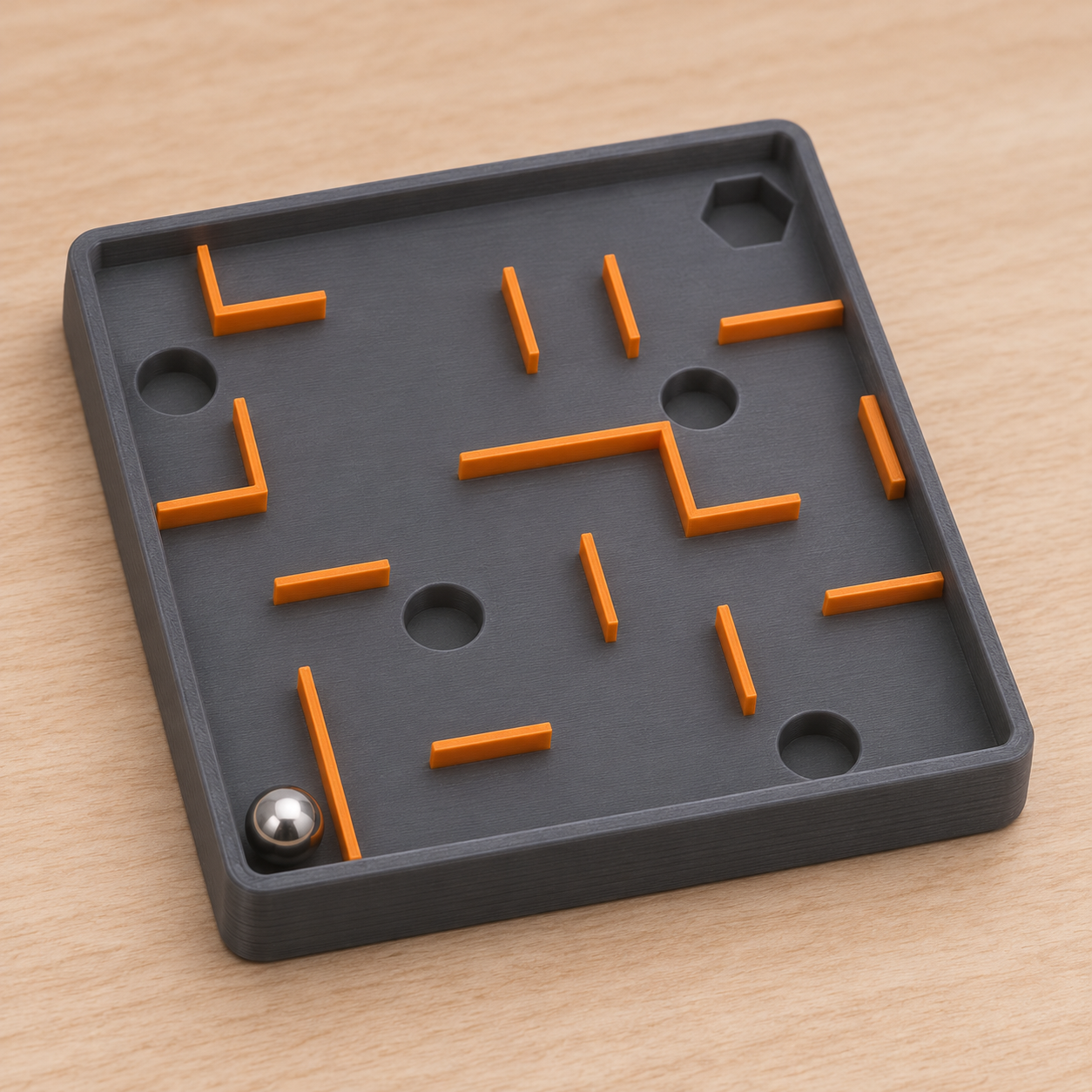
A palm-sized tilt maze where a steel ball slides until a wall stops it, with four trap pockets and one hexagonal goal, so the shortest route takes sixteen tilts.
Ice-Slide Tilt Maze with Five Pockets
A palm-sized tilt maze where a steel ball slides until a wall stops it, with four trap pockets and one hexagonal goal, so the shortest route takes sixteen tilts.
Date: 2026-11-13 Category: Puzzles and Games Modeling difficulty: Intermediate Estimated print: ~4 h total · ~46 g PETG (estimate) Suggested price: $18–$32 printed · $4 digital file (estimate) Status: Concept
Description
A shallow square tray holds a seven-by-seven field of cells, each 10 mm across, with 22 thin partitions between some of them. You drop in a single 8 mm steel ball at the bottom-left cell and tilt the board. The ball rolls in a straight line until a partition or the outer wall stops it, so every tilt is one move.
Four round pockets are sunk into the floor as traps. Fall into one and you turn the board over to dump the ball and start again. Only the hexagonal pocket in the top-right corner is the goal, so shape tells the winner from the traps at a glance.
The board is open on top, small enough for a desk, and prints in about three and a half hours.
Why it sells
This is the stop-at-the-wall mechanic from ice-sliding puzzles. A paper on ice sliding games notes that the robot can only stop on a square next to a block, and that solving reduces to a shortest path between squares (arXiv 1507.00559). Ricochet Robots uses the same movement rule (solver write-up), and indie games use it (Slippery Icy Floor Puzzle). Those show the rule is understood and fun to solve; they are not sales evidence. I found no verified sales numbers for printed tilt mazes, and printed puzzle listings in general range widely in price (SelfCAD roundup).
The gap: printed ball mazes are usually free-roll labyrinths where you steer the ball around. A stop-at-the-wall maze with a computed shortest solution is a logic puzzle you can hand someone with a known answer.
Who buys it
Puzzle fans, desk-toy buyers and people who give small gifts to colleagues. Etsy and craft markets, plus Printables or MakerWorld for the file. Not for children under 14 because of the small steel ball.
Design overview
- 7 × 7 cell grid, 10 mm cells, 12 mm pitch, 2 mm partitions; 22 partitions.
- 8 mm stainless ball; walls 10 mm tall keep it in under a normal tilt.
- Four round trap pockets (9 mm dia, 5 mm deep) trap the ball; one hexagonal goal pocket (9 mm across flats) in the top-right cell.
- Start at the bottom-left cell. A breadth-first search of the layout gives a shortest solution of 16 tilts, which I checked by script (spoiler in the modeling guide).
- 7 mm floor so the pockets stay 2 mm thick underneath.
- What sets it apart: the layout was searched for a long shortest path, rather than drawn by hand.
Dimensions
| Measurement | Value (mm) | Notes |
|---|---|---|
| Overall width (X) | 88 | outer tray |
| Overall depth (Y) | 88 | outer tray |
| Overall height (Z) | 17 | floor + walls |
| Outer wall thickness | 3 | |
| Floor thickness | 7 | pockets leave 2 |
| Cell clear width | 10 | ball is 8 |
| Cell pitch | 12 | 10 cell + 2 partition |
| Partition thickness / height | 2 / 10 | |
| Round pocket diameter / depth | 9 / 5 | trap |
| Hex pocket across flats / depth | 9 / 5 | goal |
| Corner radius | 4 | vertical outer edges |
Parts list
| Part | Qty | Material | Size X×Y×Z (mm) | Print orientation | Supports |
|---|---|---|---|---|---|
| Tilt maze board | 1 | PETG | 88 × 88 × 17 | bottom face down, open top up | none |
Hardware and non-printed parts
- 8 mm stainless steel ball ×1 (grade G100 or better). Loose, dropped into the start cell.
- Optional: 10 mm × 1 mm self-adhesive felt pad ×4, glued into the underside recesses.
Fits and tolerances
- Ball in cell: free rolling, 1 mm per side (8 mm ball in a 10 mm cell). A tighter cell makes the ball drag on the partitions.
- Ball in pocket: 0.5 mm per side (8 mm ball in 9 mm pocket), deep enough (5 mm) that the ball centre sits 1 mm below the floor surface.
- Felt pad in recess: press, 0 mm; glue with the pad's own adhesive.
Modeling guide
Origin: lower-left bottom corner of the tray. +X right, +Y up the page toward grid row 0, +Z up.
- Sketch on XY: square 88 × 88, corner radius 4. Extrude 17.
- Sketch on the top face: square 82 × 82 inset 3 from each outer edge, corner radius 1. Cut down 10 (open top above Z=7).
- Grid: cell (c, r) has its centre at X = 8 + 12c, Y = 80 − 12r, with c and r from 0 to 6 and r = 0 the top row.
- Vertical partitions (between column x−1 and x in row y): 2 × 12 × 10 box, centre X = 12x + 2, centre Y = 80 − 12y, Z 7 to 17. List (x,y): (1,3) (1,6) (2,0) (2,4) (3,0) (3,2) (3,5) (5,2) (5,3) (5,6) (6,1).
- Horizontal partitions (between row y−1 and y in column x): 12 × 2 × 10 box, centre X = 8 + 12x, centre Y = 86 − 12y, Z 7 to 17. List (x,y): (0,3) (0,5) (1,4) (2,1) (4,1) (4,3) (4,5) (5,1) (5,4) (5,5) (6,2).
- Round pockets, diameter 9, 5 deep from Z=7, at cells (2,6) (3,6) (4,1) (4,2).
- Hexagonal pocket, 9 across flats, 5 deep from Z=7, at cell (6,0), flats facing +Y/−Y.
- Underside: four recesses diameter 10 × 1 deep at (12,12) (76,12) (12,76) (76,76).
- Fillet the four vertical outer edges 4; chamfer the bottom perimeter 0.4 × 45°.
Rules and QA: the ball starts in cell (0,6) and a tilt moves it in one direction until a partition or outer wall stops it. Rolling over a pocket cell drops it into the pocket. Shortest solution by script (U = toward row 0, D = away, L/R = left/right): URULURDRDRDLULUR (16 tilts). Keep this spoiler out of the customer-facing listing.
Print settings
| Setting | Value |
|---|---|
| Material | PETG |
| Nozzle | 0.4 mm |
| Layer height | 0.2 mm |
| Walls / perimeters | 3 |
| Infill | 20% gyroid |
| Supports | none |
| Brim / adhesion | none |
| Notes | Print upright, open top up. Optional two-colour: swap filament at Z=7.0 only if you accept the outer walls changing colour too; otherwise paint the partitions. Test one print with the ball before listing. |
Assembly
- Print the board and glue four felt pads into the underside recesses (optional).
- Drop the 8 mm ball into the bottom-left cell.
- Hold the board flat and tilt it one direction at a time until the ball reaches the hexagonal pocket.
- If the ball enters a round pocket, turn the board upside down to empty it and start again.
Variants and upsells
- 9 × 9 grid (112 mm) for a harder version.
- Layout pack: five other searched layouts with different pit counts, as separate files.
- Magnet-lid version with a clear PETG sheet 88 × 88 × 1.5 mm to keep the ball in.
Selling and distribution
Etsy and craft markets for the physical board; Printables and MakerWorld for a low-cost file. Price from material plus about 3.5 hours of machine time plus margin; the steel ball is cheap. Digital: personal-use licence, small-commercial add-on. Keywords: tilt maze, ice sliding puzzle, ball maze, 3d printed maze, desk puzzle, logic puzzle, brain teaser, steel ball puzzle, fidget puzzle, stocking filler puzzle.
Risks and IP notes
- Steel ball is a choking hazard; mitigation: label 14+ and sell no version for small children.
- Ball may jump out in a hard tilt; mitigation: 10 mm walls and a clear PETG lid variant.
- Many free mazes exist; mitigation: compete on the searched shortest-path layout and the pocket shapes.
- Ball tolerance matters; mitigation: test with the exact ball size before shipping.
Resource links
- Ice sliding games (arXiv 1507.00559) — Stop-at-a-block movement and shortest path solving
- Ricochet Robots Solver (Kevin Cox) — Same sliding rule as a board game
- Slippery Icy Floor Puzzle (itch.io) — Ice-slide mechanic as a game
- 3D Printed Puzzle Box: 9 Designs (SelfCAD) — Printed puzzle context
- 3D printed puzzle box curated models (All3DP) — Printed puzzle listings
More from 3D Print Designs