Gridfinity SD and microSD Card Bin (2×1, 28 Cards)
A 2×1 Gridfinity-compatible bin with eight upright slots for full-size SD cards and twenty for microSD, so a Raspberry Pi or camera tinkerer can see and grab the right card.
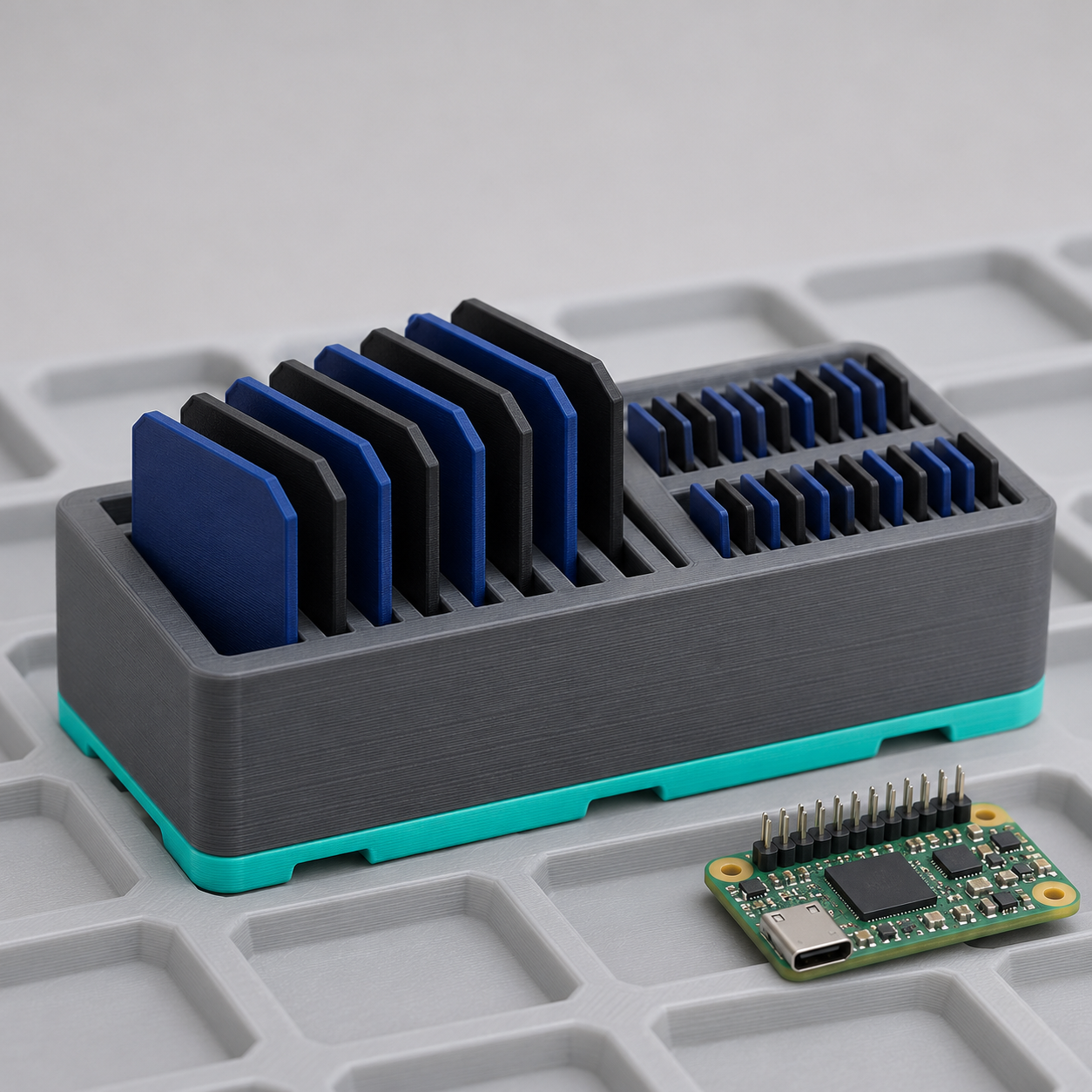
Gridfinity SD and microSD Card Bin (2×1, 28 Cards)
A 2×1 Gridfinity-compatible bin with eight upright slots for full-size SD cards and twenty for microSD, so a Raspberry Pi or camera tinkerer can see and grab the right card.
Date: 2026-11-12 Category: Organization and Storage Modeling difficulty: Beginner Estimated print: ~3 h total · ~38 g PLA (estimate) Suggested price: $9–$16 printed · $3 digital file (estimate) Status: Concept
Description
The bin fits a standard Gridfinity baseplate: two 42 mm grid cells wide and one deep, 21 mm tall, with the usual stepped base. On top it has two blocks of narrow slots. The left block holds eight full-size SD cards standing on edge, with half of each card above the rim so you can pinch it. The right block holds twenty microSD cards in two rows of ten.
It stays deliberately simple: one solid body with pockets, no lid and no hardware. A modeler can build it in an afternoon, and it prints in about three hours without supports. Colour options are easy; a contrasting base ring looks good.
Why it sells
Gridfinity has a large ecosystem. An All3DP roundup of Gridfinity models quotes download counts in the tens of thousands for the popular organizers (All3DP, undated snapshot), and a Qidi blog says one soldering-station bin set has over 44,000 downloads on Printables (vendor blog, so treat with caution) (Qidi3D). MakerWorld hosts sizeable Gridfinity collections, and at least one creator there sells a commercial licence for printed copies (MakerWorld 2529131). Etsy shows 473+ Gridfinity listings in one search, which proves that sellers offer them, not how well they sell (Etsy Gridfinity search). I did not find a verified sales number for SD card bins specifically. The gap: card holders on those listings tend to be generic. This one fits both card sizes in one 2×1 and stands every card upright where you can see its face.
Who buys it
Raspberry Pi and microcontroller hobbyists, photographers, drone and dashcam owners, retro handheld modders and anyone with a drawer of unlabelled cards. They already own Gridfinity baseplates. They shop on Printables, MakerWorld and Etsy.
Design overview
- Outer footprint 83.5 × 41.5 mm (2 × 1 Gridfinity units), height 21 mm (3 units).
- Standard stepped Gridfinity base, 4.75 mm tall; no stacking lip, so the top is flat.
- Left block: eight slots, 2.9 × 25 mm, each 16 mm deep for SD cards (32 × 24 × 2.1 mm).
- Right block: two rows of ten slots, 1.6 × 11.8 mm, each 9 mm deep for microSD cards (15 × 11 × 1.0 mm).
- Capacity: 28 cards. Walls between slots are 2.0 mm.
- Sets it apart: both card sizes in a single 2×1 cell, with half of each SD card standing proud so you can read and grab it.
Dimensions
| Measurement | Value (mm) | Notes |
|---|---|---|
| Overall width (X) | 83.5 | 2 × 42 − 0.5 |
| Overall depth (Y) | 41.5 | 42 − 0.5 |
| Overall height (Z) | 21 | 3 × 7 |
| Outer wall thickness | 2.2 | around the pockets |
| Base profile height | 4.75 | 0.8 + 1.8 + 2.15 |
| SD slot | 2.9 × 25 × 16 deep | pitch 4.9 along X; floor at z = 5 |
| microSD slot | 1.6 × 11.8 × 9 deep | pitch 3.6 along X; floor at z = 12 |
| Divider between blocks | 2.0 | x = 39.4 to 41.4 |
Parts list
| Part | Qty | Material | Size X×Y×Z (mm) | Print orientation | Supports |
|---|---|---|---|---|---|
| Card bin | 1 | PLA | 83.5×41.5×21 | base down | none |
Hardware and non-printed parts
None — fully printed. (Optional: 6 × 2 mm disc magnets in the base's four corner holes, if the owner's baseplate uses magnets; leave them out for the default.)
Fits and tolerances
| Mating parts | Fit | Clearance |
|---|---|---|
| Bin base to Gridfinity baseplate | drop-in | 0.25 mm per side (41.5 vs 42 pitch), per the Gridfinity convention |
| SD card in slot | sliding | 0.4 mm on thickness (2.9 vs 2.1), 0.5 mm per side on width (25 vs 24) |
| microSD in slot | sliding | 0.6 mm on thickness (1.6 vs 1.0), 0.4 mm per side on width (11.8 vs 11.0) |
The slots are looser than a press fit on purpose: cards must come out with one finger and layer lines make slot walls slightly wider than drawn.
Modeling guide
Origin at the bin's bottom-left-front corner. +X along the long side, +Y depth, +Z up. Gridfinity's public convention is a 42 mm grid and a 7 mm height unit; check the community specification for the exact base profile before you model (gridfinity.xyz).
- Body: rectangle 83.5 × 41.5, corner radius 3.75, extrude 21.
- Base profile: along the bottom edge of each 41.5 mm cell, inset 0.8 mm at 45° over the first 0.8 mm of height, vertical for 1.8 mm, then 2.15 mm at 45°, reaching full width at z = 4.75. The bottom face of each cell is 35.6 × 35.6 mm.
- SD slots: for i = 0 to 7, cut a rectangle 2.9 (X) × 25 (Y) with its lower-left corner at x = 2.2 + 4.9 i, y = 8.25, from z = 5 to z = 21.
- Divider: leave solid from x = 39.4 to 41.4.
- microSD slots: for i = 0 to 9, cut two rows of 1.6 (X) × 11.8 (Y) at x = 44.35 + 3.6 i. Row 1 starts at y = 7.95, row 2 at y = 21.75. Cut from z = 12 to z = 21.
- Fillet the top outer edges 0.6 mm and chamfer slot mouths 0.4 mm for easier card entry.
Print settings
| Setting | Value |
|---|---|
| Material | PLA |
| Nozzle | 0.4 mm |
| Layer height | 0.2 mm |
| Walls / perimeters | 3 |
| Infill | 15% gyroid |
| Supports | none |
| Brim / adhesion | none |
| Notes | The base profile prints cleanly with the bin base-down. Print one slot test strip if your printer over-extrudes thin slots. |
Assembly
No assembly — prints ready to use.
Variants and upsells
- 3×1 version with SD only (12 slots) and a 2×2 version with CompactFlash and XQD slots.
- Colour-coded sets: three bins in three colours as "project", "archive" and "spare" cards.
- A matching 1×1 bin for USB sticks, as the next item in a card-and-drive set.
- A parametric file so buyers can change slot count and depth.
Selling and distribution
Print and sell sets of two or three on Etsy, or sell the file on Printables and MakerWorld. Price from filament (~$1), 3 h of machine time and margin: $9 to $16 printed. Gridfinity itself is an open system, so say "Gridfinity-compatible" in listings and avoid claiming any official status. Use CC BY-NC for free sharing and a paid commercial licence for print sellers. Keywords: Gridfinity SD card holder, microSD organizer, memory card storage, Raspberry Pi accessories, Gridfinity bin, 2x1 Gridfinity, camera card holder, retro handheld, desk organizer, 3D printed card holder.
Risks and IP notes
- Saturation: SD card holders are common. Mitigation: lead with the combined SD plus microSD layout.
- Slot width: thin walls can warp. Mitigation: 2.0 mm walls and a test strip.
- Compatibility: baseplate variants differ slightly. Mitigation: test the fit on one baseplate before listing.
- IP: Gridfinity is community-licensed, with its own listing rules. Mitigation: read the current spec page before selling.
- Card dimensions: cards from some makers are marginally thicker. Mitigation: slots have 0.4 mm of play.
Resource links
- All3DP: Gridfinity models — a roundup with download counts for popular organizers
- Qidi3D: Gridfinity organizers to print — popular bins and download counts (vendor blog)
- MakerWorld: Gridfinity bin complete system — a large collection and a commercial licence tier
- Etsy: Gridfinity search — shows 473+ Gridfinity listings
- Gridfinity specification — the community spec (magnet size, labels, work-in-progress notice)
- Kingspec: SD card dimensions — SD and microSD physical sizes
More from 3D Print Designs