Roly Totem: Self-Righting Rocking Sculpture
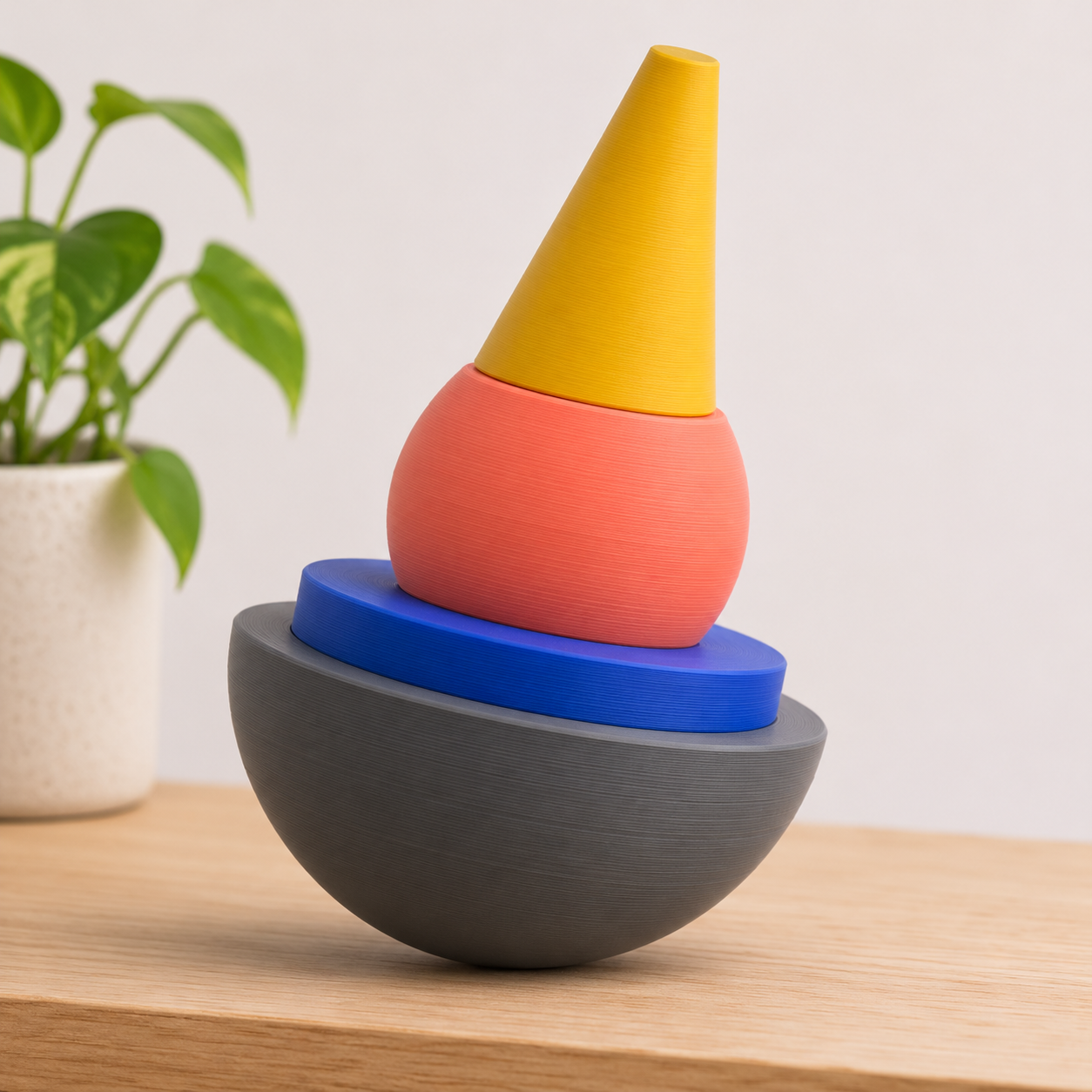
A cobalt, coral and mustard totem on a charcoal half-dome that wobbles when touched and always settles upright, for the top of a cabinet or shelf.
Roly Totem: Self-Righting Rocking Sculpture
A cobalt, coral and mustard totem on a charcoal half-dome that wobbles when touched and always settles upright, for the top of a cabinet or shelf.
Date: 2026-11-13 Category: Art and Decor Modeling difficulty: Intermediate Estimated print: ~11.7 h total · ~110 g PLA (estimate) Suggested price: $45–$70 printed · $6 digital file (estimate) Status: Concept
Description
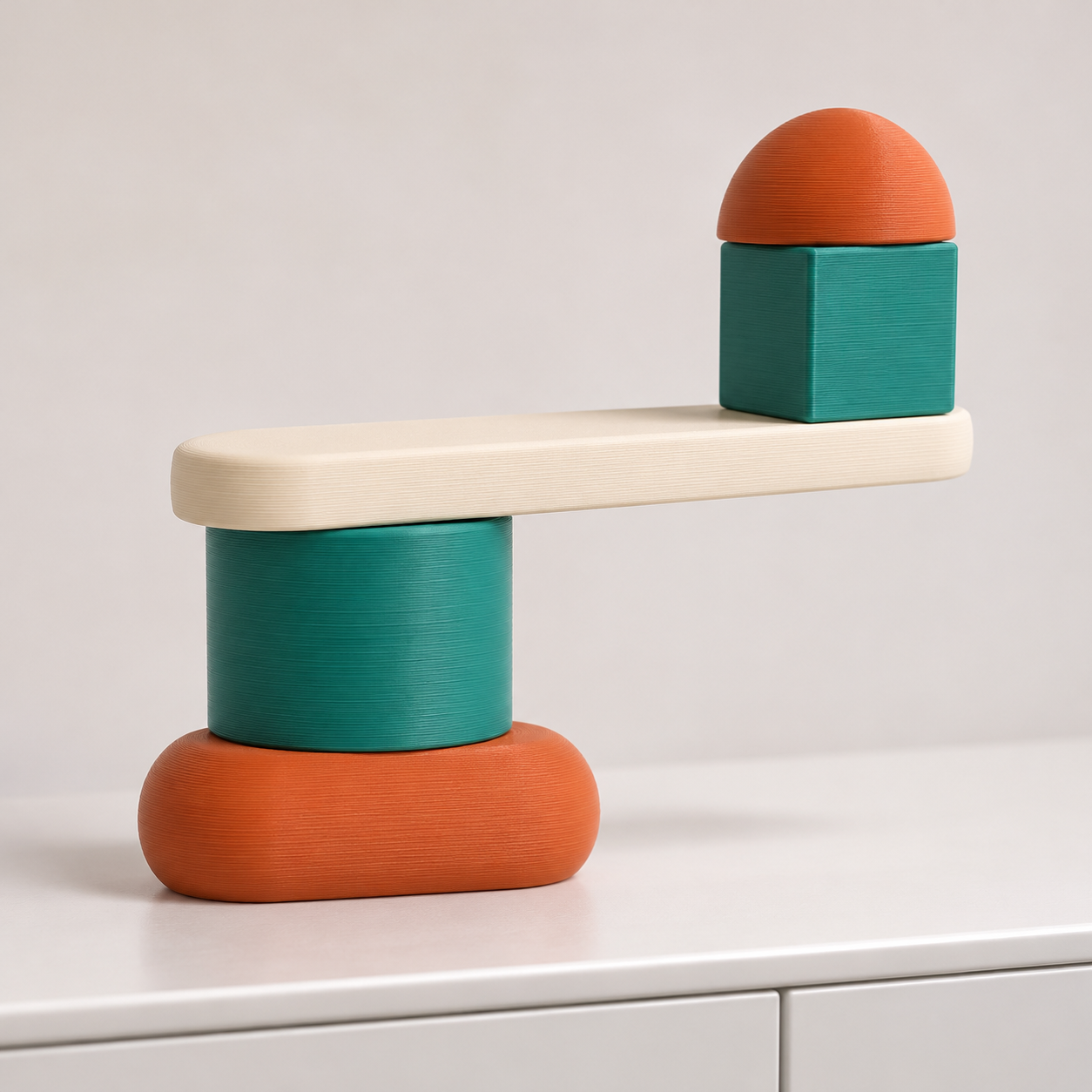
Roly Totem is a shelf sculpture that moves. A 90 mm hemisphere forms the base. On top sit a flat disc, a truncated sphere and a tapering cone, each printed in its own colour. Give it a push and the whole stack leans, swings back and rests upright.
The motion comes from a single steel ball hidden in the base. It keeps the centre of mass below the centre of the dome, which is the same principle as a roly-poly toy. The shapes above it are plain solids, so the piece reads as modern abstract decor and not as a toy.
It stands 130 mm tall and 90 mm wide, small enough for a cabinet top or a bookshelf. The sphere and cone keep the colours apart, so the contrast stays sharp.
Why it sells
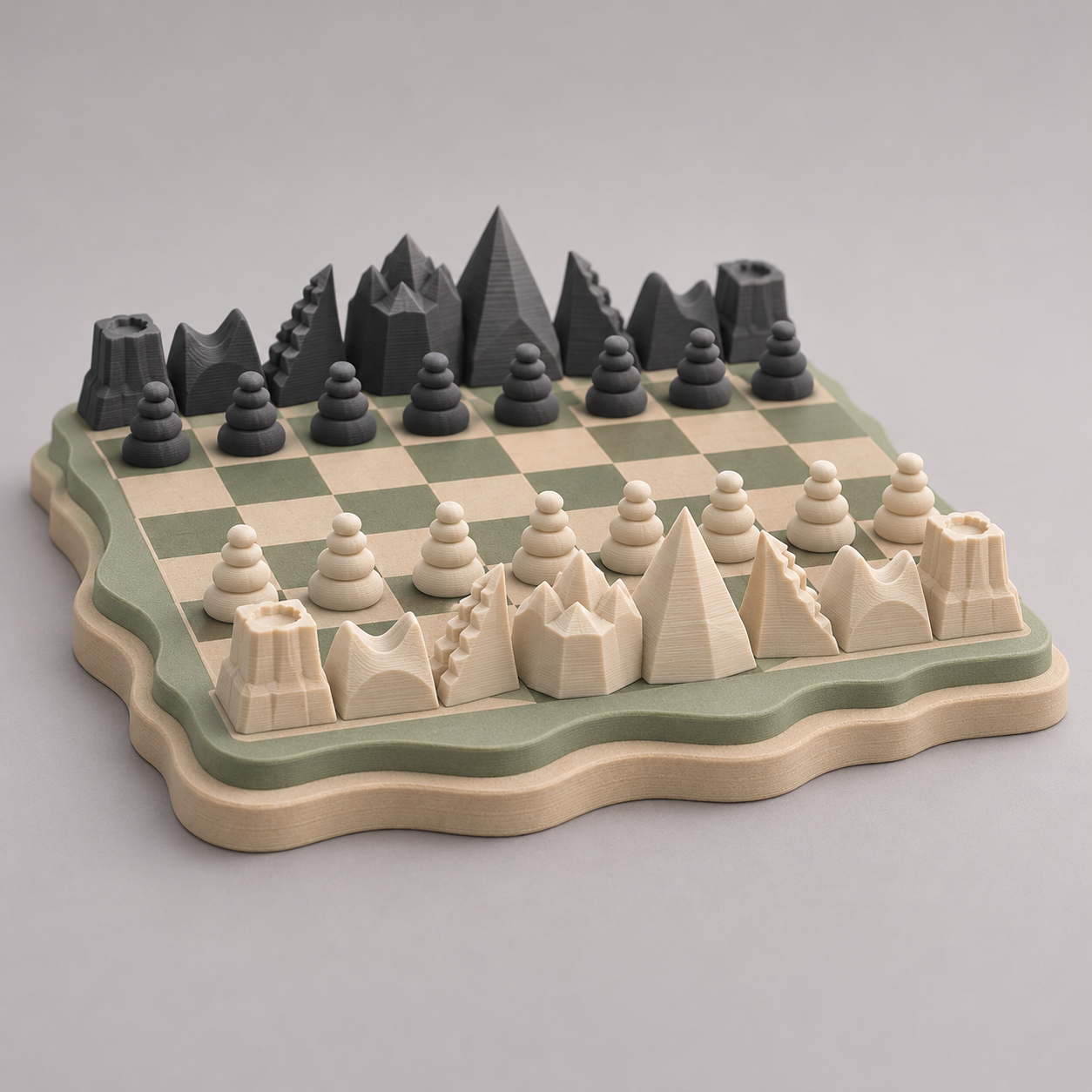
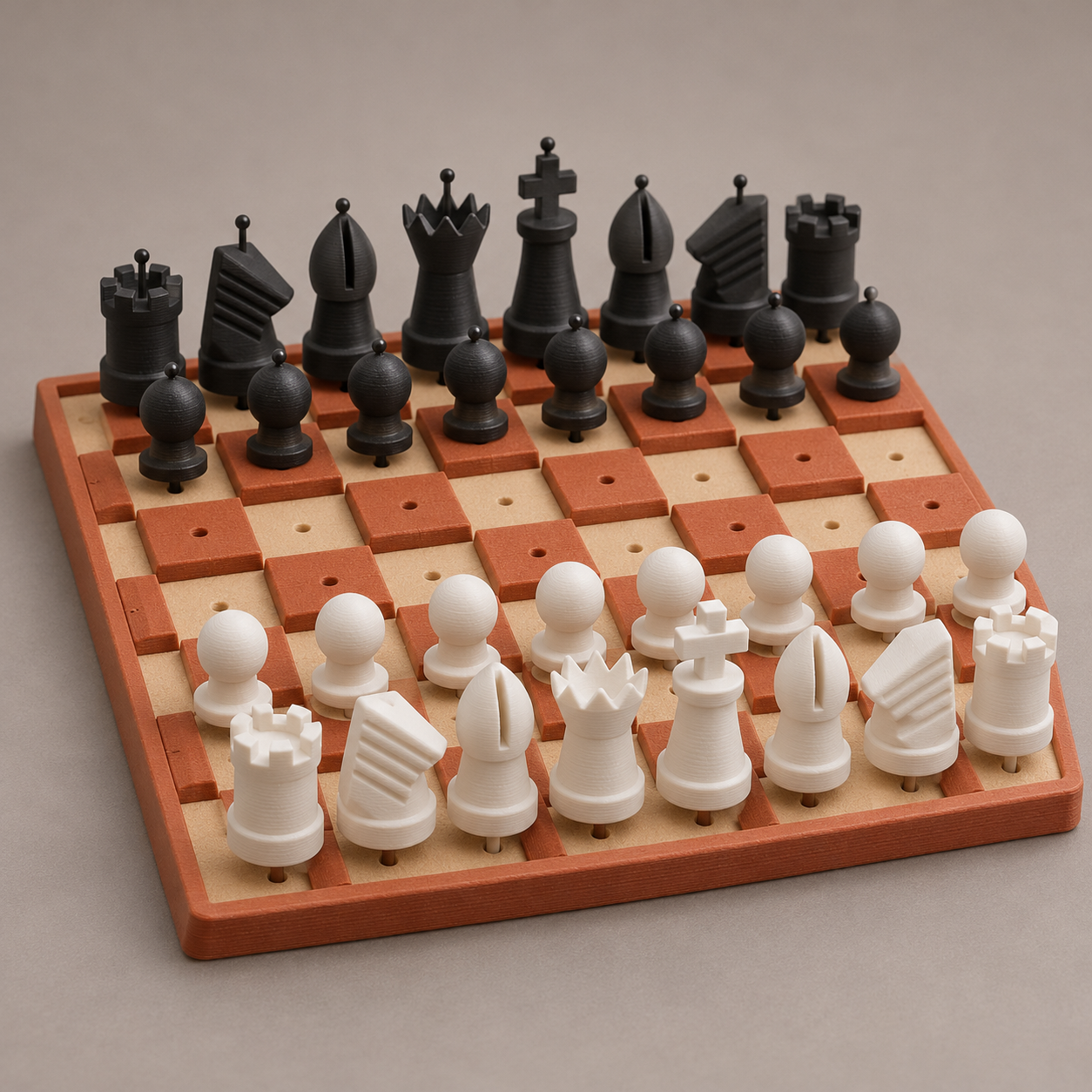
This is an art idea, so the evidence is inspiration, not sales data. A weighted round base that rights itself is the documented mechanism of the roly-poly toy (Wikipedia). The look draws on Josef Hartwig's 1923 Bauhaus chess set, which reduced its pieces to cubes, spheres and cylinders (Wikipedia, Kunstpalast). I did not look for sales figures. The gap: self-righting toys are made for children, and Bauhaus-style block sculptures sit still. This piece does both for adults.
Who buys it
Someone who styles a shelf or sideboard and wants a coloured object that does something when touched. It also works as a desk fidget and as a gift for design-minded people. Shops: Etsy, your own site, craft fairs and design markets.
Design overview
- A 90 mm hemisphere base with a ball pocket and a 45 degree funnel floor that centres a 38.1 mm steel ball.
- A 70 mm disc closes the pocket with a 1.5 mm plug so the ball cannot rattle out.
- Truncated sphere in two printed halves, joined on an 8 mm dowel, so no part needs supports.
- A truncated cone finishes the stack at 130.2 mm total height.
- One colour per solid: charcoal, cobalt, coral, mustard.
- What sets it apart: it looks like a still Bauhaus block sculpture but rocks and rights itself because of the hidden steel ball.
Dimensions
| Measurement | Value (mm) | Notes |
|---|---|---|
| Overall width (X) | 90 | Base diameter |
| Overall depth (Y) | 90 | |
| Overall height (Z) | 130.2 | 45 base + 14 disc + 39.2 sphere + 32 cone |
| Wall thickness | 1.2 | 3 perimeters at 0.4 mm; the interior is infill |
| Base radius | 45 | Centre of curvature is the equator face |
| Ball pocket diameter | 38.6 | For a 38.1 steel ball, 0.25 per side |
| Ball pocket depth | 40 | 28.7 cylinder plus 11.3 funnel |
| Funnel floor diameter | 16 | 45 degree cone |
| Disc diameter x thickness | 70 x 14 | Plug 38.2 x 1.5 below |
| Sphere diameter | 44 | Truncated, flat faces 20 diameter |
| Cone | 36 to 8 x 32 | Base to tip diameter |
| Dowel hole | 8.2 x 10.2 | For an 8 mm dowel |
Parts list
| Part | Qty | Material | Size X×Y×Z (mm) | Print orientation | Supports |
|---|---|---|---|---|---|
| Rocker base | 1 | PLA | 90 × 90 × 45 | Flat face down, dome up | none |
| Base disc with plug | 1 | PLA | 70 × 70 × 15.5 | Top face down, plug up | none |
| Truncated sphere half | 2 | PLA | 44 × 44 × 19.6 | Equator face down | none |
| Truncated cone | 1 | PLA | 36 × 36 × 32 | Base face down | none |
Hardware and non-printed parts
- 1 × 1.5 in (38.1 mm) steel ball, about 227 g (calculated from steel density)
- 3 × 8 mm × 20 mm dowel pin, hardwood or steel
- Cyanoacrylate or two-part epoxy
Fits and tolerances
- Ball in pocket: loose, 0.25 mm per side, so the ball drops in and sits on the funnel.
- Disc plug in pocket: sliding, 0.2 mm per side, then glued.
- Dowel in hole: press, 0.1 mm per side, with glue.
- Disc to base, and each stack joint: flat faces glued.
Modeling guide
Origin: for the base, the centre of the flat equator face, +Z pointing down into the dome. For every other part, the centre of the face stated in its steps.
- Base. Sketch on the XZ plane a quarter circle of radius 45 about the origin, closed along both axes. Revolve 360 degrees about the Z axis.
- On the flat face sketch a 38.6 mm circle at the origin and cut 28.7 deep.
- Below that, cut a 45 degree funnel from diameter 38.6 down to diameter 16, ending at 40 mm depth from the face.
- Chamfer the pocket mouth 0.6 and fillet the outer rim 1.
- Disc. Sketch a 70 mm circle on XY and extrude 14. On the bottom face extrude a 38.2 mm circle 1.5 mm. Cut an 8.2 mm hole 10.2 deep at the centre of the top. Fillet the top edge 1.
- Sphere half. Sketch on XZ a quarter circle radius 22, trimmed at Z=19.6 where the radius is 10. Revolve 360 degrees. Cut 8.2 mm holes 10.2 deep in both flat faces at the axis. Make two.
- Cone. Sketch on XZ a trapezoid with base radius 18, top radius 4 and height 32. Revolve 360 degrees. Cut an 8.2 mm hole 10.2 deep in the base. Fillet the tip edge 1.
Print settings
| Setting | Value |
|---|---|
| Material | PLA (matte) |
| Nozzle | 0.4 mm |
| Layer height | 0.2 mm |
| Walls / perimeters | 3 |
| Infill | 15% gyroid |
| Supports | None |
| Brim / adhesion | None; brim 5 mm on the cone if it lifts |
| Notes | Base dome prints smooth with an outer-wall-first setting. Use one colour per part. Keep the base at 15% infill, not higher, so the centre of mass stays low. |
Assembly
- Drop the steel ball into the base pocket.
- Seat the disc on the base so the plug enters the pocket, and glue the faces.
- Glue a dowel into the disc, add the first sphere half (truncation face down), then a dowel, the second half (truncation face up), a dowel and the cone.
- Let the glue cure for 24 h, then rock the piece. It should return upright within a few swings.
Variants and upsells
- Colour sets: a warm set (coral, mustard, cream) and a cool set (teal, navy, white).
- A second totem with the shape order changed, sold as a pair.
- A mini 60% version with a 25.4 mm ball.
- A series: one new solid every month that swaps into the stack on the same dowels.
Selling and distribution
Sell the printed piece on Etsy and at design markets, and the file on Printables or Cults3D. Price from material (110 g PLA plus a steel ball), 11.7 h of machine time and a margin. The steel ball is the main unusual cost. A personal-use licence for the file with a paid commercial licence suits an art piece. Keywords: rocking sculpture, roly poly decor, Bauhaus shelf art, modern shelf decor, geometric sculpture, desk fidget sculpture, abstract tabletop art, self-righting sculpture, colourful 3D printed art, cabinet decor.
Risks and IP notes
- Centre of mass: the piece only rights if the ball is low, so weigh the finished piece and keep infill at 15%. The calculation here is an estimate; test a print before selling.
- Loose ball: if it rattles, glue a 1 mm felt disc under the plug.
- Saturation: tumbler toys exist, but abstract Bauhaus ones are rare. Mitigation: keep listings about the sculpture, not the toy.
- IP: Hartwig's chess set is cited as inspiration only. Do not copy its pieces or name it in the listing.
Resource links
- Roly-poly toy — why the weighted round base rights itself
- Josef Hartwig — Bauhaus sculptor and the 1923 chess set
- Bauhaus Schachspiel (Modell XVI), Kunstpalast — museum record of the set
- Bauhaus Chess Set (Model XVI) — Bauhaus Kooperation entry
More from 3D Print Designs