Hand-Crank Keno Ball Cage
A 120 mm tabletop lottery drum with a crank and a pull-out gate bar that draws one 20 mm ball at a time for keno, raffles or bingo-style games.
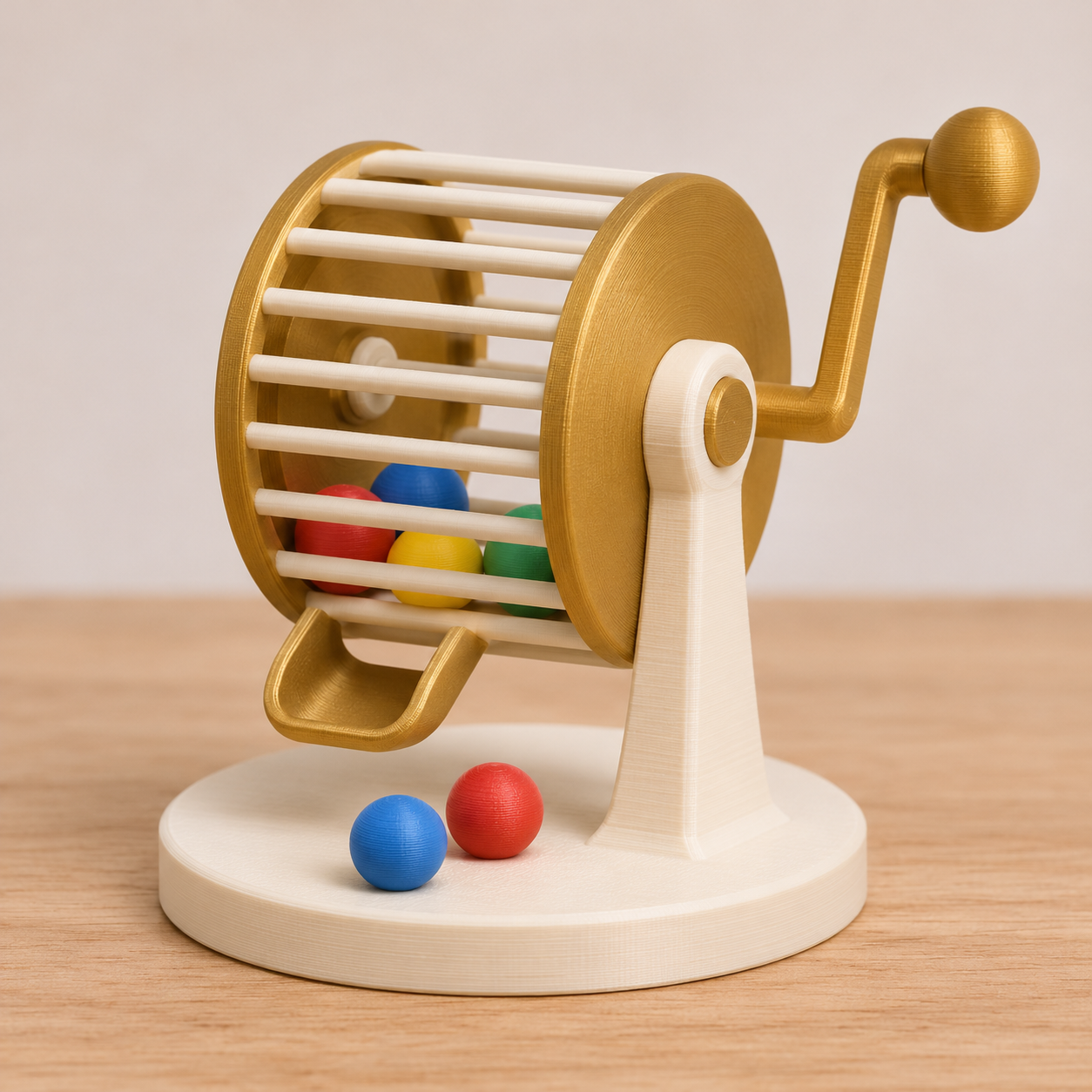
Hand-Crank Keno Ball Cage
A 120 mm tabletop lottery drum with a crank and a pull-out gate bar that draws one 20 mm ball at a time for keno, raffles or bingo-style games.
Date: 2026-11-12 Category: Toys and Fidgets Modeling difficulty: Advanced Estimated print: ~19 h total · ~270 g PLA (estimate) Suggested price: $28–$48 printed · $6 digital file (estimate) Status: Concept
Description
The cage is a drum of 16 bars between two discs, mounted on one upright so the free end stays open. A crank on the back turns an 8 mm dowel that carries the drum. Up to 80 balls of 20 mm diameter tumble inside. The bar spacing is 15 mm, so balls cannot escape, but one bar slot is a removable gate bar. Pull the gate bar out to the right and the gap is 36 mm wide, so one ball drops out when it reaches the bottom.
The drum is two printed halves that press together with 4 mm pins and sockets, plus the dowel through both hubs. Pull the halves apart to load balls. The base plate is wide enough to carry the weight of the drum and balls.
Balls are not printed. Any 20 mm ball works: plastic, wood or acrylic beads, which the buyer can number with stickers.
Why it sells
A bingo or lottery cage is an ordinary retail product at several sizes, from a 16.5 cm table cage at Cartaloto to a Ø23 cm club drum, an 8 inch deluxe cage at MaxiAids and a Walmart listing aimed at bars and family groups. The Bingo Cage Buying Guide explains how the tumbler and crank work. These show a market for the object, not for a printed version.
I searched MakerWorld, Printables and Thingiverse on 2026-11-12 and found no printable bingo cage, only retail listings. That is a thin signal, not proof that none exists. The gap: a drum that prints in six parts, uses one steel dowel, and draws one ball at a time through a removable gate bar.
Who buys it
Hosts of casino nights, keno or raffle games, teachers running probability lessons, and families who want a bingo set with a visible tumbler. Sold as a printed gift on Etsy or at fairs, and as a file for makers with a 220 mm bed.
Design overview
- One thing sets it apart: a gate bar that slides out of the drum so one ball drops out at a time, without a hatch or a hinge.
- Sixteen 6 mm bars on a 54 mm radius give a 15 mm gap, which stops 20 mm balls and keeps the drum light.
- Two half drums press together with pins and sockets and can be pulled apart to reload.
- One upright and a cantilevered drum leave the right end open, so the gate bar can be pulled out the full 120 mm.
- An 8 mm dowel is the axle; a crank and a collar lock to it with M3 set screws.
- Fits a 220 mm bed: the largest part is the 188 mm base.
Dimensions
| Measurement | Value (mm) | Notes |
|---|---|---|
| Overall width (X) | 188 | |
| Overall depth (Y) | 138 | |
| Overall height (Z) | 147 | |
| Base plate | 188 × 120 × 8 | x from -16 to 172 |
| Upright | 36 × 60 × 86 | x 0 to 36, on the plate |
| Axle height | 78 | Above the plate bottom |
| Axle | Ø8 × 175 | Dowel, x -12 to 163 |
| Drum diameter | 120 | Discs |
| Drum length | 120 | x 44 to 164 |
| Bars | 16 × Ø6 | Radius 54, 22.5° pitch, 56 long per half |
| Bar gap | 15.07 | Chord 21.07 minus 6 |
| Gate gap (bar removed) | 36.1 | Chord × 2 minus 6 |
| Disc thickness | 4 | Both halves |
| Hub | Ø16 × 10 | 4 in disc, 6 inward |
| Pin / socket | Ø4 × 6 / Ø4.2 × 7 | Every bar except the gate slot |
| Gate bar | Ø6 × 120 + head Ø14 × 6 | Through discs at slot 16 |
| Crank arm | 55 from axis | Handle Ø14 × 30 |
| Ball size | 20 | Up to 80 balls |
Parts list
| Part | Qty | Material | Size X×Y×Z (mm) | Print orientation | Supports |
|---|---|---|---|---|---|
| Base with upright | 1 | PLA | 188 × 120 × 94 | plate bottom face down | none (bore is a teardrop) |
| Drum half with pins | 1 | PLA | 120 × 120 × 66 | disc face down, bars up | none |
| Drum half with sockets | 1 | PLA | 120 × 120 × 60 | disc face down, bars up | none |
| Gate bar | 1 | PLA | 14 × 14 × 126 | lying on its side | none |
| Crank | 1 | PLA | 80 × 22 × 30 | flat on the arm | none |
| Collar | 1 | PLA | 22 × 22 × 8 | flat | none |
Hardware and non-printed parts
- 8 mm dowel, 175 mm long × 1 (steel or hardwood).
- M3 × 6 mm set screw × 2.
- M3 heat-set insert, 4.2 mm OD × 5.7 mm × 2.
- 20 mm balls, up to 80 (not printed; number them with stickers).
Fits and tolerances
| Interface | Fit | Clearance | Why |
|---|---|---|---|
| Dowel in upright bore (Ø8.5) | sliding | 0.25 mm per side | The dowel must turn. |
| Dowel in drum hubs (Ø8.1) | press | 0.05 mm per side | Carries the drive. |
| Pins in sockets (Ø4 vs Ø4.2) | press | 0.1 mm per side | Halves hold and still come apart. |
| Gate bar in disc holes (Ø6.3) | sliding | 0.15 mm per side | Pulls out by hand. |
| Crank, collar on dowel (Ø8.1) | press + M3 set screw | 0.05 mm per side | Set screw locks them. |
Modeling guide
Origin: x = 0 at the left face of the upright, y = 0 on the plate centreline, z = 0 on the plate bottom. +X runs toward the open end. The dowel axis is at y 0, z 78.
- Base: extrude a 188 × 120 × 8 plate, then a 36 × 60 × 86 upright at x 0 to 36.
- Base: cut the Ø8.5 axle bore through the upright at z 78 as a teardrop and add two 12 mm gussets.
- Drum halves: extrude a Ø120 × 4 disc, add the Ø16 hub, 15 bars at radius 54 and the gate hole at the slot 16 position.
- Pin half: add Ø4 × 6 pins. Socket half: cut Ø4.2 × 7 sockets.
- Gate bar: Ø6 × 120 rod with a Ø14 × 6 head.
- Crank and collar: hubs with 8.1 bores and M3 insert holes.
- Check: with the collar 8 mm thick and the drum from x 44 to 164, the dowel from x -12 to 163 is flush at the open end.
Print settings
| Setting | Value |
|---|---|
| Material | PLA |
| Nozzle | 0.4 mm |
| Layer height | 0.2 mm |
| Walls / perimeters | 3 (bars solid) |
| Infill | 15% gyroid |
| Supports | None |
| Brim / adhesion | Brim 5 mm on the drum halves |
| Notes | Print drum halves with the bars up; test one pin/socket pair at 0.1 mm clearance first. |
Assembly
- Heat-set the M3 inserts into the crank and the collar.
- Slide the dowel through the upright, with the crank on the left side, and lock the crank with a set screw.
- Fit the collar on the dowel against the right face of the upright and lock it.
- Slide the pin half onto the dowel with its disc at the upright end (left). Load balls into the pin half, then slide the socket half over the dowel and press the pins into the sockets.
- Insert the gate bar through the discs at slot 16 and turn the crank.
Variants and upsells
A 15 mm ball version with 18 bars, a bigger 160 mm drum for events, a bingo number set printed as flat discs, and a keno board. Bundle with the roulette wheel and card shoe as a casino night kit.
Selling and distribution
Etsy, local fairs and MakerWorld. The print is the main product; the balls are not included so the shipping weight stays low. About 145 g PLA and 19 h printer time; $28–$48 is an estimate. File: $6, commercial licence for sellers. Keywords: bingo cage, keno, lottery drum, raffle drum, ball tumbler, casino night, game night, 3D printed bingo, raffle machine.
Risks and IP notes
- Cantilevered drum could sag on the PLA upright. Mitigation: 36 mm thick bore, steel dowel, gussets.
- Balls smaller than 17 mm escape between bars. Mitigation: state 20 mm in the listing.
- Gambling-adjacent products may be restricted. Mitigation: list as a bingo/raffle game toy.
- Pins may break when prying halves apart. Mitigation: print with 4 walls.
- No printable bingo cages were found, so the demand is unproven. Mitigation: test with a small batch.
Resource links
- Bingo Cage Buying Guide — Describes a bingo cage as a wire-frame tumbler that mixes balls before a crank releases them one at a time
- Bingo cage 16.5 cm (Cartaloto) — Retail small-format cage; shows the size class this design copies
- Pro Ø23 cm Lottery Drum (Cartaloto) — Larger club cage, evidence the product is sold at several sizes
- Deluxe Bingo Cage 8-inch (MaxiAids) — Retail 8 inch cage, close to this design's 120 mm drum scale
- Professional Bingo Cage (Walmart listing 872587602) — Mass-market listing for a bingo/lottery cage for bars and family groups
- Bingo Balls & Cages — Ball sizes: standard bingo balls about 1.5 in; smaller travel sets exist
More from 3D Print Designs