Soma Cube Seven-Piece Set with Bell Cover
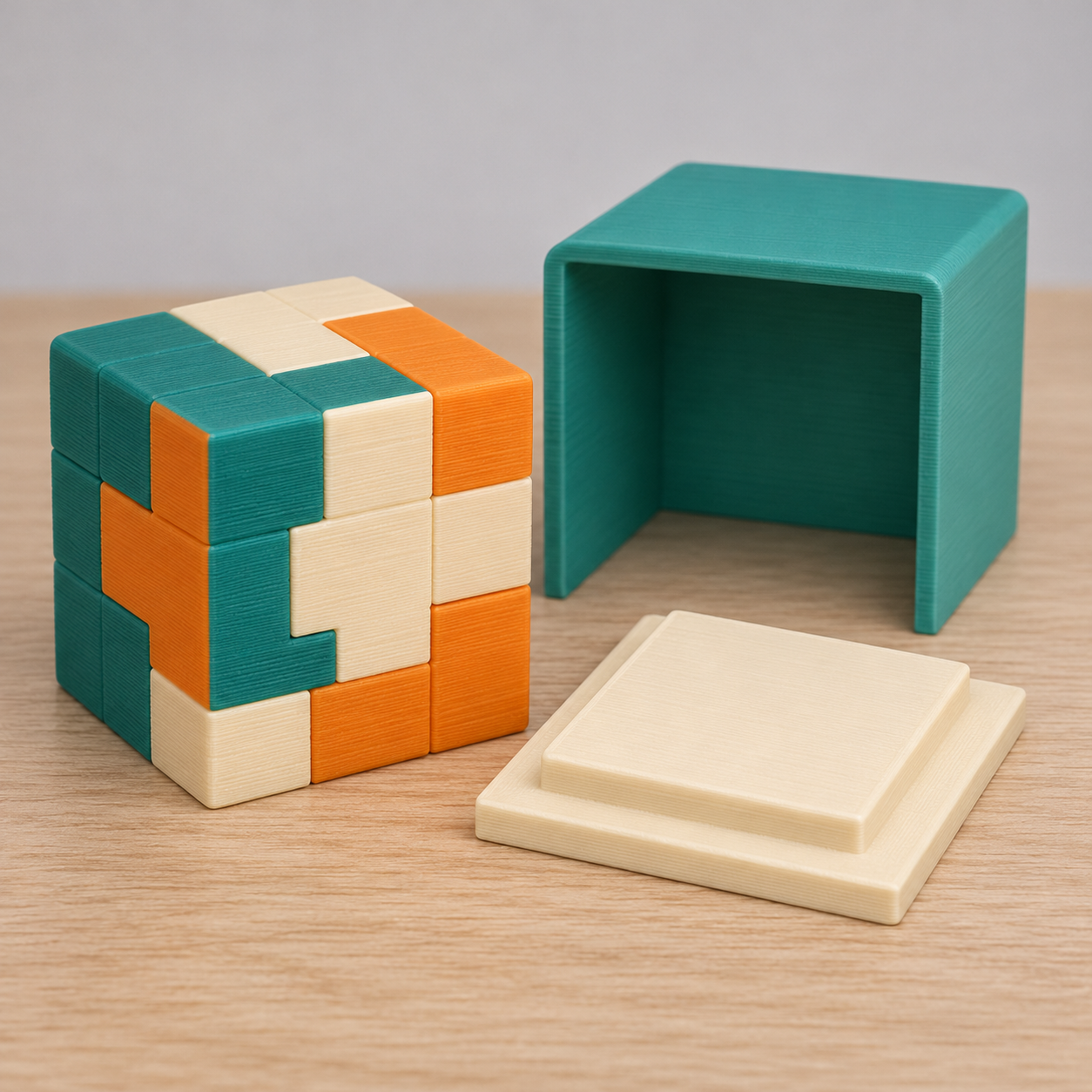
A 60 mm printed Soma cube, seven chunky pieces that build one 3 × 3 × 3 cube in 240 different ways, kept under a slide-down bell cover so the set stays assembled on a desk.
Soma Cube Seven-Piece Set with Bell Cover
A 60 mm printed Soma cube, seven chunky pieces that build one 3 × 3 × 3 cube in 240 different ways, kept under a slide-down bell cover so the set stays assembled on a desk.
Date: 2026-11-13 Category: Puzzles and Games Modeling difficulty: Beginner Estimated print: ~13 h total · ~160 g PLA (estimate) Suggested price: $22–$38 printed · $5 digital file (estimate) Status: Concept
Description
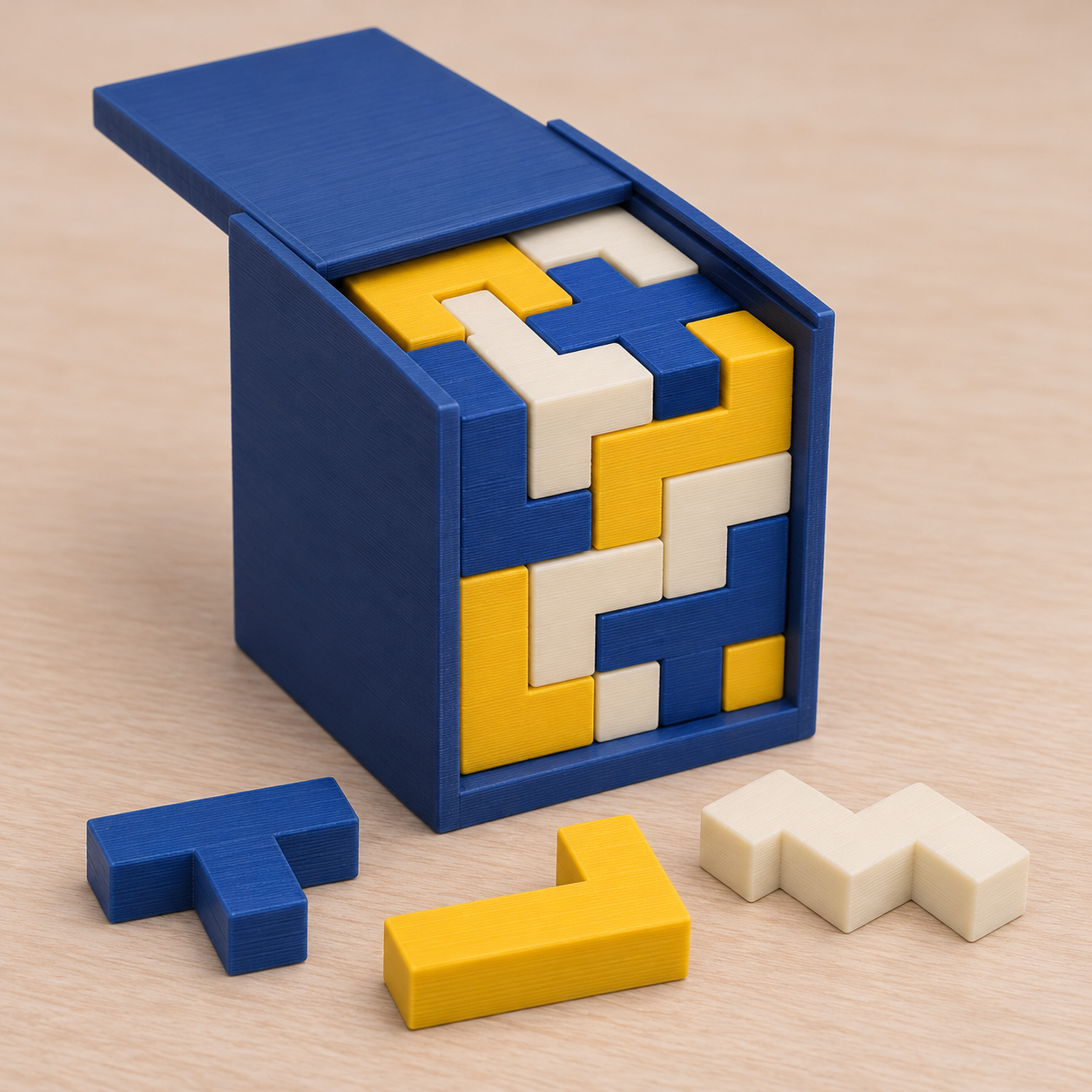
The Soma cube is a seven-piece dissection puzzle: six pieces of four unit cubes and one of three, each a different bent shape, that pack together into a 3 × 3 × 3 cube. This version uses a 20 mm unit, so the finished cube is a hand-sized 60 mm block. Each piece prints flat or with one cube on top of a flat layer, so none needs supports.
The case is a plate with a low square plinth and a hollow bell cover that slides straight down over it. Solve the cube on the plinth, lower the cover, and the puzzle sits on a shelf as a plain teal block. Lift the cover and the cube is there to scatter or re-solve.
Print the pieces in three colours (teal, warm orange, cream) so the colour patches on each face show how the shapes interlock.
Why it sells
Soma is old and well documented: the cube was invented by Piet Hein in the 1930s and has 240 distinct solutions, which John Horton Conway and Michael Guy catalogued by hand in 1961 (Wikipedia). Teachers use it (NRICH) and a museum, MMACA in Barcelona, shows it as an exhibit (MMACA). That is evidence the puzzle has lasting appeal, not sales data. I found no verified sales numbers for printed Soma sets. Free Soma models are already on MakerWorld (listing 815899, seen in search results, page not opened), so the file alone is easy to find elsewhere. Mechanical puzzles in general show up among printed puzzle listings (SelfCAD roundup).
The gap: most listings give you loose pieces in a bag. This one adds a bell cover and plinth so the finished cube becomes a tidy desk object, and the cover removes the lost-piece problem.
Who buys it
Parents and teachers who want a screen-free spatial puzzle, adults who give puzzles as desk gifts, and maths-minded people who know the Conway and Guy story. Likely channels are Etsy, craft fairs, school and museum shops, and Printables or MakerWorld for the file.
Design overview
- Seven pieces on a 20 mm cube grid: V (3 cubes) plus L, T, Z, A, B, P (4 cubes each), 27 cubes total.
- A and B are mirror-image screw shapes. Their bottom layers are three cubes in a flat L with one cube on top, so they print without supports.
- Every exposed face is offset inward 0.1 mm, so pieces slide together with a 0.2 mm gap between neighbours.
- Base plate with a 60.6 mm plinth; hollow bell cover with 61 mm inside width drops over it with 0.2 mm per side.
- One colour per piece group (teal, orange, cream) so solutions are readable from the colour patches.
- What sets it apart: the finished cube lives under a slide-down bell cover instead of in a bag or a lidded box.
Dimensions
| Measurement | Value (mm) | Notes |
|---|---|---|
| Overall case width (X) | 67 | base plate and cover |
| Overall case depth (Y) | 67 | base plate and cover |
| Overall case height (Z), cover on base | 73 | 6 base plate + 67 cover |
| Unit cube | 20 | all pieces on this grid |
| Assembled cube (nominal) | 60 × 60 × 60 | pieces are 0.1 mm smaller per face, so ~59.8 actual |
| Plinth | 60.6 × 60.6 × 3 | centered on base plate |
| Cover inside | 61 × 61 × 64 | open underside |
| Cover wall / roof thickness | 3 / 3 | |
| Base plate thickness | 6 | corner radius 3 |
Parts list
| Part | Qty | Material | Size X×Y×Z (mm) | Print orientation | Supports |
|---|---|---|---|---|---|
| V piece (3 cubes) | 1 | PLA | 39.8 × 39.8 × 19.8 | flat, 20 mm face down | none |
| L piece | 1 | PLA | 59.8 × 39.8 × 19.8 | flat, long face down | none |
| T piece | 1 | PLA | 59.8 × 39.8 × 19.8 | flat, long face down | none |
| Z piece | 1 | PLA | 59.8 × 39.8 × 19.8 | flat, long face down | none |
| A piece (left screw) | 1 | PLA | 39.8 × 39.8 × 39.8 | three-cube layer down, fourth cube on top | none |
| B piece (right screw) | 1 | PLA | 39.8 × 39.8 × 39.8 | three-cube layer down, fourth cube on top | none |
| P piece (branch) | 1 | PLA | 39.8 × 39.8 × 39.8 | three-cube layer down, fourth cube on top | none |
| Base plate with plinth | 1 | PLA | 67 × 67 × 9 | bottom face down | none |
| Bell cover | 1 | PLA | 67 × 67 × 67 | roof face down, open side up | none |
Hardware and non-printed parts
None — fully printed.
Fits and tolerances
- Piece to piece (all seven): sliding fit. Each outer face is offset 0.1 mm inward, so neighbouring pieces leave 0.2 mm between faces. This is looser than a typical 0.1 mm press fit on purpose: pieces must slip in and out, and a tight set gets stuck at the last piece.
- Cover to plinth: sliding, 0.2 mm per side (61.0 inside against 60.6 plinth).
- Cube to cover: free, 0.6 mm per side (59.8 cube in 61 cavity), and 1.2 mm headroom under the roof (cube top at Z=68.8, roof underside at Z=70).
Modeling guide
Origin and axes: for each piece the origin is its minimum corner, +X/+Y/+Z along the cube grid; for the case, the plate centre on the bottom face, +Z up.
All seven pieces (same recipe).
- Sketch on XY a 20 × 20 square for each cell with k=0 in the cell list below, at (20i, 20j).
- Extrude 20. For pieces with a k=1 cell (A, B, P), sketch one 20 × 20 square on the top face above the k=0 cell named in the list and extrude 20.
- Offset all outer faces inward 0.1.
- Chamfer the bottom perimeter 0.4 × 45°, fillet other outer edges 0.5.
Cells (i,j,k): V (0,0,0) (1,0,0) (0,1,0); L (0,0,0) (1,0,0) (2,0,0) (0,1,0); T (0,0,0) (1,0,0) (2,0,0) (1,1,0); Z (0,0,0) (1,0,0) (1,1,0) (2,1,0); A (0,0,0) (1,0,0) (1,1,0) (1,1,1); B (0,0,0) (0,1,0) (1,1,0) (1,1,1); P (0,0,0) (1,0,0) (0,1,0) (0,0,1). A and B are mirror images: build B by mirroring A across the plane X=Y, then check the cells match the list.
Base plate.
- Sketch on XY: square 67 × 67 centered, corner radius 3. Extrude 6.
- Sketch on the top face: square 60.6 × 60.6 centered, corner radius 1. Extrude 3.
- Chamfer the bottom perimeter 0.4 × 45°.
Bell cover.
- Sketch on XY: square 67 × 67 centered, corner radius 3. Extrude 67.
- On the bottom face sketch a 61 × 61 square centered, corner radius 1. Cut up 64.
- Fillet the vertical outer edges 3 and the roof perimeter 1.5; chamfer the inside bottom edge 0.5 × 45°.
Check: stack all seven modeled pieces into the 3 × 3 × 3 grid with no overlap; the total volume should equal 27 × 20³ minus the 0.1 mm offsets.
Print settings
| Setting | Value |
|---|---|
| Material | PLA |
| Nozzle | 0.4 mm |
| Layer height | 0.2 mm |
| Walls / perimeters | 3 |
| Infill | 15% gyroid |
| Supports | none |
| Brim / adhesion | none (brim 3 on the cover if it lifts) |
| Notes | Print the pieces together in one or two sessions. Use a different filament colour per piece group. Calibrate flow first: 0.1 mm faces mean over-extrusion jams the cube. Cover prints roof down. |
Assembly
- Print all pieces, plate and cover.
- Pack the seven pieces into a 3 × 3 × 3 cube on the plinth.
- Lower the bell cover straight down over the cube until it sits on the base plate.
- To play, lift the cover, scatter the pieces and rebuild.
Variants and upsells
- 25 mm unit (75 mm cube, bigger case) for a display version; 15 mm unit for a pocket version.
- Challenge-card pack (separate file): silhouette outlines, kept outside this model.
- Bundle with the 3 × 4 × 5 pentomino crate from the same run as a pair of packing puzzles.
- Sibling set: the Bedlam or Diabolical cube would use the same bell case idea.
Selling and distribution
Etsy for finished sets (cube, cover and base, all PLA), Printables and MakerWorld for a low-cost file, craft fairs for the tactile demo. Price printed sets from material plus roughly 13 hours of machine time plus margin; the file at about $5. Offer the file under a personal-use licence with a separate small-commercial licence. Keywords: soma cube, 3d printed puzzle, 3x3x3 puzzle, Piet Hein, spatial reasoning puzzle, desk puzzle, brain teaser gift, STEM puzzle, polycube puzzle, packing puzzle.
Risks and IP notes
- Tight pieces jam the last move. Mitigation: 0.2 mm gap between pieces, test cube printed first.
- Soma is public domain mathematics but the name is used by others; mitigation: call the listing a seven-piece polycube cube puzzle and use "Soma" as a keyword only.
- Free competitors exist. Mitigation: sell the case, colour set and finish, not the cube alone.
- Rotated pieces may need chamfer tuning per printer; mitigation: check that the bottom chamfer removes elephant foot.
Resource links
- Soma cube (Wikipedia) — Seven pieces, 240 solutions, Piet Hein, Conway and Guy 1961
- Soma - so good (NRICH) — Classroom use of the Soma cube
- What is a Soma Cube? (Mathematische Basteleien) — Piece shapes and solutions
- cub soma (MMACA) — Museum exhibit of the puzzle
- Soma cube model (MakerWorld) — An existing printable Soma model found in search; page not opened
- 3D Printed Puzzle Box: 9 Designs (SelfCAD) — Printed puzzle listing context
More from 3D Print Designs