Slide Vault Eight-Pocket Polyhedral Dice Box
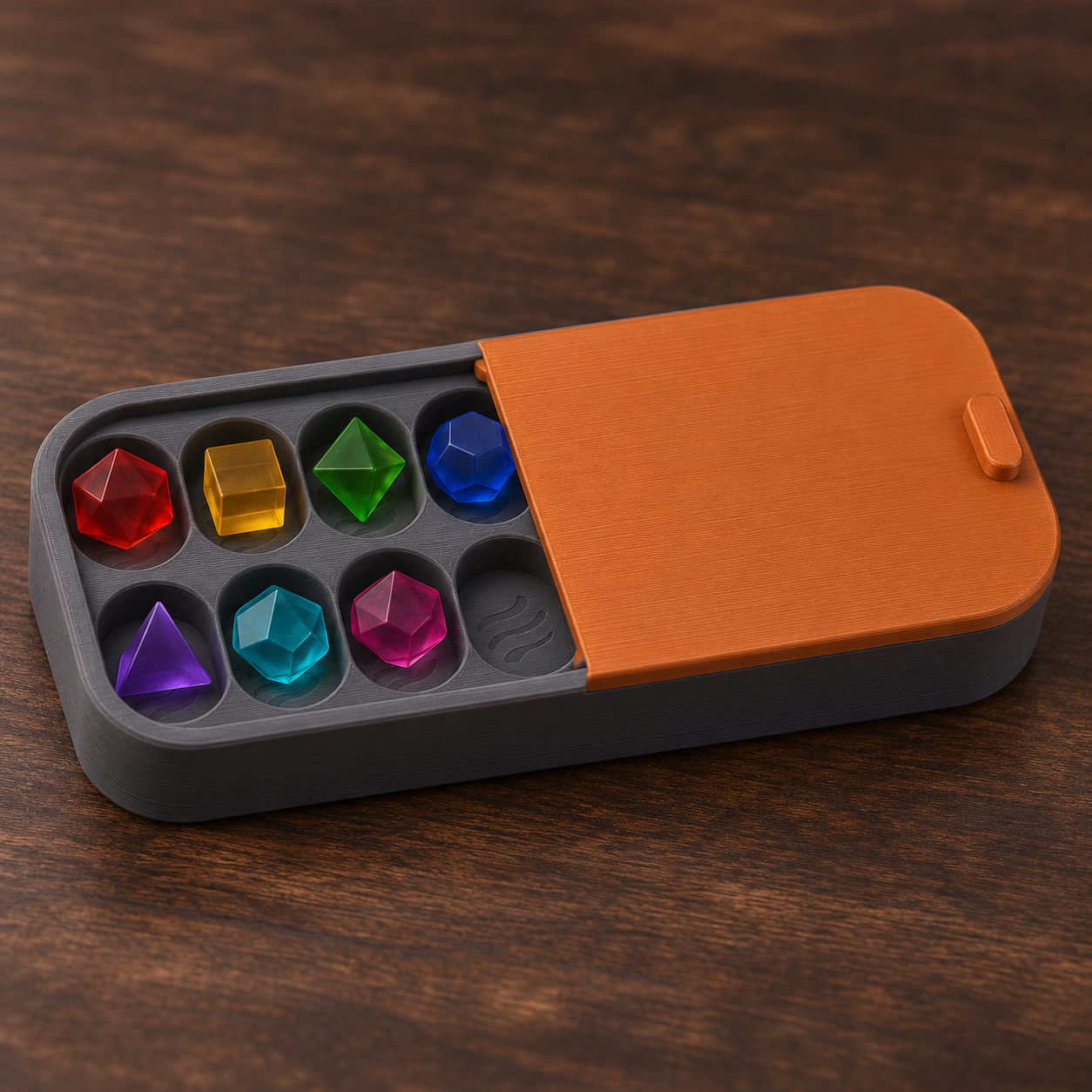
A pocket-per-die dice box with the die name in each floor and a sliding lid that needs no magnets, sized for one standard seven-die set plus a spare.
Slide Vault Eight-Pocket Polyhedral Dice Box
A pocket-per-die dice box with the die name in each floor and a sliding lid that needs no magnets, sized for one standard seven-die set plus a spare.
Date: 2026-11-11 Category: Puzzles and Games Modeling difficulty: Beginner Estimated print: ~5 h total · ~84 g PLA (estimate) Suggested price: $14–$26 printed · $4 digital file (estimate) Status: Concept
Description
A block 122 mm long, 66 mm wide and 26 mm tall with eight round pockets in two rows of four. Each pocket is 24 mm across and 22 mm deep, so even a tall d20 sits below the lid. The floor of seven pockets carries the die name recessed 0.4 mm: d4, d6, d8, d10, d%, d12, d20. The eighth is blank for a spare or a token.
The lid is a U-shaped cap that wraps the long sides and slides on tongues into slots cut in the body. It is 6 mm longer than the box so a thumb can push it open. Nothing is glued and nothing needs magnets, screws or inserts.
The pocket diameter is my estimate for common polyhedral sets, not a measured spec. Measure the largest die first; the pocket size is a parametric variable.
Why it sells
Tabletop gaming comes up in the seller guides I read. The Insight Agent guide lists tabletop items (its example is dice towers) as high demand with an estimated $15–$50 price band, but it gives no method for those numbers and says nothing about dice storage, so I treat it as directional. The eufymake roundup is similar. A PrintPal post warns generic designs face price pressure, and it is promotional.
Competition is real: free dice boxes already sit on MakerWorld, such as the 212 mm Dice Vault, a magnet-latch vault and the DiceBox. The gap this fills: a small one-set box with a named pocket per die and a lid that needs no hardware.
Who buys it
Players of tabletop role-playing games who keep a set per character, and people who give them gifts. Sells as a printed item on Etsy or at game-store markets; the file suits MakerWorld and Printables.
Design overview
- 122 × 66 × 26 mm body, 8 pockets, dia 24 × 22 deep, 28 mm pitch.
- Seven floors labelled d4 to d20, one blank; text recessed 0.4 mm so no layer change is needed.
- U-shaped sliding lid with 1.8 mm tongues in 2.2 mm slots, 0.2 mm clearance per side.
- Lid is 128 mm long, a 6 mm tab sticks out when closed for a thumb.
- No magnets, no screws. The tongues are chamfered 45° so the lid prints without support.
- The one feature that sets it apart: a labelled pocket per die, so a set stays sorted and missing dice are obvious.
Dimensions
| Measurement | Value (mm) | Notes |
|---|---|---|
| Overall width (X) | 128 | Lid length; body is 122 |
| Overall depth (Y) | 71.2 | Lid width; body is 66 |
| Overall height (Z) | 28.2 | Body 26 plus 2.2 lid plate and clearance |
| Wall thickness | 7 | Minimum between pocket and outside |
| Pocket diameter | 24 | Eight, pitch 28 |
| Pocket depth | 22 | Floor 4 |
| Pocket centres | X 19, 47, 75, 103 · Y 19, 47 | From the origin |
| Lid slot | 2.4 deep × 2.2 tall | z 22.0 to 24.2, X 0 to 118 |
| Lid plate thickness | 2 | z 26.2 to 28.2 |
| Lid tongue | 2.2 × 1.8 | z 22.2 to 24.0 |
| Floor text depth | 0.4 | Cap height 6 |
Parts list
| Part | Qty | Material | Size X×Y×Z (mm) | Print orientation | Supports |
|---|---|---|---|---|---|
| Vault body | 1 | PLA | 122 × 66 × 26 | Flat, bottom face down | none (slots are 2.2 mm tall) |
| Sliding U lid | 1 | PLA | 128 × 71.2 × 6.4 | Upside down: plate face on the bed, legs pointing up | none (tongues chamfered 45 degrees) |
Hardware and non-printed parts
None required. Optional: 1 mm self-adhesive felt discs, dia 22, ×8, for the pocket floors.
Fits and tolerances
- Lid tongue in body slot: sliding fit, 0.2 mm per side (slot 2.2 tall for a 1.8 tongue; 2.4 deep for a 2.2 tongue). Use 0.2 because the part is large and PLA warps a little; raise the lid_clearance variable to 0.25 if it binds.
- Lid legs to body sides: 0.2 mm per side, sliding.
- Dice in pockets: 1–4 mm free play (estimate, depends on the die).
Modeling guide
Origin: lower-left-front corner of the body. +X along the length (open end at X = 0), +Y across, +Z up.
Vault body
- Sketch on XY: rectangle 122 × 66 from the origin. Extrude +Z 26.
- On the top face cut eight dia 24 circles at X = 19, 47, 75, 103 and Y = 19, 47. Cut down 22 (floor at z = 4).
- On each of seven pocket floors emboss a recess 0.4 deep: d4, d6, d8, d10, d%, d12, d20, bold sans-serif, cap height 6, centred. Leave the eighth blank.
- On the front face (Y = 0) sketch a rectangle X 0 to 118, z 22.0 to 24.2. Cut 2.4 deep into the body. Repeat on the back face (Y = 66).
- Fillet the four vertical edges 3. Chamfer the bottom perimeter 0.6.
Sliding U lid (same coordinates, closed position)
- Sketch the plate: X −6 to 122, Y −2.6 to 68.6. Extrude from z = 26.2 to 28.2.
- Add legs: rectangles Y −2.6 to −0.2 and Y 66.2 to 68.6, X −6 to 122, extruded from z = 21.8 to 26.2.
- Add tongues on each leg's inner face: 2.2 deep (to Y = 2.0 and Y = 64.0), z 22.2 to 24.0, X −6 to 117.8.
- Chamfer the upper face of each tongue 45° (2.2 × 2.2) so it prints support-free when flipped.
- Fillet the plate corners 3 and chamfer the top outer edge 0.6.
Print settings
| Setting | Value |
|---|---|
| Material | PLA (matte); PETG also works |
| Nozzle | 0.4 mm |
| Layer height | 0.2 mm |
| Walls / perimeters | 3 |
| Infill | 15% gyroid |
| Supports | None |
| Brim / adhesion | None; brim 3 mm if the 122 mm base lifts at corners |
| Notes | Print the lid upside down (plate on the bed). Each part fits the bed on its own. To colour the die names, fill the recesses with a fine paint marker. |
Assembly
- Drop one die into each labelled pocket.
- Slide the lid on from the open end until it stops, leaving the 6 mm tab out.
Variants and upsells
- Pocket size variants: 20 mm for small dice, 30 mm for large dice and tokens.
- Two-row stackable version with a bottom lip.
- Personalised floors with a character name on the blank pocket.
- Bundle with a tray for rolling dice and a dice tower.
- Colour sets: charcoal with copper lid, forest green with cream lid.
Selling and distribution
Etsy and game-store markets suit the printed box; MakerWorld and Printables suit the file, where it competes with free boxes, so a clean small-set design and a paid file at $4 or a pay-what-you-want model fits. Price from material (about 84 g PLA), machine time (about 5 h) and margin, which gives $14–$26. Sell the print first. Use a CC BY-NC licence for the free file and a commercial licence for resellers.
Keywords: dice box, dice vault, polyhedral dice storage, tabletop RPG gift, D&D accessory, sliding lid dice case, 3D printed dice holder, game night, dungeon master gift, dice organizer.
Risks and IP notes
- Many free dice boxes exist. Mitigation: sell the print, not the file, and use labelled pockets as the difference.
- A sliding lid may bind if PLA warps. Mitigation: print the lid upside down, raise clearance to 0.25 mm if needed.
- Pocket size may not fit oversized dice. Mitigation: parametric pocket_dia, listed sizes.
- Name risk: "D&D" and similar are trademarks. Mitigation: use "tabletop RPG" and "polyhedral dice" in listings, never a brand.
- Dice are not food-contact; no food-safe claim is made.
Resource links
- Best Selling 3D Printed Items on Etsy (Insight Agent guide) — Lists tabletop gaming items as a category with estimated high demand; the figures have no stated method, so treat them as directional
- 23 Best Selling 3D Printed Items to Make Money in 2026 (eufymake) — Roundup of sellable prints; names tabletop gaming accessories among the categories
- Dice Vault (MakerWorld) — Comparable listing: a 212 mm vault for four dice sets plus minis; much larger than a single-set box
- Magnet latch dice vault (3dsearch index of a MakerWorld model) — Comparable listing using a magnet latch, which needs hardware
- Monsterpocalypse DiceBox (MakerWorld) — Another dice box listing; shows the item type has many free competitors
- Top 3D Models to Sell in 2026 (PrintPal blog) — Says generic designs face price pressure; promotional source, claims unverified
More from 3D Print Designs