Tri-Click Modular Fidget Keychain
A carabiner-style keychain fidget with three swappable click mechanisms (ratchet, button, and slider) that press into identical dovetail bays so a worn one can be replaced without reprinting the…
Tri-Click Modular Fidget Keychain
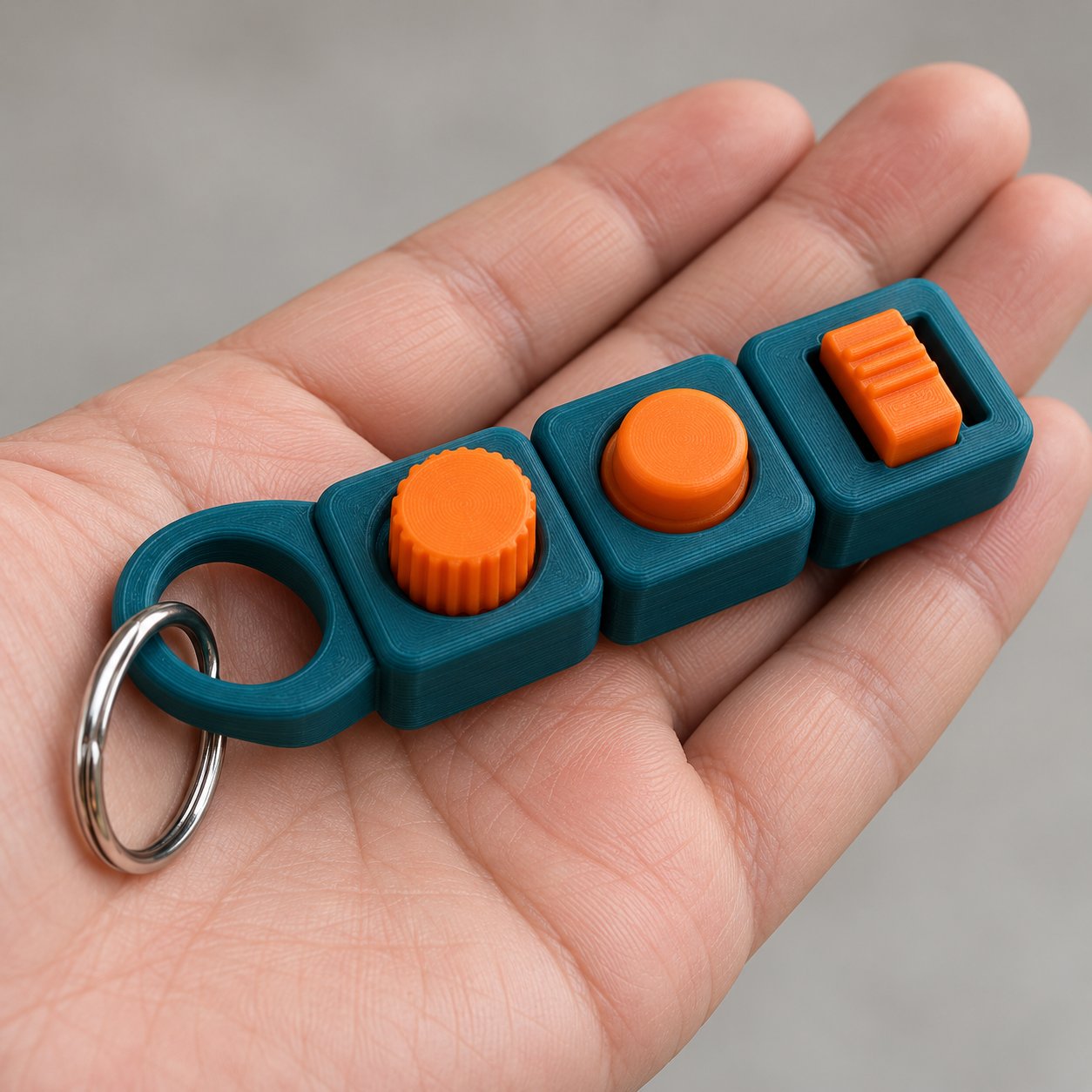
A carabiner-style keychain fidget with three swappable click mechanisms (ratchet, button, and slider) that press into identical dovetail bays so a worn one can be replaced without reprinting the whole keychain.
Date: 2026-10-03 Category: Toys and Fidgets Modeling difficulty: Intermediate Estimated print: ~3.7 h total · ~41 g PETG+PLA (estimate) Suggested price: $9–14 printed · $4 digital file (estimate) Status: Concept
Description
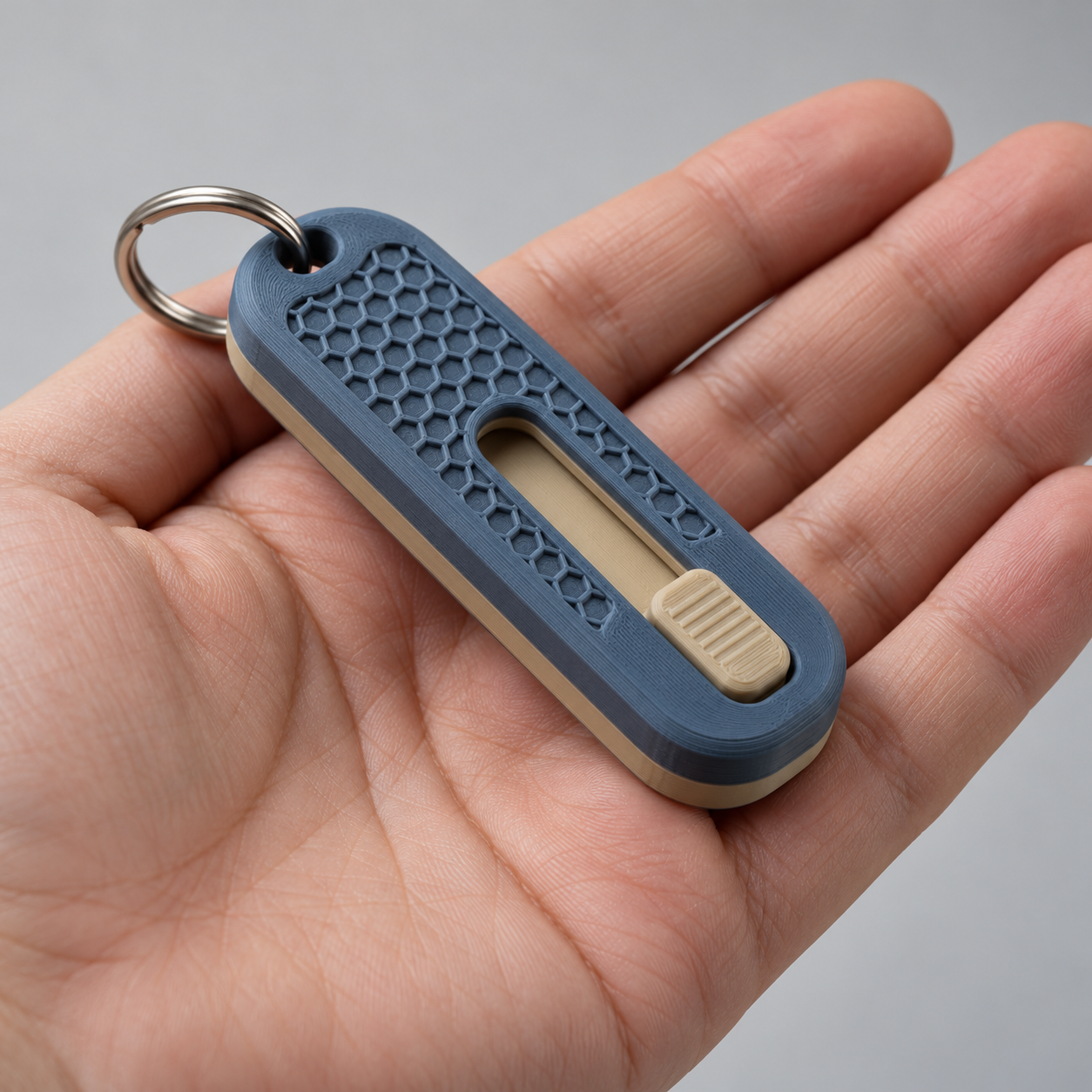
This is a keychain built around one idea: the clicking part should be the part that wears out, so it should also be the part you replace. A flat PETG spine carries a carabiner loop at one end and three identical dovetail bays along its body. Each bay holds a separate click module printed in PLA (a ratchet dial, a button, and a slider), and any one of them slides out over a retention bump and gets swapped for a fresh print when the mechanism finally gives up.
The spine itself is a 120 x 40 x 23 mm bounding box around a 120 x 40 x 7 mm bar, with a 40 mm diameter carabiner loop cut into one end and a 6 mm gate slot so a split key ring can clip through. The three bays sit at X = 40, 73, and 106 along the spine, each a 24 x 20 x 4 mm dovetail slot with a slight trapezoid draft that locks a module in place once it's pushed past the retention bump.
The three modules give three different click feelings in one object: a 12-tooth ratchet disc that clicks once per 30-degree turn of its knurled knob, a cantilever snap-dome button that clicks on press and release, and a tab that rides over 8 ridges as it slides back and forth. All three print in place, so the only assembly by hand is pressing a finished module into the spine.
Why it sells
Multi-mechanism click keychains already have a buyer base. The Etsy listing "3-in-1 Fidget Keychain, 3D Printed Sensory Toy With Gears & Clicker" has 1,974 favorites and has kept a high sales volume over the past six months, and single-mechanism comparables like "3D Printed Keycap Fidget Clickers" (4.7 stars, 15 reviews) and the themed "Sushi Fidget Clicker Keychain" show the clicker format works even as a single-gimmick novelty. Industry roundups from jlc3dp and stlspecial both name clickers among the best-selling fidget toy types for 2026, and hyper3d.ai ranks custom keychains among the top 15 best-selling 3D-printed item categories overall.
Every multi-click listing found bundles its mechanisms permanently into one molded or assembled body. None let a buyer replace just the mechanism that wore out; they throw out the whole keychain and buy another. The dovetail bays here are the gap: each module is a 5-to-10-minute reprint, not a full keychain replacement.
Who buys it
Fidget and EDC (everyday-carry) buyers who already own click toys and want a key-ring version, ADHD and anxiety stress-relief shoppers (a framing the Etsy listings above lean on directly), gift buyers looking for something more novel than a keycap clicker, and office or desk-toy shoppers who want a fidget they already carry on their keys.
Design overview
- One PETG spine (120 x 40 x 7 mm bar, 120 x 40 x 23 mm overall with the loop and modules mounted) carrying a carabiner loop and three identical dovetail bays
- Three PLA click modules, each 24 x 20 mm in footprint but a different height, that press into any bay and swap freely between them
- A ratchet dial module (24 x 20 x 16 mm) with a print-in-place 12-tooth ratchet disc and a cantilever pawl for one click per 30-degree turn
- A button module (24 x 20 x 14 mm) with a cantilever snap-dome spring that clicks on press and on release
- A slider module (24 x 20 x 10 mm) with a print-in-place tab riding over 8 ridges for a repeating click-click-click under a finger
- A 1 mm retention bump at the closed end of each bay, so a module locks in place until it's deliberately flexed and pulled back out
- One 6 mm split key ring, clipped through the carabiner gate, as the only non-printed part
Dimensions
| Measurement | Value (mm) | Notes |
|---|---|---|
| Spine overall bounding box (with loop + modules) | 120 x 40 x 23 | X x Y x Z |
| Spine bar | 120 x 40 x 7 | body before the loop and modules add height |
| Carabiner loop outer diameter | 40 | 5 mm ring wall (40 mm outer, 30 mm inner bore) |
| Carabiner gate slot width | 6 | cut through the +Y side of the loop ring |
| Dovetail bay (each of 3) | 24 x 20 x 4 deep | centered at X = 40, 73, 106 |
| Dovetail draft | 2 mm wider at bottom than top | 5-degree trapezoid |
| Retention bump height | 1 | at the closed −Y end of each bay |
| Ratchet module | 24 x 20 x 16 | bounding box |
| Ratchet disc | 14.6 diameter x 6 thick, 12 teeth | 0.4 mm clearance from housing bore |
| Ratchet knurled knob | 16 diameter x 4 tall | sits on top of the disc |
| Button module | 24 x 20 x 14 | bounding box |
| Button cap | 12 diameter x 6 tall | 1.5 mm pre-deflected spring travel |
| Slider module | 24 x 20 x 10 | bounding box |
| Slider channel | 20 x 10 x 4 deep, 8 ridges | 1 mm tall ridges, 2 mm pitch |
| Slider tab | 10 x 11 x 5 | 0.3 mm side clearance to channel walls |
Parts list
| Part | Qty | Material | Size X x Y x Z (mm) | Print orientation | Supports |
|---|---|---|---|---|---|
| Spine (carabiner + 3 module bays) | 1 | PETG | 120 x 40 x 7 | flat, loop and bays facing up | none |
| Click module, ratchet dial | 1 | PLA | 24 x 20 x 16 | flat, dovetail base down | none |
| Click module, button | 1 | PLA | 24 x 20 x 14 | flat, dovetail base down | none |
| Click module, slider | 1 | PLA | 24 x 20 x 10 | flat, dovetail base down | none |
Hardware and non-printed parts
One 6 mm nickel-plated split key ring, clipped through the carabiner loop's gate to attach actual keys. Everything else in the finished object is printed.
Fits and tolerances
- Spine bay to any module (sliding dovetail): 0.2 mm clearance per side, loose enough to slide a module in by hand from the open +Y edge, tight enough that it locks behind the retention bump and doesn't rattle free.
- Ratchet disc in its housing (print-in-place): 0.4 mm clearance per side between the disc and the bore wall, loose enough to spin freely once the print cools, with a cantilever pawl tooth engaging the 12 teeth for a 30-degree click.
- Button cap under its retention nibs (snap fit): 0.15 mm clearance per side, with a 1 mm lip that snaps under two opposing nibs at half the housing's height for a click on both press and release.
- Slider tab in its channel (print-in-place): 0.3 mm clearance per side, with a 1 mm nub on the tab's underside riding over 8 ridges, 1 mm tall at 2 mm pitch, for a repeating click as it slides.
Modeling guide
Origin sits at the center of the carabiner pivot hole. +X runs along the spine toward the modules, +Y runs across the 40 mm body, +Z runs through the thickness and up through the mounted modules.
Spine
- On the XY plane at Z = 0, sketch the body as a rectangle from X = 20 to 120, Y = −13 to 13, with a 4 mm corner radius, and extrude it up 7 mm.
- Sketch a 40 mm diameter circle centered at X = 0, Y = 0 for the carabiner loop, then subtract a 30 mm diameter circle from its center, leaving a 5 mm ring wall.
- Cut a 6 mm wide gate slot through the ring on the +Y side so the ring can open to admit a key ring.
- Extrude the loop up 7 mm and union it with the body.
- On the body's top face (Z = 7), cut three identical dovetail bays, 24 mm (X) by 20 mm (Y) by 4 mm deep, centered at X = 40, 73, and 106. Each bay is a trapezoid slot 2 mm wider at the bottom than the top (a 5-degree dovetail draft), open on the +Y edge so modules slide in sideways.
- At the closed −Y end of each bay, mold a 1 mm retention bump that a module's base notch locks behind once inserted.
- Fillet all outer edges, 1.5 mm radius.
Ratchet click module
- Sketch a dovetail base matching the spine bay, 24 mm (X) by 20 mm (Y), 5-degree trapezoid draft, with a notch matching the bay's retention bump, and extrude up 4 mm.
- On the base's top face (Z = 4), sketch an 18 mm diameter cylinder, extrude up 8 mm, and shell it inward 1.5 mm to leave a 15 mm bore for the housing wall.
- Inside the bore, sketch a ratchet disc 14.6 mm diameter by 6 mm thick with 12 saw-tooth teeth around its rim, printed in place with 0.4 mm clearance from the housing bore wall.
- Mold a 3 mm wide cantilever pawl tooth on the housing wall, pointing inward to engage the ratchet teeth, producing one click per 30-degree turn.
- On top of the disc, extrude a knurled knob 16 mm diameter by 4 mm tall for finger grip, printed as one piece with the disc and connected only through the central axle gap.
- Add a 3 mm diameter axle boss through the disc's center, retained by a 4 mm diameter cap ring printed in place 0.4 mm above the housing rim.
Button click module
- Sketch a dovetail base, 24 x 20 mm, with the matching retention notch, and extrude up 4 mm.
- On the base's top face, sketch an 18 x 14 mm rectangle, extrude up 8 mm to form the button housing wall, and shell it inward 1.5 mm.
- Mold a 1.2 mm thick curved cantilever spring arm spanning the housing floor to a center boss, pre-deflected 1.5 mm.
- On top of the spring arm's center boss, extrude a press button cap, 12 mm diameter by 6 mm tall, with a 1 mm lip that snaps under two opposing retention nibs molded into the housing's inner wall at half height.
- Fillet the button cap's top edge, 2 mm radius.
Slider click module
- Sketch a dovetail base, 24 x 20 mm, with the matching retention notch, and extrude up 4 mm.
- On the base's top face, sketch a straight channel 20 mm (X) by 10 mm (Y) by 4 mm deep.
- Along the channel floor, add 8 ridges, 1 mm tall, at 2 mm pitch, running across the channel's width.
- Sketch the slider tab, 10 x 11 x 5 mm, with a matching 1 mm nub on its underside and 0.3 mm side clearance to the channel walls.
- Assemble the tab into the channel at the open end during printing (print-in-place) so it rides over the ridges once the print finishes.
- Add two 2 mm end-stop walls at the channel's ends so the tab can't be pushed out.
Print settings
| Setting | Value |
|---|---|
| Layer height | 0.2 mm |
| Walls | 3 |
| Infill | 20% gyroid |
| Supports | none |
| Adhesion | brim 3 mm |
| Material | PETG for the spine, PLA for all three modules. This is a mixed-material print, so plan on either two separate print jobs or a filament swap mid-print |
Assembly
- Slide the ratchet module into bay 1 (X = 40) from the open +Y edge until the dovetail locks against the retention bump.
- Slide the button module into bay 2 (X = 73) the same way.
- Slide the slider module into bay 3 (X = 106) the same way.
- Open the carabiner gate and clip a split key ring through the loop.
- To replace a worn module, flex it slightly and pull it back out over the retention bump, then slide in a fresh print.
Variants and upsells
- Sell replacement module 3-packs (one ratchet, one button, one slider) separately from the full keychain. This is the upsell the dovetail design exists for.
- The
ratchet_tooth_countparametric variable (default 12, range 8–16) lets a buyer request a finer or coarser click without touching the spine file. - The
keyring_loop_diametervariable (default 40 mm, range 32–48 mm) can size the loop for a carabiner-style clip instead of a plain split ring. - A themed cap set (knob shapes, button cap graphics) could follow the novelty-keychain pattern the Sushi Fidget Clicker listing uses, without changing any of the mechanism geometry.
- A single-bay "mini" spine with just one module bay, for a cheaper entry-level listing.
Selling and distribution
Etsy is the obvious first channel: the market evidence above is almost entirely Etsy listings, and multi-mechanism clickers already sell there at volume. List the printed keychain and the digital file (STL/3MF) as separate listings, the way comparable sellers split the two. Price the printed version at $9–14, covering roughly 41 g of mixed PETG/PLA filament and under four hours of machine time plus margin; price the digital file at $4, cheap enough for someone with their own printer and a PETG/PLA setup to buy on impulse. License the file for personal printing and resale of physical prints, but not redistribution of the file itself.
Listing keywords: fidget keychain, clicker keychain, modular fidget toy, replaceable fidget, EDC fidget, ADHD fidget toy, anxiety relief keychain, 3D printed fidget, ratchet clicker, desk toy keychain, stress relief gift, swappable keychain fidget.
Risks and IP notes
- Print risk: this is a mixed-material object, PETG spine and PLA modules, so it needs two separate print jobs or a filament swap. That raises the barrier for a buyer printing their own file compared to a single-material design.
- Print-in-place risk: the ratchet disc, the slider tab, and the button's spring arm all depend on clearances (0.4 mm, 0.3 mm, and a 1.2 mm spring thickness respectively) holding up across different printers and filament brands; a listing selling the digital file should flag this as printer-dependent.
- Market risk: multi-click keychains are an established, somewhat crowded category on Etsy; the modular swap-out feature needs to be visible in listing photos and copy, since it's the one thing competitors don't have.
- IP check: "fidget clicker keychain" is a generic product type with no design patents found in the sources reviewed; avoid copying any specific seller's module shapes, knob styling, or themed caps (e.g., the sushi motif) directly.
Resource links
- "3-in-1 Fidget Keychain, 3D Printed Sensory Toy With Gears & Clicker": 1,974 favorites and sustained sales volume, direct evidence multi-mechanism click keychains sell
- "20 Best 3D Printed Fidget Toys in 2026": industry blog naming clickers among the best-selling fidget toy types
- "3D Printed Fidget Toys: 20+ Best Designs to Print in 2026": design roundup confirming clicker and articulated mechanisms as a popular category
- Best-Selling 3D Printed Items on Etsy (2026 Profit Guide): lists custom keychains among the top 15 best-selling 3D-printed item categories
- "3D Printed Keycap Fidget Clickers, Super Clicky Fidget Keychains With Keyboard Switches": 4.7 stars across 15 reviews, a comparable single-mechanism clicker listing
- "Sushi Fidget Clicker Keychain": a themed single-click keychain, showing the novelty-clicker trend this design generalizes
More from 3D Print Designs