Cell-Glow Voronoi Lampshade for LED Lamp Kit 001
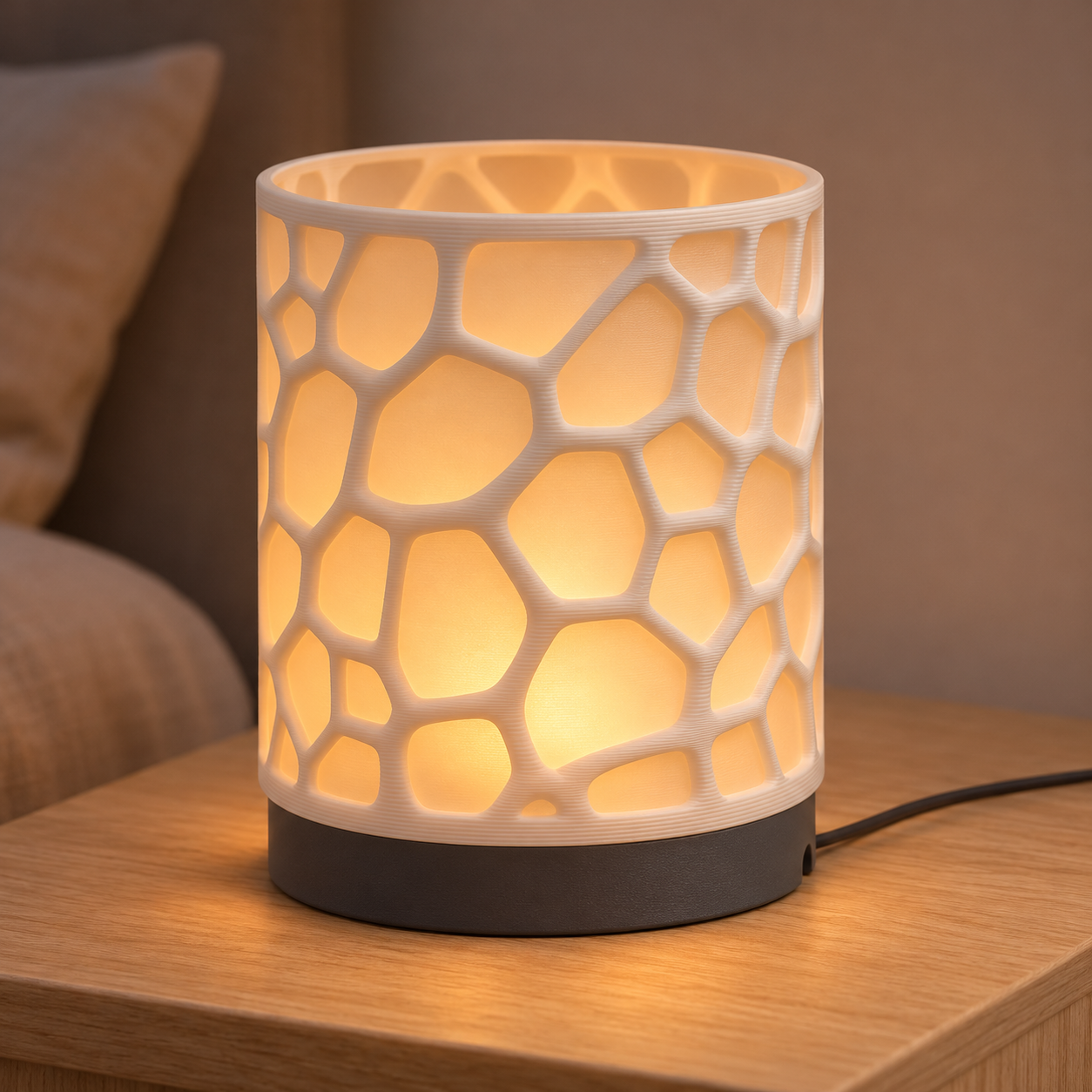
A 110 mm cylindrical lampshade whose irregular cells glow through thin membranes between thicker ribs, with a base that seats the Bambu Lab LED Lamp Kit 001 puck.
Cell-Glow Voronoi Lampshade for LED Lamp Kit 001
A 110 mm cylindrical lampshade whose irregular cells glow through thin membranes between thicker ribs, with a base that seats the Bambu Lab LED Lamp Kit 001 puck.
Date: 2026-11-11 Category: Art and Decor Modeling difficulty: Intermediate Estimated print: ~10.5 h total · ~185 g PLA (estimate) Suggested price: $35–$65 printed · $7 digital file (estimate) Status: Concept
Description
A white tube, 110 mm across and 120 mm tall, stands on a short charcoal base. The wall carries about 48 irregular Voronoi cells. Each cell is a pocket cut 1.2 mm into a 2.0 mm wall, leaving a 0.8 mm membrane that lets the light through. The ribs between cells stay full thickness and read as a dark web. Lit, it looks like a stone-fruit skin or a giraffe coat with the light behind it.
The base holds the 59 mm LED puck in a pocket flush with its top, with a small channel for the cable. The shade slides onto a short spigot and rests on the base shoulder. No screws, no glue.
It prints upright with no supports. The membrane is two perimeters of a 0.4 mm nozzle, so the shade is mostly thin-wall printing.
Why it sells
This is an art piece chosen on taste. For context, one seller-side guide rates lithophane night lights at $30–$120 with low-to-medium competition and 70–80% margins, with spikes around Mother's Day and Christmas. That guide gives qualitative ratings, not sales counts, so treat it as a hint. The thin-membrane glow is the same principle as a lithophane, where thickness sets how much light passes. The puck is a 3 W, 5 V, 59 × 18 mm LED sold without printed parts, which is why shades for it are a market of their own. The gap: a shade that gets its pattern from thickness alone, so no photo, no supports, and a single colour.
Who buys it
Owners of Bambu Lab printers who bought the LED kit and want a shade that is not a spiral vase; gift buyers at Christmas and Mother's Day. Sold as a finished lamp on Etsy or a craft market, or as a file on MakerWorld, where the kit's owners shop.
Design overview
- Shade: Ø110 outer, Ø106 inner, 120 tall; 48 Voronoi cells, ribs 2.4 mm wide.
- Membrane 0.8 mm thick, ribs 2.0 mm thick. That contrast is what makes the glow.
- Cells wrap with no seam: seeds are mirrored one circumference left and right.
- Base Ø110 × 24 with a Ø105.6 × 6 spigot; puck pocket Ø59.4 × 18.2 so the LED face is flush with the spigot top.
- 5 × 5 mm cable channel out the back.
- The one feature that sets it apart: variable thickness instead of cut-through holes, so the puck is never visible as a hot spot.
Dimensions
| Measurement | Value (mm) | Notes |
|---|---|---|
| Overall width (X) | 110 | Shade and base |
| Overall depth (Y) | 110 | |
| Overall height (Z) | 144 | Base shoulder 24 plus shade 120 |
| Wall thickness | 2.0 | Ribs and rims |
| Membrane thickness | 0.8 | Inside each cell |
| Cell pocket depth | 1.2 | From the outside |
| Rib width | 2.4 | Between adjacent cells |
| Shade inner diameter | 106 | |
| Spigot diameter | 105.6 | 0.2 per side sliding fit |
| Spigot height | 6 | z 24 to 30 |
| Puck pocket | Ø59.4 × 18.2 | z 11.8 to 30 |
| Cable channel | 5 × 5 | z 11.8 to 16.8, toward +Y |
| Full-thickness bands | 5 bottom, 3 top | Shade z 0–5 and 117–120 |
Parts list
| Part | Qty | Material | Size X×Y×Z (mm) | Print orientation | Supports |
|---|---|---|---|---|---|
| Lamp base | 1 | PLA | 110 × 110 × 30 | Bottom face down | none |
| Voronoi shade | 1 | PLA | 110 × 110 × 120 | Upright, bottom ring down | none |
Hardware and non-printed parts
1 × Bambu Lab LED Lamp Kit 001 (59 mm diameter × 18 mm LED puck, 5 V DC, 3 W, 1.5 m cable), as listed by one retailer. Measure your own puck before printing the base. The kit's double-sided tape secures it in the pocket.
Fits and tolerances
- Shade on base spigot: sliding fit, 0.2 mm per side, the standard value.
- Puck in pocket: 0.2 mm per side around a 59 mm puck. Adjust with
puck_diameter. - Cable in channel: 5 mm channel for the kit cable; check against yours.
Modeling guide
Origin: centre of the base bottom face. +Z up the lamp axis, +X right, +Y toward the back (cable side).
Base
- Sketch on XY: circle Ø110 at the origin. Extrude 24.
- On the top face sketch a circle Ø105.6 at the origin. Extrude 6 (to z = 30).
- On the top face sketch a circle Ø59.4 at the origin. Cut down 18.2 (to z = 11.8).
- On the XZ plane sketch a rectangle X −2.5 to 2.5, Z 11.8 to 16.8, from Y 29.7 to 55. Cut through.
- Fillet the bottom outer edge 1.0; chamfer the top outer edge at z = 24 by 0.6.
Shade (same origin, shade bottom at z = 0 in its own file)
- Sketch on XY: circles Ø110 and Ø106. Extrude the ring 120.
- Unroll the surface to a 345.6 × 120 mm rectangle (π × 110). Scatter 48 Poisson-disc seeds with 20 mm minimum spacing, keeping the bottom 5 mm and top 3 mm clear. Mirror seeds ±345.6 mm in X so cells wrap.
- Compute the Voronoi diagram, inset each cell 1.2 mm (rib 2.4 mm), and drop cells under 8 mm across. Blender geometry nodes, Grasshopper or an OpenSCAD script can do this; Fusion alone cannot.
- Wrap each inset cell onto the cylinder and cut it as a pocket 1.2 deep from the outside (R 55 to R 53.8).
- Chamfer the bottom inner edge 0.5.
Beginner variant: replace the Voronoi step with a hex grid, cells 16 mm across, same 1.2 pockets.
Print settings
| Setting | Value |
|---|---|
| Material | White or natural PLA for the shade; any opaque PLA for the base |
| Nozzle | 0.4 mm |
| Layer height | 0.2 mm |
| Walls / perimeters | 2 on the shade (3 on the base) |
| Infill | 0% on the shade; 15% gyroid on the base |
| Supports | None |
| Brim / adhesion | None |
| Notes | Turn on thin-wall detection for the shade. Do a 20 mm-tall test ring first to check how the 0.8 mm membrane glows on your filament. |
Assembly
- Stick the puck into the pocket, LED up, and route the cable out the back channel.
- Slide the shade over the spigot until it rests on the base shoulder.
- Plug the cable into a 5 V USB source.
Variants and upsells
- Other sizes: 90 mm and 150 mm through
shade_diameter. - Cell sets: 24 big cells, 90 small cells, or hex.
- A new pattern each week (Voronoi, wave, hex, ripple) sold as a swap-in shade for one base.
- Warm-white vs cool-white filament editions.
Selling and distribution
MakerWorld suits the file because the kit is a Bambu product and buyers search there; Etsy suits the finished lamp, especially before Christmas and Mother's Day. Price from material (about 185 g PLA), machine time (about 10.5 h) and margin. Sell the file under a commercial licence, and sell the printed lamp with the puck listed as not included unless you stock it. Do not use Bambu Lab branding in the listing beyond naming compatibility factually.
Keywords: Voronoi lamp, 3D printed lampshade, LED lamp kit shade, cell lamp, night light, bedside lamp, generative decor, modern lighting, desk lamp, gift for maker.
Risks and IP notes
- Dimensions of the kit come from a retailer listing. Mitigation: measure the puck and set
puck_diameterbefore printing the base. - 0.8 mm membranes may show gaps if the line width drifts. Mitigation: test ring first; raise to 1.0 if needed.
- Bambu Lab is a brand. Mitigation: use "compatible with" wording once, not in the title image.
- Voronoi lamps are common. Mitigation: the membrane approach and the swap-in shade set.
- Heat: a 3 W LED runs warm but the kit is designed for printed shades; do not swap in a hotter bulb.
Resource links
- Bambu Lab LED Lamp Kit-001 (3DJake) — 59 × 18 mm, 5 V DC, 3 W, 1.5 m cable; printed parts not included
- Popular 3D printed items on Etsy (InsightAgent) — lithophane night lights rated $30–$120 with low-to-medium competition
- Voronoi diagram (Wikipedia) — how the cell pattern is built
- Lithophane (Wikipedia) — thickness variation in a thin translucent wall
More from 3D Print Designs