Hexfield 9×9 Tidepool Connection Board
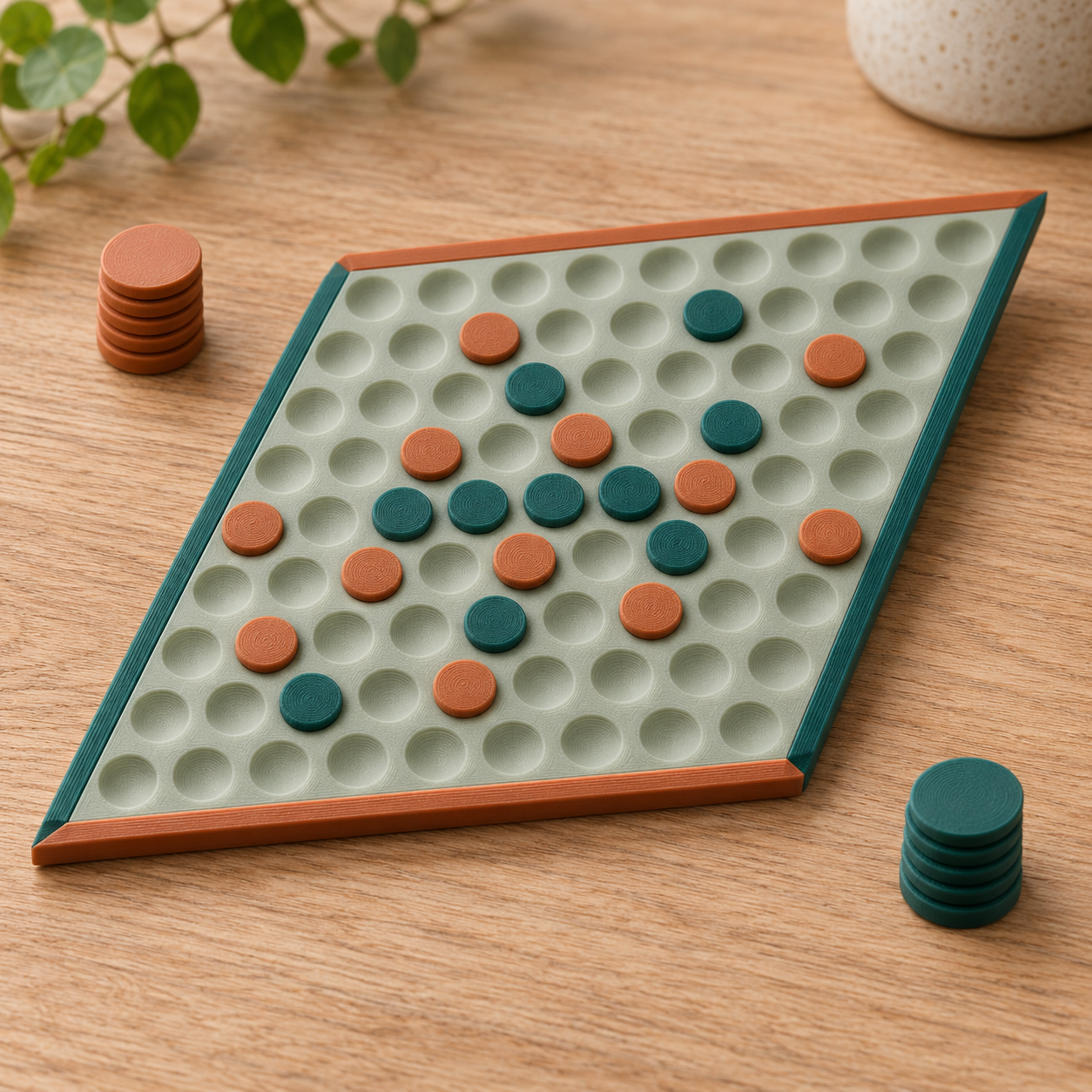
A single-piece rhombus board for the classic two-player connection game, with 81 shallow dimples that hold flat stones in place, so a game can be carried and bumped without losing the position.
Hexfield 9×9 Tidepool Connection Board
A single-piece rhombus board for the classic two-player connection game, with 81 shallow dimples that hold flat stones in place, so a game can be carried and bumped without losing the position.
Date: 2026-11-10 Category: Puzzles and Games Modeling difficulty: Intermediate Estimated print: ~8 h total · ~90 g PLA (estimate; board ~5 h and ~60 g, 82 stones ~3 h and ~28 g) Suggested price: $28–$42 printed · $6 digital file (estimate) Status: Concept
Description
Hexfield is a rhombus of 81 cells in a 9 × 9 grid, with rows offset by half a cell so every cell touches six neighbours. Players take turns placing a stone; one player must link the two terracotta edges, the other the two teal edges. The rules are those of the connection game Piet Hein introduced in 1942 under the name Polygon, as described on Wikipedia's Hex article; this design is an original board, not a copy of any listing.
Each cell is a round dimple 11.6 mm across and 1.2 mm deep. A stone is an 11.2 mm disc, 2.4 mm thick, so it sits in the dimple and stands 1.2 mm proud, easy to pick up with a fingernail. The board is a pale sage-grey, with a terracotta strip along two opposite edges and a teal strip along the other two. Stones come in terracotta and teal, 41 of each.
The board is 208 × 120 mm and prints flat in one piece on a 220 mm bed. The 11 × 11 tournament size is covered under Variants.
Why it sells
This is an art-and-game idea, chosen on taste and not on sales rankings. What the existing listings show is that the game is shared as a print: MyMiniFactory's Hex / Con-Tac-Tix model is an 11 × 11 board split into four pieces, with 61 stones per side and magnet insets, and scruss's Printables model is another Hex file (I did not read its board size). The gap this fills: a one-piece 9 × 9 board where the stones sit in dimples, with edge colours at a glance, and no magnets or assembly.
Who buys it
People who like abstract strategy games and want a handsome desk or coffee-table piece, game-night hosts, maths and puzzle gift buyers, and parents with a school-age player (the rules take two minutes to teach). Sold on Etsy, at maker markets, and as a file on MakerWorld and Printables.
Design overview
- A 9 × 9 rhombus, 81 cells at a 14 mm pitch, with 60° and 120° corners.
- A round dimple per cell, 11.6 mm across and 1.2 mm deep, that locates an 11.2 mm stone and keeps a bumped game intact.
- Terracotta strips along two opposite sides and teal along the other two, inlaid 0.6 mm, so the goal of each player is visible.
- 41 terracotta and 41 teal stones, flat on both faces, so none can be dropped upside down.
- One part, no assembly; stones are the only loose parts.
- Differentiator: the dimples make a game transportable and kid-proof, where the flat boards on the listed models need a steady table.
Dimensions
| Measurement | Value (mm) | Notes |
|---|---|---|
| Overall width (X) | 208 | mitred outline calculates to 206.1; rounding the corners only reduces it |
| Overall depth (Y) | 120 | calculated 119 |
| Overall height (Z) | 8 | |
| Cell pitch | 14 | centre to centre along a row |
| Row offset | 7 in X, 12.124 in Y | each row up shifts half a pitch |
| Margin outside the outer cell centres | 11 | the rhombus outline is offset 11 from the cell-centre rhombus |
| Dimple diameter / depth | 11.6 / 1.2 | |
| Edge strip | 3.6 wide × 0.6 deep | spans 6.6 to 10.2 outside the cell centres, so 0.8 clear of the dimples |
| Corner radius | 4 | on the board outline |
| Stone | 11.2 dia × 2.4 | 82 in total |
| Board bottom edge | 0.6 chamfer | prevents elephant-foot ridge |
Parts list
| Part | Qty | Material | Size X×Y×Z (mm) | Print orientation | Supports |
|---|---|---|---|---|---|
| Board | 1 | PLA | 208×120×8 | Flat on the bed, dimple side up | none |
| Terracotta stone | 41 | PLA | 11.2×11.2×2.4 | Flat on the bed | none |
| Teal stone | 41 | PLA | 11.2×11.2×2.4 | Flat on the bed | none |
Hardware and non-printed parts
None — fully printed. Optional: a 0.5 mm felt sheet cut to the board outline for the underside, adhesive-backed.
Fits and tolerances
- Stone into dimple: sliding fit, 0.2 mm per side (11.6 mm dimple for an 11.2 mm stone), the standard sliding clearance. The stone drops in and lifts out with no tool.
- Edge strips are colour regions of the board body, not loose parts, so no fit applies.
Modeling guide
Origin: the centre of cell (0, 0), the lowest-left cell, on the bottom face of the board (z = 0). +X runs along row 0, +Y up the board, +Z up.
Board:
- Cell centres: for i and j from 0 to 8, x = 14 i + 7 j, y = 12.124 j (14 × sin 60°). The outer rhombus of centres has corners (0, 0), (112, 0), (168, 96.99), (56, 96.99).
- Sketch on XY: offset that rhombus 11 mm outward with mitred corners, then fillet the four corners R4. Extrude 8.
- Cut 81 dimples: circle 11.6 dia at each centre from the top face, depth 1.2.
- Chamfer the bottom outer edge 0.6 and fillet the top outer edge 0.8.
- Edge strips: for each side of the centre rhombus draw a rectangle 3.6 wide whose inner edge is 6.6 mm outside that side, as long as the side, then shorten it 2 mm at both ends so strips do not touch. Cut 0.6 deep from the top face and fill with a separate colour body of the same size: terracotta on the two sides parallel to X (j = 0 and j = 8), teal on the other two (i = 0 and i = 8).
Stone:
- Sketch on XY: circle 11.2 dia, extrude 2.4, chamfer both faces 0.3.
Print settings
| Setting | Value |
|---|---|
| Material | PLA (matte): sage-grey board, terracotta, teal |
| Nozzle | 0.4 mm |
| Layer height | 0.2 mm |
| Walls / perimeters | 3 |
| Infill | 15% gyroid for the board; 100% for stones |
| Supports | none |
| Brim / adhesion | none on the board; stones print on a smooth plate, 82 per run in two batches |
| Notes | Colour change at z = 7.4 for the edge strips (two colours, so two swaps). Print stones in one colour per plate (41 fit on a 220 mm bed at 16 mm spacing in a 7 × 6 grid). |
Assembly
No assembly — prints ready to use. Stick the optional felt to the underside.
Variants and upsells
- 11 × 11 tournament board at 12 mm pitch with 9.8 mm dimples and 9.4 mm stones: the centre rhombus is 15 × 12 = 180 mm across, which fits with the margin trimmed to 7 mm (outline about 207 mm wide).
- Personalised: a name or date inlaid in the corner margin.
- Gift set with a sliding-lid stone box.
- Sibling boards: 7 × 7 beginner board for children.
Selling and distribution
Etsy and maker markets for printed boards, MakerWorld and Printables for the file under a commercial licence. Price from material (about 90 g) plus 8 h of printing plus a margin, which lands at $28 to $42; the file is a $6 estimate. Do not use "Hex" as a brand in the title if a trademark applies where you sell; "connection game board" is safe.
Keywords: connection game board, strategy board game, rhombus board game, 3D printed board game, abstract strategy game, two player game, desk game, game night gift, maths gift, travel board game, puzzle gift, tabletop game.
Risks and IP notes
- The game's name may be a trademark in some markets (Parker Brothers marketed it as "Hex" in 1952, per Wikipedia). Mitigation: title and tags say "connection game", not the proprietary name.
- Stones can be lost. Mitigation: ship extras, or add the sliding-lid box.
- Dimples that print too tight. Mitigation: 0.2 mm per side clearance and a 0.3 mm stone chamfer.
- Market: a free 11 × 11 file exists. Mitigation: the one-piece board is the selling point; sell the print, not the file.
Resource links
- Hex (board game), Wikipedia — rules, inventor (Piet Hein, 1942), board sizes
- Hex / Con-Tac-Tix Game, MyMiniFactory — an existing 11 × 11 print, in four pieces, with 61 stones per side
- Hex Game (aka Polygon, aka Nash), Printables mirror — another printable Hex file
More from 3D Print Designs