Moiré Turn: Twin-Slat Op-Art Cylinder
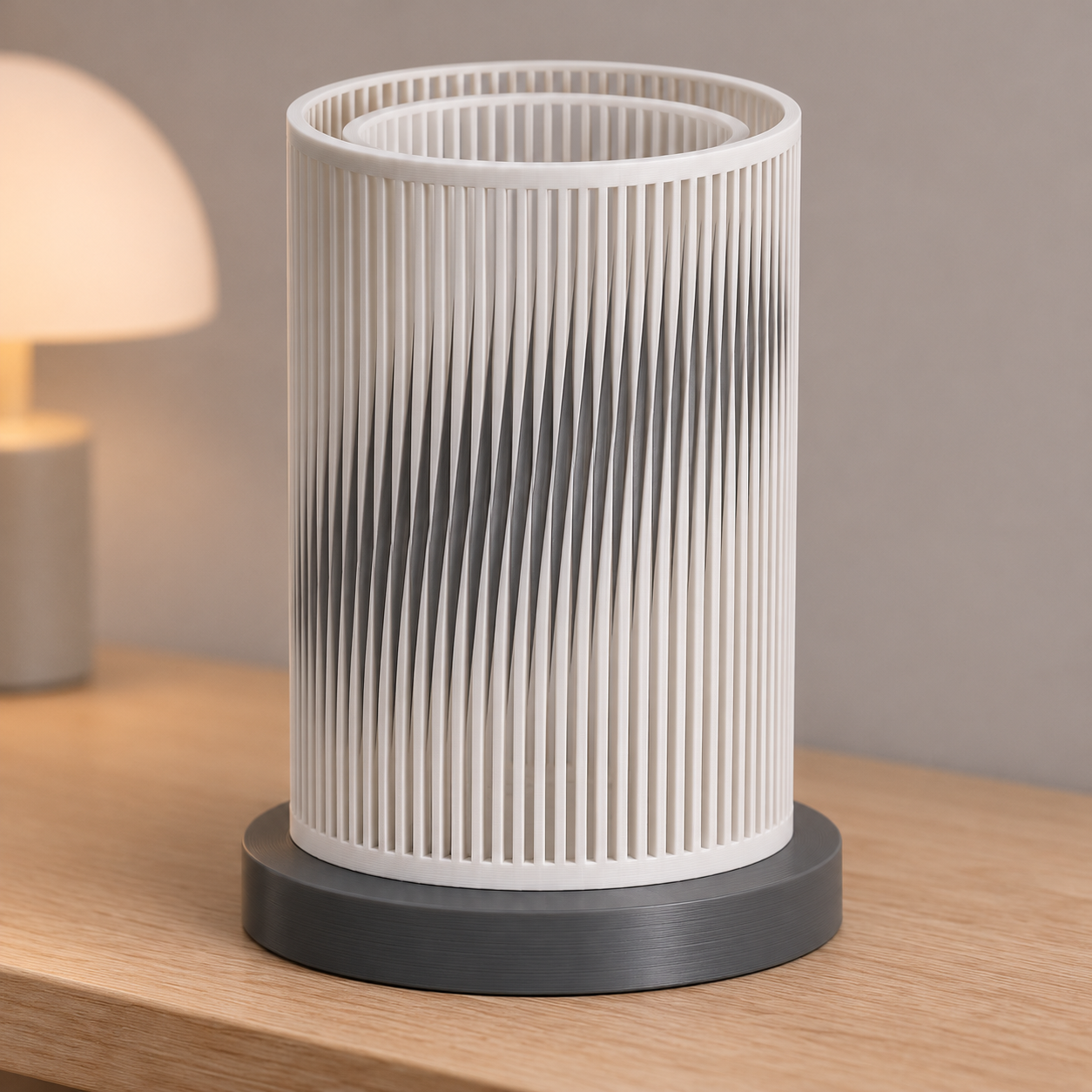
Two nested slatted cylinders, one with 60 bars and one with 61, so turning the outer sleeve sweeps a moiré shadow band round the sculpture much faster than your hand moves.
Moiré Turn: Twin-Slat Op-Art Cylinder
Two nested slatted cylinders, one with 60 bars and one with 61, so turning the outer sleeve sweeps a moiré shadow band round the sculpture much faster than your hand moves.
Date: 2026-11-11 Category: Art and Decor Modeling difficulty: Intermediate Estimated print: ~8 h total · ~96 g PLA (estimate) Suggested price: $45–$85 printed · $6 digital file (estimate) Status: Concept
Description
Moiré Turn is a desk sculpture made of three printed parts: a round base, a fixed inner cylinder built from 60 vertical bars, and a loose outer sleeve built from 61 bars. The sleeve sits on the base and spins freely around the core. Looking through both sets of bars you see a broad dark band where the two gratings line up out of phase, and a light band where they line up in phase.
The sleeve has one more bar than the core, so the pattern has exactly one band around the circumference. Rotating the sleeve by one bar pitch (5.9 degrees) moves that band roughly a full turn round the object, so a slow twist of the wrist makes the shading race past (this is my estimate from the standard moiré beat relation, not a measured value). Held still, it looks like a calm striped drum. Turned, it shimmers.
Everything prints in one colour with no supports. A white or pale cylinder against a charcoal base reads best, and a lamp placed behind the piece makes the bands much stronger.
Why it sells
This idea is chosen on taste, not sales. The inspiration is the family of counter-rotating moiré sculptures. Jeff Lieberman's Moore Pattern uses two counter-rotating aluminium discs (bea.st), a hobbyist printed a spoked-disc version (Hackaday, 2020-01-04), and Gianni Sarcone's kinegrams animate an image by sliding a striped overlay across it (Sarcone's Studio). EPFL researchers have also printed moiré on curved surfaces for decoration (EPFL paper). The gap in what I found is that the examples I saw are flat discs, whereas a hand-turned cylinder is a 360-degree object you can read from any side. I did not find a printable one with a hand-turned outer sleeve, but my search was one query, so treat that as unconfirmed.
Who buys it
A design-minded desk owner or gift buyer who likes op art and kinetic objects, someone who would put a piece beside a lamp on a bookshelf or sideboard. They would browse Etsy and maker marketplaces under kinetic art, optical illusion and desk toy searches.
Design overview
- The one surprising thing: a loose outer sleeve with 61 bars rotates over a fixed core with 60 bars, so a single moiré band races around the cylinder as you turn it.
- Three parts only: base disc, inner core, outer sleeve. No hardware.
- Bars are 1.8 to 1.9 mm wide with roughly equal gaps, which is four to five perimeters of a 0.4 mm nozzle, so the grating prints cleanly.
- Radial gap between core and sleeve is 1.2 mm, small enough for strong moiré and large enough to spin freely.
- Solid rings at both ends of each cylinder hold the 82 mm tall bars straight and give the sleeve a grip surface.
- The sleeve rests on the base's top face and the core press-fits into a 6 mm deep socket.
- Overall footprint 120 x 120 x 100 mm, stable on a shelf.
Dimensions
| Measurement | Value (mm) | Notes |
|---|---|---|
| Overall width (X) | 120 | base disc diameter |
| Overall depth (Y) | 120 | |
| Overall height (Z) | 100 | base top at 12, core and sleeve tops both at 100 |
| Wall thickness (rings) | 2.0 | sleeve; core ring is 3.0 |
| Core outer diameter | 70 | bars outer face at r=35 |
| Core bar count / size | 60 / 1.8 x 2.0 | tangential x radial, 82 tall, pitch 6.0 deg |
| Sleeve inner diameter | 72.4 | bars inner face at r=36.2 |
| Sleeve outer diameter | 76.4 | |
| Sleeve bar count / size | 61 / 1.9 x 2.0 | tangential x radial, 78 tall, pitch 5.9016 deg |
| Radial gap core to sleeve | 1.2 | clearance per side |
| Socket diameter / depth | 70.2 / 6 | core press fit |
| Base thickness | 12 |
Parts list
| Part | Qty | Material | Size X×Y×Z (mm) | Print orientation | Supports |
|---|---|---|---|---|---|
| Base disc | 1 | PLA | 120×120×12 | Bottom face down on the bed | none |
| Inner slat core | 1 | PLA | 70×70×94 | Bottom ring down, axis vertical | none |
| Outer slat sleeve | 1 | PLA | 76.4×76.4×88 | Bottom collar down, axis vertical | none |
Hardware and non-printed parts
None — fully printed. Optional: three 8 mm self-adhesive felt feet under the base if the shelf is delicate.
Fits and tolerances
- Core bottom ring (70 mm) into base socket (70.2 mm): press fit, 0.1 mm per side. If your printer runs tight, open the socket to 70.3 mm.
- Sleeve (inner 72.4 mm) around core (outer 70 mm): free rotation, 1.2 mm per side. This is far above the usual 0.2 mm sliding fit on purpose: the sleeve is only constrained by gravity and the base, so the gap sets how much the moiré parallax shifts. Do not go under 0.8 mm or elephant foot can bind the collar.
- Sleeve bottom collar on the base top face: sliding contact, no clearance needed (flat on flat).
Modeling guide
Origin: centre of the base's bottom face. +Z up, +X to the right, +Y away from you. All three parts share this axis; each part's own Z=0 is its bottom face. In OpenSCAD use rotate([0,0,i*360/N]) with a translate([R,0,0]) bar for the slat arrays; in Fusion or Onshape use a circular pattern of one bar.
Base disc
- Circle diameter 120 on XY, extrude 12.
- Chamfer top outer edge 1.5 and bottom outer edge 0.8.
- Circle diameter 70.2 on the top face, cut 6 deep (socket).
Inner slat core
- Annulus OD 70 / ID 64 on XY, extrude 6 (bottom ring).
- On Z=6 sketch one bar 1.8 tangential x 2.0 radial with its outer face at r=35, centred on +X; extrude 82.
- Circular pattern the bar 60 times, 6 degrees apart.
- On Z=88 annulus OD 70 / ID 64, extrude 6.
- Fillet the top outer edge 0.8.
Outer slat sleeve
- Annulus ID 72.4 / OD 76.4 on XY, extrude 5 (bottom collar).
- On Z=5 sketch one bar 1.9 tangential x 2.0 radial with its inner face at r=36.2, centred on +X; extrude 78.
- Circular pattern the bar 61 times, 5.9016 degrees apart.
- On Z=83 same annulus, extrude 5.
- Fillet the top outer edge 0.8.
Print settings
| Setting | Value |
|---|---|
| Material | PLA (white or pale for the core and sleeve, charcoal for the base) |
| Nozzle | 0.4 mm |
| Layer height | 0.2 mm (0.16 mm for a cleaner grating) |
| Walls / perimeters | 4 on base; bars print as solid 4-perimeter lines |
| Infill | 15% gyroid (base only) |
| Supports | None |
| Brim / adhesion | None for base; brim 3 mm on core and sleeve if they lift |
| Notes | Print the core and sleeve at the same layer height and from the same filament roll so the bar edges match. Slow outer walls to 40 mm/s for crisp bars. |
Assembly
- Press the inner core's bottom ring into the base socket until it bottoms out.
- Lower the outer sleeve over the core until its bottom collar rests on the base.
- Spin the sleeve slowly with the piece in front of a lamp or window and watch the band move.
Variants and upsells
Parametric variants: bar counts (for example 36 / 37 for a bolder, wider band, or 90 / 91 for fine shimmer), a taller 140 mm tower, and a third nested sleeve for a layered effect. Colour variants: black core with white sleeve, or translucent PETG sleeve for backlit use. Series idea: a set of three cylinders with different bar counts that sit side by side as one kinetic collection.
Selling and distribution
Etsy and a personal shop suit the printed piece as kinetic desk art; MakerWorld and Printables suit the file. Price the print as material plus roughly 9 machine hours and a margin, about $45 to $85 (estimate). Sell both file and print; use a CC BY-NC licence on the free listing and a commercial licence on the paid one. Do not use the name Moore Pattern in listings.
Keywords: moire sculpture, kinetic art, optical illusion desk toy, op art, spinning cylinder, moire pattern 3d print, desk sculpture, kinetic desk toy, illusion gift, 3d printed art, rotating sculpture, geek gift.
Risks and IP notes
- Thin bars can warp or ripple: print slowly and keep the cooling fan on; test one 20 mm slice first.
- The moiré effect depends on both cylinders being round; a wobble in either reduces contrast. Mitigation: check the first-layer extrusion width on a ring test.
- Counter-rotating moiré sculptures exist as commercial products (Moore Pattern is one). This is a different mechanism (hand-turned cylinder), but check for design patents before selling at scale.
- Market is niche. Mitigation: sell on taste and gift appeal, not volume.
Resource links
- Moore Pattern — Counter-rotating moiré disc sculpture, the main inspiration
- 3D printed moiré illusion may just drive you crazy (Hackaday) — A hobbyist 3D-printed counter-rotating moiré build
- Gianni Sarcone's Kinetic Art / Kinegrams — Striped overlay animating an image, the optical principle
- Surface moiré fabrication (EPFL paper) — Moiré on 3D-printed curved surfaces for art and decoration
- Kinetic Optical Illusion Sculpture (Walyou) — Another kinetic illusion sculpture write-up
More from 3D Print Designs