Skyline Study — Modular Building Series, Piece 01: The Spire Tower
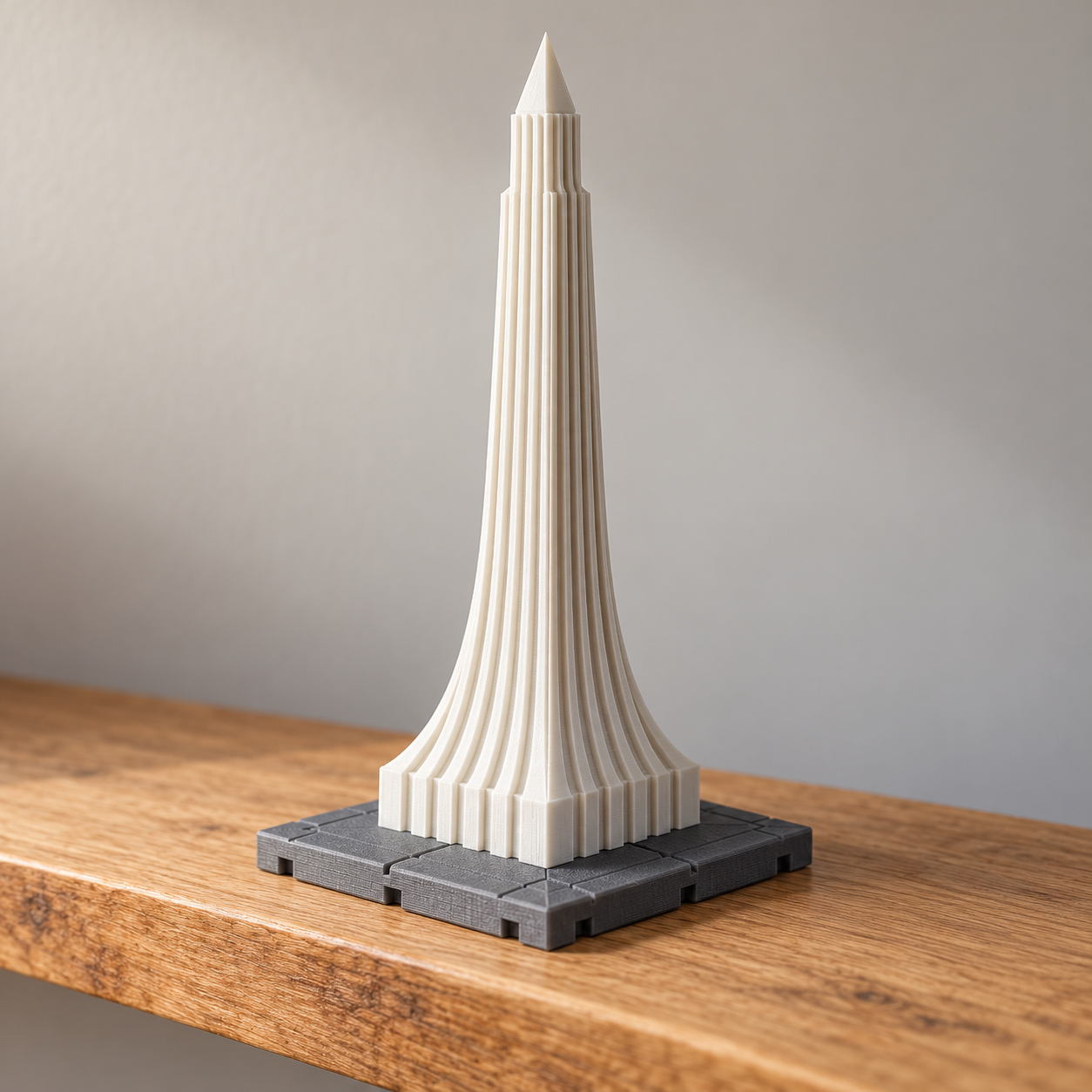
A fluted, tapering miniature tower that keys into a shared connector grid, the first piece of a shelf-growing skyline collected one building at a time.
Skyline Study — Modular Building Series, Piece 01: The Spire Tower
A fluted, tapering miniature tower that keys into a shared connector grid, the first piece of a shelf-growing skyline collected one building at a time.
Date: 2026-10-31 Category: Art and Decor Modeling difficulty: Beginner Estimated print: ~4 h total · ~70 g PLA (estimate) Suggested price: $14–$22 printed · $4 digital file (estimate) Status: Concept
Description
The Spire Tower is two parts: a 50 × 50 mm base tile and a tapering shaft that plugs into it. The shaft narrows from a 40 × 40 mm base to a 20 × 20 mm neck over 160 mm, then rises another 30 mm as a pyramidal spire, with fine vertical fluting running the full height. The base tile carries a peg-and-socket pattern on all four edges, the connector standard for the rest of the series — every future piece sits on the same 50 mm tile and keys against its neighbors, so the collection grows into a continuous miniature skyline on a shelf or windowsill.
This is piece 01: a generic, invented silhouette rather than a model of any real building, which keeps the whole series free to design around proportion and light instead of chasing landmark accuracy.
Why it sells
Modular miniature city sets are a proven free-model category: MINI-CITY on MakerWorld ships a tileable base plate with a modern house series, an apartment series, a tower series, and an office series so builders can assemble their own skyline (MakerWorld, MINI-CITY — Modular Miniature City Blocks), and miniCities Metropolis sells 9-, 20-, and 30-piece expansion sets built around the same idea of a customizable grid (MakerWorld, miniCities — Metropolis). A third expansion, miniCITIES Futurama, packages 84 buildings as a themed add-on (MakerWorld, miniCITIES — Futurama). On the commerce side, a 3D-printing profitability guide puts miniatures and collectibles at $0.50–$3 in material against $5–$25 retail, a 75–85% margin, specifically because "many people want them" (eufymake, 23 Best Things to 3D Print and Sell in 2026).
Those modular city sets ship as big all-at-once bundles. The gap is a slower release: one new building a week, sold or shared as a single small print, so a shelf collection builds the way a stamp or pin collection does rather than arriving complete on day one.
Who buys it
Collectors who already buy piece-by-piece art series (the same audience as this library's other Art & Decor collectible lines), desk and shelf decorators who want a growing display rather than a one-time purchase, and dollhouse or tabletop-terrain hobbyists who want individual buildings instead of a fixed bundle.
Design overview
- Two-part design: a connector base tile and a tapering tower
- Tower tapers from 40 × 40 mm to 20 × 20 mm over 160 mm, then rises 30 mm to a pyramidal spire point
- Fine vertical fluting (2 mm grooves, 5 mm pitch) runs the tower's full height for light and shadow without paint
- Base tile carries a peg-and-socket pattern on all four edges so any tile keys into any neighbor tile, in any rotation
- A central socket in the tile accepts the tower's mounting boss — future pieces in the series reuse the same boss-and-socket interface
- No glue required for the tower-to-tile joint; it's a firm press fit
- The feature the bundled modular-city sets don't offer: a standalone single-building release cadence instead of a multi-building pack
Dimensions
| Measurement | Value (mm) | Notes |
|---|---|---|
| Base tile width (X) | 50 | |
| Base tile depth (Y) | 50 | |
| Base tile thickness (Z) | 4 | |
| Tower base footprint | 40 × 40 | at Z=0 |
| Tower neck footprint | 20 × 20 | at Z=160 |
| Tower total height | 190 | shaft 160 + spire 30 |
| Fluting groove | 2 wide × 1 deep, 5 mm pitch | |
| Tile edge peg | Ø6 × 4 tall | one per edge |
| Tile edge socket | Ø6.3 × 4.2 deep | one per edge |
| Mounting boss / socket | Ø20.0 boss into Ø20.3 socket |
Parts list
| Part | Qty | Material | Size X×Y×Z (mm) | Print orientation | Supports |
|---|---|---|---|---|---|
| Base tile | 1 | PLA | 50 × 50 × 4 | Flat | none |
| Tower body | 1 | PLA | 40 × 40 × 190 | Base down | none |
Hardware and non-printed parts
None — fully printed.
Fits and tolerances
- Tower mounting boss into tile socket: press fit, 0.15 mm clearance per side (standard press-fit range for a joint meant to stay assembled without glue)
- Tile edge peg into neighboring tile's socket: press fit, 0.15 mm clearance per side
Modeling guide
Origin sits at the center of the base tile's bottom face; +X and +Y run along the tile's edges, +Z runs up.
Base tile:
- Sketch on XY, centered at origin: square 50 × 50, corner radius 2.
- Extrude 4 up.
- On the top face, cut a mounting socket: Ø20.3, depth 3.2, centered at X=0, Y=0.
- On each of the 4 edges, add a peg: Ø6, protruding 4 mm outward, centered 15 mm from the edge's left corner (measured looking at that edge from outside the tile).
- On each of the 4 edges, cut a socket: Ø6.3, recessed 4.2 mm, centered 35 mm from the same corner used in step 4.
- Because the peg and socket positions are mirrored across the tile's center, any two tiles butted together always align one tile's peg into the other's socket, regardless of which edge or rotation is used.
Tower body:
- Sketch on XY, centered at origin: square 40 × 40, corner radius 3.
- Loft the square, scaling linearly down to 20 × 20 (same corner radius ratio) at Z=160.
- From Z=160, continue the loft from 20 × 20 down to a point at Z=190 (the spire).
- On the shaft's 4 side faces, cut vertical fluting grooves: 2 mm wide × 1 mm deep, spaced 5 mm apart (pitch), running the full 160 mm shaft height; the grooves may be omitted on the spire section above Z=160 to keep the point simple to print.
- On the underside (Z=0 face), add a mounting boss: Ø20.0, protruding down 3 mm, centered at X=0, Y=0.
Print settings
| Setting | Value |
|---|---|
| Material | PLA |
| Nozzle | 0.4 mm |
| Layer height | 0.16 mm (finer layers read better on the fluted surface) |
| Walls / perimeters | 2 |
| Infill | 10% gyroid |
| Supports | None |
| Brim / adhesion | Brim 3 mm (tower's tall, narrow profile benefits from extra bed adhesion) |
| Notes | Print the tower vertically, base down; no pause needed |
Assembly
- Press the tower's mounting boss into the base tile's socket until it seats flush.
- No glue required — the press fit holds for shelf display; add a drop of PVA if the piece will be handled often.
Variants and upsells
- Piece 02 (next week): a shorter, wider "block" building with a flat roof and a grid of shallow window reveals, same 50 mm tile standard
- Piece 03: a rounded dome-roofed building, introducing a curved silhouette to the skyline
- Scale variant: a 2-tile-wide tower for buyers who want a taller anchor piece at the same connector standard
- Color variants: offer the same tower in a matte-black "night skyline" set versus a warm-white "daytime" set
- Bundle discount once 4+ pieces exist, sold as a growing "starter skyline" set
Selling and distribution
List individual pieces on Etsy, MakerWorld, and Printables the way the MINI-CITY and miniCities lines already do, but release one piece at a time rather than as a bundle, and cross-promote each new piece to owners of the earlier ones. Price a single piece at $14–$22 printed, in line with the $5–$25 retail range eufymake's guide gives for miniatures and collectibles, reflecting the low material cost (~70 g PLA) against the modeling and packaging time. Sell the printed piece and the STL separately; license the file non-commercially (CC BY-NC) to protect the ongoing series from being resold as a bundle by someone else before the collection is complete. Listing keywords: miniature building, modular skyline, collectible 3D print, shelf decor series, tabletop city, architectural miniature, desk decor collectible, piece of the month, dollhouse miniature, 3D printed tower.
Risks and IP notes
- This is an invented silhouette, not a model of any real landmark or building — keep future pieces in the series generic too, to avoid copying a specific architect's or city's recognizable design.
- The 190 mm tower is tall and narrow relative to its 40 mm base; if it tips easily on a shelf, consider adding a heavier infill or a slightly wider base in a later revision.
- Modular miniature-city connectors already exist as free models (MINI-CITY, miniCities); this design uses its own peg/socket geometry rather than copying a specific competitor's connector pattern, but a quick comparison before scaling the series protects against an accidental lookalike.
- A weekly release cadence only works if each piece stays genuinely distinct — track prior pieces' massing and proportions so piece 05 doesn't quietly repeat piece 02.
Resource links
- MINI-CITY — Modular Miniature City Blocks — comparable modular tile-based city series
- miniCities — Metropolis — comparable customizable-grid city set sold in 9/20/30-piece bundles
- miniCITIES — Futurama — comparable themed expansion pack, 84 buildings
- 23 Best Things to 3D Print and Sell in 2026 — margin data for miniatures/collectibles ($0.50–$3 cost, $5–$25 sale, 75–85% margin)
- 15 Most Profitable Things to 3D Print and Sell in 2026 — additional profitability context for collectible miniatures
More from 3D Print Designs