Terraced Propagation Ladder
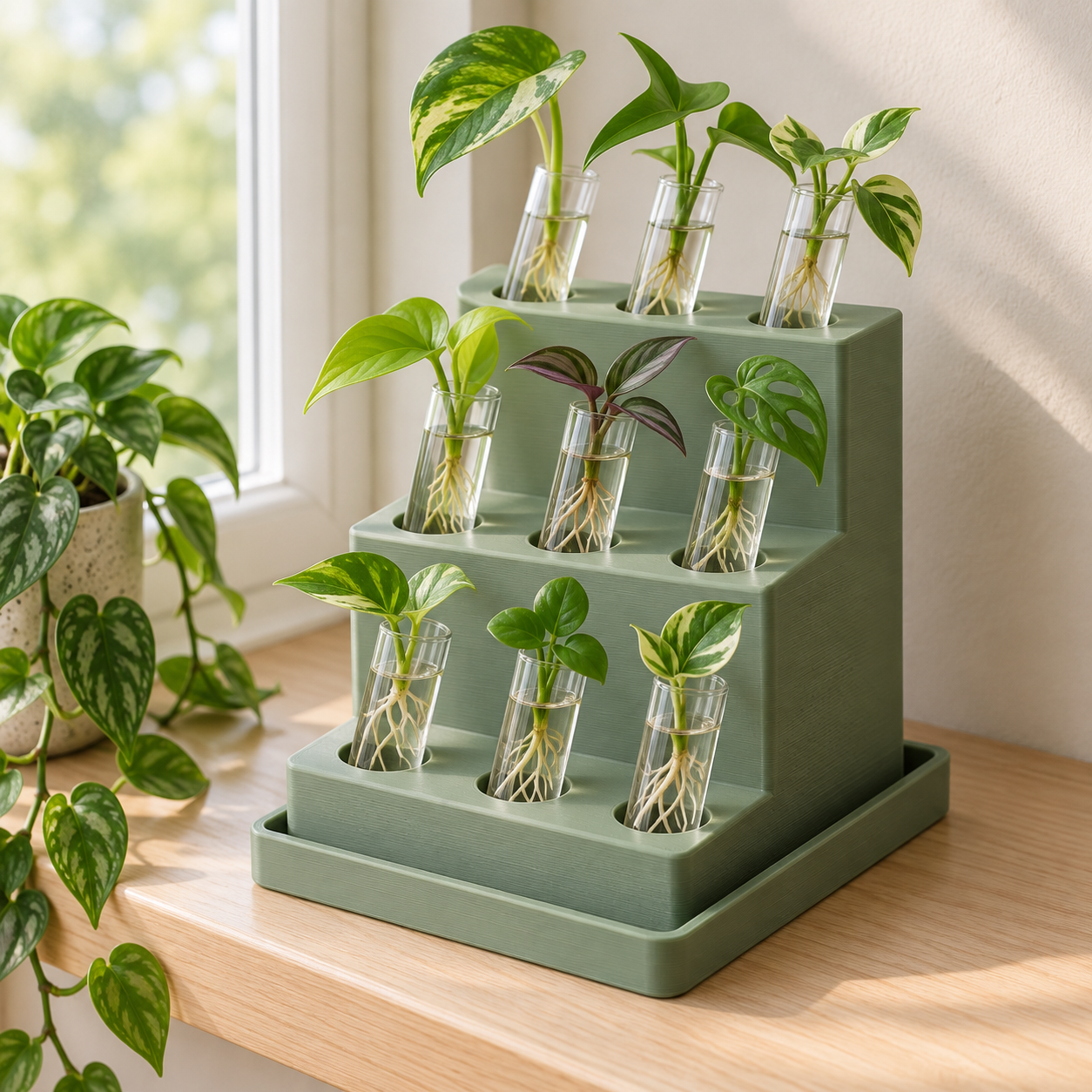
A stair-stepped test-tube stand for rooting plant cuttings that ships as one tier and grows into a taller staggered display as you add more, instead of locking you into a single fixed size.
Terraced Propagation Ladder
A stair-stepped test-tube stand for rooting plant cuttings that ships as one tier and grows into a taller staggered display as you add more, instead of locking you into a single fixed size.
Date: 2026-09-27 Category: Outdoor and Garden Modeling difficulty: Beginner Estimated print: ~5 h total · ~110 g PETG (estimate) Suggested price: $22–$32 printed (3-tier starter set) · $7 digital file (estimate) Status: Concept
Description
The Terraced Propagation Ladder holds glass test tubes of rooting cuttings — pothos, tradescantia, herbs — at three staggered heights so every tube is visible from the front instead of hiding behind the one in front of it. Each tier is a separate printed block holding three tubes at a 15-degree backward lean, and tiers stack by pressing a peg on the tier below into a socket on the tier above, offset 40 mm deeper each time so the stack climbs like a staircase rather than a straight tower.
A shallow catch tray sits under the bottom tier to hold water drips off tubes as they're topped up. The whole thing ships as a 3-tube starter (one tier plus the tray) and grows: buy a second or third tier later and it presses onto the first without new tools or hardware.
It's built for standard 18 mm × 150 mm glass test tubes — the size sold in bulk on Amazon and craft suppliers for propagation — so buyers aren't locked into a proprietary tube.
Why it sells
Propagation stations are an active, well-reviewed Etsy category: one wall-mounted test-tube station holds a 4.9-star rating across 133 reviews, and a shelf-style version has drawn over 5,300 reviews at a 4.8-star average (Etsy: wall-mounted test tube propagation station, Etsy: propagation station listing). Buyer photos and reviews describe them going on shelves, bookcases, and coffee tables as everyday decor, not just plant-care tools (Etsy: plant propagation station, bookshelf decor). A 2026 roundup of 3D-printed garden products also lists propagation and plant-care items among the categories that consistently sell on Etsy and Shopify (50 Useful 3D Printed Garden Tools and Accessories for 2026, ka3dp).
Every listing found in this research is a single fixed-size unit — one arch, one row, one shelf shape, bought once. None described an expandable, add-a-tier system, which is the gap this design fills for buyers who start with a couple of cuttings and end up propagating a whole windowsill.
Who buys it
Plant hobbyists who already have a windowsill of cuttings and post about it, gift buyers picking something for a "plant person," and small-space renters who want a specific decor look on a shelf. Sold on Etsy and at plant-focused craft markets, priced as a starter set with the tier upsell driving repeat purchases from the same buyer.
Design overview
- Each tier holds three test tubes at a 15-degree backward lean, so cuttings don't have to be topped up dead-vertical and water doesn't run down the rim
- Tiers stack via a peg-and-socket join offset 40 mm deeper per level, producing a staircase silhouette instead of a straight tower
- Standard 18 mm × 150 mm glass test tube fit — buyers already have or can cheaply source these
- Catch tray at the base with a 2 mm lip to hold splashes and drips
- Fully expandable: the same peg/socket geometry repeats on every tier, so a buyer can keep adding tiers indefinitely (structural limit noted below)
- No hardware, no glue — everything press-fits by hand
- The gap versus existing listings: this is the only propagation stand in the research designed to expand a piece at a time instead of shipping as one fixed unit
Dimensions
| Measurement | Value (mm) | Notes |
|---|---|---|
| Tier footprint width (X) | 180 | per tier |
| Tier footprint depth (Y) | 90 | per tier |
| Tier height (Z) | 60 | per tier |
| Tube bore diameter | 18.4 | 18 mm tube + 0.4 mm clearance |
| Tube bore depth | 40 | measured along the lean axis |
| Tube lean angle | 15° | from vertical, leaning back |
| Tube spacing (center to center) | 60 | three tubes per tier |
| Stacking peg diameter × height | 10 × 6 | two pegs per tier top, near the back edge |
| Stacking socket diameter × depth | 10.4 × 7 | two sockets per tier bottom, near the front edge |
| Tier-to-tier Y offset when stacked | 50 | creates the staircase stagger |
| Tier-to-tier Z offset when stacked | 60 | equal to one tier height |
| Catch tray size (X × Y × Z) | 200 × 110 × 15 | 2 mm lip height |
Parts list
| Part | Qty | Material | Size X×Y×Z (mm) | Print orientation | Supports |
|---|---|---|---|---|---|
| Tier block | 1–3 (start with 1) | PETG | 180 × 90 × 60 | Flat base down | minimal: inside the angled tube bores only |
| Catch tray | 1 | PETG | 200 × 110 × 15 | Flat, open side up | none |
Hardware and non-printed parts
- 3–9 × glass test tube, 18 mm OD × 150 mm length (3 per tier), customer-supplied — widely sold in bulk for propagation and not included with the print
- None else — fully printed
Fits and tolerances
- Test tube to bore: sliding fit, 0.4 mm clearance (18.4 mm bore for an 18 mm tube), enough to insert and remove by hand without the tube rattling loose
- Tier-to-tier peg to socket: press fit, 0.1 mm clearance per side (peg 8 mm, socket 8.4 mm total bore, i.e. 0.2 mm total diametral clearance split across both sides) so a stacked tier holds its position under normal handling but can still be lifted apart to disassemble
- Tier to catch tray: the bottom tier simply rests on the tray's flat floor, no interlocking feature — the tray's 2 mm lip provides enough visual containment without needing a snap fit
Modeling guide
Origin at the front-left-bottom corner of the tier's base, base at Z = 0, +X to the right, +Y toward the back of the tier, +Z up.
- Sketch a 180 × 90 mm rectangle at Z = 0, corner radius 6 mm. Extrude 60 mm in +Z to form the tier block.
- Shell the block: keep the solid as-is (this is not shelled), and instead cut three angled tube bores directly into the solid, described next.
- On the front face (Y = 0), mark three bore centers at X = 30, 90, 150, each at Z = 30 (mid-height). At each center, sketch a construction line tilted 15 degrees from vertical (top of the line tilted toward +Y, back of the tier).
- Along each tilted line, cut a cylindrical bore 18.4 mm diameter × 40 mm deep, entering from the top face of the block at the tilted angle so the tube leans back into the block.
- On the top face of the block, place two cylindrical bosses (stacking pegs), 10 mm diameter × 6 mm tall, centered at (45, 70) and (135, 70) — 20 mm in from the back edge (Y = 90).
- On the bottom face of the block, cut two matching socket pockets, 10.4 mm diameter × 7 mm deep, centered at (45, 20) and (135, 20) — 20 mm in from the front edge (Y = 0). When a tier's pegs (at local Y = 70) engage the tier above's sockets (at local Y = 20), the added tier's origin lands 50 mm further back in global Y and 60 mm higher in global Z than the tier below it, producing the staircase stagger.
- Fillet the block's top and bottom outer edges at 3 mm radius.
- For the catch tray: sketch a 200 × 110 mm rectangle at Z = 0, corner radius 8 mm. Extrude 15 mm. Shell the extrusion, removing the top face, leaving 2 mm wall thickness on the sides and bottom.
Print settings
| Setting | Value |
|---|---|
| Material | PETG (moisture and light resistant) |
| Nozzle | 0.4 mm |
| Layer height | 0.2 mm |
| Walls / perimeters | 3 |
| Infill | 20% gyroid |
| Supports | minimal, inside the angled tube bores only (tree supports, easy to pick out) |
| Brim / adhesion | brim 5 mm on the tray only |
| Notes | Print tiers with the tilted bore axis oriented so the overhang inside each bore stays under 45°; if your slicer flags it, add tree supports scoped to the bore interiors only |
Assembly
- Set the catch tray on a flat surface.
- Set the first tier block on top of the tray.
- Insert three test tubes into the tier's angled bores.
- To add a second tier, press its four bottom sockets onto the first tier's four top pegs; the added tier's footprint will sit 40 mm further back, creating the staircase step.
- Repeat for a third tier.
Variants and upsells
- Tier color variants (terracotta, sage green, white) to match different plant shelf aesthetics
- A single-tube "starter" tier for buyers who want to try one cutting before committing to a full set
- Bundle upsell: sell the 3-tier tower plus tray as a complete 9-tube set at a discount over buying tiers separately
- A wall-mount bracket variant of the tier for buyers without shelf space
Selling and distribution
List on Etsy alongside the existing propagation-station category, since review counts there show buyers already actively shopping and comparing within it (Etsy: propagation station listing). Sell the printed 1-tier starter plus tray as the entry listing ($22–$32, covering ~110 g of PETG and machine time), with additional tiers as a separate lower-priced add-on listing to drive repeat purchases from the same buyer. Offer the digital file at $7 under a CC BY-NC license. Cross-list on MakerWorld and Printables to build awareness ahead of physical sales.
Listing keywords: propagation station, test tube plant stand, staggered propagation stand, plant cutting holder, expandable propagation station, modular plant stand, windowsill propagation, PETG plant decor, shelf plant display, gift for plant lovers.
Risks and IP notes
- Angled tube bores need support material inside them; skipping supports risks a rough, snag-prone interior that scratches glass tubes on insertion — scope supports to just the bore interiors to keep cleanup fast
- The propagation-station niche has many sellers already; lead marketing with the expandable tier system, since no comparable listing found in this research offers it
- PETG is specified over PLA for the tiers because they sit near water and, on a windowsill, direct sun — PLA can soften or discolor in a hot, sunny window over months
- Test tube diameters vary slightly by supplier; note the 18 mm nominal size clearly in the listing so buyers don't order a mismatched tube size
Resource links
- Etsy: wall-mounted test tube propagation station — 4.9-star rating across 133 reviews, comparable product
- Etsy: 3D printed propagation station listing — bestselling example with over 5,300 reviews
- Etsy: plant propagation station, bookshelf decor — shows buyers using these as everyday shelf decor
- Etsy: arch propagation station — comparable fixed-size single-unit design
- 50 Useful 3D Printed Garden Tools and Accessories for 2026, ka3dp — propagation and plant-care items named as a consistently selling category
More from 3D Print Designs