Tri-Angle Three-Position Phone Dock
A one-piece phone dock shaped like a triangular prism: turn it onto a different face to hold your phone at 50°, 60° or 70°, with a cable notch for charging.
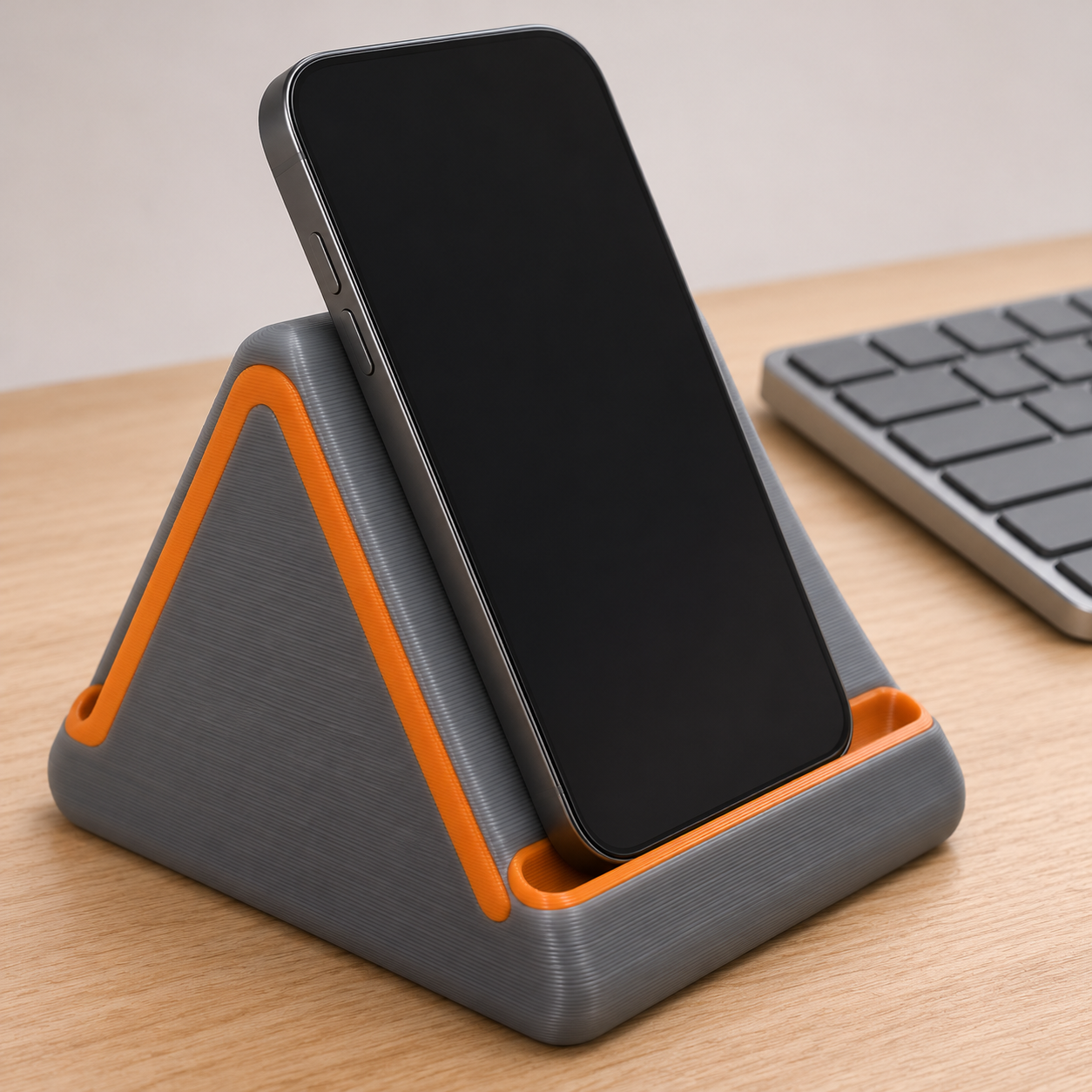
Tri-Angle Three-Position Phone Dock
A one-piece phone dock shaped like a triangular prism: turn it onto a different face to hold your phone at 50°, 60° or 70°, with a cable notch for charging.
Date: 2026-11-09 Category: Desk and Tech Modeling difficulty: Beginner Estimated print: ~7 h total · ~80 g PETG (estimate) Suggested price: $14–$24 printed · $4 digital file (estimate) Status: Concept
Description
A solid wedge with three flat faces of different lengths: 100, 92.2 and 81.5 mm. Because the three angles of the cross-section are 50°, 60° and 70°, standing the prism on any face tilts the two other faces up at two of those angles. Every face has a 12 mm wide groove near each end that catches the bottom edge of a phone, even one in a case, and a deeper notch in the groove leaves room for a charging plug.
There are no hinges, screws or moving parts. You pick the viewing angle by turning the block. The lowest position (50°) suits typing and video calls with the phone nearly flat, and the steepest (70°) is for glancing at notifications on a desk.
The whole model is one triangle sketch, one extrude and a few cuts, so a beginner can model it in an afternoon, and it prints on its end with no supports.
Why it sells
The evidence here is thin, and I won't dress it up. Hyper3D, a company that sells AI 3D tools, ranks phone stands first in its list of Etsy bestsellers, but it gives no sales figures. The model sites show plenty of adjustable stands: a Printables adjustable phone stand with 373 downloads on the search result I saw, a MakerWorld two-part stand with three fixed tilt positions, and a stand with adjustable angle. A foldable five-height stand is sold as a finished print. The gap is that most adjustable stands need a hinge, a ratchet or several parts. This one is a single rigid piece, so it cannot break at a joint.
Who buys it
Remote workers and students who keep a phone beside the keyboard, people buying a small desk gift, and anyone who wants a cheap stand that survives a drawer. Sold as a finished print on Etsy and at craft markets, or as a file on MakerWorld and Printables.
Design overview
- One rigid prism: triangle 50° / 60° / 70°, sides 100 / 92.2 / 81.5 mm, 80 mm long.
- Three desk footprints and heights: 100 wide × 70.6 tall, 92.2 × 76.6, 81.5 × 86.6.
- Viewing angles of 50°, 60° and 70° from the desk, depending on which face is down and which leans.
- Six 12 mm wide, 6 mm deep cradle grooves, two per face, so every orientation has a lip at the lower end.
- Six cable notches, 22 mm wide, 10 mm below the face, for a charging plug.
- Prints on its triangular end with no supports. The feature that sets it apart is the single-piece, no-moving-parts angle change.
Dimensions
| Measurement | Value (mm) | Notes |
|---|---|---|
| Overall width (X) | 100 | longest side AB |
| Overall depth (Y) | 70.6 | triangle height over AB |
| Overall height (Z) | 80 | prism length, also the print height |
| Side lengths | 100 / 92.2 / 81.5 | AB / CA / BC |
| Interior angles | 50° / 60° / 70° | at A / B / C |
| Edge fillet | 3 | three long edges |
| Groove width × depth | 12 × 6 | full 80 length |
| Groove position | 14 to 26 from each vertex | measured along the face |
| Cable notch | 22 × 12 × 10 deep from the face | centred at Z = 40 |
| Minimum wall under a cable notch | about 4.3 | worst case at the 50° vertex, notch floor 10 below the face |
Parts list
| Part | Qty | Material | Size X×Y×Z (mm) | Print orientation | Supports |
|---|---|---|---|---|---|
| Triangular dock body | 1 | PETG | 100 × 70.6 × 80 | triangle face down, extrusion axis vertical (80 tall) | none |
Hardware and non-printed parts
None — fully printed. Optional: self-adhesive silicone dots on one face if the desk is very smooth.
Fits and tolerances
No mating parts. The one fit that matters is the phone in the groove: 12 mm wide for a phone and case up to 11 mm thick, a loose fit with 0.5 mm of play. For a thicker case or a tablet, raise the groove_width parameter to 15.
Modeling guide
Origin at vertex A, the 50° corner. +X runs along the longest side toward B, +Y runs up toward the apex, +Z runs along the 80 mm length and is also print-up. All numbers are mm.
1. Triangular dock body (×1)
- Origin at vertex A of the triangle, +X along the base toward B, +Y toward the apex, +Z along the extrusion (this is also the print-up direction).
- Sketch on XY: triangle with vertices A (0, 0), B (100, 0) and C (59.3, 70.6). The interior angles are 50° at A, 60° at B and 70° at C; side AB = 100, BC = 81.5, CA = 92.2.
- Extrude +Z 80.
- Fillet the three long edges (parallel to Z) with radius 3.
- Cradle grooves: on each of the three faces cut two grooves that run the full 80 length. Each groove is 12 wide along the face and 6 deep perpendicular to it. Measure along the face from each sketch vertex: the near edge of the groove is 14 from the vertex and the far edge is 26 from it. That gives face AB grooves at 14 to 26 and 74 to 86 from A, face BC at 14 to 26 and 55.5 to 67.5 from B, face CA at 14 to 26 and 66.2 to 78.2 from C.
- Cable notches: in the floor of each of the six grooves cut a pocket 22 wide (along Z, centred at Z = 40) × 12 long (the groove width) × 4 additional depth, so the notch floor is 10 below the face. Fillet the notch's vertical edges 2.
- Chamfer the groove edges where they meet the face 0.6 so a phone case does not catch.
Print settings
| Setting | Value |
|---|---|
| Material | PETG (PLA works indoors) |
| Nozzle | 0.4 mm |
| Layer height | 0.2 mm |
| Walls / perimeters | 3 |
| Infill | 12% gyroid |
| Supports | None |
| Brim / adhesion | None needed; the triangle base is 35 cm² |
| Notes | Set the top and bottom to 4 layers. Print on its triangular end with the 80 mm axis vertical. Do not rotate it onto a face; the cradle grooves would need support. |
Assembly
- No assembly — prints ready to use.
- Stand the dock on the face that gives the angle you want. On the longest face the two leaning faces are at 50° and 60°. On the shortest face they are at 60° and 70°.
- Set the phone's bottom edge in the groove nearest the desk and lean it back against the face.
Variants and upsells
Parametric: groove width 12 to 15 for thicker cases, prism length 80 to 120 for a tablet version, and a text-personalised end face. Upsells: a two-colour version with the groove walls in an accent filament, a set of three in different sizes, and a version with a 4 mm lip for heavy phones. Next in a desk series: the same prism with a pen well cut in one end.
Selling and distribution
Etsy and craft markets suit the finished print; buyers know what a phone stand is, so the listing photo needs to show the three angles. Sell the file on MakerWorld and Printables with a CC BY-NC licence. The price covers about 80 g of PETG (roughly $2 of filament), 7 hours of machine time and a margin; $14 to $24 is an estimate. Listing keywords: phone stand, desk phone dock, adjustable phone holder, 3D printed phone stand, charging stand, desk organizer, geometric desk decor, triangle phone stand, work from home gift, minimalist desk accessory.
Risks and IP notes
- Stability: a heavy phone leaning at 70° on the shortest face (81.5 base) is the tippiest position. I have not tested it, since this is a concept. Mitigation: print a sample and test it with a heavy phone before selling, and drop the infill only after.
- Saturation: phone stands are a crowded category with no real sales data here. Mitigation: sell on the single-piece angle change and compete on photography, not price.
- Heat: PLA softens in a car or in direct sun. Mitigation: use PETG and say it is for indoor desks.
- Not for tablets or devices over about 250 g. Mitigation: say so in the listing, and make a separate larger variant.
- IP: a triangular stand is generic. Keep brand names such as phone models out of listings.
Resource links
- 15 Best Selling 3D Printed Items on Etsy (Hyper3D) — Ranks phone stands first among Etsy bestsellers; a vendor article with no sales figures
- Adjustable Phone Stand (Printables) — Articulating stand, 373 downloads in the search result; shows demand for angle adjustment
- Two-part stand with three fixed tilt positions (MakerWorld) — Closest competitor: three fixed angles, but two parts
- Phone stand with adjustable angle (MakerWorld) — Another adjustable design on MakerWorld
- Phone/tablet adjustable stand (ThinkRobotics) — A foldable five-height stand sold as a finished printed product
More from 3D Print Designs