Tuck-Away Fold-Up Four-Hook Wall Rail
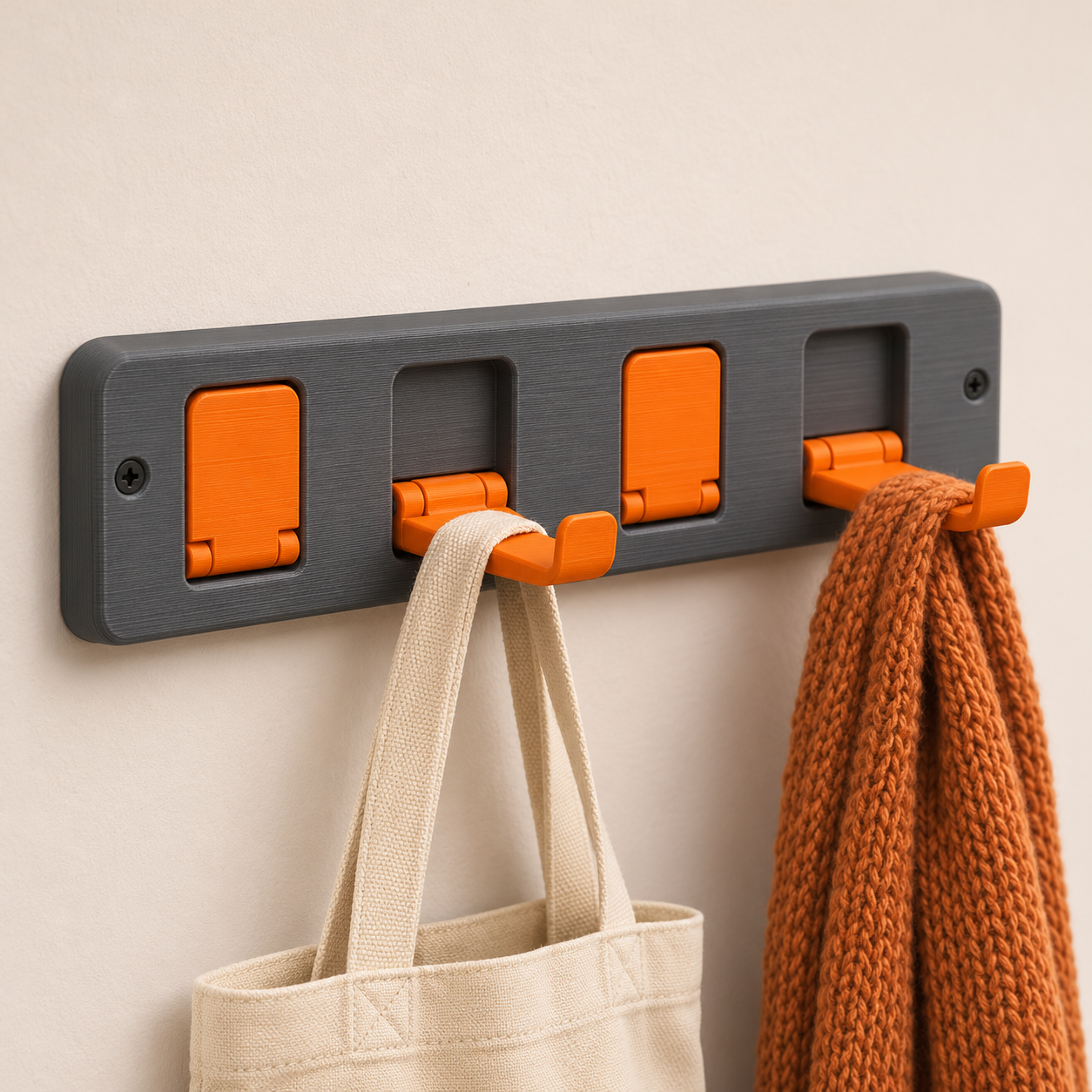
A 200 mm wall rail with four paddle hooks that fold up into recesses when idle and swing out onto a printed shelf stop when you need them.
Tuck-Away Fold-Up Four-Hook Wall Rail
A 200 mm wall rail with four paddle hooks that fold up into recesses when idle and swing out onto a printed shelf stop when you need them.
Date: 2026-11-10 Category: Household Modeling difficulty: Intermediate Estimated print: ~8.5 h total · ~115 g PETG (estimate) Suggested price: $22–$38 printed · $6 digital file (estimate) Status: Concept
Description
A flat rail, 200 × 46 mm and 22 mm deep, screwed to a wall or the back of a door. Four recesses are cut into its face. In each sits a paddle hook, 28 mm wide, hinged on a single steel rod that runs the length of the rail. Folded up, the hooks lie 4 mm below the rail face and the rail looks like a plain bar. Swung out, each hook lands on a shelf at the bottom of its recess and sticks 34 mm from the wall, with a 7 mm lip to hold a strap or a loop.
Use it for bags, scarves, a dog lead, keys on a ring, or headphones. The shelf takes the downward load. The rod only has to hold the hook in place.
Why it sells
Wall hooks are a listed seller category: an eufymake guide names wall hooks and cable organizers as Amazon Handmade items and says useful everyday items suit 3D printing, with practical gadgets at $8–$40; it gives no unit sales. A PrintPal guide puts organization and everyday items among top Etsy 3D models. Foldable hooks specifically are popular as free files: the MakerWorld hinged hook showed a 4.9 rating from 51 ratings in a search listing on 2026-11-10, with a commenter reporting it holds about 1 kg while another found it too weak for headphones; the Printables OOKER hook is a print-in-place purse hook that is 12 × 69 × 88 mm open and prints in about 20 min per the listing; and a parametric foldable wall hook uses a separate pin. The gap: those are single hooks with thin hinges that people report as weak. This is a rail of four with a printed shelf stop that carries the load, so the hinge only positions the hook.
Who buys it
Renters and small-flat households who want hooks that disappear when not in use, and gift buyers. Also people with front doors that open onto a narrow hall. They shop on Etsy, Amazon Handmade and craft fairs.
Design overview
- Rail body: 200 × 46 × 22 mm with four 29 × 40 mm bays, 20 mm deep.
- Four fold-up hooks, 28 wide × 38 long × 8 thick, each with a 5 × 7 mm lip at the tip.
- One 3 mm × 196 mm steel rod through all four hooks.
- Shelf stop: the 3 mm floor of each bay carries the arm's underside when deployed. This is the feature that fixes the weak-hinge complaint.
- Stowed hooks sit 4 mm below the rail face (arm front at z = 18, rail face at z = 22).
- Three countersunk screw holes, 4.2 mm, through the solid walls between bays.
- Design target: light loads, about 1 kg per hook (an estimate, not tested).
Dimensions
| Measurement | Value (mm) | Notes |
|---|---|---|
| Overall width (X) | 200 | Rail |
| Overall depth (Y) | 46 | Rail height up the wall |
| Overall height (Z) | 22 | Rail depth out from the wall; hooks reach 48 when deployed |
| Wall thickness | 12 / 20 | End walls / walls between bays |
| Bay size | 29 × 40 | X × Y, 20 deep, floor at z = 2 |
| Bay positions (X start) | 12, 61, 110, 159 | |
| Shelf thickness | 3 | Y 0 to 3 under each bay |
| Pivot hole | Ø3.2 | At Y 7, Z 14, through X |
| Screw holes | Ø4.2 | At (51,25), (100,25), (149,25); Ø8.5 countersink |
| Arm size | 28 × 38 × 8 | Plus the 5 × 7 lip |
| Arm bore | Ø3.4 | At the pivot centre |
Parts list
| Part | Qty | Material | Size X×Y×Z (mm) | Print orientation | Supports |
|---|---|---|---|---|---|
| Rail body | 1 | PETG | 200 × 46 × 22 | Back face down, bays up | none (teardrop pivot hole) |
| Fold-up hook arm | 4 | PETG | 28 × 38 × 15 | On the 28 × 38 face, lip up | none (teardrop bore) |
Hardware and non-printed parts
- 3 mm × 196 mm steel rod ×1 (pivot rod)
- Cyanoacrylate glue, one drop at each end of the rod hole ×2
- No. 8 flat-head wood screw, 40 mm ×3, plus wall anchors on drywall
Fits and tolerances
- Hook arm in bay: sliding, 0.5 mm per side (28 mm arm in 29 mm bay). It is wider than the usual 0.2 mm because the arm must swing without rubbing the bay wall on a warped print.
- Rod in rail hole: 3.2 mm hole for a 3 mm rod, 0.1 mm per side. The rod is held at the ends with glue.
- Rod in arm bore: 3.4 mm bore, 0.2 mm per side, sliding. This is the pivot.
Modeling guide
Rail origin: back-bottom-left corner. +X along the rail, +Y up the wall, +Z out from the wall.
Rail body
- Sketch on XY: rectangle 200 × 46. Extrude +Z 22.
- On the front face (z = 22) sketch four rectangles 29 × 40 at X 12–41, 61–90, 110–139, 159–188, Y 3–43. Cut down 20 (floor at z = 2).
- Pivot hole: Ø3.2 along X through the full 200 mm at Y 7, Z 14, with a teardrop top.
- Three Ø4.2 holes through Z at (51, 25), (100, 25), (149, 25). Add a 90° countersink Ø8.5 on the front face of each.
- Fillet the outer front edges 1.0, chamfer the back edge 0.4.
Hook arm Origin: pivot centre. +A along the hook length, +X along the rail, +B across the thickness.
- Sketch the side profile on the A-B plane: stadium from A = −4 to A = 34, B = −4 to +4, pivot end radius 4. Extrude 28, centred on X = 0.
- Lip: on the B = −4 face add a block A 29 to 34, B −4 to −11, full 28 wide. Fillet its outer corner 1.5.
- Pivot bore: Ø3.4 through along X at the pivot centre.
- Fillet tip corners 1.0 and long edges 0.6.
When deployed the hook rotates 90° about the pivot: its length points out from the wall, its underside (B = −4 side swaps with +4) rests on the shelf, and the lip points up. Check in CAD: the lip, which sits on the wall side when stowed, must stay at least 1 mm clear of the bay floor (lip lowest point z = 3, floor z = 2).
Print settings
| Setting | Value |
|---|---|
| Material | PETG |
| Nozzle | 0.4 mm |
| Layer height | 0.2 mm |
| Walls / perimeters | 4 |
| Infill | 30% gyroid |
| Supports | None |
| Brim / adhesion | Brim 5 mm on the rail, none on arms |
| Notes | Print all four arms in one session. Print the arms flat so layer lines run along the length and take the bending load. |
Assembly
- Drop the four arms into the bays, stowed, bores lined up with the pivot hole.
- Push the 196 mm rod through the rail and all four bores.
- Put one drop of glue in each end of the rod hole.
- Screw the rail to the wall with the three screws.
- Swing a hook out until its underside lands on the shelf stop.
Variants and upsells
- Two-hook (100 mm) and three-hook (150 mm) rails.
- Colour sets: charcoal rail with orange hooks, white rail with oak-coloured hooks.
- A 300 mm doorway kit with six hooks (this is outside the 220 mm bed, so split the rail in two and join on the rod).
- Next pieces: a matching key tray, a shelf with fold-up hooks.
Selling and distribution
Etsy and Amazon Handmade for the print, MakerWorld and Printables for the file. Price on material (about 115 g PETG), machine time (about 8.5 h) and a margin. Sell the print and the file. Licence the file with a commercial-use option. Include the rated load as "about 1 kg per hook, design target" in the listing, not as a safety rating.
Keywords: foldable wall hook, fold-up hook rail, hidden hooks, coat hook rail, bag hook, entryway organizer, renter friendly hooks, door hook, 3D printed hooks, minimalist hook.
Risks and IP notes
- Hinge pin load: mitigated by the shelf stop, which carries the downward force.
- Warped bays can bind arms. Mitigation: 0.5 mm side clearance and a brim.
- Overloading. Mitigation: state a light-load limit and do not market it for climbing or safety use.
- Saturation of foldable hooks. Mitigation: the rail format, four hooks per rail.
- Existing patents on folding hooks are possible. Do a quick search before selling at volume; this design uses a plain rod hinge and a shelf stop.
Resource links
- eufymake: best-selling 3D printed items — wall hooks and useful gadgets as seller categories
- PrintPal: top 3D models to sell in 2026 — organization and everyday items ranking
- MakerWorld hinged hook — a comparable hook, 4.9 from 51 ratings per search listing, with load comments
- Printables OOKER foldable table hook — print-in-place folding hook, size and print time
- MakerWorld parametric foldable wall hook — a separate-pin foldable wall hook
More from 3D Print Designs