Courtside Paddle & Ball Caddy
A wall-mount caddy that clips a pickleball paddle by the handle and feeds balls one at a time from a gravity tube below it, so you leave the court without a paddle rolling around the trunk of your…
Courtside Paddle & Ball Caddy
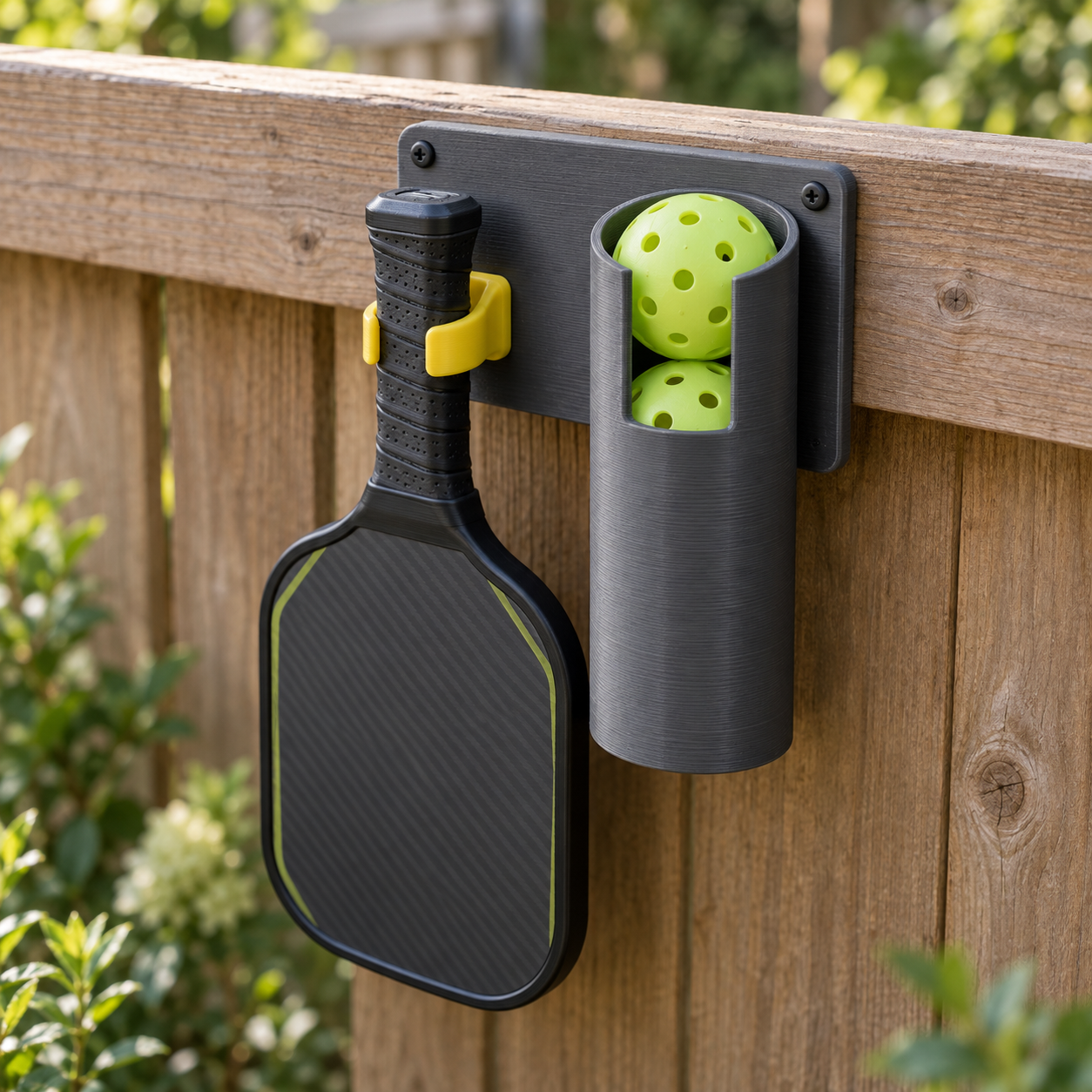
A wall-mount caddy that clips a pickleball paddle by the handle and feeds balls one at a time from a gravity tube below it, so you leave the court without a paddle rolling around the trunk of your car or balls scattered across the garage floor.
Date: 2026-09-26 Category: Sports and Fan Gear Modeling difficulty: Intermediate Estimated print: ~8 h total · ~150 g PETG + TPU (estimate) Suggested price: $18–$28 printed · $7 digital file (estimate) Status: Concept
Description
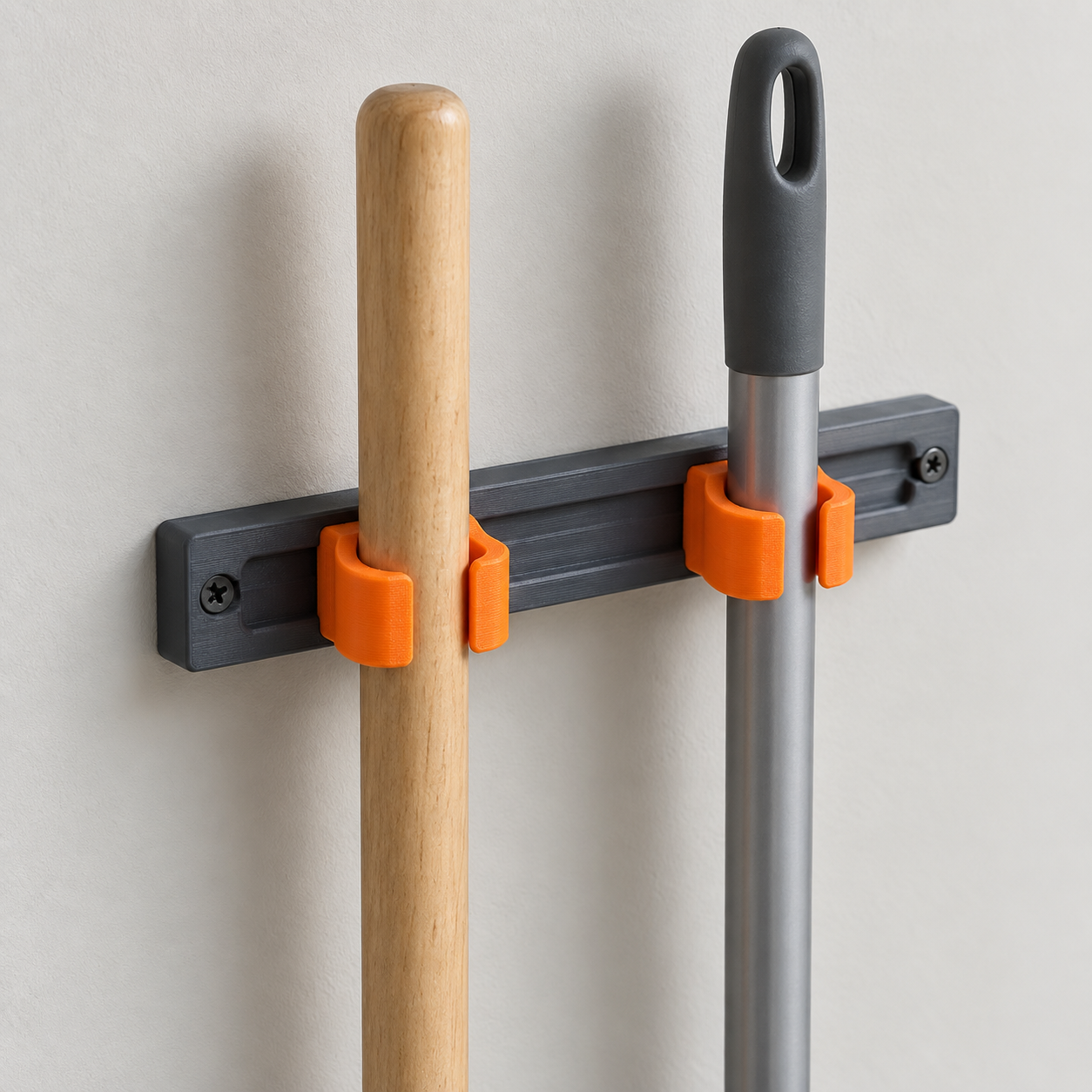
The caddy is three parts: a flat backplate that screws to a wall, fence, or garage stud; a vertical tube that dispenses balls one at a time through a side slot near its base; and a flexible clip that grips a paddle by its handle. The tube and clip both slide onto dovetail rails molded into the backplate, so the whole thing snaps together without tools beyond the two wall screws.
Balls load from the open top of the tube and stack under gravity. A retaining lip at the bottom holds the lowest ball in place until you tip it sideways through the exit slot, and the ball above drops down to take its place. The paddle clip is an open C-ring sized for a standard paddle handle that flexes wide enough to fit slightly larger or taped grips.
Everything mounts flush against a fence rail, a garage wall, or the side of a shed, and holds one paddle plus two balls — enough for a solo practice session without a bag.
Why it sells
Pickleball accessories have real, visible Etsy demand: multiple sellers list paddle holders that hang from a fence, net, or bench, and personalized versions of the same basic idea sell as gifts (Etsy, "3D Print Pickleball Holder" search; Etsy listing, Pickleball Paddle Holder; Etsy, "Pickle Ball Accessories 3D Print" search). A search on Yeggi alone surfaces listings from a wide spread of independent designers, which is a sign the category has room for more than one seller (Yeggi, "pickleball holder" search). Gravity-fed ball dispensers are their own proven mechanism on Printables, with free files for tennis balls and table-tennis balls built around the same side-exit-slot idea used here (Printables, Tennis Ball Dispenser; Printables, Table Tennis / Ping Pong Ball Dispenser).
Every paddle holder found in research does one job — hold the paddle. None of them also store and dispense balls. This design's gap-filler is combining both in one wall-mounted unit, on the strength of a dispensing mechanism that's already proven for other ball sports.
Who buys it
Pickleball players who practice against a wall or backboard and want their paddle and balls in one spot instead of a bag they have to dig through between serves. It fits garages, home courts, and fence-mounted setups at community courts (portable, screw-mount version), and sells as a practical gift for someone who just picked up the sport.
Design overview
- Three-part snap-together build: backplate, ball tube, and paddle clip, joined by dovetail rails — no tools beyond the wall screws.
- Gravity-fed ball tube holds two standard pickleballs, dispensing one at a time through a side slot.
- Retaining lip at the tube's exit keeps the stack from spilling out until a ball is deliberately tipped free.
- Flexible TPU paddle clip grips handles from 25–32 mm in diameter, covering bare and overwrapped grips.
- Keyhole mounting slots for a flush, no-visible-screw-head wall mount.
- PETG backplate and tube for outdoor-adjacent durability (fence or garage mounting, more UV- and moisture-tolerant than PLA).
- The one feature the researched competitors don't have: it stores and dispenses balls, not just the paddle.
Dimensions
| Measurement | Value (mm) | Notes |
|---|---|---|
| Overall width (X) | 100 | backplate |
| Overall depth (Y) | 20 | tube protrusion from wall, deepest point |
| Overall height (Z) | 210 | backplate |
| Backplate thickness | 8 | |
| Ball tube OD | 82 | |
| Ball tube ID | 76 | |
| Ball tube wall thickness | 3 | |
| Ball tube height | 175 | |
| Exit slot width × height | 60 × 70 | |
| Exit slot retaining lip height | 8 | above tube's true bottom |
| Vertical dovetail rail height | 165 | root 20 mm, tip 26 mm, 5 mm protrusion |
| Horizontal dovetail slot length | 40 | root 20.2 mm opening, 26.2 mm internal, 5 mm deep |
| Paddle clip inner diameter (at rest) | 27 | flexes 25–32 mm |
| Paddle clip wall thickness | 3 |
Parts list
| Part | Qty | Material | Size X×Y×Z (mm) | Print orientation | Supports |
|---|---|---|---|---|---|
| Backplate | 1 | PETG | 100 × 8 × 210 | Flat, front face up | none |
| Ball tube | 1 | PETG | 82 × 82 × 175 | Standing on end, exit slot facing out | none |
| Paddle clip | 1 | TPU 95A | 40 × 20 × 50 | Standing on flat back/tab face | none |
Hardware and non-printed parts
2 × #8 wood screw, 4.5 mm shank, 9 mm head (not included) — sized to the backplate's keyhole slots for a flush wall mount.
Fits and tolerances
- Ball tube dovetail channel to backplate rail: sliding fit, 0.2 mm clearance per side. The channel is a blind slot closed at its bottom, so the tube seats at a fixed height with a positive stop rather than relying on friction alone.
- Paddle clip tab to backplate slot: press/friction fit, 0.05 mm interference per side (neck 20.1 mm into a 20.2 mm opening; head 26.3 mm into a 26.2 mm internal width). The TPU tab compresses slightly on insertion, which holds the clip in place without hardware.
- Paddle clip C-ring to paddle handle: flex fit, not a fixed clearance — the ring's 27 mm at-rest diameter opens to 32 mm for insertion and closes down to grip handles as slim as 25 mm.
Modeling guide
Origin at the backplate's bottom-left-front corner; +X runs across the backplate's width, +Y points away from the wall, +Z runs up.
Backplate:
- Sketch on the XZ plane at Y=0: rectangle 100 (X) × 210 (Z). Extrude 8 mm in +Y.
- On the front face (Y=8), sketch two keyhole slots: each a 9 mm diameter circle at Z=205 transitioning to a 4.5 mm wide slot running down to Z=180 (25 mm of vertical travel). Center one at X=25, the other at X=75. Cut through the full 8 mm Y thickness.
- On the front face, sketch the vertical dovetail rail: root 20 mm wide (X=58 to X=78) at Y=8, tip 26 mm wide (X=55 to X=81) at Y=13 (5 mm protrusion), running from Z=5 to Z=170 (165 mm tall). Loft/extrude this trapezoid profile along Z.
- On the front face, cut the horizontal dovetail slot: opening 20.2 mm tall (Z=174.9 to Z=195.1) at Y=8, widening to 26.2 mm tall (Z=171.9 to Z=198.1) at Y=3 (5 mm deep), running 40 mm in X (X=5 to X=45), open at X=5 (backplate's left edge).
- Fillet all external edges 1 mm.
Ball tube:
- Sketch on the XZ plane at local Y=0: circle 82 mm diameter. Extrude 175 mm in +Y (tube's long axis becomes the local "up" direction when printed standing on end — treat this extrusion axis as the part's vertical axis).
- Shell the cylinder to a 3 mm wall (ID becomes 76 mm), leaving both ends open.
- On the tube's outer wall, cut the exit slot: 60 mm wide × 70 mm tall, positioned with its bottom edge 8 mm above the tube's bottom end.
- On the wall directly opposite the exit slot, add a flat land strip 30 mm wide running the tube's full height. Cut a blind dovetail channel into this land: opening 20.2 mm wide at the tube's outer surface, widening to 26.2 mm wide at 5 mm depth, running from 2 mm above the tube's bottom end up to the tube's top end (173 mm long), closed at its lower end (2 mm floor) to form a positive stop against the backplate's rail.
- Chamfer the tube's top opening 3 mm at 45° for easy ball loading. Fillet the exit slot's edges 2 mm.
Paddle clip:
- Sketch on the local XZ plane at Y=0: circle outer radius 16.5 mm, centered X=20, Z=33. Cut a 10 mm wide wedge from the +Z-facing side of the circle to form an open C profile (13.5 mm inner radius, 3 mm wall), opening facing up.
- Extrude the C profile 20 mm in +Y to form the clamp body (clamp depth along the handle axis).
- On the back face (Y=0), sketch the tab: 20.1 mm wide neck (X=9.95 to X=30.05) extruded -3 mm in -Y, then a 26.3 mm wide head (X=6.85 to X=33.15) extruded a further -2 mm in -Y. Tab length along X matches the neck/head widths; tab depth (Y) totals 5 mm.
- Fillet the two open ends of the C-ring (insertion gap edges) 1.5 mm.
Print settings
| Setting | Value |
|---|---|
| Material | PETG (backplate, tube), TPU 95A (clip) |
| Nozzle | 0.4 mm |
| Layer height | 0.2 mm |
| Walls / perimeters | 3 |
| Infill | 15% gyroid (backplate, tube), 25% gyroid (clip) |
| Supports | none |
| Brim / adhesion | brim 5 mm on clip (TPU bed adhesion) |
| Notes | Print the tube standing on its closed-channel end for a clean exit-slot edge; no pause needed. |
Assembly
- Slide the ball tube's dovetail channel down onto the backplate's vertical rail until it stops at the closed channel end.
- Slide the paddle clip's tab into the backplate's horizontal slot from the open left edge until it seats.
- Screw the backplate to the wall through the two keyhole slots.
- Load up to 2 pickleballs into the tube's open top; flex the paddle clip open and press a paddle handle into the C-ring.
Variants and upsells
Parametric variables cover paddle-clip inner diameter (for overwrapped or oversized grips) and tube height (for a 3-ball version, printed in two halves joined by the same dovetail-lap technique used for the backplate rail). A tennis-ball or racquetball version is a natural size variant using the same backplate and clip pattern with a resized ring diameter. Bundle two units side by side on a shared backplate as a "doubles" version for two paddles and a shared ball supply.
Selling and distribution
Best sold on Etsy alongside the existing pickleball-holder listings, priced above simple single-purpose hooks on the strength of the built-in ball dispenser. Sell the printed unit and the file separately; license the file for personal use under CC BY-NC, with a commercial license available since court facilities and pro shops are a plausible bulk buyer. Listing keywords: pickleball paddle holder, ball dispenser, wall mount paddle rack, court accessory, garage sports storage, paddle and ball caddy, pickleball gift, fence mount holder.
Risks and IP notes
- Design risk: the exit slot's retaining lip depends on print accuracy; an under-tolerance lip lets balls spill, an over-tolerance one jams them. Mitigation: the 8 mm lip height has margin either way, and the listing should note a quick test-load before wall mounting.
- Design risk: PETG is UV-resistant enough for occasional fence mounting but will still degrade under years of full sun. Mitigation: note in the listing that indoor or garage mounting extends service life.
- Market risk: pickleball accessories are trending toward saturation as the sport grows. Mitigation: lead marketing with the dispenser feature, since no comparable listing found in research combines paddle storage and ball dispensing.
- IP check: no team, league, or brand names appear anywhere in the design or listing copy; the paddle clip and dispenser use generic, unpatented mechanical principles already public in the cited dispenser designs.
Resource links
- Etsy, "3D Print Pickleball Holder" search — active multi-seller market for paddle holders
- Etsy, Pickleball Paddle Holder listing — comparable single-purpose paddle hook
- Etsy, "Pickle Ball Accessories 3D Print" search — shows the wider accessory category this design competes in
- Yeggi, "pickleball holder" search — breadth of independent designers already selling in this niche
- Printables, Tennis Ball Dispenser — comparable gravity-fed, side-exit dispenser mechanism
- Printables, Table Tennis / Ping Pong Ball Dispenser — second precedent for the same dispensing approach
More from 3D Print Designs