Lantern Chess Set with Backlit Board and Glass-Look Pieces
A chess set that glows: a board that prints like a lithophane, with thin light squares and thick dark ones over warm LEDs, and 32 one-wall translucent pieces that fill with light when they stand on…
Lantern Chess Set with Backlit Board and Glass-Look Pieces
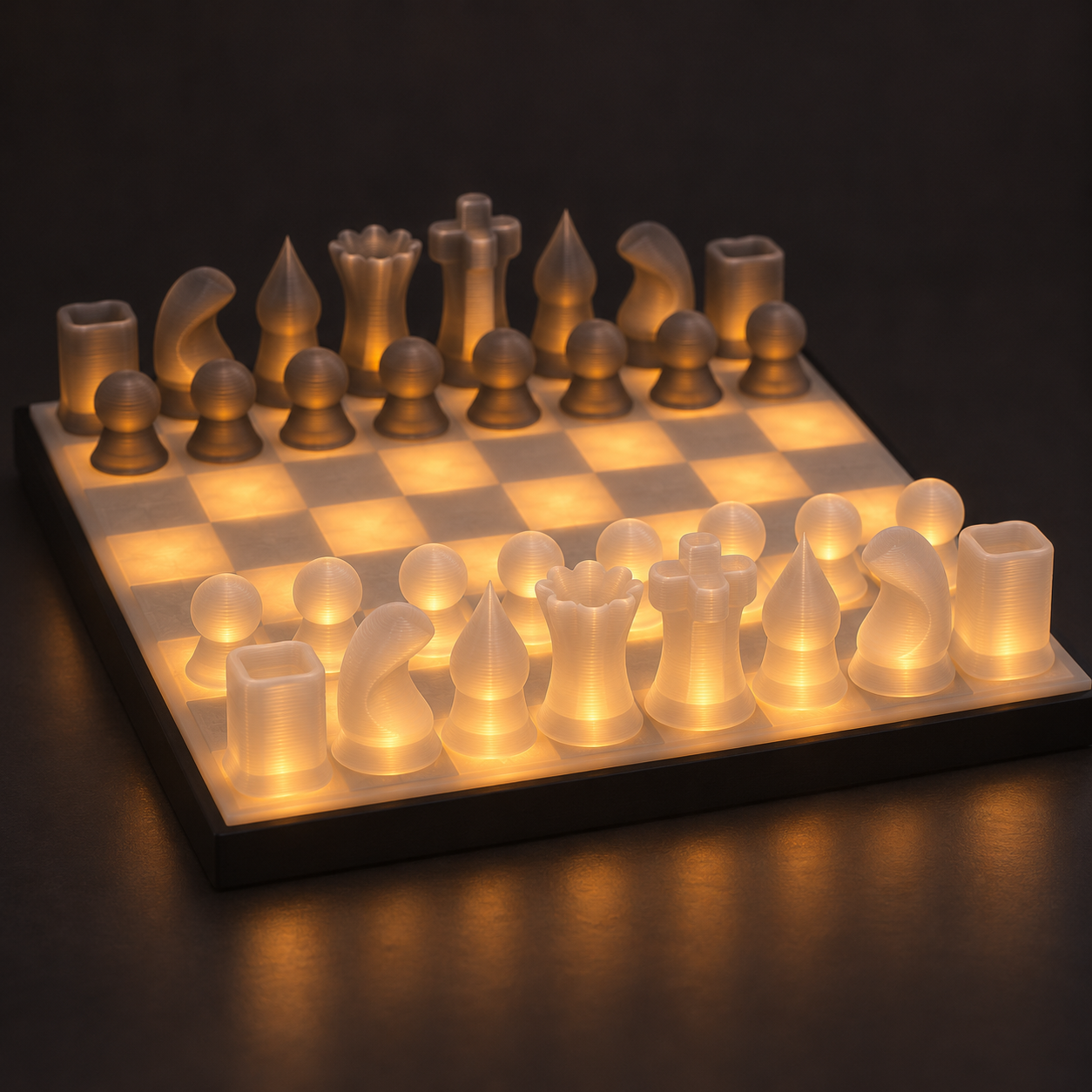
A chess set that glows: a board that prints like a lithophane, with thin light squares and thick dark ones over warm LEDs, and 32 one-wall translucent pieces that fill with light when they stand on it.
Date: 2026-11-12 Category: Art and Decor Modeling difficulty: Advanced Estimated print: ~38 h total · ~351 g PLA and PETG (estimate) Suggested price: $90–$160 printed · $10 digital file (estimate) Status: Concept
Description
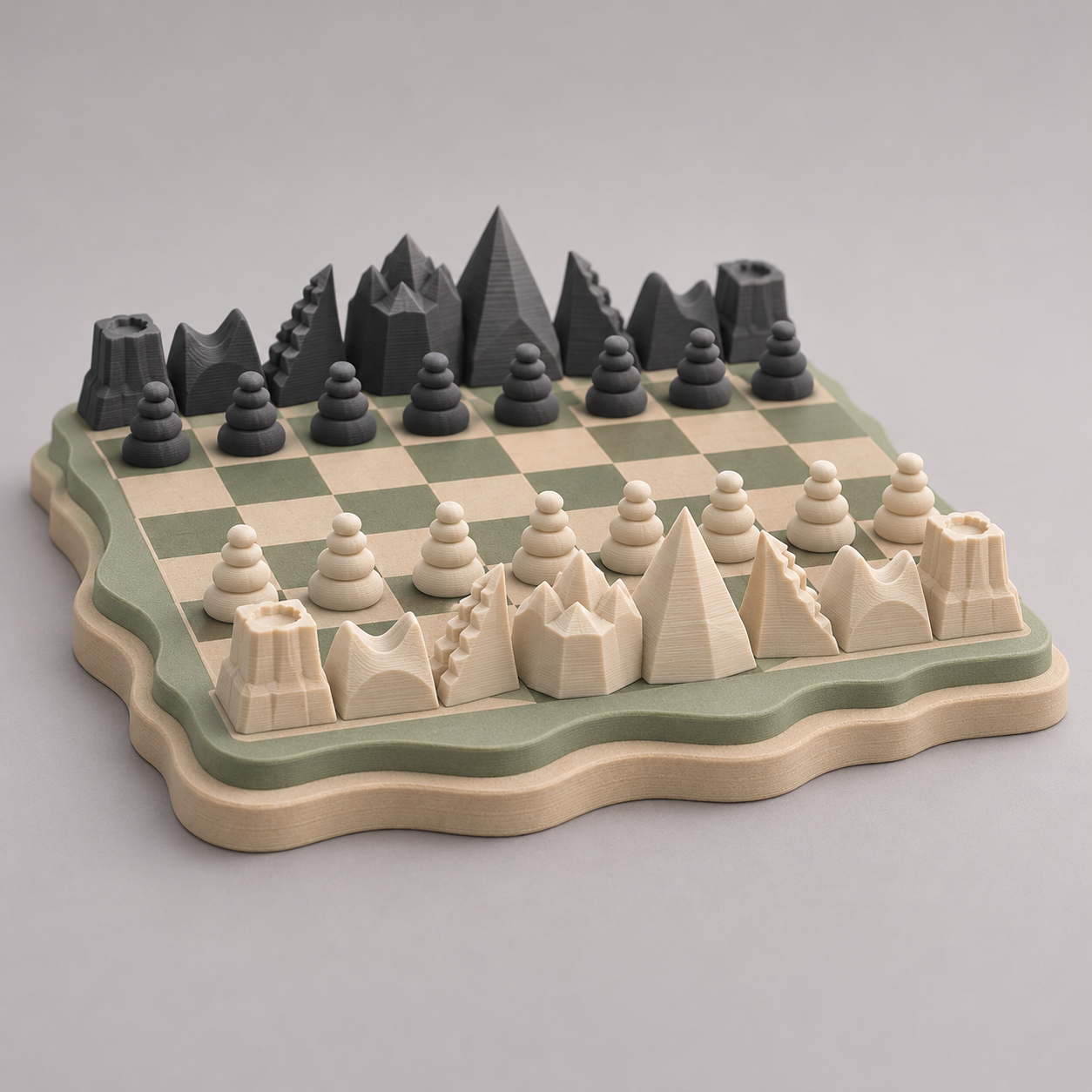
Lantern is a night-time chess set. The board is a 216 mm square tray with warm-white LED strips on its floor, closed by a white lid printed like a lithophane. On the 8 × 8 playing field the 32 light squares are 0.8 mm thick and glow, and the 32 dark squares are 3.0 mm thick and glow far less. Nothing needs painting or a second filament: the pattern comes from thickness alone, the way a lithophane makes an image.
The pieces are printed in spiral vase mode, a single 0.6 mm wall with a thin closed base, in translucent PETG. Set on the lit board they fill with light and show their layer lines like blown glass. Each type is told apart by its outline and by its cross-section seen from above: a round pawn, a rounded-square rook, a pointed bishop, an eight-lobed queen, a king with a four-lobed plus cross-section, and a knight made from a bent elliptical tube with a keel for the mane. The two sides are frosted natural and smoke-grey PETG.
It sits on a table as a lamp when nobody is playing. Pieces are 28 to 46 mm tall on 25 mm squares, with bases 40 to 50 percent of height per the FIDE handbook rule.
Why it sells
Light-up chess is something people already make. Inductive Chess prints pieces in white or black PETG with transparent PETG parts and an LED in every base, and Dead or Alive LED Chess Set is another printed LED set. Backlit lithophanes are an established technique too: SparkFun's DIY lithophane project lights a printed panel from behind, and Bambu Lab sells a lithophane LED backlight board kit for it. This is an art piece chosen on taste, so no sales figures are offered.
My search turned up no board that lights its squares from behind with lithophane-style thickness, and no set with single-wall pieces whose cross-sections differ. Those two are the gap: the light lives in the board, so the 32 pieces need no electronics.
Who buys it
People who like lamps and objects as much as games: design-minded gift buyers, desk and shelf display collectors, and chess players who want a set for evening play. Sold on Etsy as a finished lamp-and-game, and as a file on Printables and MakerWorld.
Design overview
- The surprise: a lithophane board. Light squares 0.8 mm thick, dark squares 3.0 mm, same white PLA, over four warm-white LED strips.
- 32 vase-mode pieces with a 0.6 mm wall and a sealed 0.8 mm base; the light enters through the base and out through the open top.
- Types are readable from above: pawn circle, rook rounded square, queen 8 lobes, king 4 lobes (a plus), bishop and knight by silhouette.
- Heights 28 / 32 / 35 / 38 / 42 / 46 mm (P / R / N / B / Q / K), square size 25 mm, bases Ø14 to Ø21.
- Frame 216 × 216 × 28 mm with a 4 mm wall; the lid has a 3 mm locating lip that drops inside it.
- One USB cable exits at the back; the strips are cut and wired in parallel.
Dimensions
| Measurement | Value (mm) | Notes |
|---|---|---|
| Board width (X) | 216 | frame and lid |
| Board depth (Y) | 216 | |
| Board height (Z) | 31 | frame 28 + 3 of lid; the 3 mm lip sits inside the frame |
| Frame wall | 4 | |
| Frame floor | 2 | |
| Lid thickness | 3 | border and dark squares |
| Light square skin | 0.8 | 4 layers at 0.2 |
| Square size | 25 | 8 × 8 = 200 field, 8 mm border |
| Lid lip | 3 | outer 207.6, inner 204.4, high 3 mm |
| Strip positions (Y) | 30 / 82 / 134 / 186 | four strips along X, 190 long |
| Piece base Ø (K/Q/B/N/R/P) | 20 / 19 / 18 / 17 / 16 / 14 | vase-mode bases; the king's lobes reach Ø21 higher up |
| Piece height (K/Q/B/N/R/P) | 46 / 42 / 38 / 35 / 32 / 28 | |
| Piece wall | 0.6 | single line, vase mode |
| Piece base floor | 0.8 | 4 solid layers |
Parts list
| Part | Qty | Material | Size X×Y×Z (mm) | Print orientation | Supports |
|---|---|---|---|---|---|
| LED board frame | 1 | PLA | 216 × 216 × 28 | floor face down | none |
| Lithophane top plate | 1 | PLA | 216 × 216 × 6 | playing surface down on the build plate, lip pointing up | none |
| King (white) | 1 | PETG | 21 × 21 × 46 | base face down, vase mode | none |
| King (black) | 1 | PETG | 21 × 21 × 46 | base face down, vase mode | none |
| Queen (white) | 1 | PETG | 19 × 19 × 42 | base face down, vase mode | none |
| Queen (black) | 1 | PETG | 19 × 19 × 42 | base face down, vase mode | none |
| Rook (white) | 2 | PETG | 16 × 16 × 32 | base face down, vase mode | none |
| Rook (black) | 2 | PETG | 16 × 16 × 32 | base face down, vase mode | none |
| Bishop (white) | 2 | PETG | 18 × 18 × 38 | base face down, vase mode | none |
| Bishop (black) | 2 | PETG | 18 × 18 × 38 | base face down, vase mode | none |
| Knight (white) | 2 | PETG | 17 × 22 × 35 | base face down, vase mode | none |
| Knight (black) | 2 | PETG | 17 × 22 × 35 | base face down, vase mode | none |
| Pawn (white) | 8 | PETG | 14 × 14 × 28 | base face down, vase mode | none |
| Pawn (black) | 8 | PETG | 14 × 14 × 28 | base face down, vase mode | none |
Hardware and non-printed parts
- 5 V warm-white COB LED strip, 8 mm wide, 2700 K, about 320 LEDs/m ×4: Cut four 190 mm lengths, stick them in the floor channels at y = 30, 82, 134, 186 and wire them in parallel with 2-core wire (basic soldering).
- USB-A to bare-lead cable, 1 m, 5 V ×1: Exits through the 9 × 4 mm back-wall notch; add an inline dimmer if wanted.
- White card or copy paper 204 × 204 mm ×1: Lines the floor between the strips as a diffuse reflector.
- Double-sided tape, 6 mm ×8: Short pieces to hold the wiring flat to the floor.
Fits and tolerances
- Lid lip to frame: sliding, lip outer 207.6 in a 208 inner, 0.2 mm per side, with a 3.0 mm engagement. No adhesive, so the lid can lift off for LED access.
- Pieces to board: loose, they stand on the flat playing surface.
Modeling guide
Origin for the frame: front-left bottom corner, +X right, +Y toward the back wall, +Z up. For the lid, the playing surface is z = 0 and the lip points up (print orientation). Pieces: origin at the centre of the base underside, +Z up.
LED board frame (x1, id board-frame)
- Sketch on XY, origin at the front-left bottom corner: rectangle 216 × 216, corner radius 3. Extrude 28.
- Shell: cut the inner rectangle x 4 to 212, y 4 to 212, from z = 2 to z = 28. The floor is 2 thick, the walls are 4.
- Cut a cable notch in the back wall (y = 212 to 216): 9 wide × 4 tall, centred at x = 108, from z = 2 to z = 6.
- Add four strip guides: for each strip centre y = 30, 82, 134 and 186, two ribs 1.2 wide × 2 tall × 190 long along X at y ± 5.0 (leaving an 8.8 mm channel); each strip runs from x = 13 to x = 203.
- Fillet the top outer edge 0.6.
Lithophane top plate (x1, id top-plate)
- Model it face-down: the playing surface is z = 0. Sketch on XY, origin at the front-left corner: rectangle 216 × 216, corner radius 3. Extrude 3.0 (border and dark squares are this thick).
- Squares: the playing field is x 8 to 208, y 8 to 208, with 25 mm squares. For the 32 light squares (file i, rank j with (i + j) odd) cut a pocket 25 × 25 (corner radius 1) into the back face (z = 3.0 down to z = 0.8), leaving a 0.8 mm skin. Dark squares stay 3.0 thick.
- Locating lip on the back face: a square ring, outer 207.6 × 207.6 centred at (108,108), inner 204.4 × 204.4, extruded 3 above the back face (z 3.0 to 6.0). It drops inside the frame walls (inner 208).
- Fillet the front top outer edge 0.6.
King (white) (x1, id king-white)
- Spiral-vase body: revolve about Z, profile (z, r): (0,10) (2,9.8) (7,6.2) (15,4.2) (19,4.4) (26,6.8) (36,8.2) (42,8.4) (44,7.6) (46,6.8). Cross-section: 4-lobed plus: r(θ) = r(z) × (1 + 0.25 cos 4θ), blended from 0 at z = 18 to full at z = 26.
- Leave the top open. The wall is a single 0.6 mm line; model it as a surface or give it 0.6 thickness.
- Close the base with a flat disc of the base radius, 0.8 thick (4 layers) so the board light shines up into the piece.
- Slicer: spiral vase mode, line width 0.6, 4 bottom solid layers, no top layers.
King (black) (x1): Identical to king-white; print in smoke-grey translucent PETG instead.
Queen (white) (x1, id queen-white)
- Spiral-vase body: revolve about Z, profile (z, r): (0,9.5) (2,9.3) (6,6.0) (14,3.8) (18,4.0) (24,6.5) (32,8.0) (38,8.6) (42,7.0). Cross-section: 8-lobed: r(θ) = r(z) × (1 + 0.08 cos 8θ), blended from 0 at z = 18 to full at z = 24.
- Leave the top open. The wall is a single 0.6 mm line; model it as a surface or give it 0.6 thickness.
- Close the base with a flat disc of the base radius, 0.8 thick (4 layers) so the board light shines up into the piece.
- Slicer: spiral vase mode, line width 0.6, 4 bottom solid layers, no top layers.
Queen (black) (x1): Identical to queen-white; print in smoke-grey translucent PETG instead.
Rook (white) (x2, id rook-white)
- Spiral-vase body: revolve about Z, profile (z, r): (0,8) (2,8) (4,6.4) (20,6.0) (21,6.2) (24,7.8) (32,8.0). Cross-section: rounded square, corner radius 3.
- Leave the top open. The wall is a single 0.6 mm line; model it as a surface or give it 0.6 thickness.
- Close the base with a flat disc of the base radius, 0.8 thick (4 layers) so the board light shines up into the piece.
- Slicer: spiral vase mode, line width 0.6, 4 bottom solid layers, no top layers.
Rook (black) (x2): Identical to rook-white; print in smoke-grey translucent PETG instead.
Bishop (white) (x2, id bishop-white)
- Spiral-vase body: revolve about Z, profile (z, r): (0,9) (2,8.8) (6,5.5) (14,3.4) (16.5,5.2) (19,3.8) (22,4.8) (26,6.0) (30,5.4) (34,3.4) (37,2.0) (38,1.6). Cross-section: circle.
- Leave the top open. The wall is a single 0.6 mm line; model it as a surface or give it 0.6 thickness.
- Close the base with a flat disc of the base radius, 0.8 thick (4 layers) so the board light shines up into the piece.
- Slicer: spiral vase mode, line width 0.6, 4 bottom solid layers, no top layers.
Bishop (black) (x2): Identical to bishop-white; print in smoke-grey translucent PETG instead.
Knight (white) (x2, id knight-white)
- Base: loft from z = 0 (circle r 8.5) through (z,r) (2,8.3) (6,6.0) (12,5.2) to an ellipse at z = 12.
- Neck path in the YZ plane: vertical from (y,z) = (0,12) to (0,12); then an arc of radius 22 bending 40° toward +Y, ending at (5.15,26.14); then a straight run 8 long at 40° from vertical, ending at (10.3,32.3).
- Sweep an ellipse along the path: half-axes 5.2 (X) × 6.0 (Y) at z = 12, tapering to 3.6 × 4.2 at the end. Add a keel: widen the section by a lobe of +1.5 on the −Y side (the mane) for the whole sweep.
- Leave the muzzle end open (a cut perpendicular to the path). Highest point z = 35.
- Slicer: spiral vase mode, line width 0.6, 4 bottom solid layers, no top layers.
- Print with the open muzzle facing up and the neck leaning at 40° (within the 45° overhang limit).
Knight (black) (x2): Identical to knight-white; print in smoke-grey translucent PETG instead.
Pawn (white) (x8, id pawn-white)
- Spiral-vase body: revolve about Z, profile (z, r): (0,7) (2,6.8) (5,4.4) (10,3.2) (13,3.8) (15,5.2) (18,6.0) (21,6.0) (23,5.2) (25,3.8) (27,2.4) (28,2.0). Cross-section: circle.
- Leave the top open. The wall is a single 0.6 mm line; model it as a surface or give it 0.6 thickness.
- Close the base with a flat disc of the base radius, 0.8 thick (4 layers) so the board light shines up into the piece.
- Slicer: spiral vase mode, line width 0.6, 4 bottom solid layers, no top layers.
Pawn (black) (x8): Identical to pawn-white; print in smoke-grey translucent PETG instead.
Print settings
| Setting | Value |
|---|---|
| Material | Frame: black PLA (opaque). Lid: white PLA. Pieces: frosted natural PETG and smoke-grey translucent PETG. |
| Nozzle | 0.4 mm |
| Layer height | 0.2 mm (lid and frame); 0.16 mm for the pieces |
| Walls / perimeters | Frame 3, lid 3; pieces: spiral vase, 1 wall, line width 0.6 |
| Infill | Frame 15% gyroid; lid 100% (it is thin); pieces none |
| Supports | None |
| Brim / adhesion | None (lid on a smooth PEI plate for a clean playing surface); 3 mm brim for the pawn and bishop |
| Notes | Print the lid playing-surface down. Pieces need good cooling and a slow outer wall. A white lid wants a brightness test tile first. |
Assembly
- Print the frame, lid and 32 pieces. Wash the lid and check light squares are 0.8 mm with a caliper on a sacrificial test tile.
- Lay the white card on the frame floor. Stick the four LED strips into their channels.
- Solder each strip's + and − to a 2-core bus along the west wall, route it to the back-wall notch and solder to the USB lead.
- Test with the lid off at 5 V, then seat the lid with the lip dropping into the frame.
- Place pieces: frosted natural PETG on ranks 1 and 2, smoke-grey on ranks 7 and 8, with a dark square at each player's left.
Variants and upsells
A tinted-lid edition in warm cream or pale blue PLA for different glow colours. A colour-cycling RGB strip version with a small remote. A pocket-lamp mode where a 3 mm engraved pattern replaces the squares. A matching clock-face or go board on the same frame.
Selling and distribution
Etsy and design-minded markets suit the finished lamp-and-set; the file suits Printables and MakerWorld. Price from material (about 350 g, an estimate), about 38 print hours at machine rate, wiring time and LEDs. Sell both: the printed set with LEDs fitted at a premium, the file with a hobby licence. Keywords: lit chess set, glowing chess board, lithophane chess, LED chess set, translucent chess pieces, vase mode chess, chess lamp, desk chess, night chess, modern chess set.
Risks and IP notes
- LED hot spots under the light squares. Mitigation: cavity 24 mm deep, white liner, strips on a 52 mm pitch; add a 0.2 mm frosted film if the test tile shows banding.
- Vase-mode pieces are fragile and light. Mitigation: 0.6 mm wall, 0.8 mm base, and a note that they are display-grade; ship in a foam tray.
- Soldering is a barrier for casual makers. Mitigation: offer a pre-wired USB strip kit variant and a no-solder version with a single long strip folded at the corners.
- Low-voltage electronics. Mitigation: USB 5 V only; no mains wiring in the design.
- Market: light-up chess already exists. Mitigation: lead with the lithophane board and the cross-section language rather than "LED chess".
Resource links
- Inductive Chess (stlfinder) — Printable chess set with transparent PETG parts and LEDs in the pieces
- Dead or Alive LED Chess Set (stlfinder) — Another printable LED chess set
- Bambu Lab Lithophane LED Backlight Board Kit (MatterHackers) — Ready-made 96 × 144 mm backlight boards; shows the lithophane-backlight approach this design generalises to a 216 mm board
- DIY 3D-printed lithophane (SparkFun) — A printed lithophane backlit with LEDs; thickness sets brightness
- FIDE Handbook: Standards of chess equipment — Base diameter is 40-50% of height
- Chess piece sizes (House of Staunton) — Piece size and square relationships for tournament sets
More from 3D Print Designs