Lunar Tide Ring: A Month of Tides as a Desk Sculpture
A 170 mm ring whose rim rises and falls with 29.5 days of predicted tides at a harbour of your choice, so one full turn is one lunar cycle.
Lunar Tide Ring: A Month of Tides as a Desk Sculpture
A 170 mm ring whose rim rises and falls with 29.5 days of predicted tides at a harbour of your choice, so one full turn is one lunar cycle.
Date: 2026-11-12 Category: Art and Decor Modeling difficulty: Intermediate Estimated print: ~7 h total · ~60 g PLA (estimate) Suggested price: $35–$75 printed · $9 digital file (estimate) Status: Concept
Description
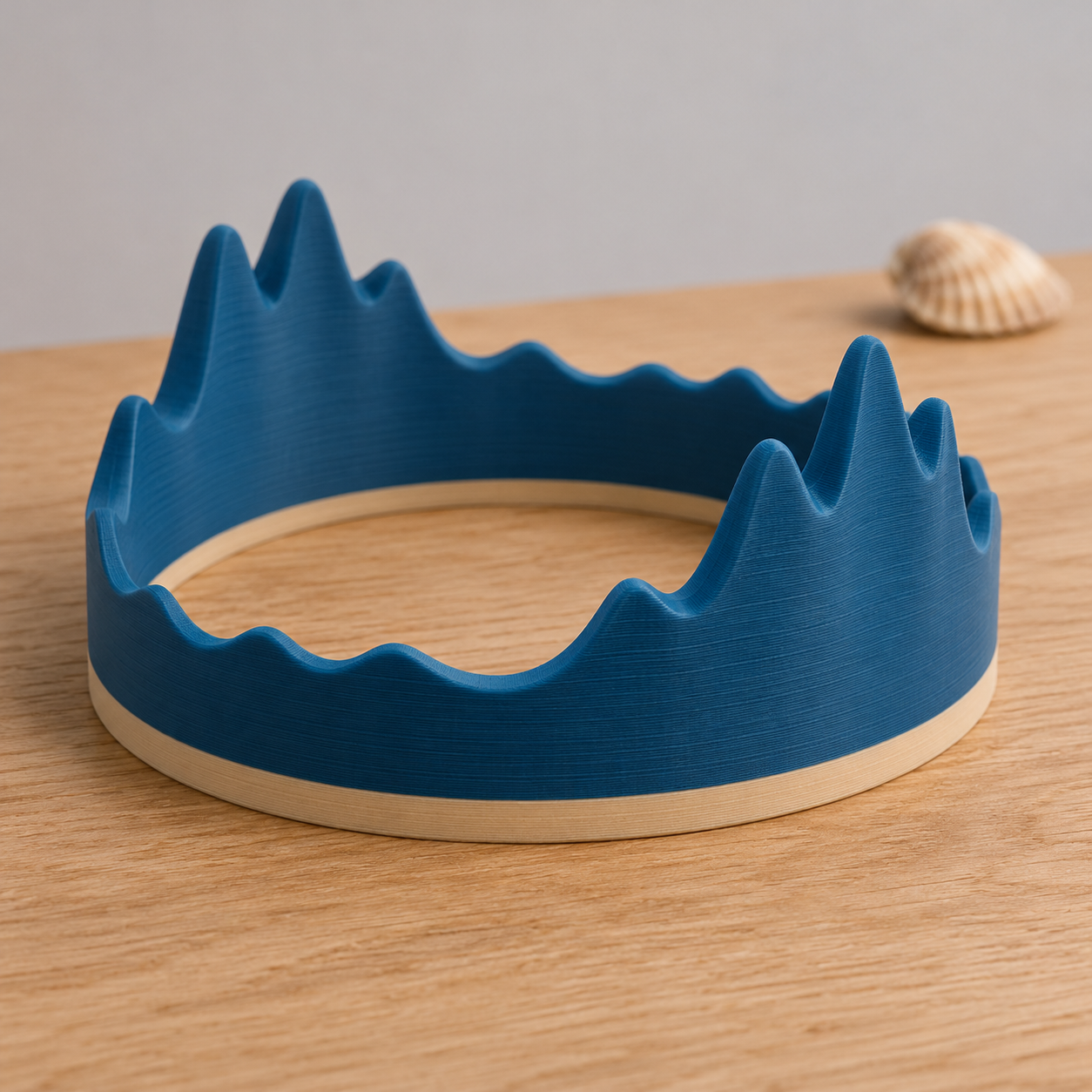
The Lunar Tide Ring is a plain circular band, 170 mm across and 10 mm thick, with a solid 8 mm base. The top edge is not flat. Its height at every point comes from NOAA's hourly tide predictions for one station, wrapped once around the circle. Go clockwise from 12 o'clock and you read 29.5 days, a full cycle of the moon.
Two things show up in the silhouette. Tides come about twice a day, so you get a ring of roughly 59 ridges. Their height swells and shrinks: tall peaks near new and full moon (spring tides), low ones near the quarter moons (neap tides). The two clusters of tall peaks end up on opposite sides of the ring, which is the moon's rhythm made visible. It sits on a shelf as an object, or holds a candle, a plant pot or a bowl of keys.
The ring prints flat in one piece with no supports. Change the station and start date and you get a different ring, so a harbour the buyer knows becomes a personal gift.
Why it sells
This is an art piece, so the case rests on inspiration rather than sales rankings. Data sculpture has a real tradition: the Dataphys catalogue of physical visualizations has a whole section for sea and tide pieces (Dataphys, sea tag), and a Glasgow School of Art student built Tide Over Time, resin sculptures from tide-gauge data around full and half moons (Morven Walker, GSA showcase 2022). Nathalie Miebach turns weather and tide data into woven sculpture (Smithsonian Magazine). The spring and neap pattern is standard tidal science: spring tides at new and full moon, neap tides at the quarters (NOAA Ocean Service). I found no 3D-printable version of a lunar-month tide ring, which is the gap: most printable "data art" is a vase or a skyline, not a calendar you can hold.
Who buys it
Coastal people and people who miss the coast: sailors, surfers, kayakers, marine-science teachers, anyone with a harbour tied to a memory. The occasions are a wedding or birth at a named port, a retirement gift for a harbour-master type, and a classroom model of spring and neap tides. Sold as a personalised print on Etsy or at coastal craft markets, or as a parametric file on Printables or MakerWorld.
Design overview
- A vertical ring band: 170 mm outer diameter, 150 mm inner diameter, 10 mm radial wall.
- Solid base band 8 mm tall; the data adds 0 to 30 mm above it, so the rim runs between 8 and 38 mm.
- 360 height samples, one per degree, taken from hourly NOAA predictions over 708 hours (29.5 days). 12 o'clock is the start, clockwise.
- Default data: San Francisco, NOAA station 9414290, from 2026-12-09 (close to the December 2026 new moon; check an almanac and shift the start if you want the exact new moon at 12 o'clock).
- The station name, ID and start date are engraved on the outer face of the base band.
- Sets it apart: the whole piece is one real measured dataset, wrapped so that a full revolution equals a lunar month and the two spring-tide clusters face each other across the ring.
Dimensions
| Measurement | Value (mm) | Notes |
|---|---|---|
| Overall width (X) | 170 | outer diameter |
| Overall depth (Y) | 170 | outer diameter |
| Overall height (Z) | 38 | at the highest tide; base is 8 |
| Wall thickness | 10 | radial, constant |
| Inner diameter | 150 | |
| Base band height | 8 | minimum rim height at lowest predicted tide |
| Data height range | 30 | added above base, scaled min to max |
| Engraved text height | 4 | cap height, 0.6 deep, centred at z = 4 |
Parts list
| Part | Qty | Material | Size X×Y×Z (mm) | Print orientation | Supports |
|---|---|---|---|---|---|
| Tide ring | 1 | PLA | 170×170×38 | flat, base band down | none |
Hardware and non-printed parts
None — fully printed.
Fits and tolerances
No mating parts. If the buyer wants a candle or pot to sit inside, the 150 mm inner diameter leaves 0.5 mm per side of clearance for a 149 mm item; most users will just set things in it loosely.
Modeling guide
Origin at the ring centre on the build plate. +Z up, +Y at 12 o'clock, angles measured clockwise from +Y.
- Download the data. Request
https://api.tidesandcurrents.noaa.gov/api/prod/datagetterwithproduct=predictions,station=9414290,datum=MLLW,interval=h,time_zone=lst,units=metric,format=csv,begin_date=20261209and a 708 hour range. NOAA's page confirms these options and that hourly predictions allow up to a year per request. - Resample the 708 values to 360 by linear interpolation (one value per degree), then apply a 3-sample moving average to remove stair-steps.
- Normalise:
h_i = 8 + 30 × (v_i − v_min) / (v_max − v_min), so every value lies between 8 and 38 mm. - In OpenSCAD, build a
polyhedronwith 4 vertices per degree: inner-bottom (r 75, z 0), outer-bottom (r 85, z 0), outer-top (r 85, z h_i), inner-top (r 75, z h_i). Place vertex i at angle θ = i° clockwise from +Y. Close the 360 side quads, plus the top, bottom, inner and outer faces. The same ring in Fusion is a spline-driven loft; OpenSCAD is simpler. - Engrave the text on the outer face: 4 mm cap height, 0.6 mm deep, centred at z = 4 (inside the 8 mm base band), starting at 12 o'clock and following the curve:
SAN FRANCISCO 9414290 2026-12-09. - Check that no vertical wall is thinner than 10 mm and that the model is one manifold solid.
Print settings
| Setting | Value |
|---|---|
| Material | PLA |
| Nozzle | 0.4 mm |
| Layer height | 0.2 mm |
| Walls / perimeters | 3 |
| Infill | 15% gyroid |
| Supports | none |
| Brim / adhesion | brim 5 mm |
| Notes | Optional colour change at z = 8.0 mm (base band in sand, data band in blue). The tall ridges are vertical, so they print without overhangs. |
Assembly
No assembly — prints ready to use.
Variants and upsells
- Personalised harbour edition: any NOAA station that has harmonic predictions (Great Lakes stations have none).
- A birth-month or wedding-month ring: begin_date set to the day.
- A 12-ring year set, one ring per lunar month, stacked in a shelf rack; each new ring completes the year.
- A mini 100 mm ring version as a keepsake or ornament.
Selling and distribution
Sell the print on Etsy as a personalised item, with the buyer choosing the port and date. Put the parametric OpenSCAD file on Printables or MakerWorld at $9 with a commercial-use option. Price: material is about $1.50 for 60 g, machine time 7 h, plus the personalisation work and packing, so $35 to $75 is plausible (estimate). NOAA's API page I read asks only for an optional application identifier and states no credit rule. I did not find the data-use policy itself, so read it before selling and add a short NOAA credit line to listings anyway. Keywords: tide sculpture, lunar tide ring, moon phase decor, data art, tide chart gift, harbour gift, nautical decor, spring tide, personalised coastal gift, 3D printed data sculpture.
Risks and IP notes
- Market: data art is niche. Mitigation: sell the personalisation, not the ring.
- Accuracy: the shape shows predictions, not observed levels. Mitigation: label them as predictions in the listing.
- Printing: sharp ridges can look rough at 0.2 mm layers. Mitigation: use the 3-sample smoothing, or print at 0.16 mm.
- Data licence: unverified beyond the API page. Mitigation: confirm NOAA's data-use policy and credit NOAA CO-OPS.
- Not for navigation or safety use. State it in every listing.
Resource links
- NOAA CO-OPS Data API builder — the prediction parameters (datum, interval, time zone, units, range limits) used in step 1
- NOAA CO-OPS web services overview — the three CO-OPS APIs and the cloud URL change
- NOAA Ocean Service: spring tides and neap tides — why the heights swell at new and full moon
- Dataphys: physical visualizations tagged sea — the tradition of tide and sea data as objects
- Morven Walker, Tide Over Time (GSA showcase 2022) — resin sculptures made from tide-gauge data around moon phases
- Smithsonian Magazine on Nathalie Miebach — data turned into sculpture, for inspiration
More from 3D Print Designs