Mode Lines Chladni Lampshade Set for LED Lamp Kit 001
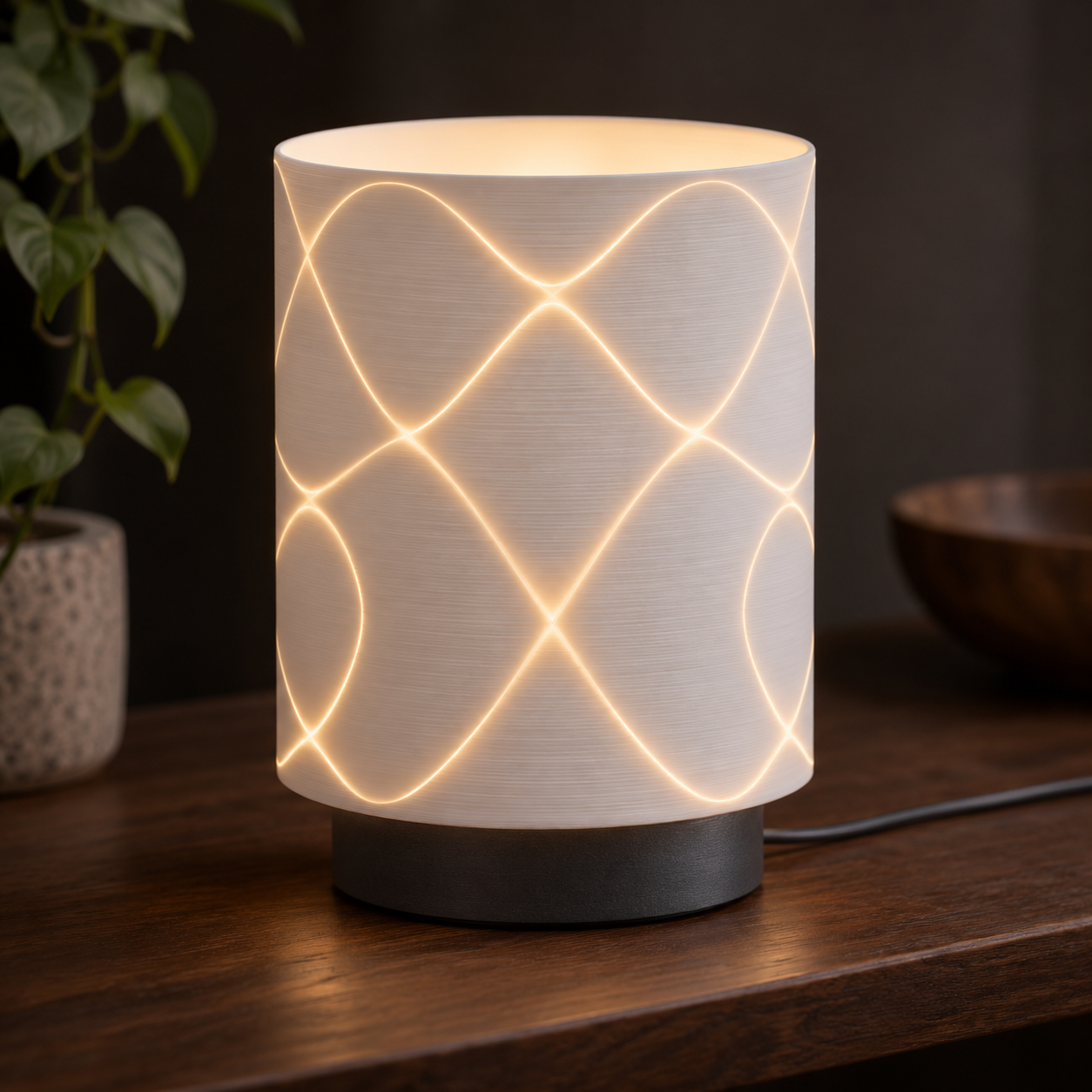
A cylindrical lampshade whose glowing lines trace a vibration-mode pattern, with one base that takes a growing set of shades, each a different mode.
Mode Lines Chladni Lampshade Set for LED Lamp Kit 001
A cylindrical lampshade whose glowing lines trace a vibration-mode pattern, with one base that takes a growing set of shades, each a different mode.
Date: 2026-11-12 Category: Art and Decor Modeling difficulty: Advanced Estimated print: ~9.5 h total · ~150 g PLA (estimate) Suggested price: $40–$75 printed · $8 digital file (estimate) Status: Concept
Description
A white tube, 100 mm across and 130 mm tall, on a charcoal base. The wall is 2.0 mm thick except along a set of curved lines, where it drops to 0.8 mm. Unlit, you see a faint embossed pattern. Lit from inside, the thin lines glow and the rest of the wall stays dark, like sand gathered along the still lines of a vibrating plate.
The pattern is a standing-wave field computed on the unrolled sheet, f = cos(mθ)·cos(nπu) − cos(nθ)·cos(mπu), where θ is the angle around the shade and u runs from 0 to 1 up its height. Whole-number m and n make the lines meet at the seam. The default is m = 3, n = 2. It is a plate-pattern formula applied to a cylinder, not a physical Chladni plate.
The base seats the 59 × 18 mm Bambu Lab LED Lamp Kit 001 puck and uses the same spigot and pocket geometry as the library's Cell-Glow lampshade, so the shades swap between bases. Each new (m, n) pair is a new shade.
Why it sells
This is an art piece chosen on taste. For the physics, Chladni's law relates a circular plate's vibration modes to its numbers of diametric and circular nodal lines. A 2024 paper in Entropy gives the general solution in polar coordinates as Bessel terms multiplied by cos(nθ). The glow comes from the same thickness-controls-light principle as a lithophane. The puck is a 59 × 18 mm, 3 W LED, sold without a shade. The gap: the library's first lamp shade used random Voronoi cells. This one takes its form from a rule, so each shade in the set comes from one pair of numbers.
Who buys it
Owners of the Bambu Lab LED kit, people who like maths and physics objects, teachers and science-minded gift buyers. Sold finished on Etsy or at craft markets, or as a file on MakerWorld. Collectors can buy shades one at a time.
Design overview
- Shade: Ø100 outer, Ø96 inner, 130 tall; wall 2.0 mm, nodal lines pocketed to a 0.8 mm membrane.
- The field is f = cos(mθ)·cos(nπu) − cos(nθ)·cos(mπu) with whole-number m ≠ n; nodal band where |f| < 0.12, roughly 3 mm wide.
- Full-thickness bands: 5 mm at the bottom, 3 mm at the top.
- Base Ø100 × 30 with a Ø95.6 × 6 spigot; puck pocket Ø59.4 × 18.2; 5 × 5 mm cable channel out the back.
- Set plan: (3,2), (4,1), (4,3), (5,2), (5,3), (5,4); all share one base.
- The one feature that sets it apart: a lamp pattern that is a computed standing wave, where each shade is one pair of whole numbers.
Dimensions
| Measurement | Value (mm) | Notes |
|---|---|---|
| Overall width (X) | 100 | Shade and base |
| Overall depth (Y) | 100 | |
| Overall height (Z) | 154 | Shade sits on the base shoulder at z = 24; top at z = 154 |
| Wall thickness | 2.0 | Shade, outside the lines |
| Membrane thickness | 0.8 | Along nodal lines |
| Line pocket depth | 1.2 | From the outside |
| Nodal band threshold | 0.12 | |
| Shade inner diameter | 96 | |
| Spigot diameter | 95.6 | 0.2 per side sliding fit |
| Spigot height | 6 | z 24 to 30 |
| Puck pocket | Ø59.4 × 18.2 | z 11.8 to 30 |
| Cable channel | 5 × 5 | z 11.8 to 16.8, toward +Y |
| Full-thickness bands | 5 bottom, 3 top | Shade z 0–5 and 127–130 |
Parts list
| Part | Qty | Material | Size X×Y×Z (mm) | Print orientation | Supports |
|---|---|---|---|---|---|
| Mode shade | 1 | PLA | 100 × 100 × 130 | Upright, bottom ring down | none |
| Lamp base | 1 | PLA | 100 × 100 × 30 | Bottom face down | none |
Hardware and non-printed parts
1 × Bambu Lab LED Lamp Kit 001 (59 mm diameter × 18 mm LED puck, 5 V DC, 3 W), as listed by one retailer. Measure your own puck before printing the base. The kit's tape holds it in the pocket.
Fits and tolerances
- Shade on base spigot: sliding fit, 0.2 mm per side. The shade inner diameter is 96 and the spigot is 95.6.
- Puck in pocket: 0.2 mm per side around a 59 mm puck. Adjust with
puck_diameter. - Cable in channel: 5 mm channel for the kit cable; check against yours.
Modeling guide
Origin: centre of the base bottom face. +Z up the lamp axis, +X right, +Y toward the back (cable side).
Base
- Sketch on XY: circle Ø100 at the origin. Extrude 24.
- On the top face sketch a circle Ø95.6 at the origin. Extrude 6 (to z = 30).
- On the top face sketch a circle Ø59.4 at the origin. Cut down 18.2 (to z = 11.8).
- On the XZ plane sketch a rectangle X −2.5 to 2.5, Z 11.8 to 16.8, from Y 29.7 to 50. Cut through.
- Fillet the bottom outer edge 1.0; chamfer the top outer edge at z = 24 by 0.6.
Shade (shade bottom at z = 0 in its own file)
- Sketch on XY: circles Ø100 and Ø96. Extrude the ring 130.
- Unroll the surface to a 314.16 × 130 mm sheet (π × 100). Set θ = 2π·x ÷ 314.16 and u = y ÷ 130.
- Evaluate f = cos(3θ)·cos(2πu) − cos(2θ)·cos(3πu) on a 0.25 mm grid. Mark cells with |f| < 0.12.
- Keep marked cells only between y = 5 and y = 127. Smooth outlines at 0.3 mm tolerance and drop pieces narrower than 1.2 mm.
- Wrap the bands onto the cylinder and cut each as a pocket 1.2 deep from the outside (R 50 to R 48.8). A Python script with marching squares, OpenSCAD heightmap, or Blender geometry nodes can do this; Fusion alone cannot.
- Chamfer the bottom inner edge 0.5.
Beginner fallback: replace f with 12 evenly spaced vertical lines 3 mm wide.
Print settings
| Setting | Value |
|---|---|
| Material | White or natural PLA for the shade; any opaque PLA for the base |
| Nozzle | 0.4 mm |
| Layer height | 0.2 mm |
| Walls / perimeters | 2 on the shade (3 on the base) |
| Infill | 0% on the shade; 15% gyroid on the base |
| Supports | None |
| Brim / adhesion | None |
| Notes | Turn on thin-wall detection for the shade. Print a 20 mm-tall test ring first to check how the 0.8 mm membrane glows on your filament. |
Assembly
- Stick the puck into the pocket, LED up, and route the cable out the back channel.
- Slide the shade over the spigot until it rests on the base shoulder.
- Plug the cable into a 5 V USB source.
Variants and upsells
- The set: (3,2), (4,1), (4,3), (5,2), (5,3), (5,4). Each new pair is a new shade for the same base.
- Line width through
band_threshold(0.08 thin lines to 0.20 bold). - 80 and 120 mm diameters through
shade_diameter. - A boxed trio sold as a "first three modes" set.
Selling and distribution
MakerWorld suits the file because the kit is a Bambu product and its owners shop there. Etsy suits the finished lamp, and individual shades sell the collection. Price from material (about 150 g PLA), machine time (about 9.5 h) and margin. Sell the file under a commercial licence, and sell the printed lamp with the puck listed as not included unless you stock it. Do not use Bambu Lab branding in the listing beyond naming compatibility factually.
Keywords: Chladni lamp, resonance lampshade, standing wave lamp, mathematical lamp, LED lamp kit shade, lithophane style lamp, physics gift, science decor, nodal pattern lamp, 3D printed lampshade.
Risks and IP notes
- The thin lines are fragile on handling. Mitigation: 0.8 mm is two perimeters, and every line is bounded by 2.0 mm wall.
- The maths is a plate-pattern formula applied to a cylinder. Mitigation: say so on the listing; do not claim physical accuracy.
- Light leaks at the seam if the field does not wrap. Mitigation: whole-number m and n only.
- Lamp-kit shade market is crowded. Mitigation: set-of-modes collection and computed pattern.
- Bambu Lab is a trademark. Mitigation: name compatibility factually, no logos.
Resource links
- Chladni's law (Wikipedia) — Relates circular-plate mode frequencies to diametric and circular nodal lines
- Entropy 2024 paper on plate vibration (PMC10969725) — Polar-coordinate solution with Bessel terms and cos(n theta)
- Lithophane (Wikipedia) — Thickness variation controls light transmission
- Bambu Lab LED Lamp Kit-001 (3DJake) — Retailer listing: 59 x 18 mm, 3 W, 5 V puck
- Bambu Lab LED Lamp Kit 001 [MH001] (3D Printer Gear) — Second retailer listing for the same kit
More from 3D Print Designs