Rolling Trio: Sphere, Bicone and Oloid on a Display Tray
Three solids about 50 mm wide that roll in a straight line, a circle and a weave, kept together in a display tray you can leave on a desk or shelf.
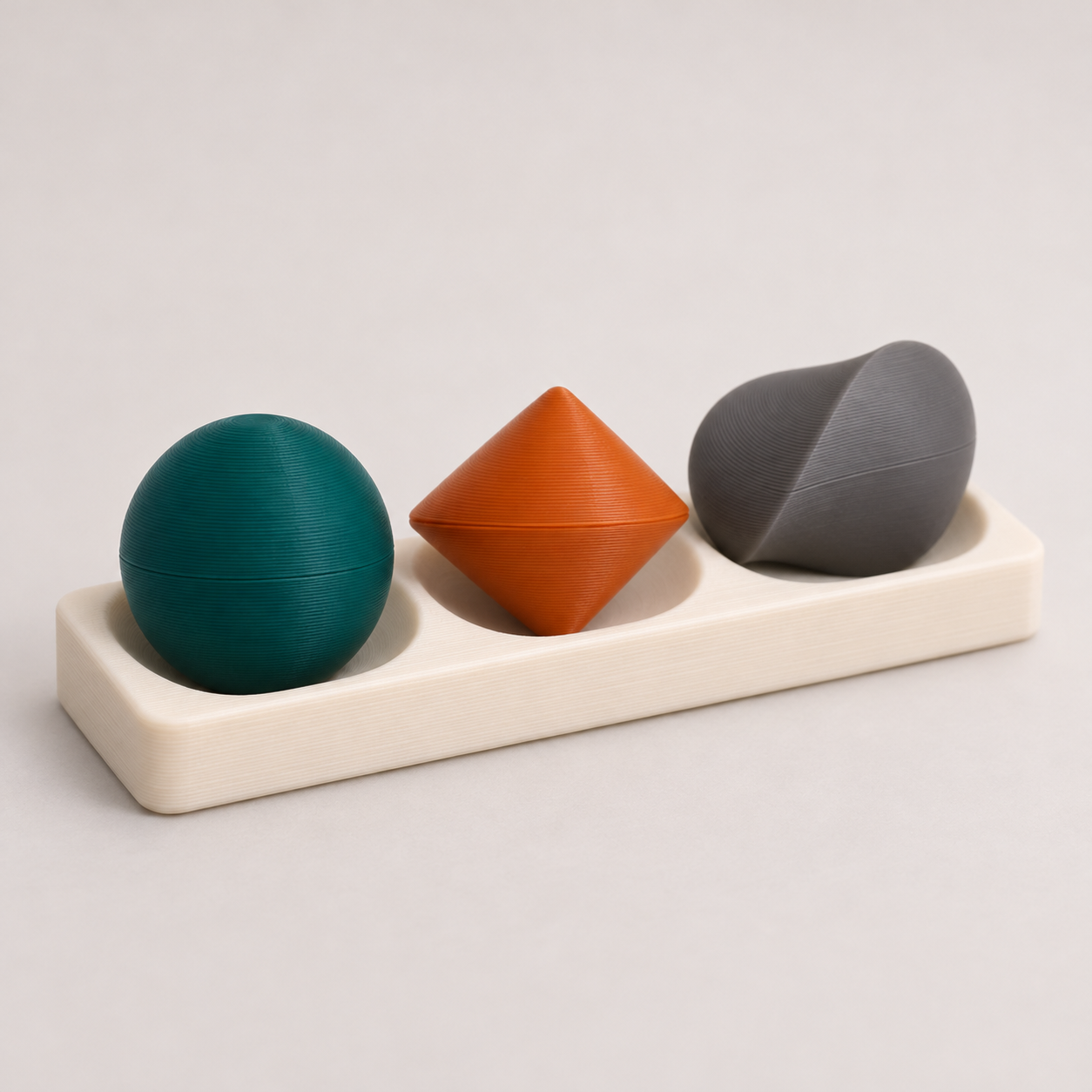
Rolling Trio: Sphere, Bicone and Oloid on a Display Tray
Three solids about 50 mm wide that roll in a straight line, a circle and a weave, kept together in a display tray you can leave on a desk or shelf.
Date: 2026-11-12 Category: Art and Decor Modeling difficulty: Intermediate Estimated print: ~15 h total · ~150 g PLA (estimate) Suggested price: $28–$48 printed · $6 digital file (estimate) Status: Concept
Description
Give a sphere, a double cone and an oloid the same gentle push and they behave differently. The sphere rolls straight. A double cone rolls in a circle. The oloid, found by Paul Schatz in 1929, is the convex hull of two perpendicular circles, each with its centre on the other's edge. Its centre of mass wobbles from side to side as it rolls, so it weaves. All three are printed as two halves each, glued around two filament pins, and sit in shallow cradles in a tray.
On the tray they look like a small still-life of three quiet shapes in three colours. Pick one up and set it rolling on a table or a gentle slope (a book under one end of a board) and the difference shows. The oloid is the surprise: it rolls smoothly but never in a line, and its whole surface touches the table in turn.
Print the halves in different colours per solid, for example teal sphere, orange bicone, charcoal oloid, on a warm white tray.
Why it sells
This is an art and desk piece, chosen on taste. The oloid and the double cone are old, well-documented mathematical solids: the oloid article gives the geometry, an area equal to a sphere's (4πr²), and the meandering centre of mass; the sphericon article notes that a double cone rolls only in circles, and a Boing Boing post shows how fascinating such rolling solids are to watch. A 2026 arXiv preprint (not yet peer reviewed) examines the oloid among developable rollers. Single oloids are not hard to find as prints; I did not look for a three-way comparison set with its own cradle tray, and that is the gap here: one object that is a display piece and a demonstration at once.
Who buys it
Maths and physics teachers, engineers, and people who keep fidget-friendly objects on a desk. Occasions: gifts for science-minded people, a classroom demonstration, a shelf piece. The tray makes it display-ready, which a loose oloid is not. Sold on Etsy and at maker markets, with the file on MakerWorld and Printables.
Design overview
- Three solids, each in two halves: a sphere of diameter 50, a bicone of radius 25 (two cones of height 25 joined base to base), an oloid with circle radius 25 (75 × 50 × 50 mm).
- A 216 × 76 × 14 mm tray with three cradles cut 8 mm deep, each 2% larger than its solid.
- Alignment: two 1.75 mm filament pins per solid in 2.0 mm holes, plus cyanoacrylate or epoxy.
- What sets it apart: same width, three different rolling paths (straight, circle, weave) in one set, with a place to keep them.
- Everything prints without supports. Sphere halves and the oloid halves print on their flat cut face.
- The tray works as a tilted ramp if you prop one end 3–5 degrees (optional, not printed).
Dimensions
| Measurement | Value (mm) | Notes |
|---|---|---|
| Tray width (X) | 216 | |
| Tray depth (Y) | 76 | |
| Tray height (Z) | 14 | |
| Cradle depth | 8 | each cradle |
| Cradle oversize | 2% | cradle radius 25.5 for a 25 mm solid |
| Sphere diameter | 50 | |
| Bicone radius / total length | 25 / 50 | each cone height 25 |
| Oloid circle radius | 25 | length 75, width 50, height 50 |
| Cradle centres (X) | −72, −12, 60.5 | sphere, bicone, oloid; tray origin at centre |
| Pin hole diameter / depth | 2.0 / 5 | per half |
| Pin hole offset | ±8 | from each solid's centre line (oloid: from x = −12.5) |
Parts list
| Part | Qty | Material | Size X×Y×Z (mm) | Print orientation | Supports |
|---|---|---|---|---|---|
| Display tray | 1 | PLA | 216 × 76 × 14 | bottom face down | none |
| Sphere half | 2 | PLA | 50 × 50 × 25 | cut face down | none |
| Cone (half of bicone) | 2 | PLA | 50 × 50 × 25 | base down | none |
| Oloid half | 2 | PLA | 75 × 50 × 25 | cut face down | none |
Hardware and non-printed parts
- 1.75 mm filament offcuts, 10 mm long, ×6 (alignment pins, 2 per solid)
- Cyanoacrylate gel or 5-minute epoxy, a small tube
- Optional: 4 self-adhesive felt pads, 10 mm diameter × 2 mm, under the tray
Fits and tolerances
| Interface | Fit | Clearance per side |
|---|---|---|
| Pin (1.75 mm) in half (2.0 mm hole) | press / glued | 0.125 |
| Halves to each other | glued flat joint | 0 |
| Solids in cradles | loose | 0.5 (2% oversize) |
The pin fit is in the 0.1–0.15 mm press range given in the brief. The cradle clearance is larger so the solids drop in and lift out without sticking.
Modeling guide
Origin: tray centre on the top face, +X right, +Y back, +Z up. The solids use their own local origin at their centre.
- Tray: sketch a rectangle 216 × 76, corner radius 4, extrude 14. Chamfer the top edge 1.
- Sphere cradle: sphere of radius 25.5, centre at (−72, 0, 17.5); subtract from the tray (depth 8 below the top).
- Bicone cradle: bicone of radius 25.5, cone height 25.5, axis along X, centre at (−12, 0, 17.5); subtract.
- Oloid cradle: oloid hull of two discs of radius 25.5 (see step 7) with disc A horizontal and centre at (60.5, 0, 17.5); subtract.
- Sphere: sphere radius 25, split on the XY plane. Each half is a hemisphere of height 25. Add two holes of 2.0 mm diameter, 5 mm deep on the flat face at (±8, 0).
- Bicone: revolve a triangle with base 25 and height 25 around the axis (a cone of radius 25, height 25). Make two. Holes 2.0 mm × 5 mm at (±8, 0) on each base.
- Oloid: hull of two zero-thickness discs of radius 25. Disc A lies in XY centred at (−12.5, 0, 0). Disc B lies in XZ centred at (12.5, 0, 0). Split at Z = 0. Each half has a flat face in XY. Holes 2.0 mm × 5 mm at (−20.5, 0) and (−4.5, 0).
- Mirror positions so mating halves have matching holes.
Print settings
| Setting | Value |
|---|---|
| Material | PLA |
| Nozzle | 0.4 mm |
| Layer height | 0.2 mm (0.12 mm for the solids if you want smoother curves) |
| Walls / perimeters | 3 for the tray; 3 for the solids |
| Infill | 15% gyroid tray; 10% gyroid halves |
| Supports | none |
| Brim / adhesion | none; 3 mm brim on the tray if the corners lift |
| Notes | Print the solids in three colours. Use ironing or a 0.12 mm layer on the curved parts if you want to hide layer steps. |
Assembly
- Test-fit a 10 mm filament pin in each hole; ream with a 2.0 mm drill bit if tight.
- Put a dab of glue on the flat face of one half and a pin in each hole.
- Press the mating half on, aligning pins, and hold for a minute.
- Wipe off squeezed-out glue and let it cure for 24 hours.
- Sand any seam ridge lightly with 400 grit.
Variants and upsells
- A fourth solid: a cylinder, which rolls straight but flat, or a sphericon; sold as an add-on.
- Three sizes of oloid (radius 15, 20, 25) as a nesting set.
- A matching tilted ramp board with three lanes, 215 × 200 mm, as a second file.
Selling and distribution
Etsy and maker markets suit the printed set. Sell the file on MakerWorld and Printables with a CC BY-NC licence and an optional commercial licence. Pricing: about 150 g of PLA plus 15 h of printing plus margin (estimate). Keywords: oloid, rolling oloid, math art, bicone, geometry toy, desk sculpture, science gift, STEM decor, kinetic desk toy, Paul Schatz, maths gift.
Risks and IP notes
- Glued seams may show. Mitigation: sand and paint, or leave the seam as a design line.
- The oloid is hard to keep from rocking in the cradle. Mitigation: cradle depth of 8 mm holds it.
- Many oloids already exist on print sites. Mitigation: sell the trio and tray as a set; do not compete on the oloid alone.
- The shapes are mathematics and are not protectable; avoid trademarked names such as product brand names for oloid toys.
Resource links
- Oloid (Wikipedia) — definition, surface area 4πr², volume about 3.0524 r³, meandering centre of mass
- Sphericon (Wikipedia) — notes that a double cone rolls only in circles; the sphericon meanders
- Sphericons rolling (Boing Boing) — video post on rolling solids
- Computational validation of the oloid (arXiv 2604.12238) — 2026 preprint, not peer reviewed
More from 3D Print Designs