The Third Share
What if… What if, in the summer of 476, the Roman general Orestes had given his mutinous Germanic troops the land they demanded, and the Western Empire had lasted another thousand years?
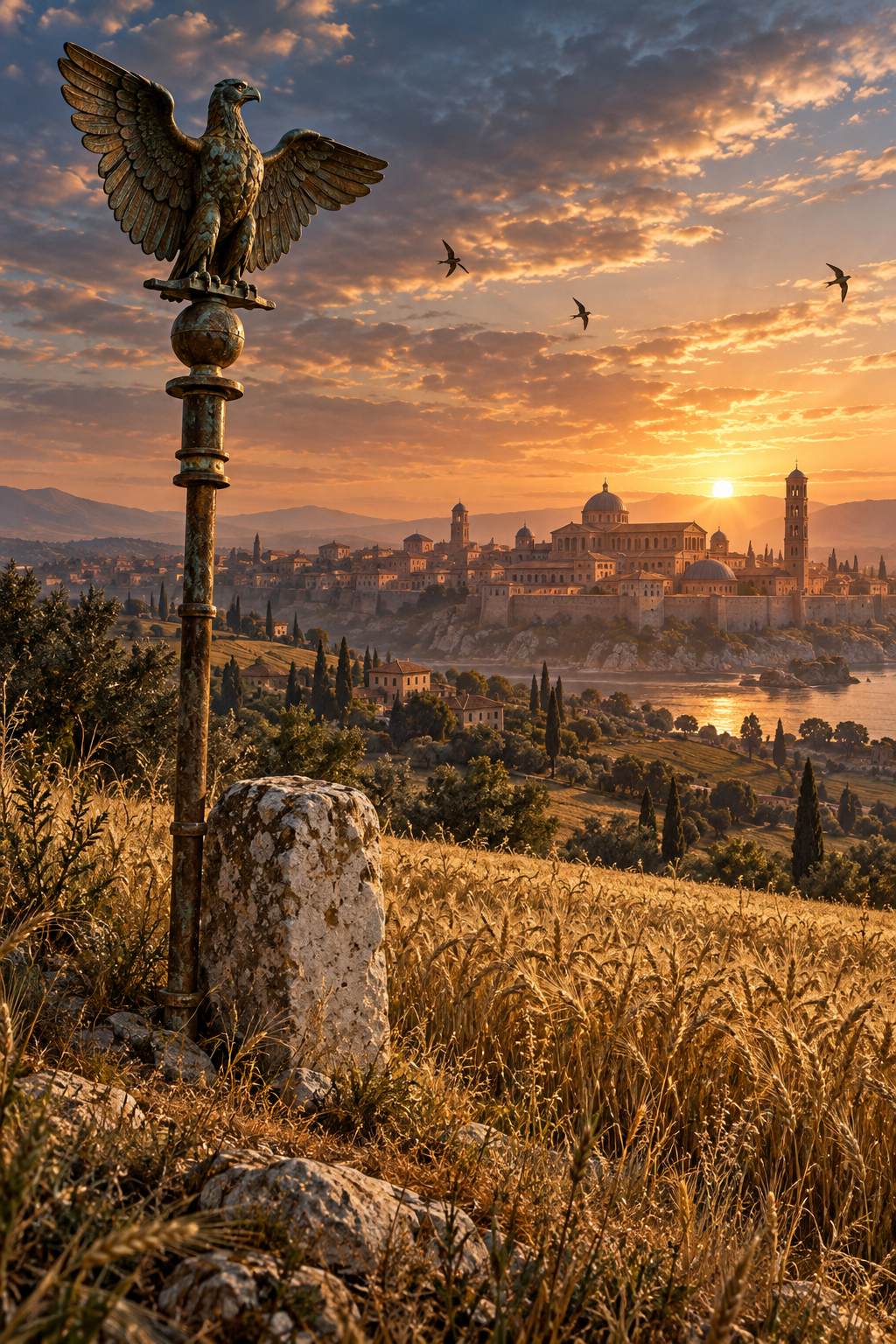
Synopsis
Orestes buys his army's loyalty with a third of Italy's farmland, and the Western Empire becomes a poorer, smaller state run by its generals, but it survives. Germanic veterans and Roman stewards end up sharing the same fields. The Ostrogoths are paid to guard the Alps instead of conquering Italy, so Justinian never fights his ruinous Gothic War and Rome keeps its aqueducts through the plague years. The Lombards are stopped at the Isonzo. A western fleet keeps Carthage Roman through the Arab conquests. In 800 Charlemagne gets a patrician's diploma from Ravenna instead of a crown, so no rival empire forms in the West. Roman law and Latin legal forms never drop out of use. In 1476 refugees from fallen Constantinople teach Greek in Ravenna, where a printer sets the Digest in type and notices that the empire has passed a thousand years since Placentia.
The Third Share
What if… What if, in the summer of 476, the Roman general Orestes had given his mutinous Germanic troops the land they demanded, and the Western Empire had lasted another thousand years?
By the summer of 476 the Western Roman Empire was little more than Italy and a few coastal strips. Most of its army was Germanic soldiers serving for pay. Their commander, Orestes, had made his teenage son Romulus emperor the year before. The troops asked for what federate armies in Gaul had already received: a third of the land of Italy. Orestes refused. An officer named Odoacer promised them the land if they followed him, and they did. He captured Orestes at Placentia and had him executed on 28 August. A week later he deposed Romulus, pensioned him off to a villa in Campania, and sent the imperial regalia to Constantinople. In this timeline Orestes reads the mood of his camp and agrees.
The surveyors go out
The grant was announced at Ticinum in July. Orestes called it hospitalitas, stretching the old billeting law far past its purpose. The Senate in Rome protested by letter and then paid. Land surveyors who had spent their careers on inheritance disputes now walked estates across the Po valley with groma and chain, marking every third field with a new stone. In our history Odoacer would have been king of Italy within weeks. Here he got a generalship and a villa near Verona. Romulus, fourteen years old, rode through Ravenna in a purple cloak that had been taken in at the shoulders. Nobody in the city expected him to last. But the soldiers had their land, and in 476 theirs was the only vote that counted.
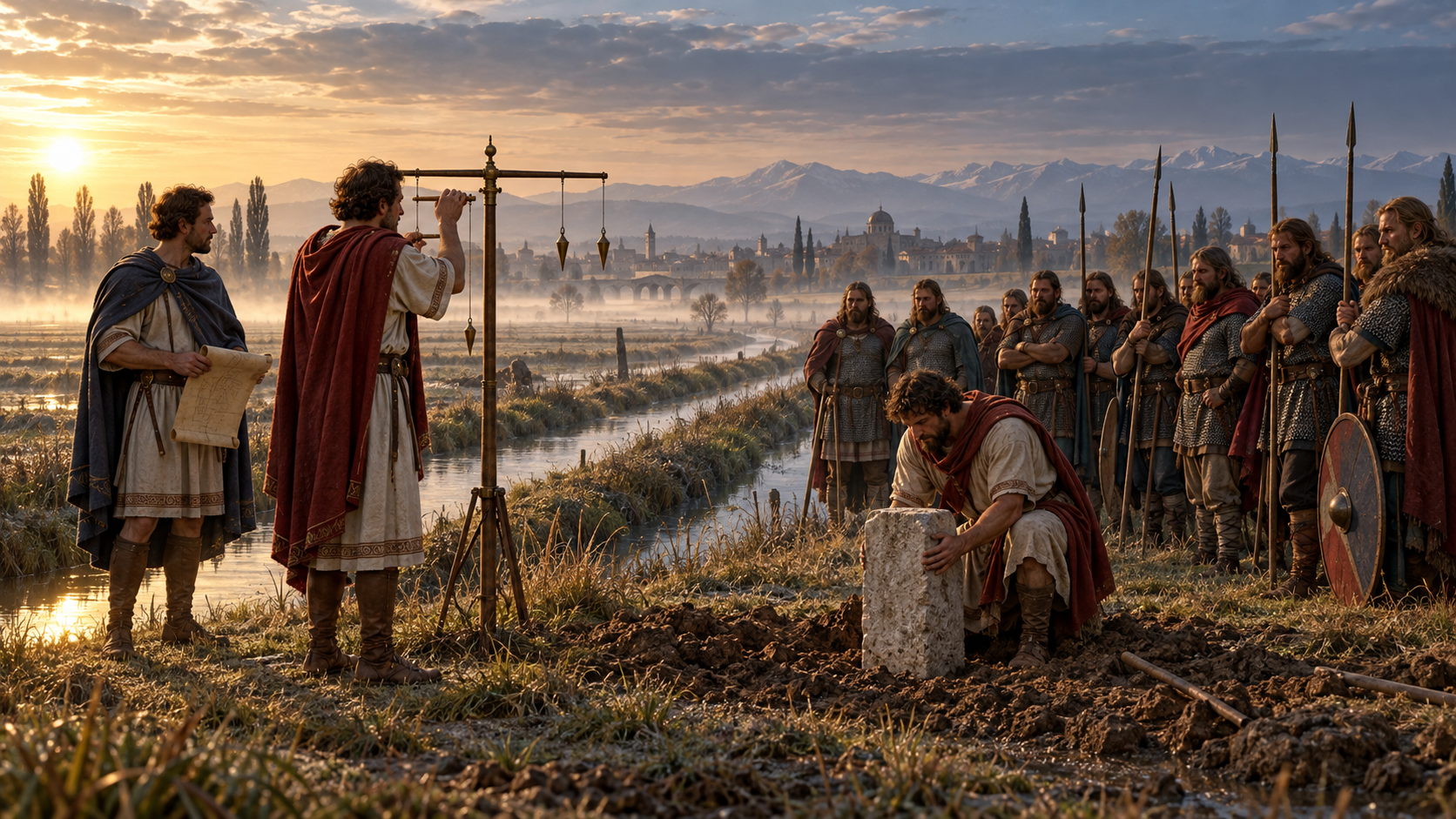
Boundary stones
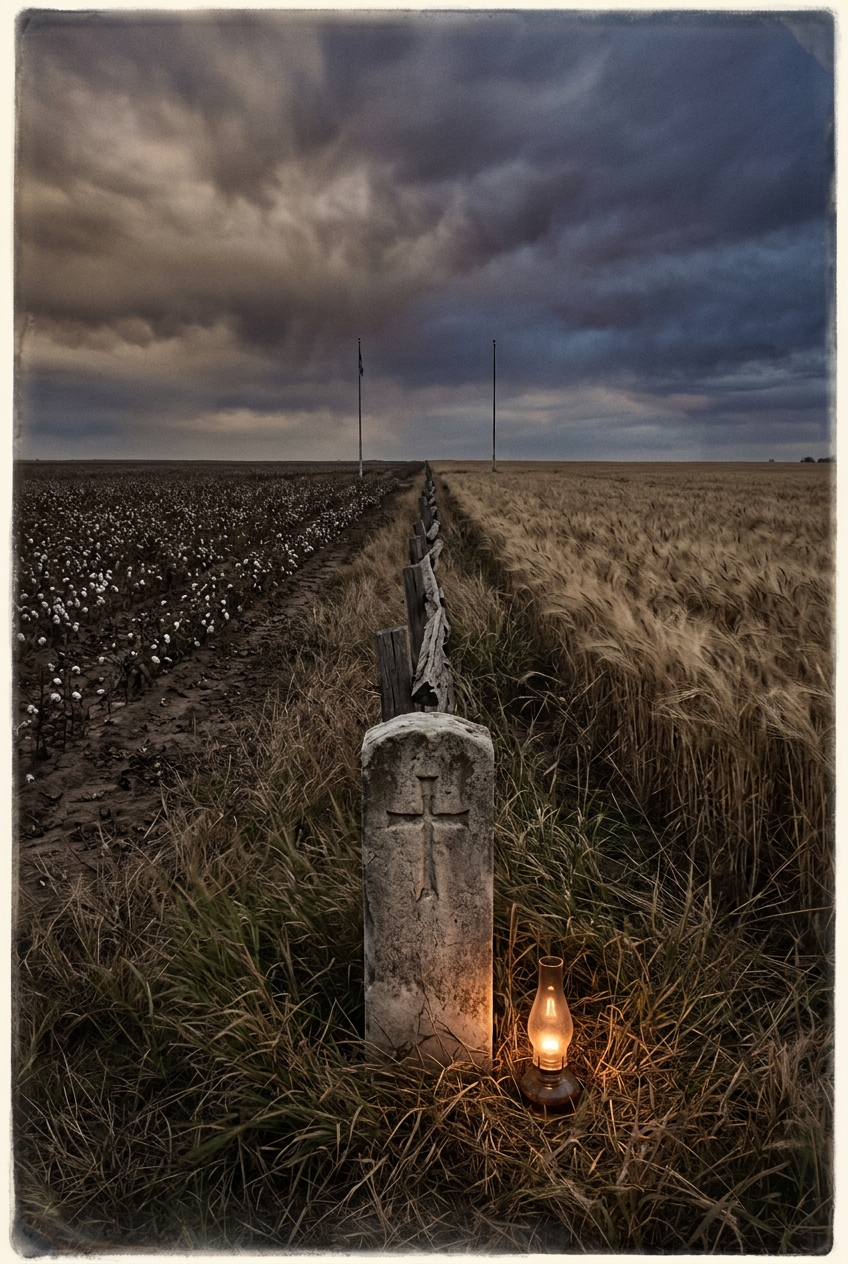
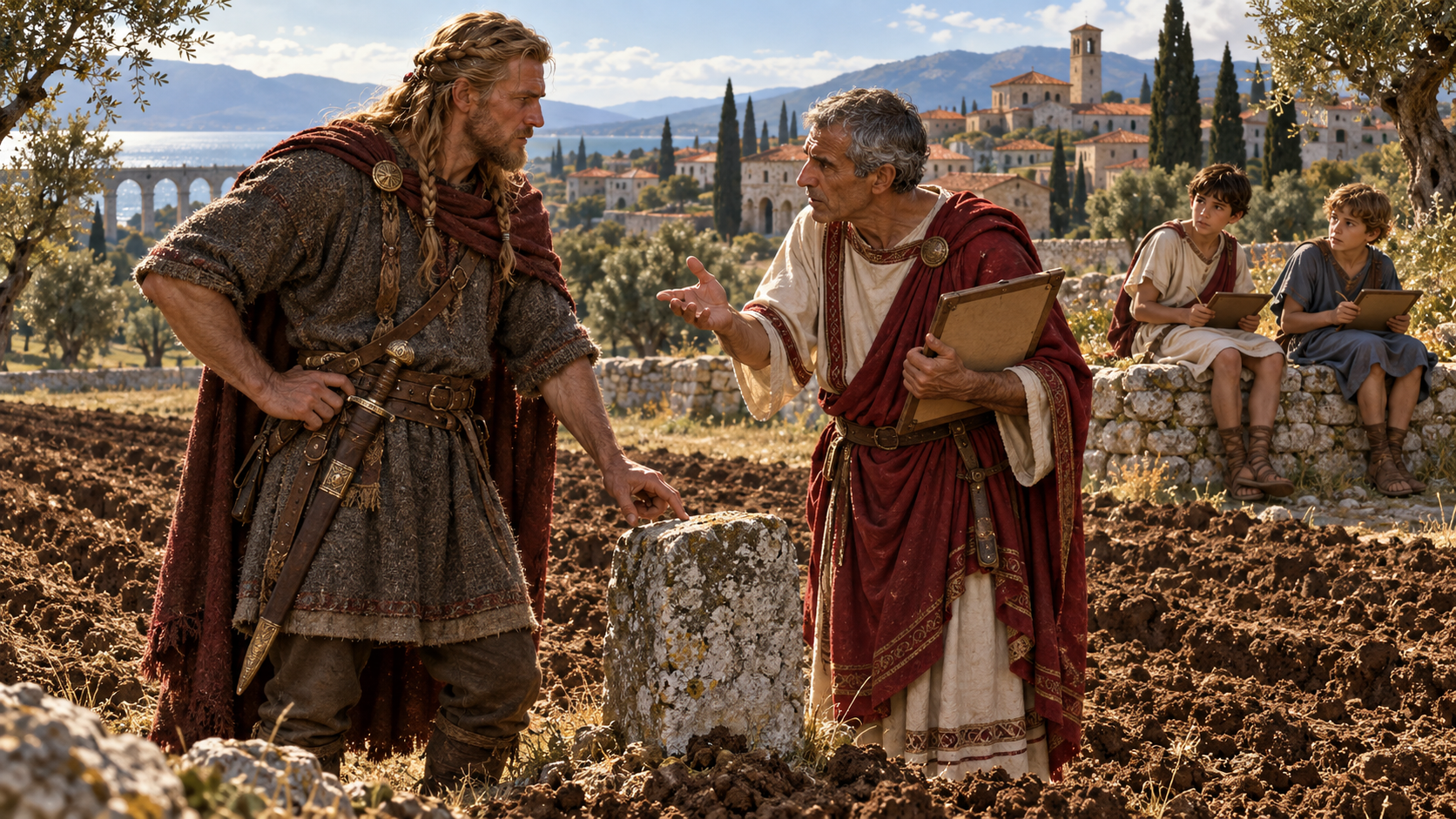
Hrodulf, a Scirian spearman, received forty iugera of wheat land outside Placentia. It was cut from an estate whose senatorial owner lived in Rome and had never visited. The steward stayed on and ran both halves, because Hrodulf knew horses and nothing about drainage. The bishop would not share his church with the Arian settlers, so they built their own across the forum. By 495 Hrodulf's sons were writing their names in Latin and attending neither. In 480 Julius Nepos, the emperor Orestes had driven out, was murdered in Dalmatia. With no one else left to back, Zeno in Constantinople recognized Romulus. Orestes died in his bed in 487. His son went on ruling through a council of generals, as western emperors had for seventy years.
Italy keeps its roofs
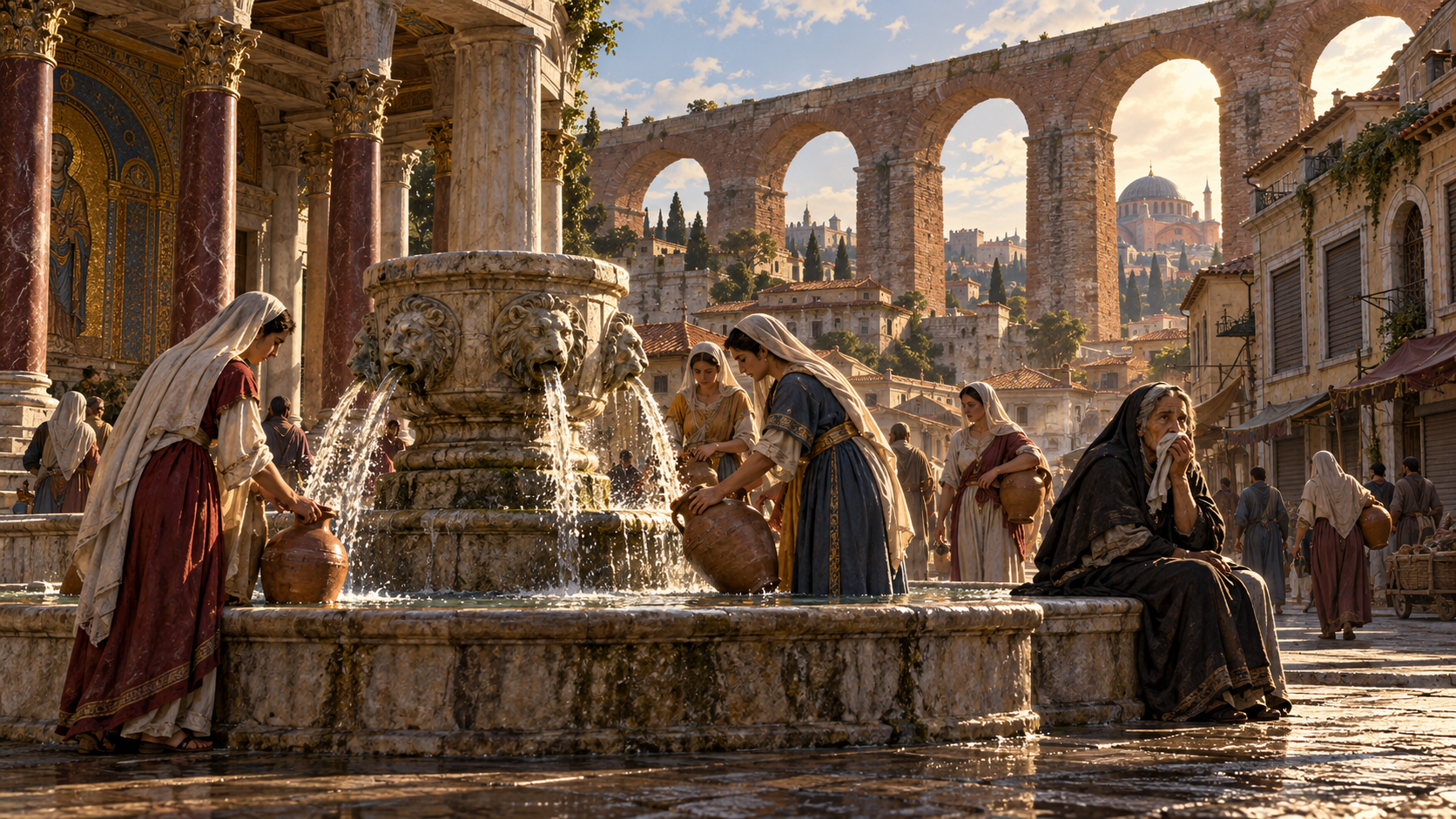
In 488 Theodoric's Ostrogoths came looking for land, and the court at Ravenna did what it had learned to do: it paid. The Goths took Noricum and Pannonia as federates and held the Alpine passes for a yearly subsidy of grain and silver. When Justinian took the eastern throne in 527, there was no Gothic kingdom in Italy for him to reconquer. In our history his war there lasted twenty years, cut Rome's aqueducts in 537, and left the city half empty. None of that happened. Plague arrived anyway in the 540s, carried by ship, and emptied whole streets in Naples and Ostia. When it was over, Rome still had running water. Cassiodorus spent his old age revising tax registers for the prefecture.
The Isonzo line
The Lombards crossed the Julian Alps in the spring of 568, as they did in our history, with families, cattle, and a following of Gepids and Saxons. In our history they found an Italy worn out by war and walked through it. This time they met Gothic federates in the passes and, at Aquileia, a field army that had never been disbanded. Their king, Alboin, got a treaty instead of a kingdom: land on the Danube plain, a subsidy, and a Roman title he never used. The popes stayed what they had been, bishops of an imperial city who took orders and stipends from Ravenna. In our history Gregory the Great fed Rome himself. In this one he spent his career arguing with a prefect about grain.
Carthage holds
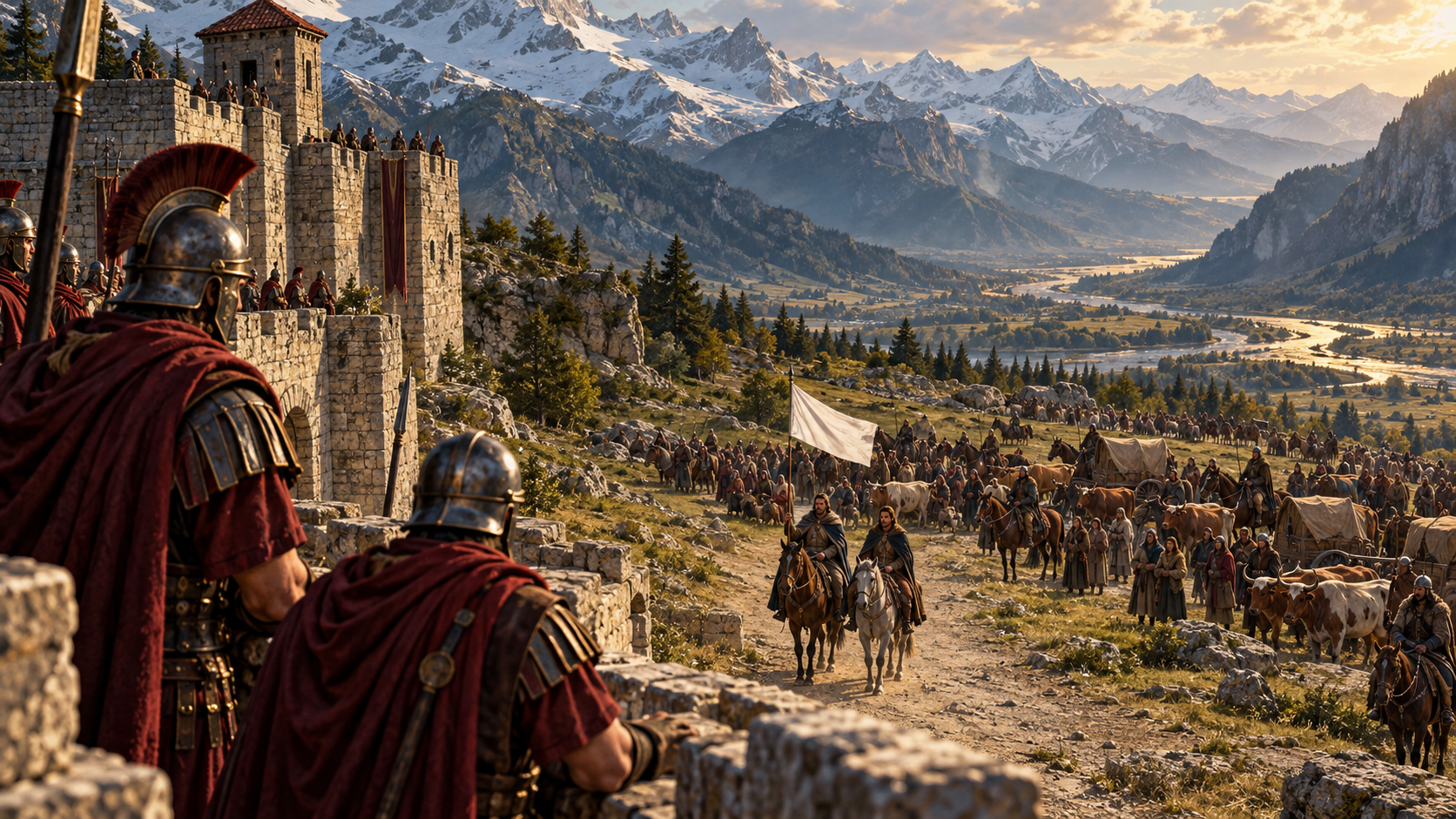
Arab armies took Egypt in the 640s and pushed west along the coast. Constantinople was fighting for its survival in Anatolia and could spare little. The western fleet at Syracuse could. When the Umayyad general Hassan ibn al-Nu'man reached Carthage in the 690s, ships from Sicily and Sardinia kept the harbor supplied, and the city held through two summers. Most of Africa still went to the caliphate and its Berber allies, and the frontier settled on the old ditch-and-wall lines south of the city. Spain was different. The Visigothic kingdom fell in 711 much as it did in our history, and Ravenna lost a federate it had stopped controlling long before. Carthage stayed a Latin port on a Muslim coast and did business with both.
A king who was not crowned
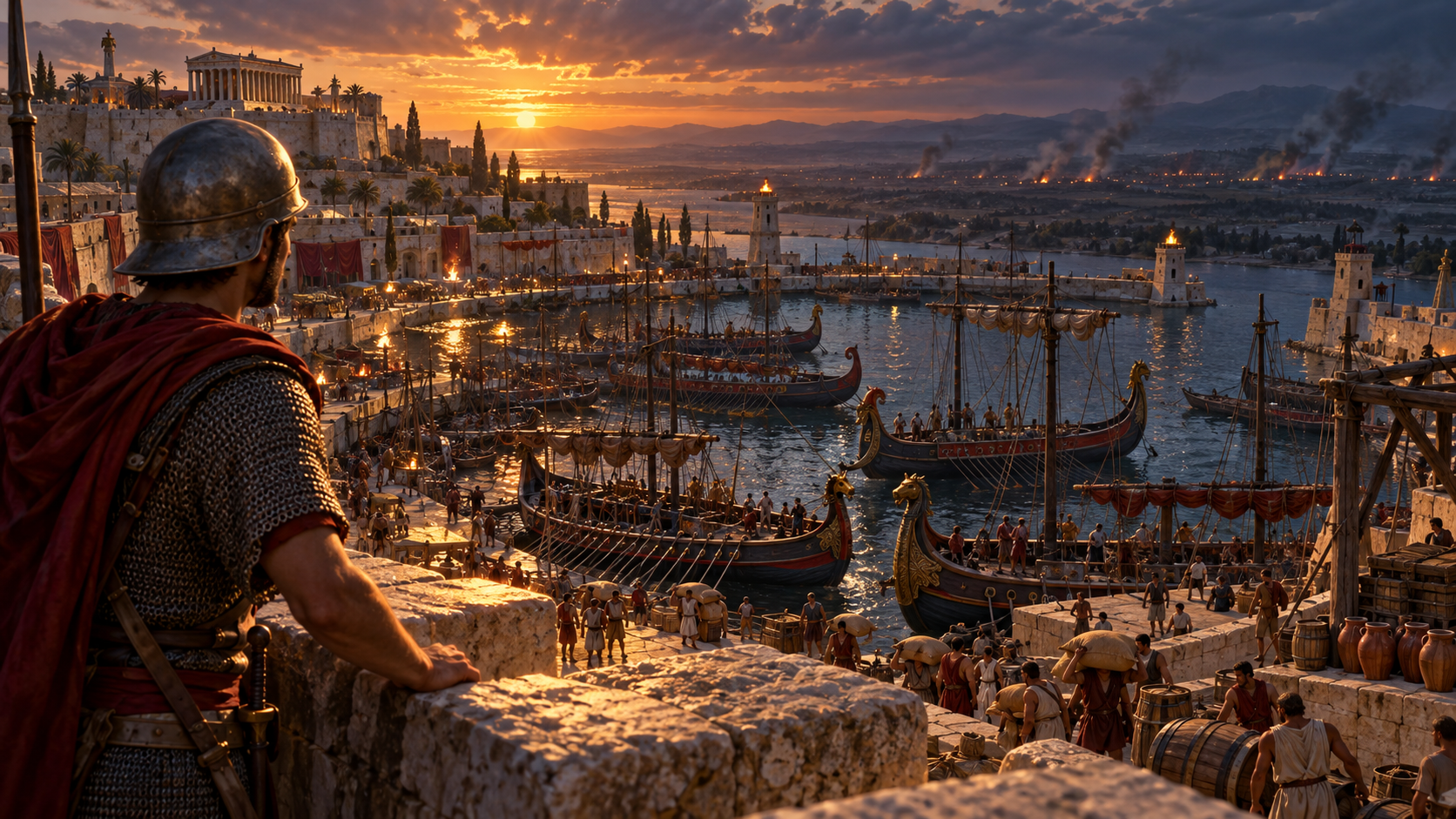
On Christmas Day 800, Charles, king of the Franks, heard Mass in Rome. In our history Pope Leo III set a crown on his head that day and called him emperor. In this timeline no pope could do that. The West already had an emperor, a dull and solvent one, and Leo was his subject. Charles had to settle for the title of patricius, sent from Ravenna with a gilded diploma, and for the fact that his Franks were still, on paper, federates of Rome. He ruled from Aachen anyway. The effects came later. When his grandsons divided his lands, no imperial title went with any share, and none of the Frankish kingdoms ever claimed to be the empire. They argued instead about which of them stood closest to it.
The notaries of Ravenna
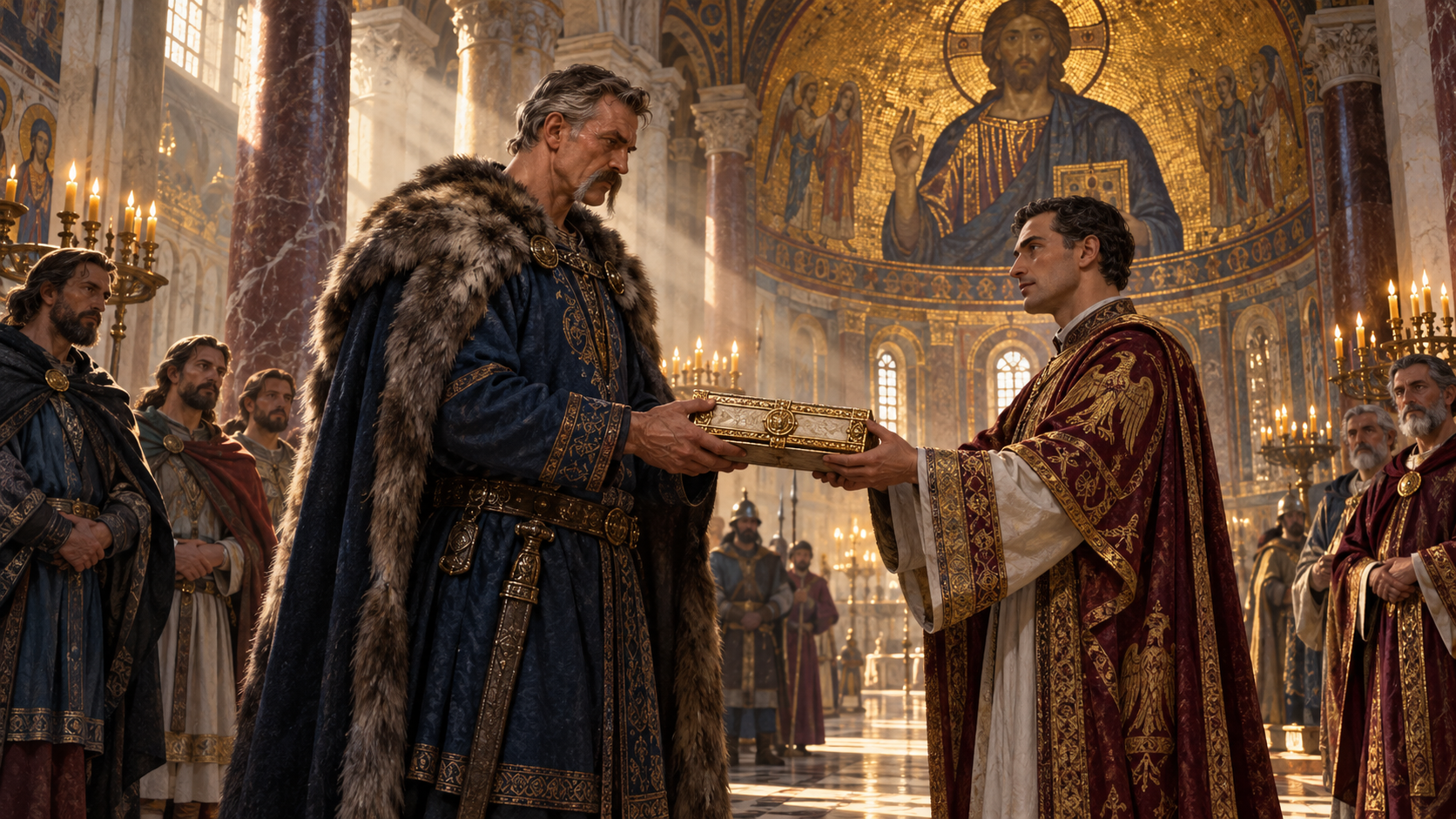
In 1140 Giovanni di Leone, a notary on the Via Caesarea in Ravenna, drew up the sale of a Frisian merchant's woollens to a buyer from Palermo. He used the same Latin forms his office had used for six hundred years, cited a constitution of Justinian that the western chancery had adopted in 560, and charged by the line. In our history Roman law was rediscovered at Bologna. In this one it was never lost, and courts from Arles to Syracuse heard the Digest pleaded, sometimes well. Spoken Latin was still sliding toward Italian and French, the same as in ours, but contracts and courtrooms held to the old forms. All three of Giovanni's sons became notaries. His daughter kept the ledgers.
The thousandth summer
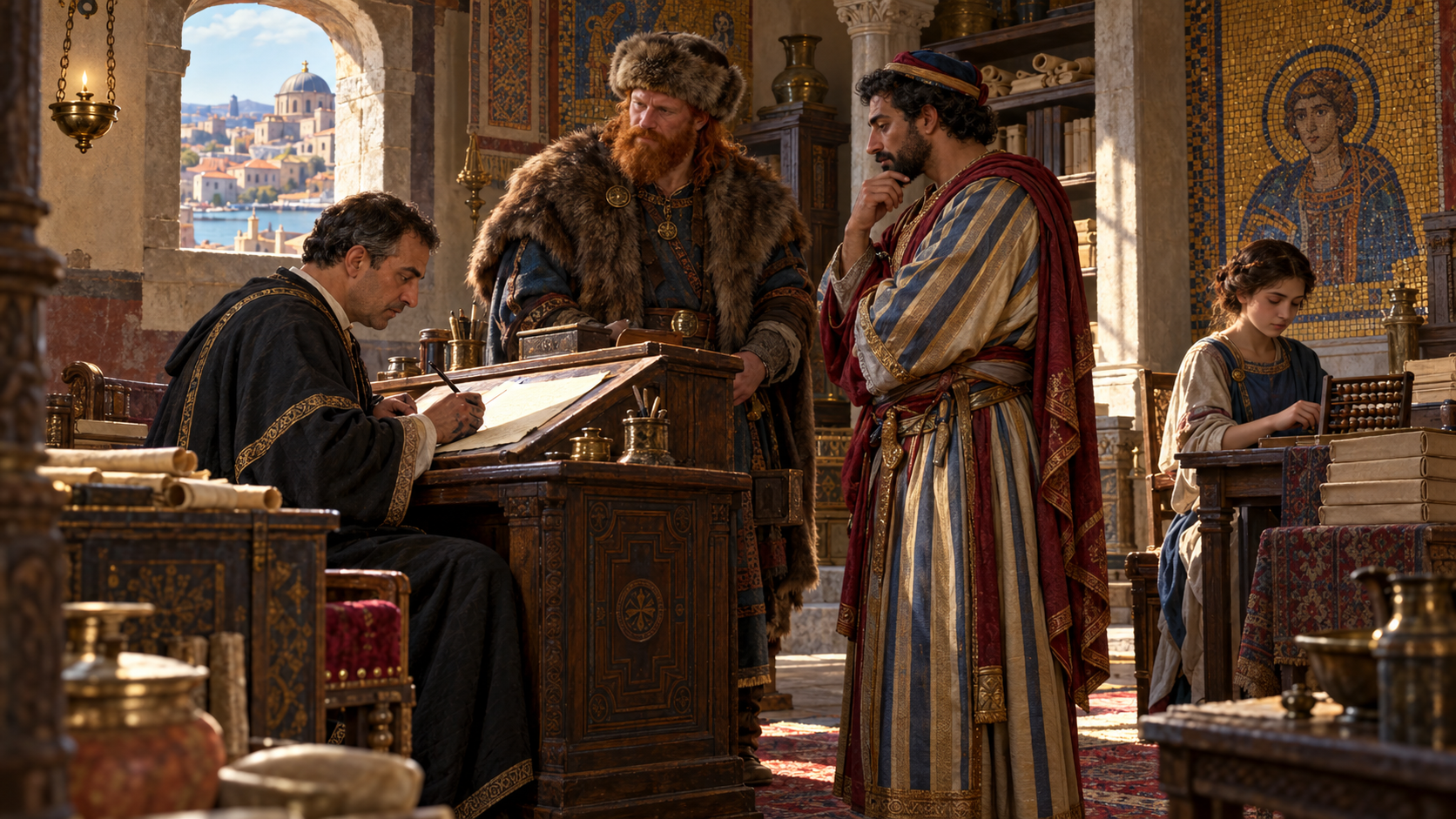
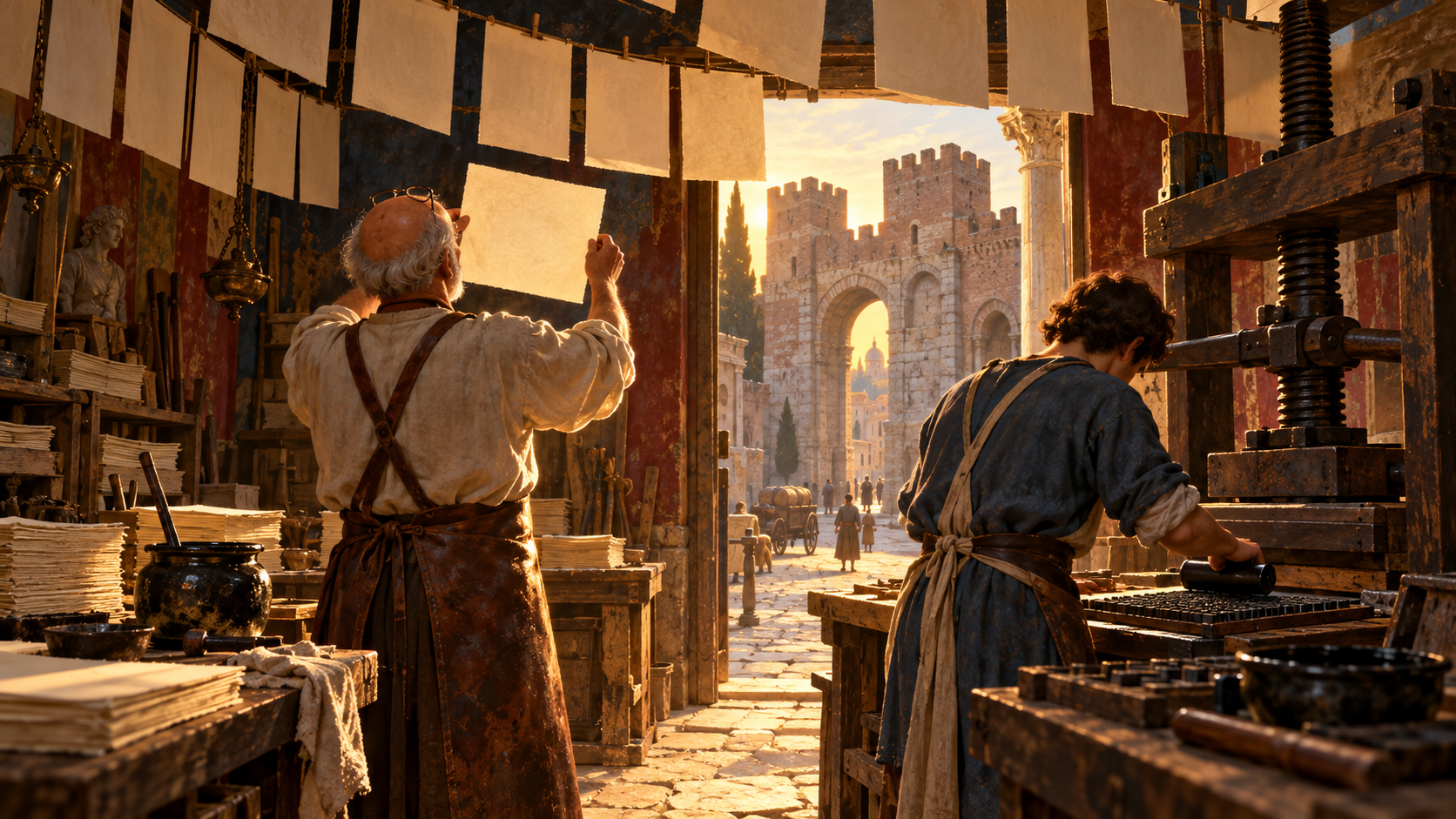
Constantinople fell to the Ottomans in May 1453, as it did in our history. The Western Empire sent eleven galleys. They arrived after the walls were breached and took off whoever reached the quay. Many of those refugees ended up in Ravenna, teaching Greek to officials' sons. By 1476 the emperor there was a ceremonial figure. He opened the Senate, signed what the prefects put in front of him, and paid the Frankish kings to keep his name in their charters. That August, a printer near the Porta Aurea was setting the third volume of the Digest in type. From a chronicle on his shelf he worked out that the settlement at Placentia was a thousand years old that month. He told his apprentice. Then they went back to work.
More from Alternate History