Backburn
Design brief
Cut firelines and burn out fuel ahead of a wind-driven blaze while carrying exhausted survivors to the extraction point, because the fire reads the map better than you do.
Date: 2026-08-17 Genre: tactical RPG Platform: PC (Windows; keyboard & mouse, controller) Status: Concept
Target player
Someone who finished Into the Breach and immediately wanted a longer campaign built on the same idea: the enemy is a system you can read, not a villain you can out-roleplay. They also want the squad stakes of Jagged Alliance 3, a crew they've named, injured, and worried about, without a war to justify it. They're drawn to games about disaster response and specialized labor (Papers, Please; Firewatch; PowerWash Simulator's weird cousin) more than fantasy conflict, and they'll forgive a slower campaign pace if every incident forces a real decision about what gets saved.
Core loop
Per-turn loop: each of your five crew members gets two actions. Move. Cut Line (clear a tile's fuel, creating a barrier fire can't cross under normal conditions; costs 2 of 12 Stamina). Backburn (deliberately ignite an unburned fuel tile so it burns out under your control before the main fire reaches it; costs 3 Stamina, takes one turn to catch, and if the wind shifts before it does, you've lit a second fire pointed at your own line). Carry a downed survivor or animal (halves movement, both hands full, no line-cutting that turn). Hydrate a teammate (restores 4 Stamina, costs your action, not theirs). After every crew member acts, the fire resolves: each active-fire tile has a spread chance into adjacent fuel, 70% for grass, 45% for brush, 25% for timber, modified by wind (+20% with the wind, -15% against it) and slope (+15% moving upslope). At wind speed 3 or higher, embers can spot: a 10% chance per burning tile to ignite an unburned tile two to three tiles downwind, jumping any line you've cut.
Per-incident loop: deploy onto a hand-built fireground (a ridge, a canyon draw, a small town's edge) with a fixed number of survivors, animals, and structures to reach before their individual fire-tolerance windows close, and a containment target: the percentage of the fire's perimeter bordered by a cut line or burnt-out ground. You're given an imperfect wind forecast, something like "shifting southwest, turns 6 through 8, likely," and you plan against a probability, not a certainty. The incident ends when you hit 100% containment, the fire runs out of fuel, or it reaches the map edge, an extraction route is cut, or your crew is wiped. Back at Fire Camp between incidents, you spend Command Points earned on gear and roster management, and choose the next incident from a regional board where fires you ignore keep growing.
Systems
- Fire spread simulation — a per-tile cellular automaton (fuel type, moisture, slope, wind vector) is the entire opposing force. There's no scripted AI; the Fire Behavior overlay shows next-turn spread probability for every tile before you commit an action, so the fire is always legible even when it's winning.
- Cut Line / Backburn toolkit — the two core verbs are a defense/offense pair built for this theme specifically. Cutting a line is slow and safe. Backburning is fast and denies fuel proactively, but it's a bet against the wind forecast; get it wrong and you've started a fire aimed at your own crew.
- Wind forecast — a probability track shown at the start of each incident ("SW shift, turns 6-8, likely confidence"), never a guarantee. The game never lies about what it told you, but it also never tells you everything.
- Stamina and Heat Exposure — Stamina (12 per crew member) is spent on line-cutting and backburning and regenerates only via Hydrate. Heat Exposure rises by 2 per turn standing adjacent to one active-fire tile, 4 for two, decays by 1 when clear of fire, and a unit at 10 Heat collapses and must be carried out by a teammate.
- Rescue and structure triage — survivors, livestock, and structures each carry their own fire-tolerance clock (a structure catches and is lost after a fixed number of turns of adjacent active fire). Not everything on the map can be reached in time, and the game tracks what you left behind rather than pretending you saved it all.
- Fire Camp meta-layer — between incidents, Command Points buy gear (a chainsaw cuts a line faster but costs more Stamina than a hand tool; a drip torch backburns in one action instead of taking hold over a turn) and pay for crew recovery. The regional map runs several incidents in parallel; an unaddressed fire grows one ring of tiles per week you skip it and can merge with its neighbor into something much bigger.
- Crew dossiers and burnout — injuries, not permadeath, are the default consequence of a bad incident. But every near-collapse adds to a crew member's Burnout meter, and a maxed-out crew member will refuse a dangerous order mid-incident or quit the roster entirely at season's end: the genre's usual stakes, tuned to a job where walking off is a real option.
Progression
A campaign is one ten-week Fire Season on a regional map. Each week presents two or three active incidents; skip one and it's still there next week, one ring of tiles bigger, sometimes now touching a second fire and merging into a single larger incident. Crew abilities unlock on milestones tied to specific survived situations: three ember-spot jumps survived unlocks Spotting Watch (embers are flagged a turn earlier), two carries through active-fire tiles unlock a Stamina discount on Carry for the whole crew. Growth reads as earned competence, not a level-up screen.
The gear tree (hand tools → chainsaw and Pulaski → drip torch and pump truck) trades Stamina cost against speed and line quality, and is the main lever for handling later incidents' fuel density. The season closes on a Megafire finale: two or three merged incidents running at once across a map built from the season's hardest terrain, using every system introduced along the way. Between seasons, injured or retired crew become Fire Camp staff (dispatch, logistics, training), carrying institutional knowledge forward even when they've left the line.
World & setting
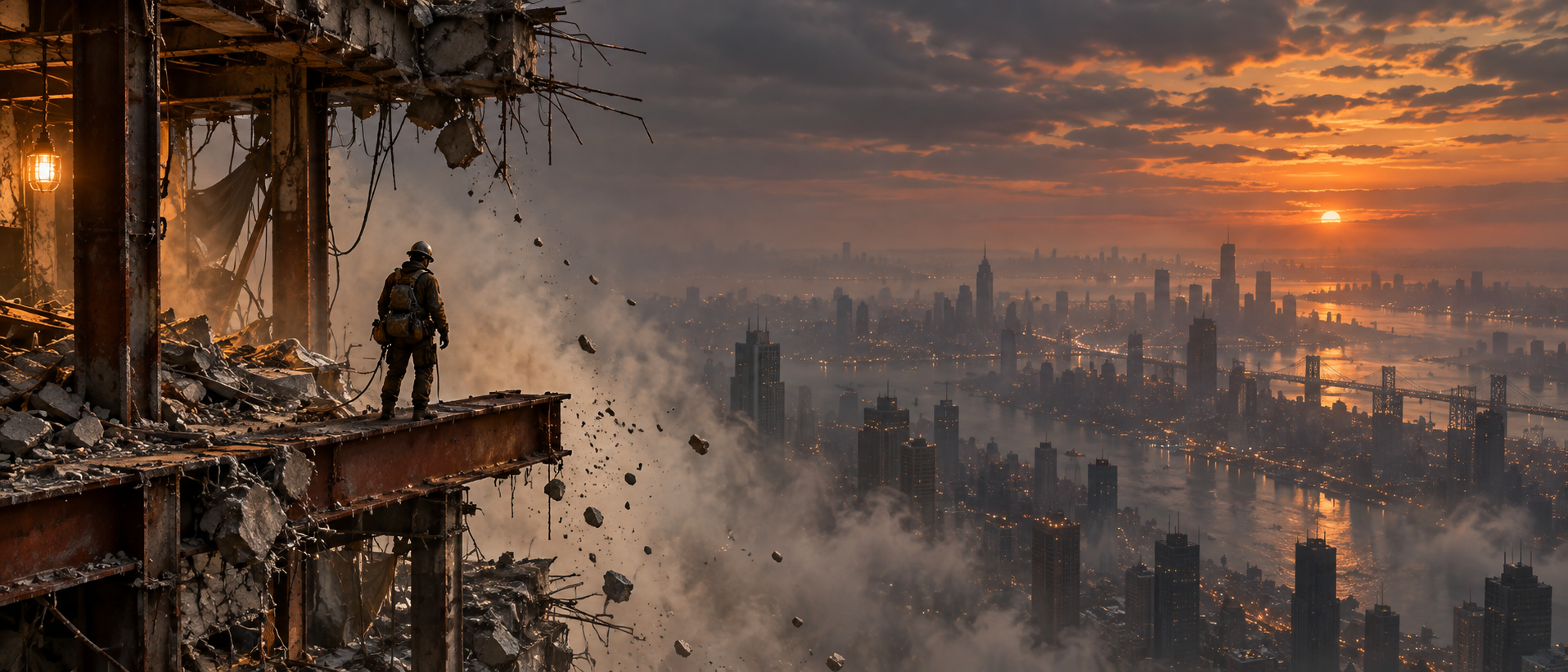
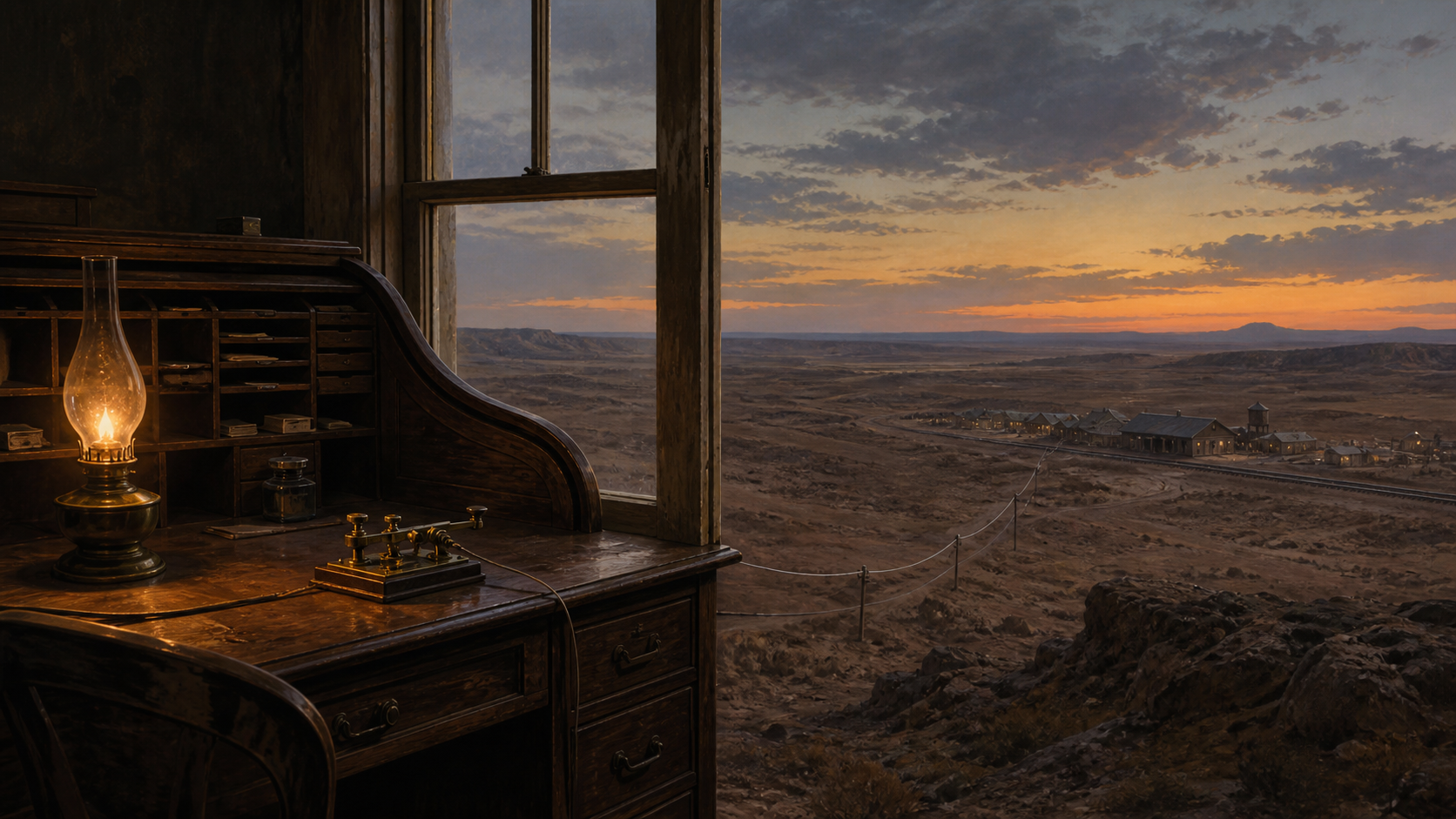
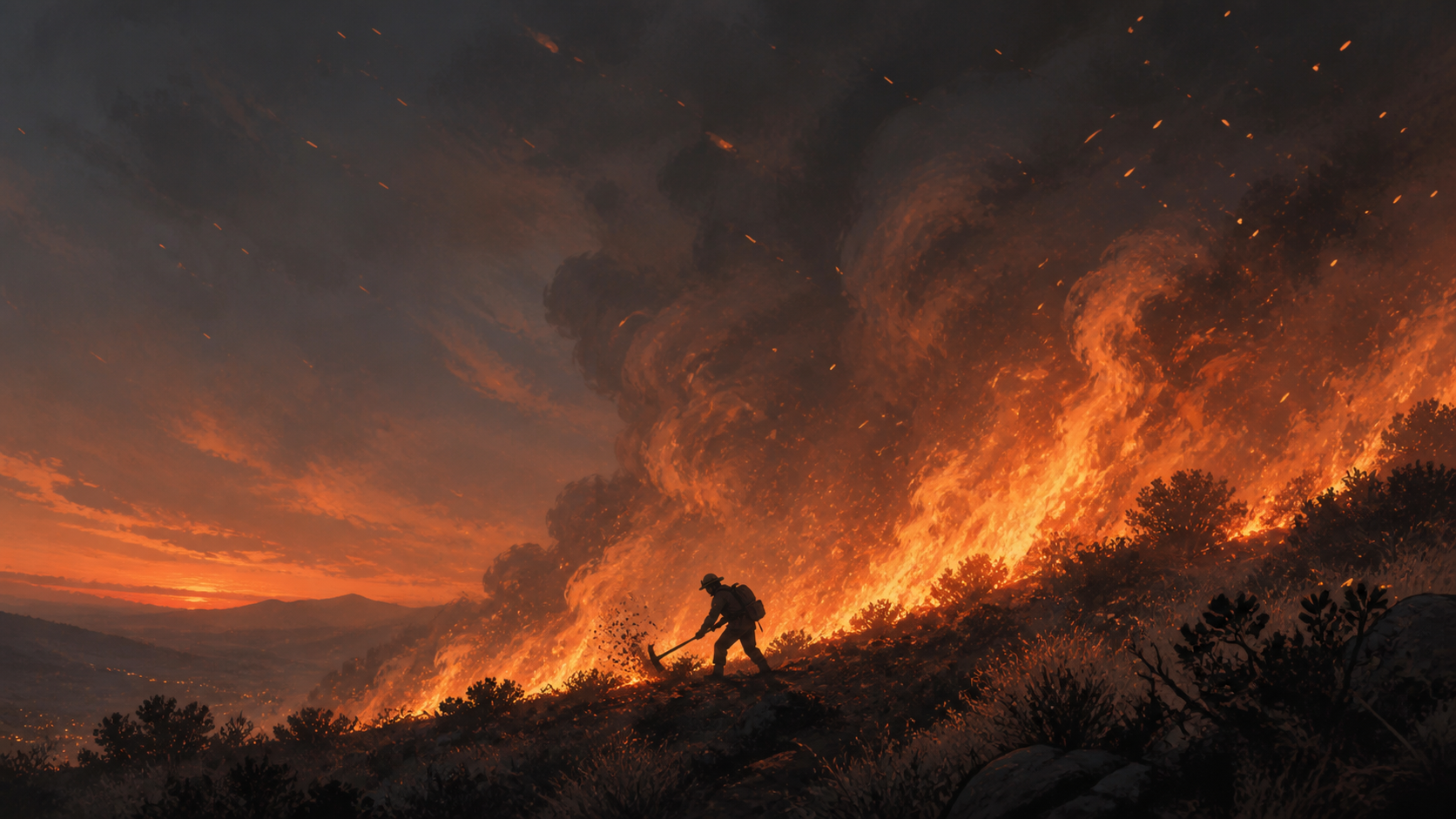
A contemporary American West-style fire country: dry ridgelines, chaparral draws, small towns built right up against wildland, all rendered in a painterly, slightly stylized art style rather than photoreal disaster footage. No named real places, no real incidents. The color language is the design language. Green-gray brush and blue dusk sky mark the calm approach to a fire; ember-orange and ash-gray take over as containment slips, with smoke haze cutting visibility the same way the simulation is cutting your options. The tone sits closer to quiet, competent dread than action-movie heroics. The crew talks like people who do this job every season, tired and precise, and the game's emotional core is the running tally of what got saved.
Differentiators
- The opposing force is a fire-behavior simulation, not an army — legible, deterministic, and readable through the Fire Behavior overlay, but it adapts to every tile you burn or clear, so it never plays the same incident twice
- Cut Line and Backburn are a genuinely novel tactical verb pair — one is safe and slow, the other is fast and denies terrain to the enemy before the enemy claims it, and getting the second one wrong is a self-inflicted second fire, not a missed attack roll
- Objectives are triage, not elimination — survivors, animals, and structures each run their own fire-tolerance clock, losing some of them is a designed and tracked outcome rather than a fail state, and the campaign remembers what you didn't save
- A regional map where ignored problems compound — unaddressed fires grow and merge on their own schedule whether or not you're looking at them, turning the meta-layer into real triage under real pressure
- No fantasy or war framing in a genre built almost entirely on both — grounded, contemporary-adjacent stakes without leaning on a real disaster for shock value
Monetization notes
Premium release, Early Access first at $19.99, full release at $24.99. That's in line with where the genre's terrain-driven tactics titles are pricing right now (Blightstone launched Early Access at $15.99; the segment supports $20-30 premium pricing when the hook is distinct). Early Access ships three regions and a full first Fire Season; full release adds two more regions, the Megafire finale content, and a scenario editor for community-built incidents. No DLC roadmap beyond one paid campaign expansion post-launch. There's clearly room for a mechanically distinct entrant here: 2026 has seen several environmental-hazard-forward tactical RPGs (RuneCipher, Blightstone) find an audience by making terrain interaction the main system rather than a modifier on combat. Backburn takes that same instinct and makes it the entire game instead of one system among several.
Accessibility notes
- Fully remappable keyboard/mouse and controller bindings, with a controller preset tuned for grid selection over a fire map
- Colorblind-safe fire-state palette (a shape language of dot, stripe, and cross-hatch layered under the color for active fire, embers, and burnt-out ground, not color alone)
- Fire Behavior overlay is always available by design, not a hint system to unlock or toggle off; reading the sim is core to the game, not a spoiler
- Adjustable UI scale (80-200%) and a high-contrast HUD mode
- Turn-timer-free by default; an optional soft timer can be enabled for players who want incident pressure to include real-time urgency
- Full subtitles and a persistent radio-chatter log for all voiced crew lines
- Animation speed toggles for fire spread resolution: 0.5x, 1x, 2x, and an instant-resolve option
- Assist tier that widens the wind forecast's confidence window (more certainty, less bluff) without changing spread math, for players who want the tactics without the guesswork
Risks
- The fire sim reads as a puzzle with one correct solution. Mitigation: every hand-built incident is playtested for at least two distinct viable containment routes before it ships; incidents that collapse to a single solvable line are redesigned, not just re-balanced.
- Wildfire as subject matter can read as exploiting real disaster. Mitigation: no real place names, no real incidents referenced, no depicted civilian deaths. Losses are abstracted to "structure lost" or "extraction failed," and the tone is calibrated toward the competence and camaraderie of the job rather than spectacle.
- The simulation's number of interacting variables (fuel, slope, wind, moisture) overwhelms new players. Mitigation: the campaign's first two incidents introduce fuel type and wind separately before combining them, and the Fire Behavior overlay is on by default with no unlock gate.
- Niche premise limits discoverability against combat-forward tactical RPGs. Mitigation: the pitch leans entirely on the differentiator; marketing and store page lead with "the enemy is the map," not with generic tactics-game language.
- Balancing Stamina against fire-spread pacing is a tuning problem with no obvious answer. Mitigation: spread rates and Stamina costs are exposed as a single tunable difficulty pass validated against telemetry from the Week 6 external playtest, not locked in early.
6-week prototype plan
- Week 1: Fire spread simulation core — fuel/slope/wind tile model, Fire Behavior overlay showing next-turn probabilities, one test map with three fuel types; deliverable: a fire that spreads convincingly on its own with no player input
- Week 2: Crew actions — Move, Cut Line, Backburn, Stamina economy, one five-member crew; deliverable: a player can contain a small test fire using only Cut Line and Backburn
- Week 3: Heat Exposure and Carry — collapse/rescue loop, one survivor-extraction scenario, wind forecast UI; deliverable: one full incident with a rescue objective and a Stamina-managed crew
- Week 4: Ember spotting and structure triage — spot-fire jump mechanic, structure fire-tolerance clocks, containment percentage tracking; deliverable: an incident where a cut line can be legitimately outflanked by spotting
- Week 5: Fire Camp meta-layer — Command Points, one gear unlock (chainsaw), regional map with two simultaneous incidents and fire growth-while-ignored; deliverable: a two-incident week where skipping one visibly changes it
- Week 6: Vertical-slice playtest — three connected incidents across one region, full Stamina/Heat/spotting/triage systems, Fire Camp between each; playtest with 8-10 external players and tune Stamina cost against spread rate based on where runs actually fail
Genre references
- RuneCipher — https://store.steampowered.com/app/4689550/RuneCipher/ — a 2026 stamina-based SRPG whose battlefield lets wind spread fire through grass tiles and thunder conduct through water; confirmed that a fully simulated environmental-hazard layer is buildable and marketable as a headline system, not just a combat modifier
- Blightstone — https://store.steampowered.com/app/2832280/Blightstone/ — dark fantasy tactical roguelite in Steam Early Access (launched January 2026 at $15.99) where players burn long grass to deny enemy cover and use water to amplify lightning; validated both the Early Access pricing point and the design instinct that terrain you can set on fire reads as more tactically interesting than terrain you just walk around
- Turn Based Lovers, "Top 20 Upcoming Tactical RPGs You Should Not Miss" — https://turnbasedlovers.com/lists/top-20-upcoming-tactical-rpgs-you-should-not-miss/ — coverage of Never's End's spirit-power environmental manipulation (temperature, wind, density) as part of a broader 2026 trend piece; confirmed environmental interaction is a genre-wide direction Backburn can push further than any combat-first title has
- Jagged Alliance 3 review, RPGFan — https://www.rpgfan.com/review/jagged-alliance-3/ — on mercenary permadeath and deadline-driven rescue scenarios creating "a living world that keeps going whether or not you take part in it"; directly shaped the regional map's fires-grow-while-ignored design and the choice of injury-plus-burnout over hard permadeath
- RuneCipher overview, Turn Based Lovers — https://turnbasedlovers.com/overview/runecipher-srpg/ — detail on the active-timing parry layered under the environmental hazard system; informed the decision to keep Backburn's core verbs simple (no parry-timing layer) so the fire simulation stays the single thing the player has to master