Clearance Rate
Design brief
Pin every piece of evidence to the exact minute and suspect it belongs to, and one unconfirmed guess can pull down two alibis you already trusted — case after case, until your own backlog is the thing working against you.
Date: 2026-09-14 Genre: detective mystery Platform: PC (Windows; mouse-first, full keyboard navigation, controller cursor support) Status: Concept
Target player
Someone who finished Return of the Obra Dinn or The Rise of the Golden Idol and immediately wanted a second case — and was disappointed that there wasn't one, because the puzzle only works once. They liked Papers, Please for the same reason: a simple rule set that stays interesting because the input changes, not the fiction. They don't need voiced dialogue or a branching relationship system; they want a board, a clock, and a case they haven't seen the shape of yet. Roguelike and logic-puzzle players who've never tried a detective game because the genre usually means reading, not solving, are the secondary audience.
Core loop
The mechanical sentence: pin a piece of evidence to the exact suspect and time slot it belongs to on a shared board, knowing that any pin you weren't sure about can be challenged later and take a second pin down with it.
30 seconds: you pick up an evidence card — a bar receipt, a bus transfer, a neighbor's statement — read its two or three facts, and drag it onto the board where a suspect's lane crosses a time column. The card locks in with a confidence ring around it: solid if the source can't lie, dashed if it's circumstantial, dotted if it's hearsay. A dotted pin sitting under a dashed one is a small, standing threat you chose to leave there.
30 minutes: across a single shift, you fill the board until every suspect has an accounted-for evening except one, whose gaps are the case. You close it, and a reviewer picks your weakest pin — always the lowest confidence one still standing — and challenges it. If you have a second card that backs it up, you play it and the pin holds. If you don't, that suspect's charge drops and the shift ends on a partial clearance instead of a full one. Then the next case is already loading, and it doesn't look like the last one.
Systems
- The board: a horizontal timeline (six two-hour columns at the start of a tour, narrowing to sixty-minute columns later) crossed with one lane per named suspect or witness. Every evidence card has exactly one correct slot; dragging it anywhere else just tells you it doesn't fit there, with no further hint.
- The generator: cases are assembled at the start of each shift from an authored library — suspect write-ups, evidence texts, location sets — not written wholesale by the game. Before a shift is handed to the player, a solver checks the assembled case for exactly one internally consistent chain of guilt. A case that comes back unsolvable, or solvable two different ways, gets rejected and reassembled. The story details change every time; the underlying logic never ships broken.
- Cross-examination: the challenge phase at the end of every case. It always attacks your single weakest standing pin, never a random one, so the fix is always legible: back it up, or lose that piece of the case.
- The shift clock: a visible countdown, eight in-fiction hours at the start of a tour (about fourteen real minutes), that keeps running while you work. Overtime is available — two extra fiction-hours, roughly three and a half real minutes — but it costs burnout.
- Burnout: rises from overtime, from pins that get overturned in front of you, and from cases carried into the next shift unfinished. Past a threshold, the board starts a slow tremble that nudges one or two of your placed pins on redraw — forcing you to re-check work you'd already trusted, which is the game's honest way of making a caseload feel heavy.
- Informant favors: a small resource, two or three per cleared case, spendable to reveal one card's true slot outright or to buy back a single pin mid-challenge. Favors reset at the start of each tour; they don't carry over, so spending them late in a tour is a real bet against the clock.
- The tour: twelve shifts make a tour — the game's run structure. Every third shift is a headline case with an added suspect lane and a denser board. A tour ends at shift twelve with a review of your clearance rate, or early if three of your closures get overturned across the tour, which pulls you off the desk.
- Unlockable evidence categories: a tour finished above a clearance threshold unlocks a new fragment type for future tours — forensic reports first, then phone records, then financial ledgers — so the generator has more to draw from as you get better at reading what it already gives you.
Progression
Shifts 1–3: three suspects, eight evidence cards, one location, six two-hour columns. No suspect corroborates another's story. This is where the drag-and-pin motion becomes automatic.
Shifts 4–6: four suspects, twelve cards, two locations, ninety-minute columns. Introduces the confederate lie — two suspects back up the same false account, so pulling one of their pins should make you suspicious of the other.
Shifts 7–9: five suspects, sixteen cards, two locations plus one off-board location only reachable by spending a favor, sixty-minute columns, clock down to seven fiction-hours. A confederate lie can now sit directly under a low-confidence pin holding up two suspects at once — the first case where a single wrong guess costs you two lanes, not one.
Shifts 10–12: six suspects across two nights' worth of columns, two confederate lies running at once, and the season's headline case folds in whatever evidence category your last tour unlocked. Clearance rate at shift twelve determines what the next tour starts with.
Across tours: the city itself reshuffles — a new set of streets, businesses, and named locations drawn from the location library — so a second tour doesn't retrace the first one's map even before the case-by-case generator gets involved.
World & setting
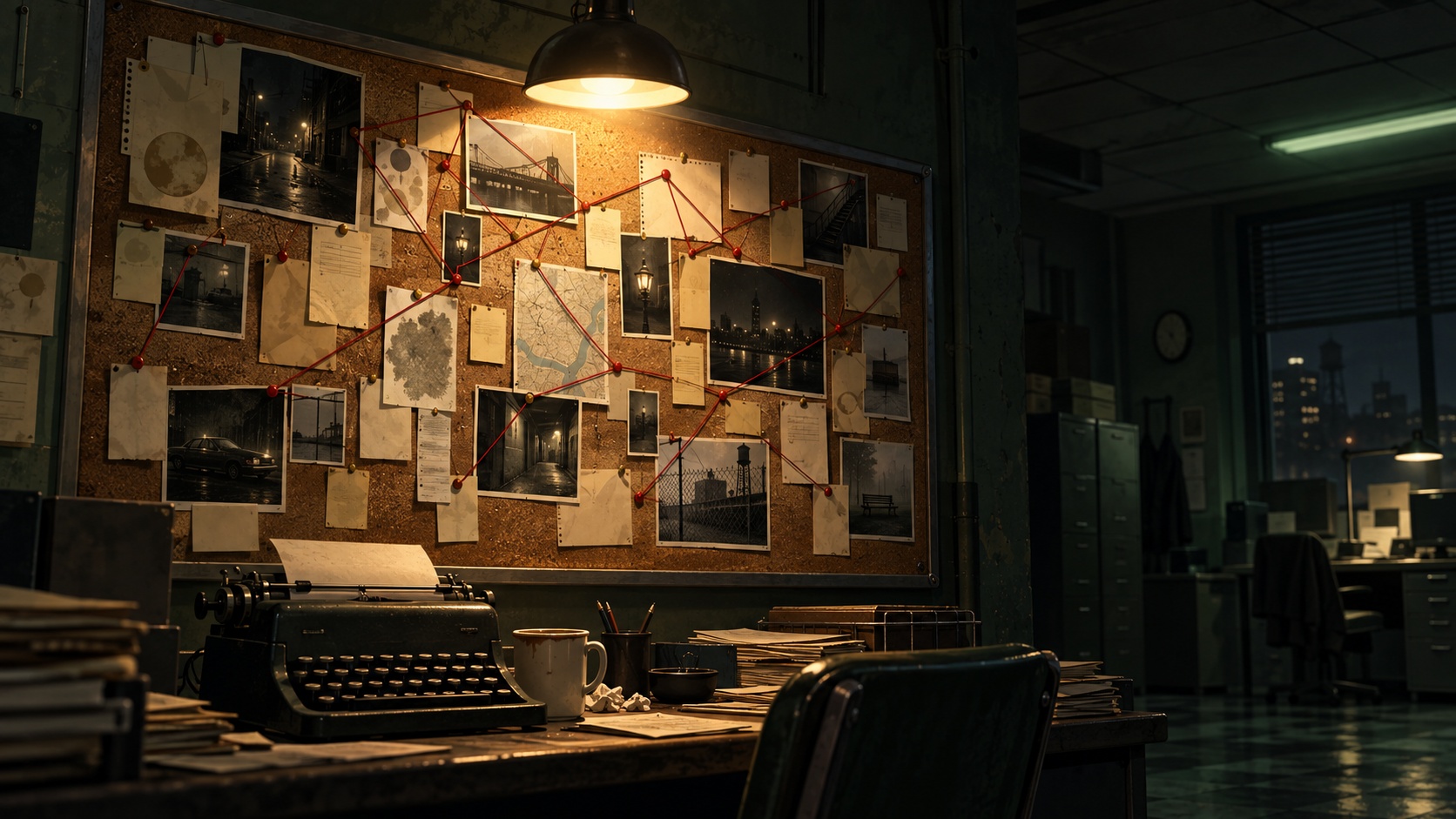
Harrow Falls, a mid-sized American city somewhere past its industrial peak, present day. You work the overnight desk at the Fifth Precinct, where the caseload never quite clears and nobody above you is interested in why. The corkboard sits under one bulb in a shared squad room that smells like burnt coffee and toner. There's no supernatural hook and no career-defining villain — the antagonist is the shift clock and your own last case coming back to bite you.
Visually, the game lives entirely on that one board: manila case folders, a coffee ring on the corner of the desk, a single hanging bulb throwing hard shadows across the timeline grid. The palette is fluorescent-office green, case-file manila, black coffee brown, and a warm incandescent yellow where the desk lamp hits the board. Sound is sparse — pen scratches, a folder slap when a card locks in, a low hum when the clock ticks under two minutes.
Differentiators
- One truth, not one script. The solver guarantees a single, fully consistent chain of guilt every shift, which turns a genre built on one-and-done authored cases into something you can play every night — the exact gap the deduction-genre press has been writing about since Blue Prince showed a roguelike escape room could do it for puzzle design. Every fragment the generator draws from is hand-written; only the combination is assembled, so the writing never degrades into the placeholder-NPC feel that dragged down procedural detective sandboxes like Shadows of Doubt.
- The board is the whole interface. There's no conversation tree, no tell-reading, no hidden hotspot to click. The single verb — pin a card to a slot — is the entire skill the game is testing, so what you get better at in shift one still matters in shift eleven.
- Burnout is the real opponent. Cross-examination and the late-tour tremble mean a case you solved correctly two shifts ago can still come back and cost you if you cut a corner to beat the clock. The threat in the back half of a tour isn't a smarter suspect; it's your own backlog.
Monetization notes
Premium, one-time purchase in the $16–18 range on Steam and GOG, sized like The Case of the Golden Idol and Return of the Obra Dinn rather than a full-priced release. Early access is worth considering here specifically because the generator and solver are systems that benefit from a live audience stress-testing the fragment library for edge cases before the full evidence-category unlock chain ships. Paid DLC follows the path The Rise of the Golden Idol already proved works in this genre — its four 2025 expansion packs sold on top of the base solving system — so a "Fragment Pack" model (new evidence categories, a new city, a new confederate-lie variant) is a natural fit rather than a reach. The 2026 press narrative that the genre had gotten stuck on "glowing magnifying glass icons and waiting for monologues" and is now actively moving past it is a real tailwind, but it also means the shelf is getting crowded; the pitch has to lead with "the mystery game you can play every night," not just "another detective game."
Accessibility notes
- Full keyboard navigation of the board (tab between cards and slots, no mouse required) alongside mouse-drag and controller cursor support
- Confidence rings distinguished by shape and line pattern (solid, dashed, dotted), never by color alone
- Scalable board UI with independent zoom, since a late-tour board is dense by design
- Full text log of every case narration and challenge exchange; the game has almost no voiced dialogue to begin with
- Adjustable shift clock speed, including an untimed practice mode that removes the countdown entirely
- Motion-reduction option that replaces the burnout tremble with a static red outline pulse on affected pins
- Independent difficulty sliders for fragment density and confederate-lie frequency, separate from clock speed, so a player can slow the pace without also simplifying the deduction
Risks
- A generator bug ships an unsolvable or double-solvable case. Mitigation: the solver's contradiction check runs before a shift is ever handed to the player, and any case that fails it gets silently reassembled rather than shown.
- The fragment library reads as thin after enough tours, the same complaint leveled at Shadows of Doubt's procedurally generated citizens. Mitigation: budget for a large initial library — well over a hundred evidence texts and dozens of suspect write-ups — written with distinct voice per archetype, and treat "the library feels repetitive" as a ship-blocking playtest finding, not a nice-to-have polish pass.
- A tour-ending scandal after hours of good play feels punishing rather than fair. Mitigation: keep the threshold at three overturned closures, not one, and make a single overturned pin a partial clearance rather than an instant tour-ender.
- The board gets overwhelming once six lanes and sixty-minute columns are both live. Mitigation: the six-week plan tests density increases one axis at a time, and cards only ever appear in the lanes they're relevant to.
- The genre had a strong two years running (Nobody Wants to Die, four Golden Idol expansions, Shadows of Doubt's console launch), so a new entrant needs a hook that isn't just "detective game." Mitigation: the pitch and the first ten minutes both lead with the tour structure, not the setting — this is a roguelike wearing a detective's coat, and that's the sentence that has to land first.
6-week prototype plan
- Week 1: Build the board UI and the drag-to-pin interaction against one hardcoded case — three suspects, eight cards, confidence rings included. Goal: does dropping a card onto the right slot feel like a small discovery rather than a filing task?
- Week 2: Write the solver — the constraint check that verifies a case has exactly one consistent chain of guilt — and run it against a set of hand-built test cases, including ones deliberately broken. Goal: does the solver actually catch the broken ones before a player would?
- Week 3: Build a first-pass generator drawing from a small library (about twenty cards, two locations) validated by the Week 2 solver, and add the shift clock overlay. Goal: does a freshly assembled case feel structurally different from the last one, not just reskinned?
- Week 4: Add cross-examination and the confidence-collapse challenge at case close. Goal: when a pin gets challenged and falls, does it read as the consequence of an earlier guess rather than a random gotcha?
- Week 5: Add the burnout meter, the late-tour tremble, and the informant favor bank; chain three shifts into a mini-tour. Goal: is shift three visibly tenser than shift one, and can a player point to why?
- Week 6: Vertical slice — a full three-shift tour with generator, solver, clock, burnout, and cross-examination all running together. Playtest with eight to ten people. Primary success metric: how many start a second tour immediately after the first one ends.
Genre references
- Mystery Gamedev, "Roguelikes and Replayability in Mystery Games" — https://mysterygamedev.substack.com/p/roguelikes-and-replayability-in-mystery-games — argues authored mysteries give players no reason to replay once solved and proposes "one culprit, one truth, infinite replayability" through skill mastery rather than randomizing the solution; this is the design problem Clearance Rate's generator-plus-solver structure is built to answer.
- Shadows of Doubt review, PCGamesN — https://www.pcgamesn.com/shadows-of-doubt/review — a procedurally generated detective sandbox praised for its freedom but criticized for repetitive, personality-free citizens and low consequence for player actions; Clearance Rate keeps every fragment hand-authored and gives overturned closures a real cost, specifically against that failure mode.
- The Rise of the Golden Idol, Wikipedia — https://en.wikipedia.org/wiki/The_Rise_of_the_Golden_Idol — a pure fill-in-the-blank deduction interface that shipped four paid expansions through 2025, confirming both the appetite for dialogue-free deduction and the DLC model this concept's monetization plan follows.
- Nobody Wants to Die review, PCGamesN — https://www.pcgamesn.com/nobody-wants-to-die/review — praised for atmosphere, criticized for hand-holding that removes player agency over which tool to use and when; Clearance Rate's board never highlights a correct next move.
- "The best detective games 2026," PCGamesN — https://www.pcgamesn.com/best-detective-games — frames 2026 as the genre finally moving past "a loop of finding glowing magnifying glass icons and waiting for monologues," the exact interface convention this concept's board-only design was built to avoid.