Standing Order
Design brief
Hot-swap a machine into a running production line before its buffer runs dry, because the contract behind it never agreed to a pause.
Date: 2026-08-31 Genre: automation/factory sim Platform: PC (Windows; keyboard & mouse, the genre-standard input for precision belt and machine placement; no controller support planned) Status: Concept
Target player
Someone with 200+ hours in Satisfactory or Factorio who has started skipping their own creative-mode saves. An empty field stops being interesting once you already know the belt patterns that solve it; the tension of the first playthrough doesn't survive a second trip through the same greenfield decision tree. They still want the spatial-logistics puzzle: routing belts, balancing throughput, hunting bottlenecks. They just want a reason those decisions still matter after the hundredth hour, and they'd rather that reason be operational pressure than Factorio's biters, which turn the factory game into a tower-defense game they didn't ask for.
Core loop
The 30-second loop. You're watching the Diagnostic Scope, a live overlay that colors every belt segment by throughput and flags the one true bottleneck on the current line. No hunting: the game tells you where the problem is, and the decision is what to do about it. You select that segment and arm a splice: drop a replacement machine next to it, wire a temporary bypass, hit Confirm. A countdown starts, 4 to 11 seconds depending on the machine, during which that segment produces nothing. The buffer silo upstream drains to cover the gap. If the buffer empties before the countdown ends, everything downstream starves and a red STARVED tag cascades machine to machine while an alarm ticks. The game won't even let you press Confirm if your buffer is smaller than the countdown times the current throughput; it greys the button out and tells you the exact shortfall, so a starve-out is always a plan you got wrong, never a number you weren't shown.
The 30-minute loop. The Ledger lists your active contracts: item, required rate, deadline, and a grace window, meaning how many seconds a contract's output can sit at zero before it takes a strike. Three strikes cancels it and adds its penalty to your debt. You spend a session working a wing of the inherited factory toward a new contract's rate, tracing the Scope's bottleneck flag back through machine after machine, stockpiling buffer ahead of each splice, and discovering that the "solved" wing next door shares a raw-ore belt with the one you're upgrading. Fixing this wing's throughput just starved that one's buffer, and it's back on your list. Clearing a contract pays down debt; clear enough and the bank unlocks the next wing, which is exactly as tangled as the first one was, just bigger.
Here's where it gets boring in hour three if we don't watch it. Once a player has internalized "buffer 1.5x the countdown, then swap," every splice becomes the same checklist, and checklist repetition is not tension. Two things keep it from settling there. First, Emergency Orders: contracts that arrive with a grace window under two seconds, too short for any buffer to fully cover, so the honest answer is a partial strike you accept and route around, not a puzzle you solve cleanly. These show up more often as your reputation grows, because bigger clients expect faster turnaround. Second, cross-wing resource contention means no wing ever gets to be "finished and forgotten." The shared-ore problem above recurs by design, so the player's attention keeps moving instead of settling into one optimized loop.
Systems
- The Diagnostic Scope — a toggleable overlay coloring every belt by current throughput (green flowing, yellow constrained, red stalled) and outlining machine wear with a pulsing countdown to failure. It always shows the true bottleneck; the game never expects the player to hunt for a hidden cause.
- Splice & buffer economy — swapping any machine opens a real-time disconnect window covered only by upstream buffer stock. The Confirm button is mathematically gated: it will not arm a splice the current buffer can't survive.
- Wear and jams — every inherited machine has a wear meter that climbs with use and forces an eventual splice even on lines the player isn't actively upgrading, so the pressure never fully switches off once a wing is "done."
- The Ledger — the contract book: item, rate, deadline, grace window, and a three-strike fail state per contract. Losing a contract adds its penalty to the factory's debt rather than ending the run outright.
- Cross-wing resource contention — wings drawing from a shared raw-material belt compete for it; upgrading one can silently starve another, which is how a "solved" wing comes back onto the player's plate.
- Emergency Orders — sub-two-second-grace contracts that scale in frequency with reputation, deliberately too tight for full buffer coverage, forcing an accepted partial strike instead of a clean fix.
- Debt-to-asset ledger — the campaign's overarching number: contract income pays down the auction debt on the building; if debt outpaces the factory's appraised value, the bank forecloses and the campaign ends.
- Blueprint Mode — a difficulty toggle that triples every grace window and removes foreclosure as a fail state, keeping the buffer-math puzzle while cutting the pressure to zero for players who want the routing challenge without the clock.
Progression
A campaign is a bankrupt facility bought sight unseen, split into wings that unlock as debt drops below thresholds. Each wing roughly doubles the machine count and adds one new pressure element: a second shared resource, a machine type with a longer splice window, a client with a shorter grace window by default. There's no separate skill tree; growth is entirely in what you understand about the plant and how much buffer capacity you've built, since buffer silos cost money and floor space, and doubling a silo also increases the ore or parts it holds hostage from other wings. A full campaign runs four wings and ends when the building is paid off outright, roughly 15 to 25 hours for a first clear, in line with how long factory-sim campaigns already run. There is no auto-scaling infinite mode at launch; the debt-to-asset arc has a defined end, and reaching it is the win state.
World & setting
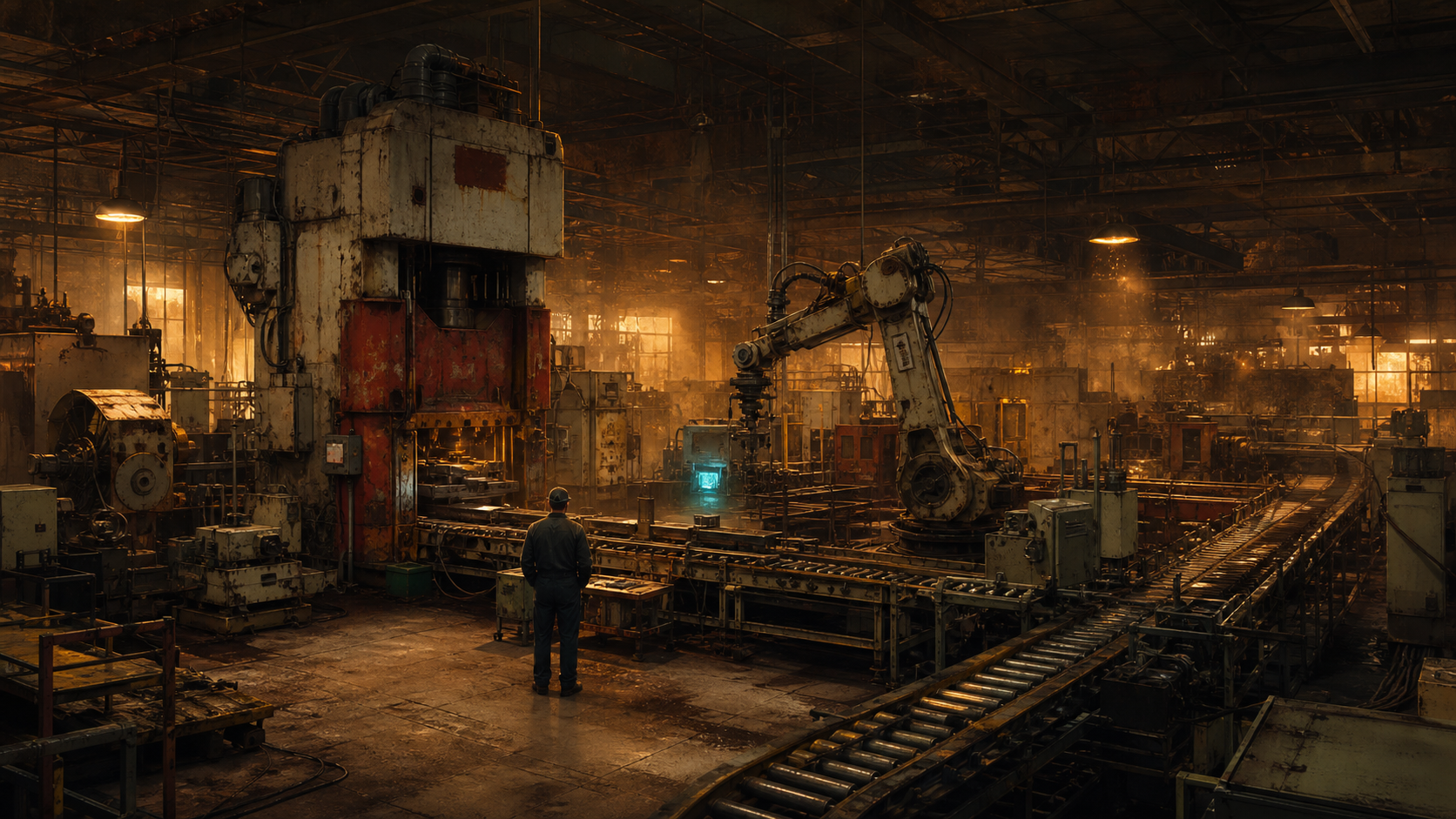
You're a laid-off line engineer who bought Fenwick Regional Fabrication at a distressed municipal auction, sight unseen except for its standing contracts and its debt. The building has been patched, not designed: a 1970s stamped-steel press bolted next to a robot arm someone installed in a hurry, hand-painted warning stencils half worn off, conduit run wherever it would fit rather than where it should go. Tone leans blue-collar and quietly hopeful rather than sci-fi: no neon, no synthetic materials, no alien ore. Between-shift beats come as short voicemails and texts from the auction broker, a skeptical former Fenwick line lead who stayed on, and the bank, which puts the debt pressure in people's voices instead of an abstract meter. The look is meant to read as rust, amber sodium lighting, and analog wear, deliberately apart from the sci-fi-conveyor aesthetic most of the genre reaches for and from Shapez's abstract geometric minimalism.
Differentiators
- You inherit a tangled, already-running factory instead of an empty field, and it must never fully stop producing while you rebuild it. Spaghetti is the day-one condition here, not the mistake other factory games teach you to avoid.
- Every upgrade is a hot-swap with a real disconnect window that buffer stock has to cover, so the core skill is stockpiling insurance ahead of a cut, not just routing belts for peak throughput.
- Wear, jams, and shared upstream resources mean a wing you already fixed can come back broken because of a decision you made somewhere else. Nothing you build ever gets to stay solved and forgotten.
Monetization notes
Premium, one-time purchase, shipping into Early Access first. The splice/buffer economy is a real simulation core that needs live playtesting to tune, the same reasoning that shaped Satisfactory's multi-year Early Access run and Shapez 2's path to its April 2026 1.0 (PCGamesN). Target price sits in the $20–$30 band both of those titles occupy at launch, undercutting Satisfactory's full-scope price given a tighter initial vertical slice of two wings. The genre's 2026 output (Modulus, Farm Factory Simulator, moorestech) shows real appetite for new premium entries even in a crowded field (GameGeeker, Games Press), but most of that wave differentiates by theme, anime RPG hybrid, farming skin, rather than by changing what the player is actually deciding on the factory floor. Standing Order's opportunity is a mechanical hook none of them share: reputable outlets and player discussion both treat "belt spaghetti" and late-game tedium as the genre's known failure points (Steam community, Satisfactory discussion), and this design turns the first into the starting condition and aims the second at the untangling itself instead of at repeating the same build pattern at a larger scale.
Accessibility notes
Fully remappable keyboard and mouse bindings. Buffer, wear, and throughput states are distinguished by icon and pattern, not color alone, for colorblind players. Scalable UI text up to 150%. Blueprint Mode removes the hard fail state and triples grace windows for players who want the puzzle without the clock. Adjustable simulation speed independent of UI responsiveness. Jam alarms default to a steady amber glow rather than a strobe, with an optional audible-only mode for photosensitivity. Full subtitles and captions for every voicemail and text beat.
Risks
- The splice/buffer decision reads as UI busywork instead of a real choice. Mitigation: the Diagnostic Scope always names the one true bottleneck, so the player's decision stays "when and how to splice," never "where is the problem." The hunting that makes busywork feel like busywork is removed by design.
- A live hot-swap simulation with buffer-timing math is a nontrivial core to get feeling right. Mitigation: prototype splice-and-buffer in total isolation, one belt, placeholder art, before any building UI. See Week 1–2 below.
- The genre's established leaders (Satisfactory, Factorio, Shapez 2) already hold most of the attention a new factory sim can expect. Mitigation: lead marketing on the single sharp hook, you inherit someone else's mess and keep it running while you fix it, since none of 2026's other new entrants are pitching a mechanical hook, only a theme skin (Games Press, GameGeeker).
- Players who play this genre for stress-free creative building may bounce off constant pressure. Mitigation: Blueprint Mode ships at launch, not as a post-launch patch, so the routing puzzle is available without the clock from day one.
- Tuning buffer requirements and splice durations across dozens of machine types is a large surface to balance. Mitigation: launch the vertical slice with a fixed roster of eight machine types and expose the buffer-math formula directly in the Scope overlay, so balance problems show up as visible numbers during playtesting instead of hidden behind opaque failure.
6-week prototype plan
- Week 1: Build the live-simulation core — one belt line, three machine types, throughput ticking in real time, zero building-UI polish. Deliverable: a single line producing at a fixed rate you can watch flow end to end.
- Week 2: Add buffer silos and the splice mechanic — arm, confirm, countdown, reconnect — on that one line. Deliverable: successfully hot-swap a machine without stopping output, and deliberately starve one to see the cascade.
- Week 3: Build the Diagnostic Scope — throughput coloring, wear countdowns, automatic bottleneck flagging. Deliverable: a line that degrades naturally over time and telegraphs failure before it happens.
- Week 4: Add the Ledger — contracts, grace windows, strikes, reputation — plus a second small wing sharing one upstream resource with the first. Deliverable: two wings genuinely competing for one raw material.
- Week 5: Add Emergency Orders, reputation-scaled grace-window shrinkage, and the Blueprint Mode toggle. Deliverable: the hour-three autopilot-breaker in place and playable back to back against base difficulty.
- Week 6: Vertical slice — a pre-tangled starting factory of roughly 18 machines across two wings, a full debt-payoff arc to a single milestone. Deliverable: external playtest focused on one question — does the splice tension read as a real decision, or as busywork?
Genre references
- "Satisfactory Review | The Newly Crowned King of Factory Games," Game8 — https://game8.co/articles/reviews/satisfactory-review — Satisfactory's 3D verticality and long Early Access run informed why Standing Order also ships into Early Access first, and its spatial-creativity focus is the contrast point for Standing Order's operational-pressure focus instead.
- Shapez 2 1.0 release reviews, PCGamesN — https://www.pcgamesn.com/shapez-2/release-reviews — Shapez 2's "competent software" build tooling and April 2026 1.0 exit from Early Access shaped the Diagnostic Scope's design goal of feeling precise and legible rather than fiddly.
- "Late Game Factory Design Guide?", Satisfactory Steam community discussion — https://steamcommunity.com/app/526870/discussions/0/4691154661545120795/ — players describing their own factories as "spaghetti design at its best" and late-game building as "very very tedious" is the exact pain point Standing Order makes the starting condition instead of the failure state.
- Kaizen: A Factory Story, Wikipedia — https://en.wikipedia.org/wiki/Kaizen:_A_Factory_Story — its grounded 1980s manufacturing setting and character-driven narrative beats informed Standing Order's blue-collar, non-sci-fi world direction, though Kaizen's puzzles are discrete and self-contained where Standing Order's pressure runs continuously.
- "Gear-Driven Factory Automation Sim × Anime-Style RPG 'moorestech' — Steam Store Page Now Live," Games Press — https://www.gamespress.com/Gear-Driven-Factory-Automation-Sim-Anime-Style-RPG-moorestech-Steam-St — a 2026 genre entrant differentiating through a theme hybrid (anime RPG) rather than a new core mechanic, which sharpened the case for Standing Order leading with a mechanical hook instead.