Night Audit
Design brief
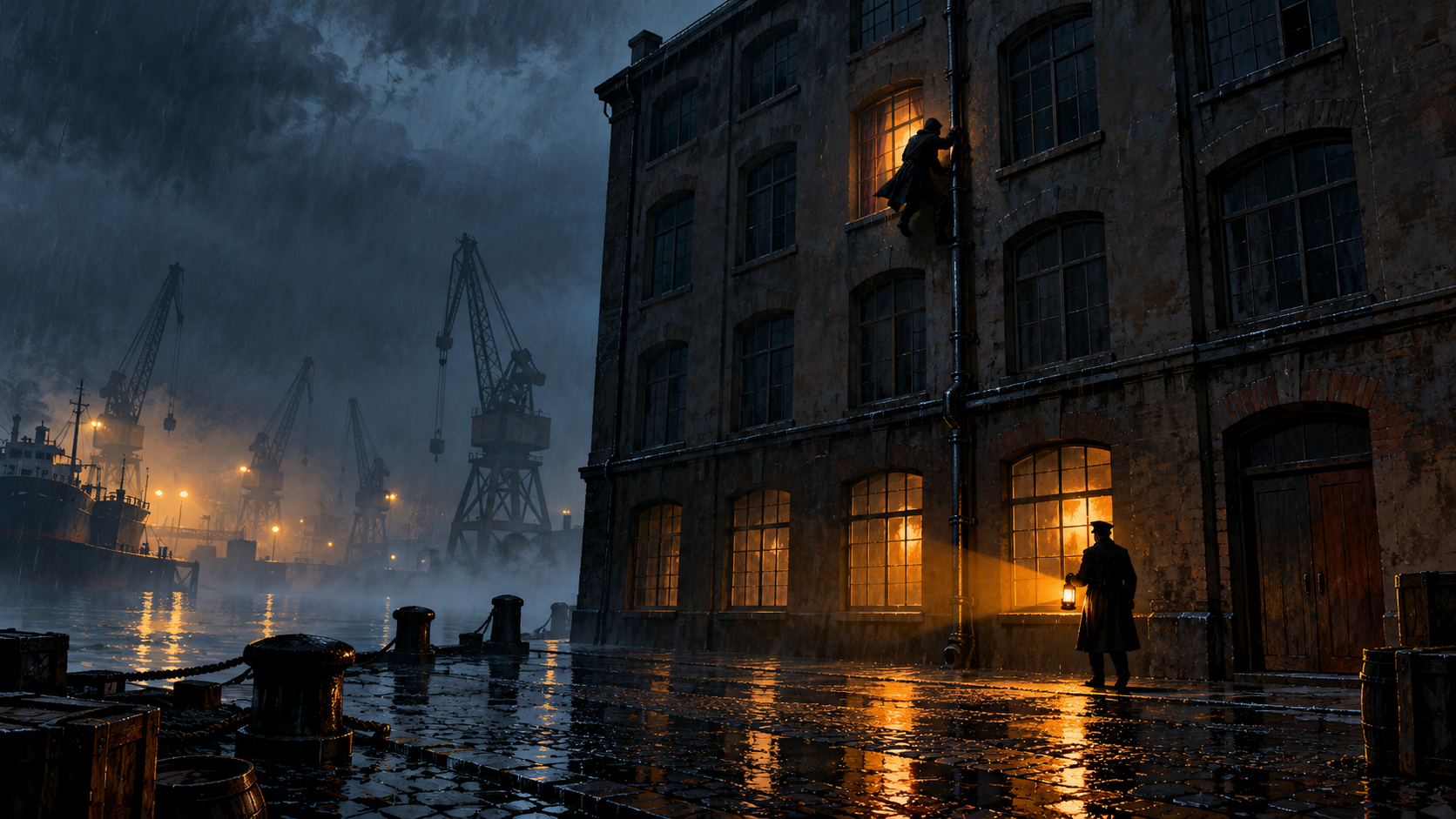
Break into the same harbour records office for nine nights running, knowing every scratch, open drawer and dead bulb you leave behind will be turned into tomorrow night's security by a chief who reads her building better than you do.
Date: 2026-10-05 Genre: immersive sim Platform: PC (Windows; keyboard & mouse, full controller support) Status: Concept
Target player
People who finished Thief and Gloomwood, then bounced off newer stealth games because the guards felt like clockwork. They know that once you learn a patrol, the level stops being a problem and turns into a timing exercise. CGMagazine's May 2026 review of Thick as Thieves names the same complaint: guards with "incredibly telegraphed patrol patterns" who "aren't particularly bright," and progression that has you grinding the same two maps.
Night Audit agrees with half of that. You will play one building over and over. The difference is that the building is arguing back. The itch it scratches is the feeling of being studied by an opponent who is careful, budget-limited and fair, and of learning to plan around her.
Core loop
Loop sentence: Get to one ledger page before the 05:40 shift change, then choose which of the marks you left to scrub and which to leave, because the morning walkthrough turns whatever it finds into tomorrow night's rules.
30-second loop. Read the light and noise ring, pick a route (lock, window, vent, roof hatch, coal chute), use a tool, and notice the trace that tool left. Picking a lock leaves scratches. Smashing a bulb leaves glass on the floor. A wet coat leaves drips on the lino. Each trace shows up in your Trace Ledger (Tab) with a visibility rating from 1 to 5.
30-minute loop (one night). A night runs 22:00 to 05:40 in game time. One game minute is two real seconds, so the full night is about 15 real minutes if you stay until the end, and most runs land between 9 and 13. The night has three phases:
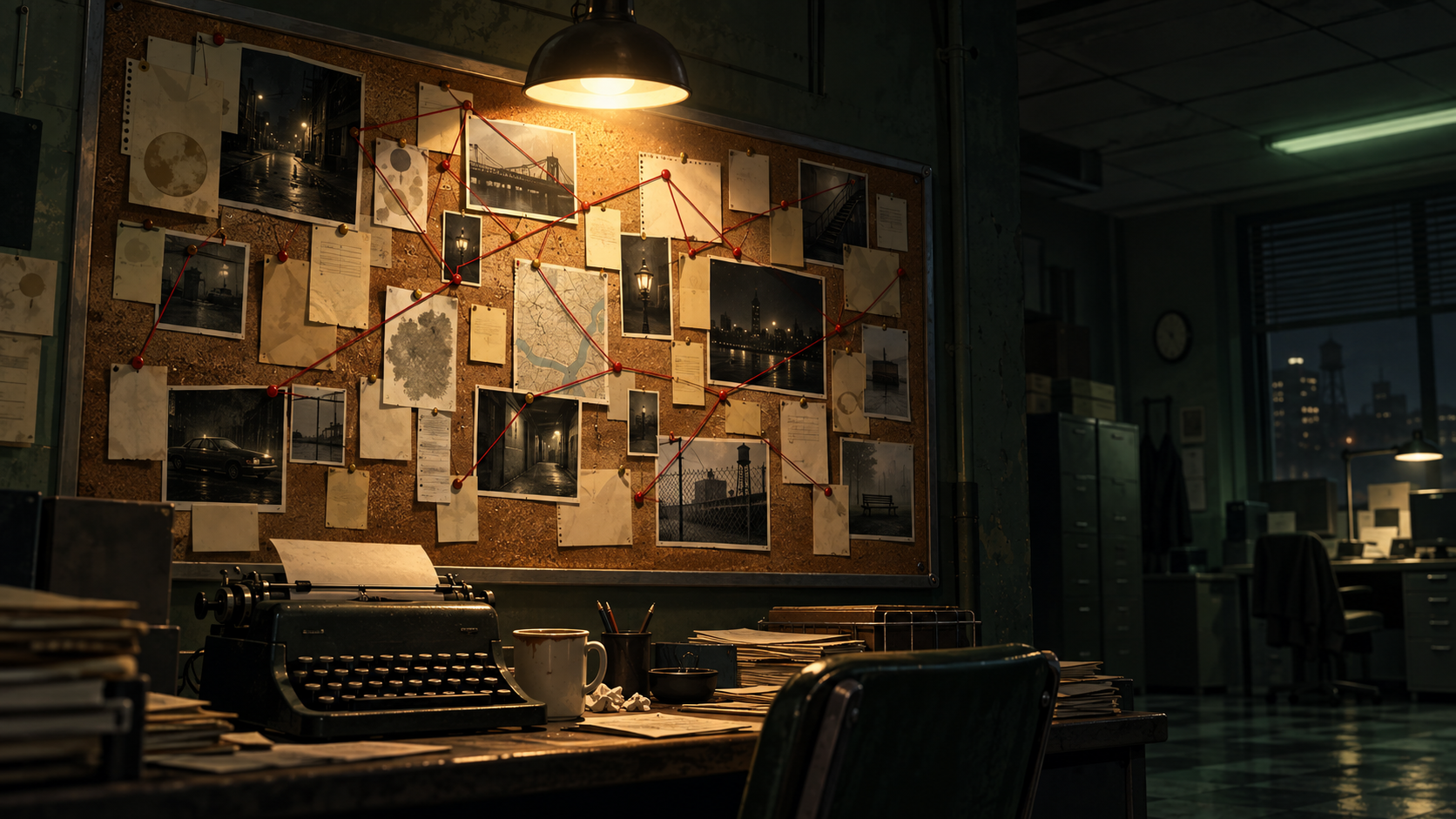
- Read the memo (22:00). The chief's typed memo is pinned in the guardhouse and lists every new procedure since last night. You read it through the guardhouse window or steal the carbon copy from her out tray.
- Get the page. Each night has one objective: one entry in the harbour ledger to swap, remove or copy. It is in a different office each night.
- Clean up or don't. On the way out, the clock is your enemy. Relocking a picked door takes 8 seconds, resetting a filing drawer takes 3, and swapping in a spare bulb takes 5 plus a ladder. Usually you can't clean everything, so you decide what the chief gets to see.
On a typical night, second 5 has you on the wet quay looking at the lit guardhouse window. By second 30 you've read the memo through the glass and picked an entry. By second 90 you're crouched inside, watching the first guard try a door handle that wasn't on his round yesterday.
Controls. WASD move, mouse look, Ctrl crouch, Q/E lean, Shift sprint (loud), left click use tool, right click scrub, F interact, Tab Trace Ledger, M floor plan with the memo pinned to it.
Between nights (2–3 minutes). The Morning Report screen plays the walkthrough as a top-down floor plan. Guards' lanterns sweep their route, and each trace they find is circled in red with a typed line ("Office 3B, drawer 2 left open. Contents disturbed."). Then the chief spends her budget on countermeasures, and you see exactly what she bought and why.
Where it gets boring in hour three. Once a player knows the countermeasure table, cleanup turns into a chore: relock every door, close every drawer, every night. Two things fight that. The clock makes a full scrub impossible after night 4, because objectives move to the top floor and the shift change stays fixed. And deliberate decoys (see Systems) give the cleanup phase a real decision: the best players stop tidying and start leaving false evidence. If playtests show people still tidying by rote in night 6, the fix is to cut the scrub verbs further. Making the clock longer would not help.
Systems
- Trace Ledger. Every interaction that changes the world writes a trace with a type, location and visibility from 1 to 5. Visibility 1 is a faint scuff and 5 is an unconscious guard. A trace is found at the morning walkthrough if its visibility is 3 or more, or if it lies on a guard's walkthrough route. Weather changes this: on rain nights, wet footprints are visibility 4 until 03:00, when the heating dries them to 1.
- The chief's budget. Security chief Agnete Holm, a retired harbour police sergeant, gets countermeasure points every morning: 2 after night 1, rising by 1 per night to a cap of 8. She spends them on the highest-visibility traces first, and breaks ties toward the wing she already suspects. Prices: bulb cage 1, rake the yard gravel 1, talc the windowsills 1, add a door to the patrol checklist 1, upgrade a lock to 6 pins 1, tamper tape on cabinets 2, punch-clock stations 2, night clerk working late 2, paired guards in one wing 3, yard dog 3.
- Decoys and suspicion. Because the chief responds to evidence, you can buy her purchases for her. Jimmy a ground-floor window you never used and she might spend 2 points sealing the east wing while the top-floor vent you actually use stays open. She keeps a hidden suspicion count, though. Any trace with no matching loss (a forced window with nothing missing nearby) adds 1. At 3 she buys "random spot checks" for free, where guards break route to check two random rooms per hour. Decoys work, but every decoy has a cost.
- Guards with checklists. Guards don't wander. They walk a printed round, and the memo tells you what is on it. When the chief adds a door to the checklist, a guard tries that handle every round. Alert behaviour follows readable states (curious, searching, alarmed) with a light-and-noise ring like Gloomwood's. Ask any guard and you can know what they are doing and why. Their predictability is something the chief has to pay to change, not a flaw in their AI.
- The Profile. Every time a guard or clerk sees you clearly for 1.5 seconds or longer, they give a statement: coat colour, height, hat, which hand held the lamp. The Profile has eight fields. Each filled field makes guards stop and question anyone matching it, including the cleaners who use the service door at 04:30 and who you might have been planning to blend in with. Stolen clothes clear one field. At 8 of 8, harbour police stake out the building and the campaign ends.
- Toolkit and scrubbing. You carry picks (4 per night from night 6, and a failed pick snaps), a glass cutter, a spare bulb, a rag, a steamer for tamper tape, and a coil of rope. Each tool has an action that leaves a trace and a scrub action that removes that trace, and the scrub takes longer.
- Clock. Shift change at 05:40 is a hard limit. If you are inside when it arrives, the day staff will find you, and the night ends as a capture.
Progression
Nine nights, one building: four floors, a basement, a coal yard and a roof, with 7 entry points. A full campaign takes 5–7 hours. Capture restarts the current night from 22:00 with all of that night's earlier traces wiped. Ironman mode turns that off.
The ramp adds one new kind of pressure per night on a fixed schedule. The chief's reactive purchases go on top of that.
| Night | Guards | Chief's budget next morning | New pressure | Axis |
|---|---|---|---|---|
| 1 | 2 | 2 | Objective on the ground floor; nothing new | Opening |
| 2 | 2 | 3 | Night clerk in the shipping office until 23:30 | Variety (a civilian who doesn't patrol) |
| 3 | 3 | 4 | Third guard on the upper floors | Density |
| 4 | 3 | 5 | Punch-clock stations: rounds every 15 game minutes, exact | Precision |
| 5 | 3 | 6 | Vault page needs a two-part combination kept in two wings | Cognitive |
| 6 | 4 | 7 | Picks limited to 4 per night | Resource |
| 7 | 4 | 8 | Paired guards in the wing with the most traces | Compound |
| 8 | 4 | 8 | Harbour police car on the quay 02:00–03:00 blocks two entries | Time window |
| 9 | 5 | — | The chief walks her own route; the page is in her office | Finale |
Between nights you buy tools with money found in the building (petty cash tins, pawnable fountain pens). Tool upgrades replace one another rather than stack: a tension wrench that handles 6-pin locks, a quieter glass cutter, gum soles that leave visibility 1 footprints instead of 3. You won't keep up with the chief by gearing up. You keep up by steering her.
What goes up. Your campaign score is ledger pages recovered (out of 9) and the Profile kept low. Each night's grade, from Clean to Burned, counts traces found. Leaving the chief with no findings at all on a morning ("Nothing to report") is the rare top result, and the Morning Report counts how many you've managed.
Fairness guarantees.
- Every countermeasure is in the memo. Nothing changes overnight that you can't read about.
- The chief can never seal more than 5 of the 7 entries, so at least two ways in always exist.
- Guards telegraph alerts with an audible line and a 1.2 second turn before they can see you.
- When a guard grabs you, the screen narrows, a hand reaches into frame, and you get a 0.8 second shove window once per night.
World & setting
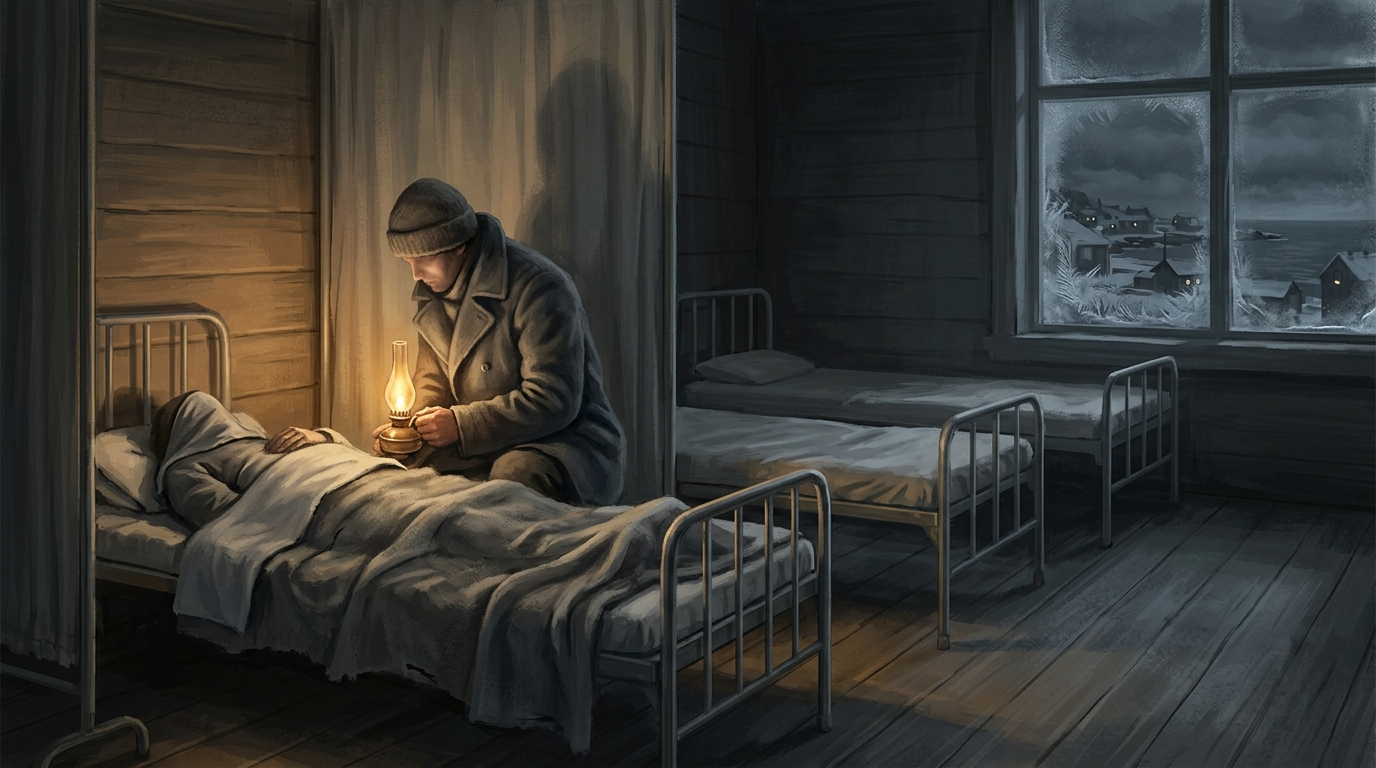
Kessendorf, a fictional Baltic port city, in November 1974. The Harbour Registry is a four-storey brick building where every ship's cargo was logged in heavy cloth-bound ledgers. You are Ilse Brandt, a dismissed night clerk who knows the building and knows that the ledgers were altered to pin a smuggling ring's losses on her. The port inquiry opens in ten days. She needs to put the original pages back, one night at a time, before it does.
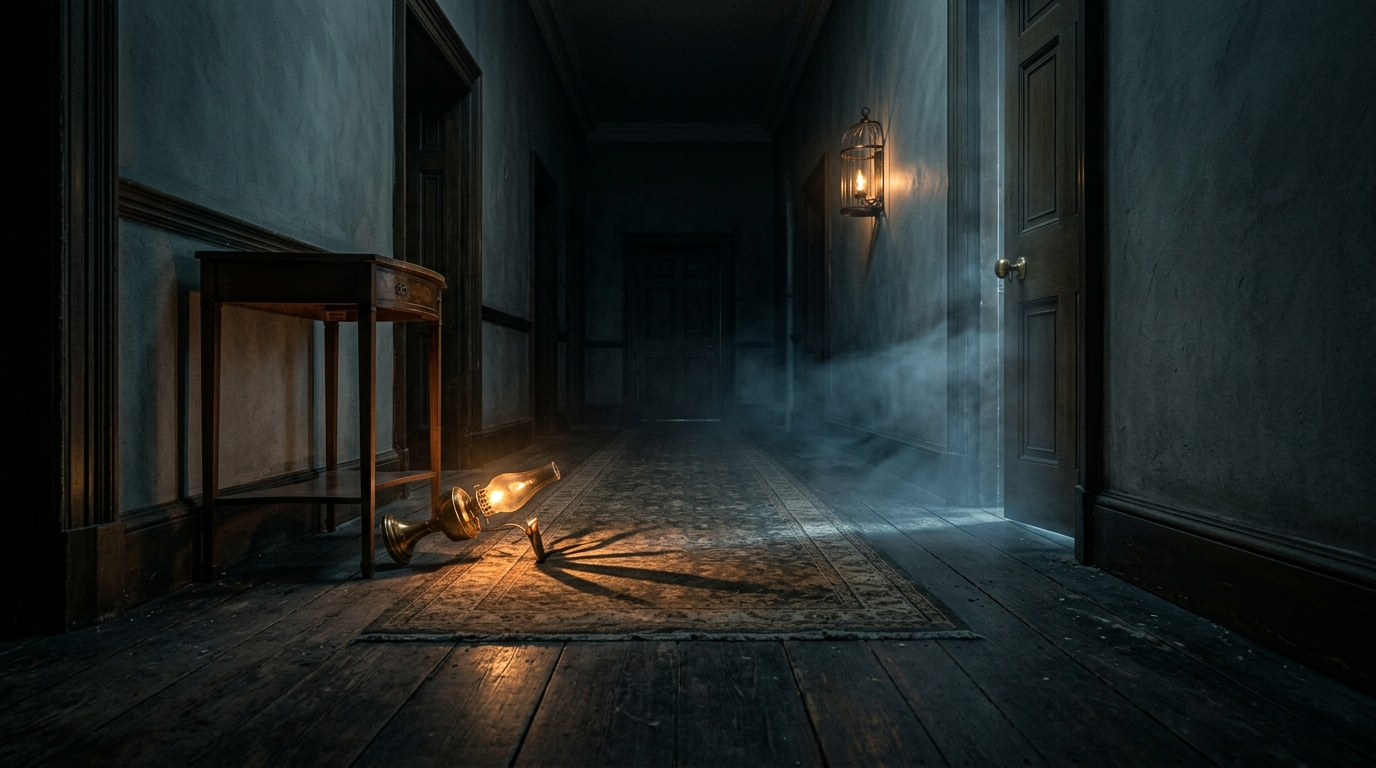
The art is painterly 3D: gouache-like textures, heavy shadow shapes, rain on everything. The palette is wet slate blue, sodium-vapour amber, oxblood and near-black. The chief speaks only through her memos, which are terse, dry and sometimes funny ("Whoever is using the coal chute: it is now locked. It was always dirty."). Sound carries the stealth: foghorns mask footsteps for 4 seconds every 90, and typewriter carriages in the night office cover a lock pick.
Differentiators
- The defence is rebuilt every morning from the evidence you left. A budget-limited chief buys countermeasures in response to traces she found, and the memo announces each one, so the level you play on night 6 is one you partly wrote yourself.
- Leaving evidence on purpose is a core tactic. Decoy traces steer where the chief spends her points, and a hidden suspicion count punishes decoys that don't match any real loss.
- Your description is a resource you spend. Witness statements fill an eight-field Profile that changes who guards stop, and stolen clothing is the only way to clear a field, so being seen costs you on later nights as well as in the moment.
- Cleanup is a timed phase of every night. Each tool has a matching scrub action that takes longer than the tool itself, and the fixed 05:40 shift change forces you to choose which traces to leave.
Monetization notes
Premium, $19.99 on Steam, no live service and no unlock grind. Thick as Thieves launched at $4.99 in May 2026 as a live-service stealth game, and the reviews (6.5 from CGMagazine) went after its arbitrary unlock gates and two maps that went stale. Night Audit repeats one building by design, but the reason to repeat it is a better story than an XP bar.
The market is small but loyal. Gloomwood has been in early access at $20 since September 2022 with strong reviews, which shows a Thief-shaped game can sustain an audience without a big publisher. Post-launch, a $7.99 second building (a customs bonded warehouse with a different chief) is the natural DLC, along with a free "Chief's Challenge" mode with seeded weekly memos. My honest read is that this does 30k–80k units if the Morning Report screen looks good in trailers, because that screen is the hook nobody else has.
Accessibility notes
- Full remapping for keyboard, mouse and controller; hold actions (lockpicking, scrubbing) can be set to toggle.
- The light-and-noise ring uses shape as well as colour (the ring segments fill and also change thickness), and the guard alert states each have a distinct icon and audio line.
- Subtitles for all speech, including guard barks, with speaker names and direction arrows for off-screen sound.
- "Memo always visible": a pinned summary of active countermeasures on the pause screen for players who don't want to rely on memory.
- Assist options that change the numbers without hiding them: clock speed (1.0x / 0.75x / 0.5x), chief's budget (−2 points), and Profile threshold (8 / 10 fields).
- Camera bob, lantern flicker and lightning flashes can be reduced or turned off, and the HUD scales from 75% to 200%.
Risks
- The chief feels random. If players can't predict what she'll buy, the system reads as dice. Mitigation: the Morning Report shows her spending order and reasons line by line, and the purchase rules are a fixed priority table that can be learned.
- One building wears out. Nine nights in the same place could feel like Thick as Thieves' two-map grind. Mitigation: the schedule adds a new pressure type each night, the objective moves floor by floor, and the chief's purchases change the routes. Playtest on night 6 specifically for "I've seen this."
- Decoy farming breaks the economy. Expert players could steer every purchase and trivialise the late nights. Mitigation: the suspicion count and free spot checks; tune decoys so each costs the player about 40 seconds of the clock.
- Cleanup as busywork. Mitigation: scrub verbs are deliberately few (relock, close, replace bulb, wipe), and the clock rules out a full scrub after night 4.
- Scope of systemic guards plus a planner AI. Mitigation: the chief is a priority list, not a planner, and guards run fixed rounds with state overrides. Both fit a small team.
6-week prototype plan
- Week 1: Greybox the Registry's ground and first floors with 4 entry points. First-person movement, light and noise ring, one guard on a checklist round. Deliverable: walk in, get spotted, understand why.
- Week 2: Trace Ledger with six trace types (picked lock, open drawer, broken bulb, wet footprints, forced window, unconscious guard) plus scrub actions. Deliverable: a debug overlay showing every trace and its visibility.
- Week 3: Morning Report screen and the chief's budget with five countermeasures (lock upgrade, checklist door, bulb cage, tamper tape, paired guards). Deliverable: play night 1, watch the report, play night 2 against what she bought.
- Week 4: Memo in the guardhouse, decoys and the suspicion count, and the Profile with four fields. Deliverable: a three-night run where a tester steers a purchase on purpose.
- Week 5: Add the second floor, the night clerk and punch clocks. Run the ramp for nights 1–4, and add the clock and capture/restart. Deliverable: a four-night campaign that runs start to finish.
- Week 6: Vertical slice of nights 1–4 with a first art pass (palette, rain, lantern lighting) and memo writing. Run 8 external playtests and measure two numbers: how many testers use a decoy unprompted by night 3, and how many describe the chief's purchases as "fair" in exit interviews. Greenlight if at least 5 of 8 say fair and at least 3 try a decoy.
Genre references
- Thick as Thieves (OtherSide Entertainment), CGMagazine PC review, 2026-05-19 — https://www.cgmagonline.com/review/game/thick-as-thieves-pc-review/ — the current complaint about telegraphed guard patterns and grinding two maps; Night Audit makes repetition the premise and gives the predictability to an opponent who has to pay to change it.
- Gloomwood (New Blood Interactive) — https://en.wikipedia.org/wiki/Gloomwood — light and noise ring stealth, praised small-scale level design, and a $20 early access price that shows a Thief-shaped audience exists.
- Shadows of Doubt (ColePowered Games) — https://en.wikipedia.org/wiki/Shadows_of_Doubt — simulated routines and evidence-driven play; the model for guards who walk real rounds and for evidence as the thing that drives the game.
- RetroSpace developer interview, Game Rant — https://gamerant.com/retrospace-horror-game-interview/ — the warning that immersive sim systems multiply complexity "up to 10", which is why the chief is a priority table and not a planner.
- Raphaël Colantonio interview, Game World Observer — https://gameworldobserver.com/2024/02/09/what-is-immersive-sim-raphael-colantonio-interview — "you basically let the player cheat the game": decoys are a sanctioned way to cheat the chief.