Undertow
Design brief
In a drowned rust-belt America, compete with other salvagers to dive the submerged ruins of flooded cities — where murky water is equal parts cover, oxygen clock, and coffin.
Date: 2026-07-20 Genre: extraction shooter Platform: PC (Windows; keyboard & mouse, full controller support) Status: Concept
Target player
Extraction shooter veterans who are burned out on military-realism aesthetics and want a game that uses the environment as the primary threat, not just the backdrop. They played Hunt: Showdown long enough to appreciate audio as a tactical weapon and appreciate ARC Raiders' accessibility approach, but want something with real mechanical novelty. They also skew toward atmospheric, narrative-adjacent settings — they want to feel like they're inside a plausible near-future disaster, not a gun catalog. Secondary audience: survival game players (Subnautica, The Long Dark) who haven't found an extraction shooter with environmental stakes they respect.
Core loop
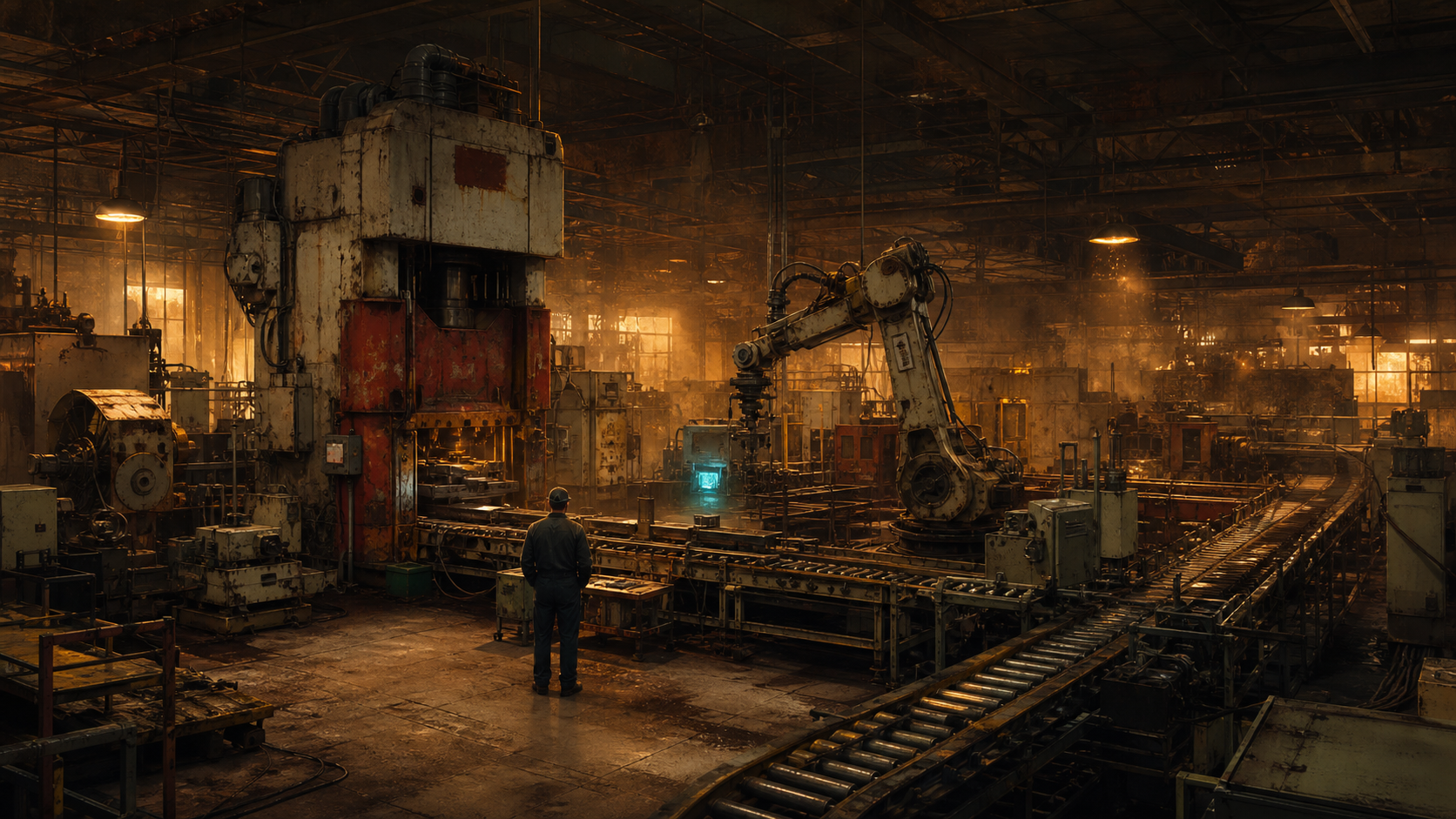
30-second: You move through a partially submerged factory floor — boots in knee-deep water above, clear rooftop light ahead, and a 12-meter dive into the supervisor's office below. You check your O2 gauge (3 minutes left), scan sonar for life-signs (one ping, 40 meters northeast — moving parallel, not toward you), and drop under the waterline. Sound cuts to a deep, muffled hush. Your fins push you forward. You spot the data locker. A scavenger drone sweeps its spotlight through a shattered window. You go still — moving stirs silt, silt creates a trail. The drone passes. You crack the locker, pocket the drive, and push back up.
30-minute: You enter Memphis Bottoms via your dinghy at a surface access zone, choose a depth tier (shallow rooftops for quick loot, mid-depth commercial floors, or the deep basement vaults for high-value contracts). You work through three buildings before your oxygen reserves force a surface trip — or you find an air pocket inside an overturned tank car on the factory floor. An enemy salvager surfaces 20 meters away; you both clock each other. Standoff. They swim left; you go deep. You extract your contract package from a pre-Flood server room, kick hard for the surface, reach your boat, and slot the drive into your uplink device. The run ends. You keep what you extracted. You lost a good dive knife to a surveillance drone. You can live with it.
Systems
- Depth / Oxygen Management: Dive tanks hold 4 minutes of air at rest; exertion burns it faster. Air pockets in sealed rooms, submerged vehicles, and found rebreathers replenish it. No O2 = drowning, which triggers a brutal 30-second bleed-out timer that forces surfacing or death. The oxygen budget is the run's fundamental clock.
- Acoustic Duality: Above water, audio behaves like a polished extraction shooter — footsteps, ricochets, and weapon reports carry as expected. Below the waterline, that system flips: gunshots become muffled pressure thuds, footsteps vanish entirely, and movement through water creates visible silt trails. Grenades become area-denial monsters underwater (pressure wave, massive AoE). Players learn two distinct audio languages.
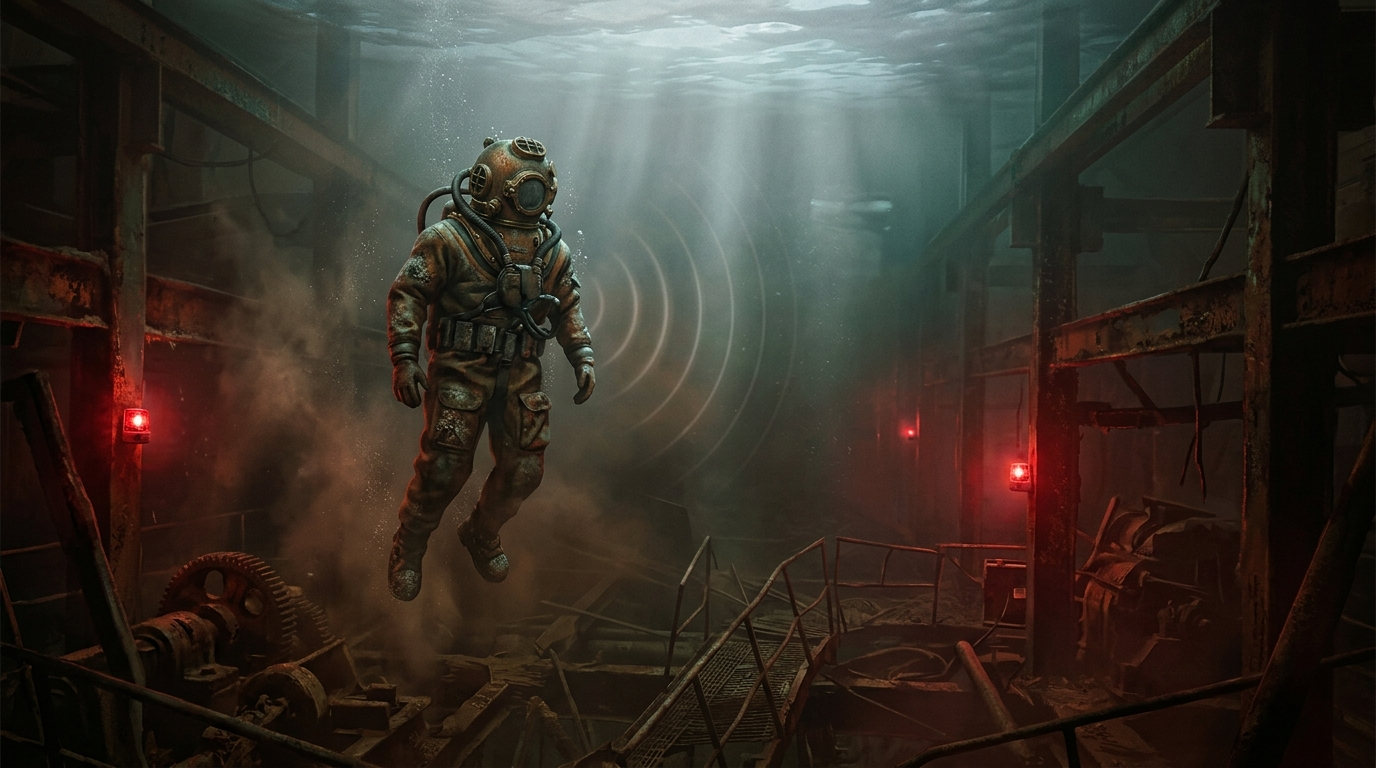
- Sonar System: A handheld sonar device pings nearby metal masses and life-signs through murky water. Useful for navigation and spotting enemies — but your ping is audible to anyone holding a sonar receiver. Using sonar is a bet on knowing where threats are before they know you used it.
- Silt & Visibility: Moving fast in submerged areas kicks up silt, creating visible trails and reducing sight lines. Hovering still clears the water but costs O2 at the same rate. Tactical stillness is a real skill — learning to approach locations by drifting, not thrashing.
- Surface Control & Environment Manipulation: Flood valves, bilge pumps, and emergency pressure switches exist throughout the maps. Activating them can drain a section of a building (exposing loot and removing the O2 cost), flood a topside route (cutting off a sniper's perch), or trigger a pressure release that clears an entire floor of murk for 90 seconds. These are high-noise actions — every player in the zone hears the pumps.
- Faction Contracts: Three contractors — the Levine Corp salvage firm (wants data drives, pays in premium gear), the Bottoms Collective community network (wants medical and food supplies, pays in faction standing and unique local-manufacture weapons), and Morel's Brokerage (wants pre-Flood artifacts, pays in cash). Rep with each faction unlocks hideout upgrades, unique loadout slots, and targeted mission types.
- Loadout & Persistence: You bring gear in; you lose it on death. One exception: your wetsuit and dive frame (the physical dive rig) are always recovered if you make it to water — only dropped if you die topside or at the surface. This creates a mechanical reason to dive deep: topside combat is riskier for your carry-in gear.
Progression
Run-by-run: Each run earns currency and faction rep based on what you extracted. Better contracts unlock at higher rep tiers. The hideout upgrades over time (tank capacity, sonar range, stash size, crafting options for diving consumables). No run-to-run stat inflation — a new player with a good air supply can compete with a veteran on gear knowledge alone.
Meta-progression: Three faction rep tracks advance independently. Reaching rep tier 3 with Morel's Brokerage unlocks the Basin (the deepest, most valuable map). Reaching tier 3 with the Collective unlocks faction-protected safe zones in two maps. The faction tracks create meaningful choices about which contractor to prioritize, and reaching max rep with all three (a long-haul goal) unlocks the game's final narrative contract: recovering a pre-Flood corporate archive that reveals why the levees really broke.
Seasonal structure: Each season (12 weeks) introduces one new drowned zone, a rotating narrative contract chain, and a cosmetic reward track (no gameplay advantage). Between seasons, a mid-season patch adjusts loot tables, AI patrol paths, and pump/valve locations to prevent route calcification.
World & setting
- A decade after the Great Inundation — a cascade of failed levees and climate-driven Mississippi River flooding that permanently submerged 40% of Memphis's south and west sides — the U.S. government declared Memphis Bottoms an Unrecoverable Flood Zone and withdrew. What was left: 14 square kilometers of partially submerged factories, residential blocks, warehouses, and municipal infrastructure. Some of it sits 2 meters down. Some of it — the basement vaults of the old MetroTech financial campus — sits 20 meters under.
The Bottoms is now a gray zone. Corporations send licensed salvage teams. The people who stayed send their own. The black market sends Morel's guys. They all share the same murky water and they all want different things from it. The aesthetic is rust-orange, algae-green, and concrete-gray — Americana in decay, lit by shaft light filtering through murky water and the red blink of still-active emergency lighting on dead circuits. The tone is grounded and melancholy, not grimdark — the disaster happened to real people and you're picking through what they left.
Differentiators
- Aquatic verticality — the map plays across three distinct strata (below waterline, at the surface, above water on rooftops and bridge spans), each with fundamentally different movement, combat, audio, and loot economics. No extraction shooter in 2025–2026 operates across a water/air boundary as a core design mechanic.
- Acoustic duality as a skill system — mastering two audio environments (topside extraction-shooter acoustics vs. muffled underwater sonar-based awareness) is itself a progression curve. Veterans will move between both modes seamlessly; novices will drown in one of them.
- Oxygen as a natural run timer — unlike zone-shrink circles or artificial time limits, the O2 budget imposes pressure that scales with how deep and how ambitious you are. You set your own clock by deciding how far down to go.
- Post-flood Americana — drowned rust-belt cities, submerged factory floors, murky Mississippi water and emergency lighting. Distinct from military gray, fantasy dungeons, or sci-fi chrome. Politically resonant without being didactic.
- Environmental control shifts the battlefield — activating pumps and valves to drain or flood sections creates emergent situational changes mid-run. Players can reshape the map to their advantage, but it makes noise that telegraphs their position.
Monetization notes
$34.99 premium PC launch on Steam Early Access (targeting 12–18 months EA). Two maps and faction system at launch; a third map in month 2; full launch out of EA with four maps and the faction narrative conclusion. Cosmetic-only seasonal shop: wetsuit and dive frame aesthetics, boat customizations, flare gun skins. No gameplay advantage sold. DLC maps planned post-launch ($9.99 each): New Orleans canal district, Detroit River industrial collapse, St. Louis arch district. Market opportunity is real: ARC Raiders (2025) and Marathon (2026) have carved out healthy audiences, proving the genre is not Tarkov-only. A $35 buy-in with strong first-person audio design and a novel mechanical hook (aquatic verticality) has a credible path to 150–250k units in year one through word-of-mouth in extraction shooter communities.
Accessibility notes
- Fully remappable keyboard/mouse and controller bindings; no default chord requiring two simultaneous analog inputs
- Colorblind-safe sonar UI: silt-trail visibility and sonar pings use shape + pattern coding, not color alone; four colorblind palettes selectable
- Adjustable turbidity rendering: a "clarity assist" mode reduces maximum silt opacity, preserving the navigational challenge while avoiding disorientation for players sensitive to low-visibility environments
- Scalable HUD: O2 gauge, sonar display, and depth readout all independently scalable from 50% to 200%; positional flexibility
- Photosensitivity option: disables the pressure-wave flash on underwater grenades
- Motion sickness mitigation: FOV slider (60–120°), optional vignette reduction for swimming transitions, screen-edge fade option during rapid depth changes
- Full subtitles for surface voice comms with speaker labels; underwater hand-signal emotes are visually captioned in the UI
- Crossplay keyboard/controller support with separate input-method matchmaking option
Risks
- Matchmaking population: Online-only PvPvE means a small player base produces long queues and hollow maps. Mitigation: AI salvager population scales dynamically to fill maps; full PvE-only mode available from day one so players can learn the mechanics before entering PvP.
- Underwater movement feel: Aquatic movement that doesn't feel good is immediately immersion-breaking and frustrating. This is the single hardest thing to prototype right. Mitigation: Week 1 deliverable is movement exclusively — no other systems until swimming/diving feels right; outside playtester feedback before any other feature is added.
- Complexity cliff: Inventory, oxygen management, faction reps, and acoustic duality layered together create onboarding risk. Mitigation: Guided first-run tutorial (one locked solo dive before PvP unlocks), progressive system introduction (sonar unlocked at rep tier 1, environment manipulation at tier 2).
- Market crowding: Players already deep in ARC Raiders or Marathon have sunk time and loadouts. Mitigation: $35 entry (not $60 or subscription) and a demonstrably different mechanical hook — the aquatic setting is not a reskin, it's a different game to learn.
- Network / physics complexity: Syncing underwater physics, silt simulation, and sonar pings across a P2P or dedicated server architecture is technically demanding. Mitigation: Early decision on authoritative server architecture; silt is client-side visual only (not physics-replicated); sonar is server-authoritative position pings.
6-week prototype plan
- Week 1: Core movement prototype — walk, wade (knee-deep water), swim (surface), dive (submerged). Oxygen depletion + surfacing. No other systems. External playtest at end of week. Movement must feel right before anything else is added.
- Week 2: Single graybox map ("The Stacks") with two depth tiers; basic loot pickup and stash system; inventory UI first draft; O2 pickup items (rebreathers).
- Week 3: AI scavenger threats (patrol routes, awareness states, alert propagation); above-water combat (hitscan weapons, basic cover, audio spread); extraction boat mechanic.
- Week 4: Underwater combat (altered ballistics — shorter range, slower projectiles; pressure-wave grenades; sonar ping mechanic); silt-trail visual system; acoustic duality pass (above vs. below waterline audio profiles).
- Week 5: 8-player network multiplayer test (dedicated server); full run loop — spawn at boat, dive, extract, return; faction contract hooks (one contract type each faction); basic flood valve interaction.
- Week 6: Vertical slice playtest with 12 players on The Stacks; tune oxygen timings, loot density, AI encounter frequency, PvP encounter rate; stakeholder presentation build.
Genre references
- Arc Raiders (Embark Studios, 2025) — https://noisypixel.net/arc-raiders-review-extraction-shooter-2025/ — Informs the accessible PvPvE balance approach and the lesson that AI enemies fundamentally change player social dynamics; also the model for what "approachable but mechanically deep" extraction shooter UX should aspire to.
- Marathon (Bungie, 2026) — https://gamers.wiki/en/games/marathon/review — Demonstrates that full-loot-on-death (no safe slots) is viable in 2026 if gunplay feel is exceptional; also the cautionary tale on solo play isolation that Undertow's PvE mode and faction social structures aim to address.
- Hunt: Showdown 1896 (Crytek) — https://www.eneba.com/hub/games/best-extraction-shooters/ — The gold standard for audio-as-tactics in extraction design; Undertow's acoustic duality system is a direct evolution of Hunt's principle that sound is the map.
- Aquametsis (2025, submerged corporate tactical FPS) — https://thinglabs.io/aquametsis-game — The closest prior art in aquatic shooter territory; Undertow differentiates by operating surface-to-depth as a spectrum rather than purely underwater, and by centering the extraction loop rather than infiltration missions.
- Best Extraction Shooters 2026: Genre Overview — https://www.eneba.com/hub/games/best-extraction-shooters/ — Genre landscape, design inflection point framing, and Delta Force / Dark and Darker positioning used to map white space.