Teardown Works
Design brief
You get one sample of a product you have never seen and no recipe, so you destroy it a layer at a time to guess what's inside, build a line around the guess, and let the output's measured error tell you where you guessed wrong.
Date: 2026-11-09 Genre: automation/factory sim Platform: PC (Windows; keyboard & mouse, full controller support) Status: Concept
Loop sentence: Spend a sample's limited integrity to narrow a hidden recipe, build a cell to test the guess, read the error in the output, and scale the line before the market learns the product is cheap to copy.
Target player
Someone with 300 hours in Factorio or Satisfactory who has started to notice they are mostly executing a wiki. The recipes are known on day one, so the satisfaction of the first hour (working out what goes into what) is gone by hour ten and replaced by layout engineering. This player still loves belts, buffers and ratios. They would like the ratios to be something they have to find out.
Also a fit for fans of Opus Magnum and Zachtronics-style teardown puzzles who bounce off the open-ended sprawl of big factory games. A contract here lasts about 90 minutes, not 90 hours.
Core loop
30 seconds. Put a probe on the sample, spend integrity, and get back a reading: a range, not a number ("copper wire in the coil: 14 to 22 turns' worth"). Each probe narrows one range and permanently damages that region of the sample. Place a machine, wire a belt, press Run on a one-unit pilot cell, and the bench instrument prints a deviation trace comparing your unit to the original.
30 minutes. One contract. The loop is: teardown the sample (about 8 minutes), build a pilot cell and iterate on error (about 12 minutes), then scale it into a full line that hits the contract quantity before delivery day (about 10 minutes). The first delivery pays. Then the knock-off market starts moving, and you have the rest of the contract's market life, about 8 game weeks, to squeeze margin from it.
The hour-three problem. Once you've done five teardowns, probing becomes a routine: hit the same four regions, take the same readings. The pilot-cell phase turns into guess-and-check with a known answer shape. Two things are designed to break that. Later samples arrive worn, with regions already missing, so some ranges can never be narrowed by probing and must be inferred from your own output traces. And supplier batches drift mid-contract (copper gets thinner, resin gets brittle), which shifts a recipe that was right last week. A solved recipe is never solved for long.
Systems
- Sample integrity. Every sample has 100 integrity across five layers: casing, board, components, sub-assemblies, finish. A probe costs 2 to 9 integrity depending on tool (a calliper costs 2 and gives a wide range, an acid etch costs 9 and gives a tight one) and destroys that region. At 0 the sample is scrap. Typical full teardown spends 70 to 85; the remainder is your emergency budget for one late probe.
- Hidden recipes. Each product is a tree of 6 to 30 parts with ratios and process settings (temperature, dwell time, press force) drawn from fixed authored curves, not random numbers. A machine's output quality is a smooth function of how far its inputs and settings sit from the true values.
- Deviation trace. The pilot cell's output is scored on a bench instrument that shows a coloured spectrum with five bands (mass, electrical, fit, finish, durability). A single stage being off bends one band in a recognisable shape: too-hot curing raises the finish band's right edge, undersized windings drag the electrical band down at low frequencies. The trace is the main puzzle. It never names the faulty stage.
- Line construction. Belts, sorters, buffers, splitters and about 25 machine types, placed on a grid. Standard logistics. Throughput, buffer starvation and backlog behave as in other factory games, with one addition: every machine has a tolerance wobble, and wobble stacks through a line, so a 12-stage line needs a calibration station mid-way.
- Fidelity and the audit. Fidelity is the match to the sample, 0 to 100%. Buyers pay on a curve that reaches full price at 90%. Above 96% the original maker's inspector has a rising chance each game week of finding your goods (the odds are shown), and a hit ends the contract with a fine. The way out is a deliberate house tell: a visible variance stage on the line that costs throughput.
- Knock-off market. Rivals teardown your product too. The price index drops by a set step every game week once their count of units in the market passes a threshold, and the threshold is lower the higher your fidelity (a perfect copy is easy to copy again).
- Supplier drift. Raw input grades shift on a visible schedule (a forecast strip shows the next 3 weeks at 80% accuracy). Drift is the main source of mid-contract disturbances.
Progression
Campaign of 9 products across 1958 to 1974, each an era with new machine types, in order: pocket radio, electric razor, toaster, record player, desk calculator, portable TV, hair dryer, cassette deck, microwave oven. A contract is 90 minutes; the whole run is 12 to 15 hours.
Ramp by kind of pressure, one axis per contract:
| Contract | Product | New pressure |
|---|---|---|
| 1 | Pocket radio | Learn the bench. 3 layers only, ranges narrow to under 10%, no audit, no rivals |
| 2 | Electric razor | Process settings (heat, dwell) join ratios |
| 3 | Toaster | Rivals appear; price drops 4% per week past threshold |
| 4 | Record player | Moving assemblies: wobble stacking begins, calibration station unlocked |
| 5 | Desk calculator | Audit: the 96% line, first house-tell stage |
| 6 | Portable TV | Supplier drift: forecast strip, 3 grades per input |
| 7 | Hair dryer | Worn sample: 18 integrity already gone, one region missing |
| 8 | Cassette deck | Two samples, different revisions of the same product; a line must serve both |
| 9 | Microwave oven | All of the above; sample arrives sealed, two layers unprobeable |
Meta-progression is the shop itself: a cross-contract machine floor, a tool bench (better probes at higher integrity cost per reading), and a library of archived traces. Tools never trivialise a contract; an acid etch still destroys its region.
World & setting
A free-port island city, 1958, where imported goods arrive in single crates and the harbour authority looks the other way on patents. The shop is a rented foundry hall with a bench, a lamp and a bank loan. Tone is dry and a little conspiratorial: the supplier calls you "the gentlemen on the third floor"; the inspector's letters get politer as they get worse.
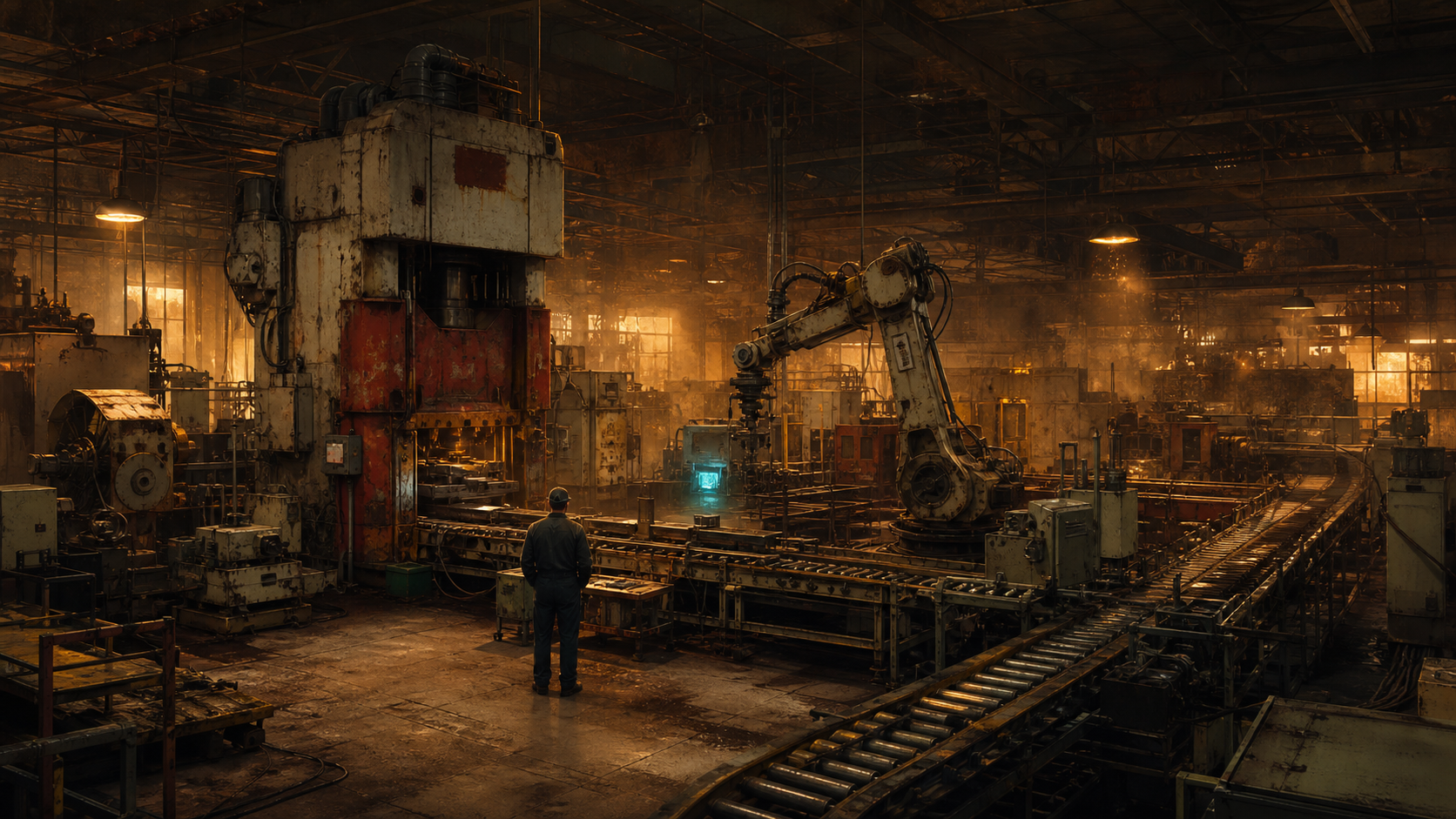
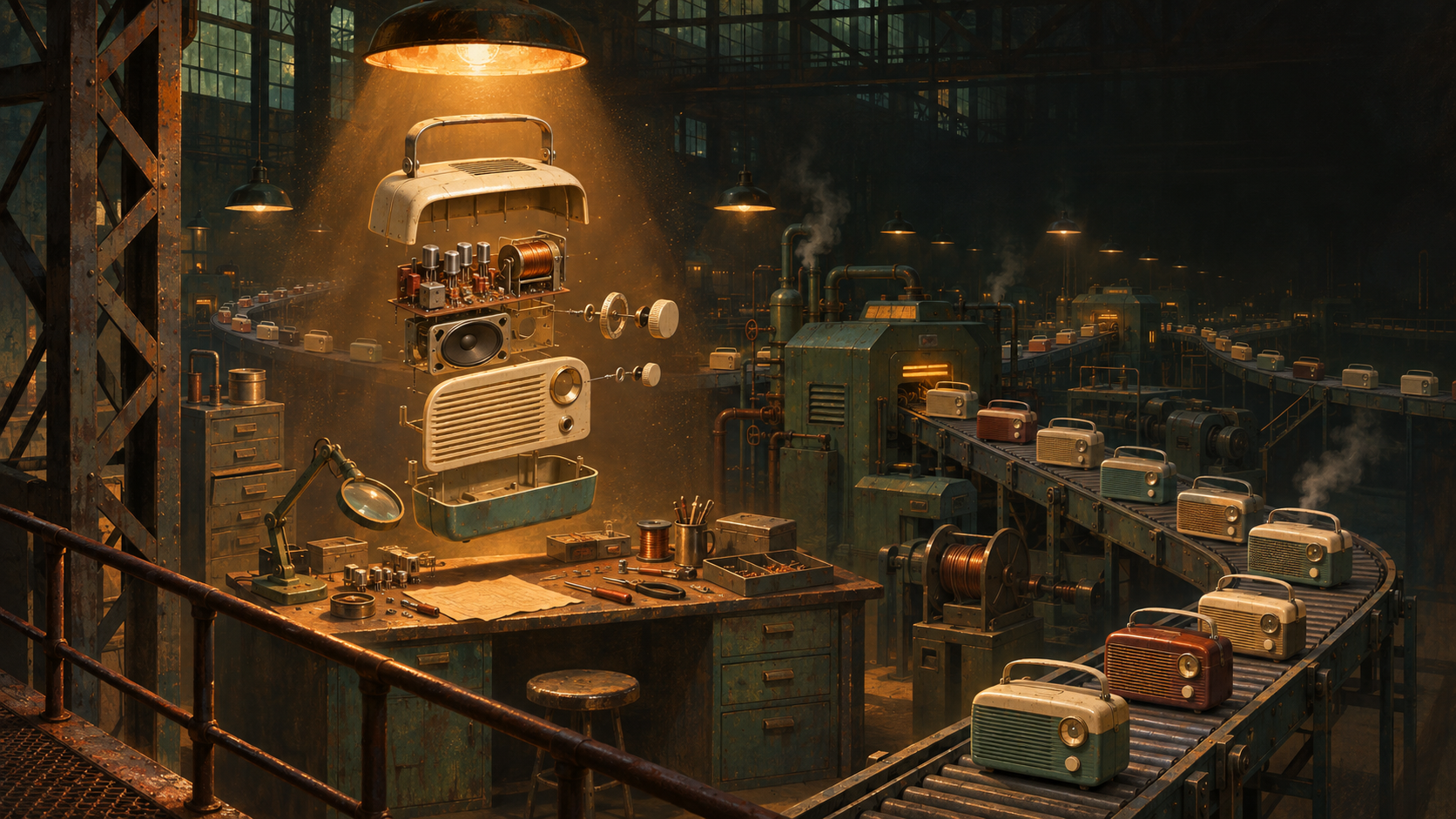
Art direction is painterly mid-century industrial: oxidised teal steel, sodium-amber lamps, bone-cream plastics, near-black shadow. The factory floor is warm at the bench and dark at the edges, so the eye lands on the work. Sound is physical: relays, dwell clicks, and a bench instrument that hums a pitch shifting with the deviation trace, so a trained ear can hear an error before the screen shows it.
Differentiators
- The recipe is the puzzle: a sample you can only read by destroying it, with a finite budget, so the early hours are deduction, not wiki-lookup, and recipe knowledge is earned each contract rather than unlocked from a tech tree.
- The output is the instrument: a deviation trace that bends in a recognisable shape for each faulty stage, so a one-unit pilot cell tells you something no belt-throughput counter does.
- Perfection is penalised: above 96% fidelity the original maker's audit finds you, so the best line includes a deliberately worse stage, which no comparable in the genre-reference list asks the player to build.
- Contracts of 90 minutes with a hard end, a delivery and a market, in a genre that mostly offers 100-hour sandboxes.
Monetization notes
Premium, $24.99 on Steam, no microtransactions. A free demo containing the pocket radio contract (about 90 minutes) and the sandbox bench. Post-launch DLC of new eras (sample packs, $7.99 each) fits, since each product is authored content.
Market read: shapez 2 left Early Access on 2026-04-23 and holds 96% positive across about 9,000 English reviews, Captain of Industry shipped Update 4 and a Trains DLC on 2026-03-09, and Factorio sits at the top of every 2026 roundup. The genre has an audience that pays and stays. The risk is that all of it is sandbox: a structured, contract-based entry with a puzzle at the front is rare, but "rare" can also mean "no proven demand". Wishlist count from the demo is the test.
Accessibility notes
- Deviation trace shown with both colour and pattern (hatch, dot, solid) per band; colourblind-safe palette with three presets.
- Trace sonification is optional and has a visual twin, so no clue is audio-only.
- Fully remappable keyboard and controller; belt-drawing has a click-to-click mode as well as drag.
- Scalable UI to 200%, adjustable text contrast, no flashing; the lamp flicker effect has an off switch.
- Pause-and-plan at any time; contracts have no real-time pressure during teardown. An assist mode widens all ranges' narrowing by 30% and drops audit odds by half.
Risks
- Teardown feels like a minigame bolted to a factory game. Mitigation: the pilot cell is built on the real grid with the real machines, and probe results are pinned as overlays on the build area so the two phases share one screen.
- Deviation traces turn out to be unreadable. Mitigation: prototype only the trace and a three-machine cell first (week 2), and cut bands from five to three if testers cannot name the faulty stage in under 3 attempts.
- The recipe is solvable by spreadsheet once the formulas are guessed. Mitigation: curves are authored per product with interaction terms (heat moves the ideal winding count), so fitting one axis at a time does not converge.
- Authoring nine products is a lot of content. Mitigation: six at launch, three as DLC; share machine types across eras.
- The audit mechanic punishes the skilled player for being skilled. Mitigation: odds are always visible, and a house tell is cheap on first unlock, so it reads as a choice and not a trap.
6-week prototype plan
- Week 1: Grid, belts and six machines with tolerance wobble. Deliverable: a belt line that builds a three-part toy product with measurable throughput.
- Week 2: Pilot cell and the deviation trace on a three-band version. Deliverable: five testers each find a deliberately wrong stage from the trace alone.
- Week 3: Sample integrity and the probe bench for the pocket radio. Deliverable: a complete teardown with ranges narrowing, and a measured average of 78 integrity spent.
- Week 4: Fidelity pricing, delivery contract, and the knock-off price index. Deliverable: one full pocket radio contract start to finish in under 90 minutes.
- Week 5: Audit and house tell, plus the razor contract's heat and dwell settings. Deliverable: two playable contracts with different pressure axes.
- Week 6: Vertical slice with supplier drift on the toaster. Deliverable: external playtest of three contracts; the target is that 6 of 8 testers can say why they lost fidelity.
Genre references
- shapez 2 (Steam page; full release 2026-04-23, blueprint library, difficulty tiers, sandbox mode) — https://store.steampowered.com/app/2162800/shapez_2/ — informs the 90-minute authored contracts versus a pure sandbox, and the blueprint sharing we keep.
- shapez 2 review summary (reviewers cite slow game speed and repetition) — https://vaporlens.app/app/2162800/shapez_2 — informs the hour-three problem and why a contract ends.
- Factorio: Space Age review summary (spoilage criticised, quality praised) — https://vaporlens.app/app/645390/factorio_space_age — informs supplier drift being forecast and visible, and quality as a continuous scale.
- Captain of Industry, Captain's Diary #53 (Update 4 and Trains DLC on 2026-03-09) — https://www.captain-of-industry.com/post/cd-53 — informs the DLC-as-content-pack model and the paid-expansion market.
- 12 Best Factory & Automation Games on Steam (2026) — https://gamegeeker.com/editors-picks/best-factory-automation-games-on-steam — informs the competitive set, with Factorio as the genre's rulebook.