The Common Rack
Design brief
You and the duelist across from you draw from the same rack of blades, so every card you win after a fight is one the next opponent can pull and turn on you, unless you notch it first and let it fail in their grip.
Date: 2026-11-02 Genre: roguelike deckbuilder Platform: PC (Windows; keyboard & mouse, full controller support) Status: Concept
Target player
This is for someone with a few hundred hours in Slay the Spire who has started playing the sequel and noticed that the decisions feel familiar. They know how to thin a deck and how to read an intent icon. What they haven't had in a while is a fight where the opponent's options depend on what they themselves built. Inscryption fans who liked sitting across the table from someone will recognise the posture. People who enjoy draft formats in collectible card games, where every pick is also a pick denied, will get the core tension straight away.
It is not for players who want to build a deck and then watch it go off. Here the deck goes off for both sides.
Core loop
The loop in one sentence: strike with the blade in your hand or set it back on the shared rack where your opponent draws next, notching the blades you can't afford to hand over, while every blade you win joins the rack the next duelist draws from.
Controls. Mouse: drag a card onto the opponent to play it, drag it onto the rack's top or bottom slot to rack it, right-click any card to inspect it, Space to end the turn. Keyboard: 1–4 select a hand card, F plays it, Q racks it on top, E racks it on the bottom. Controller: D-pad selects, A plays, X racks on top, Y racks on the bottom, B cancels, Menu ends the turn. Every input can be remapped.
The 30-second loop (one turn). You start the turn by drawing one card from the top of the Rack, the single draw pile both duelists share. The top card of the Rack (the peg) is always face-up, so both of you can see what comes next. You have 3 Breath. Cards cost 0–3 Breath and come in four families: Cuts deal damage, Parries block and some riposte, Feints rearrange the Rack (look at the top 3 and reorder them, for example), and Binds lock a card in the opponent's hand for a turn. Once per turn, at no cost, you can rack a card from your hand onto the top or bottom of the Rack. Racking on top decides what the opponent draws. Racking on the bottom buries a card you don't want either of you to see for a while.
Any card you racked that the opponent then draws stays face-up in their hand on your screen, with a thin thread back to where it came from. Cards they drew blind stay face-down. The intent display above them is built from their real hand, so the more you've fed them, the more of their turn you can read. Played cards go to the Floor. When the Rack runs out, the Floor is shuffled back in, and that pile belongs to both of you as well.
The 30-minute loop (one act). Each act is a branching map of 7 nodes followed by a boss duel. The node types are:
- Duel: a standard opponent.
- Grudge: an elite opponent.
- Smithy: spend Notches, grind out cracks, or remove a blade.
- Market: spend Purse on blades.
- Client: a story event. The person you're fighting for sets terms for the next duel, for example "win without drawing first blood" for double Purse.
Your Guard (HP) carries over between duels. After a win you pick 1 of 3 blades to add to your Rack, or take Purse instead.
Where it gets boring in hour three. Expert players will find the degenerate line: thin the Rack to 8 cards, notch every one, and rack junk onto the peg every turn so the opponent only ever draws dead steel. Three rules close it:
- The Statute of Twelve. The Rack can never drop below 12 blades. Removal is blocked at 12.
- Notched blades crack. Each time you play a notched blade it takes a crack. At 3 cracks it shatters and leaves the run. Sabotage costs you the blade over time.
- Opponents who don't draw from the top. Cutpurses draw from the bottom from Act 1's elites on, and Act 2 opponents draw 2 cards a turn, so stacking the peg controls only half of what they get.
The second hour-three trap is analysis paralysis. Reading a half-known hand every turn is tiring. Feint cards that reveal the opponent's face-down cards are common in Act 1 for that reason, and a "show every known card" toggle sits in the HUD.
Systems
- The shared Rack. One draw pile for both duelists, and it is your deck: you build it across the run, and every opponent fights you out of it. Each opponent also brings a kit of 2–4 signature blades that are shuffled into the Rack for that duel only. You can draw their kit cards too, and stealing a boss's signature blade off the peg is one of the big moments the game is built to produce.
- Racking. Your free action each turn, and the main tactical verb besides playing. It is the only tool that acts on the opponent's next hand rather than their current one. Some cards (Lay Out, Feed the Peg) let you rack a second card.
- Notches. The scarcest resource in the run. You start with 3, earn 1 every 2 duels in Act 1 and 1 every 3 duels in Acts 2–3, and spend them only at a Smithy. A notched blade played by an opponent "turns in the grip": it costs them its Breath and does nothing. Played by you, it works normally and takes a crack. A Smithy grind (15 Purse) removes one crack.
- Read state. Every card in the opponent's hand is either known (you racked it, or a Feint revealed it) or blind. The intent icon shows exact numbers for known cards and a range for blind ones ("Cut 4–9"). The number of known cards is the main skill readout. A strong player wins most of their duels with 3 of the opponent's 4 cards known.
- Guard and Purse. Guard: 40 at the start of the run, 25% healed at a Rest-variant Smithy, 6 healed after an elite. Purse comes from wins (12–20 per duel, 35 per elite) and Client bonuses, and is spent on blades (40–90), crack grinds (15), and removals (60, blocked at 12 blades).
- Opponent AI. Opponents play greedily from what they hold, with one personality weight per archetype. Bravos always play their highest-damage card. Clerks hold Parries until you have 6+ known damage on the table. Cutpurses rack back at you once per turn, so you can be fed your own notched steel. That last case is the only way your notches can hurt you, and a cracked notched blade in your hand is how you lose a won duel.
- Rack styles (starting decks). Three to unlock. The Salle Rack is a balanced 12. The Dock Rack has 14 cheap, brittle blades that crack after 2 uses instead of 3. The Notary's Rack has 12 blades and 5 starting Notches, but only 1 Notch per 3 duels from the start.
Progression
Run length: 3 acts × (7 nodes + boss) ≈ 24 duels and events, 50–70 minutes for a skilled player. A first run should end in Act 1's boss or early Act 2.
Difficulty ramp by kind, one new pressure per step:
| Step | Where | New pressure | Values |
|---|---|---|---|
| 0 | Act 1, duels 1–3 | none; learn racking | Opponent Guard 18–24, draws 1/turn from top, kit 2 cards |
| 1 | Act 1 Grudge (elite) | Variety: the Cutpurse draws from the bottom | Guard 34, kit 3 |
| 2 | Act 1 boss, the Dockmaster | Density: plays 2 cards a turn | Guard 70, Breath 4, kit 4 |
| 3 | Act 2 opening | Speed: opponents draw 2/turn | Guard 30–40; Notch income drops to 1 per 3 duels (Resource step, applied the following map) |
| 4 | Act 2 Grudge, the Inspector | Cognitive: files notches off any notched blade she draws, then plays it normally | Guard 48; the filed notch is gone for good |
| 5 | Act 2 boss, the Guildwarden | Compound: racks 1 card at you per turn and draws 2 | Guard 110 |
| 6 | Act 3 | Precision: magistrate audit, 2 random Rack blades exiled before each duel | Guard 45–60, kit 4 |
| 7 | Act 3 boss, the Magistrate | all of the above; her kit cards are pre-notched against you | Guard 160, 2 phases |
The ramp then plateaus. Past step 7, extra difficulty comes only from the player-chosen Statutes (12 levels, like Ascension), each adding one rule, e.g. Statute 3: "the peg is hidden every other turn."
Fairness guarantees. The opponent's draw count and draw source (top or bottom) are always printed under their portrait. No opponent ever draws a card you couldn't see coming from the peg without a visible icon (Cutpurse bottom-draw shows a downward arrow over the Rack). Kit cards are marked with the opponent's crest, so you always know what they added. Lethal damage from a known card flashes your Guard bar red at the start of their turn, before they act.
Meta-progression. Reputation, the persistent number, rises with duel wins (+1), clean wins taken without losing Guard (+3), and kit blades you stole and kept (+5). Thresholds unlock the two extra Rack styles, 40 more blades in the reward pool, and Statute levels. Nothing unlocked makes a run strictly stronger; it widens the options.
Buildability checks. At second 5: the hall, the Rack in the centre with the peg face-up, your 4 cards, the opponent's 4 face-down cards, a single intent icon, and one line of text ("Drag a card to the top of the rack."). At second 30: you have racked a card. The opponent draws it, it flips face-up in their hand with a thread back to your side, and their intent icon changes from a range to an exact number. At second 90: the first notched blade you fed them comes out of their hand and turns in the grip with a dull clank; damage 0. Just before you die, the opponent's intent shows the exact card and number, and if you racked that card yourself it's outlined in your colour.
World & setting
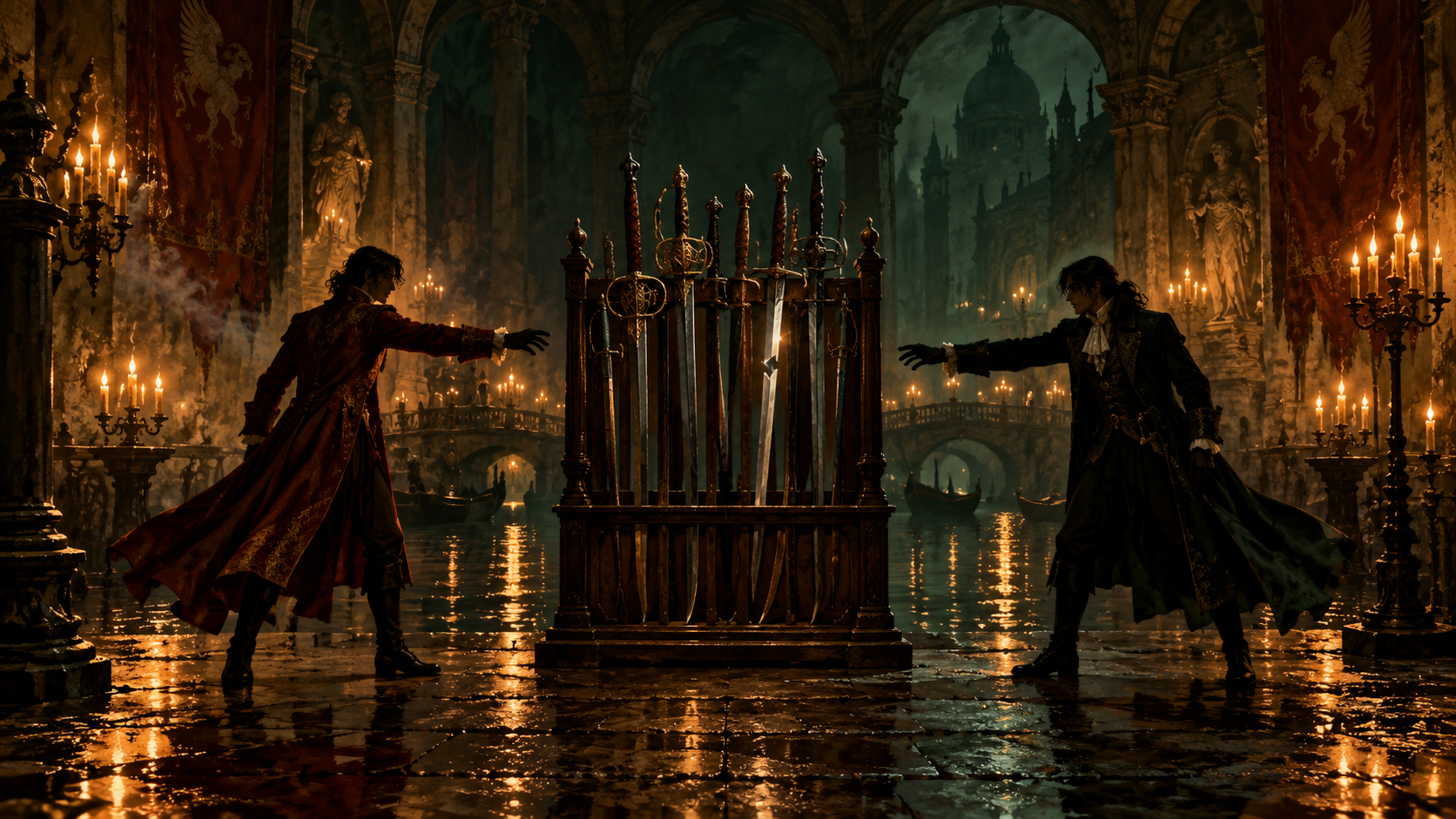
The Delta is a drowned late-baroque city of canals and lacquered fencing halls, where the courts stopped hearing civil cases two centuries ago and started settling them with steel. One law keeps the duels fair: the challenged party furnishes the rack, and both fighters draw from it. Nobody may bring their own blade. You are a proxy, hired to stand in for accused people who can't fight their own cases, and you carry your own rack from salle to salle. The opponents (dock bravos, guild clerks, an inspector whose job is catching tampered steel, and a magistrate who wrote half the statutes) are all fighting with weapons you chose.
Art direction is painterly and lit by candles: heavy chiaroscuro, wet flagstones, smoke. The palette is verdigris green, tallow amber, oxblood red and iron black. Each card is an etched blade on a dark field, and notches show as a bright cut in the steel that catches the light, so a notched card can be read from across the screen. Sound is close and physical: the scrape of a blade drawn off the rack, the clank of a turned grip, and a string quartet that drops a voice each time your Guard falls below a quarter.
Differentiators
- One draw pile shared by both duelists, built by you across the run: every blade you take after a fight is a blade the next opponent can draw and use against you, which turns each reward pick into a two-sided decision that neither Slay the Spire 2 nor Inscryption asks of the player.
- Racking, a free once-per-turn action that sets the opponent's next draw, and cards you fed them stay face-up in their hand, so reading their turn depends on what you chose to give them rather than on an intent icon the game hands you.
- Notches as the run's scarcest currency: a notched blade fails in enemy hands but cracks each time you use it, so the more of your rack you sabotage, the faster it wears out from under you.
- Opponent kits shuffle into your rack for the duel, so you can pull a boss's signature blade off the peg and keep it.
Monetization notes
Premium, Early Access at $17.99, rising to $19.99 at 1.0, with no microtransactions. A Rack-style expansion is possible after 1.0 if the base game sells.
The market is crowded. Steam Page Analyzer's niche report (snapshot 2026-09-27) counts 316 roguelike deckbuilders released in 2026 so far, against 224 in all of 2025, and 905 more unreleased store pages. In its 2024–mid-2025 cohort, 7.8% of releases reached 1,000 reviews. The $15–19.99 band did better at 22.7%, though the report itself notes that higher-priced games tend to have larger teams. The median paid price in the niche is $9.99. Pricing at $17.99 is a bet that the shared-deck hook can be understood from a single GIF of a card being racked and then turned against the player. If it can't, no price saves the game.
Slay the Spire 2 sets the ceiling. It entered Early Access on 2026-03-05 at about €23 and sits at 91% positive across roughly 72,000 English reviews, so a new entrant has to offer a decision that game doesn't have rather than a better version of the ones it does.
Accessibility notes
- Fully remappable keyboard, mouse and controller input, plus a one-click "play" mode that removes all dragging.
- No timers anywhere. Duels are strictly turn-based, and an undo is available until you end the turn.
- Card families are coded by shape (Cut = blade silhouette, Parry = guard, Feint = open hand, Bind = cord) and by icon as well as colour. Known versus blind cards differ by face-up art, not by tint alone. Notches are a white cut mark with a high-contrast outline, tested against protanopia, deuteranopia and tritanopia filters.
- UI scales from 80% to 200%, and a large-text card mode replaces flavour text with rules text only.
- A "show every known card" overlay lists every card in the opponent's hand you know about, as plain text.
- Screen shake and the candle flicker can each be turned off. The thread animation for racked cards has a static alternative.
- Assist options that don't block achievements: +25% Guard, one extra Notch per act, and a "peg peek" that shows the second card of the Rack.
- Full subtitles and captions for all sound cues, including the grip clank.
Risks
- "The game gave my best card to the enemy." Shared draws can feel like RNG punishing you. Mitigation: the peg is always visible, Act 1 opponents only draw from the top, and the face-up thread shows that every racked card was your decision.
- Balancing every card twice. Each blade has to be fair in your hand and in theirs, and players are sensitive about changes. On 2026-03-20 Slay the Spire 2 received over 10,000 negative Steam reviews in one day over a beta-branch nerf to a single card, Prepared. Mitigation: track per-card win rates separately for the player side and the opponent side from the first playtest, ship balance changes on an opt-in beta branch with in-game patch notes, and include an in-game feedback button localised for every supported language.
- Opponent AI that looks stupid. A greedy AI that plays a notched blade every time it draws one reads as a toy. Mitigation: from Act 1's boss onwards opponents can see notches and will rack notched blades back. The Dockmaster's introduction teaches that.
- Cognitive load. Tracking which cards are known gets tiring after an hour. Mitigation: the known-card overlay, exact intent numbers, and a deliberate Act 1 limit of one draw per opponent turn.
- Scope creep from three Rack styles. Mitigation: Early Access ships with the Salle Rack only. The Dock and Notary Racks are named EA milestones.
6-week prototype plan
- Week 1: Grey-box duel in Godot with the shared Rack, peg, 4-card hands, Breath, playing, and racking to top or bottom. 20 placeholder blades. Deliverable: one duel playable end to end against a scripted opponent.
- Week 2: Known/blind hand state, the thread visual, intent icons built from the real hand, and the greedy Bravo AI. Deliverable: three internal testers each play 10 duels. Measure how many known cards are in the opponent's hand at the moment each tester wins.
- Week 3: Notches and cracks, the Statute of Twelve, and the Smithy screen. Deliverable: a balance spreadsheet logging every blade's damage when played by each side, plus the first degenerate-strategy test (an "all notched" rack) to confirm the three counter-rules break it.
- Week 4: Act 1 map with 7 nodes and the Dockmaster boss, Purse, Market, rewards, the Cutpurse elite, and kit cards. Deliverable: a full Act 1 run of about 20 minutes.
- Week 5: Card art pass on 30 blades, the notch shader, the candlelit hall background, the grip-clank and draw-scrape sounds, and the Clerk AI. Deliverable: a capture-ready GIF of a card being racked, drawn and turned in the grip.
- Week 6: Vertical slice with Act 1 plus the Act 2 opening (2-card draws), and an 8-person external playtest with recorded sessions. Pass criteria: 6 of 8 testers can explain racking without being prompted, median Act 1 clear rate is 30–50% on the first run, and fewer than 2 testers say the shared Rack felt "random."
Genre references
- Slay the Spire 2 (Steam store page) — https://store.steampowered.com/app/2868840/Slay_the_Spire_2/ — the genre's current benchmark: Early Access since 2026-03-05, 91% positive across about 72,000 English reviews, four-player co-op, five characters. It sets what a new entrant must not copy and the price ceiling the market tolerates.
- "Slay the Spire 2: why the wave of negative reviews?" (Mein-MMO) — https://mein-mmo.de/en/slay-the-spire-2-negative-reviews-why,1557860 — 10,000+ negative reviews on 2026-03-20 over a beta-only nerf to the card Prepared. This informs the two-sided balancing risk and the beta-branch and localised feedback plan.
- Roguelike Deckbuilder niche report (Steam Page Analyzer, September 2026) — https://www.steampageanalyzer.com/niches/roguelike-deckbuilder — release counts (316 in 2026 to 2026-09-27), the 7.8% rate of releases reaching 1,000 reviews, and the price-band data behind the $17.99 positioning.
- Inscryption (Wikipedia) — https://en.wikipedia.org/wiki/Inscryption — the opponent preview row, where cards wait one turn before entering play, is the precedent for showing the player what the opponent will do. The Common Rack goes further: the player chooses what the opponent draws.