Matching Action
Scene 68, take four. Vivian wrote the number before the slate cracked, because she always knew what the number would be. Corky Vane had never in his life gotten a stairwell in under five.
Matching Action — Synopsis
Vivian Cresso has been a script supervisor at Comet Pictures for nineteen years and has never once appeared in a credit crawl. Her job is to keep the only complete record of a film set: which hand the hat was in, how far down the whiskey stood, where the stair runner was rolled and whether the landing lamp was burning. When Gil Shearing, the picture's twenty-six-year-old second assistant director, asks her about four men on the payroll he has signed out eleven times and never laid eyes on, she tells him to put his question in writing. Two days later he is found dead at the foot of the tenement staircase on Stage 4 with a bottle beside him, and the police call it a drunken fall. Vivian knows better within ten minutes, because the set has been dressed to match her notebook and whoever dressed it turned to the wrong page: the stairwell in front of her is Wednesday, not the Thursday night Gil died. Following that error back through a bottle of rye a teetotaler would never have carried and an out-time sheet signed by four men who do not exist, she finds a killer who is not a monster but another invisible functionary, protecting a small, illegal, decent thing at a price he could not stop himself from paying. What she does with the record afterward costs her the one principle she has held for nineteen years, and she writes that down too.
Matching Action
Story
Scene 68, take four. Vivian wrote the number before the slate cracked, because she always knew what the number would be. Corky Vane had never in his life gotten a stairwell in under five.
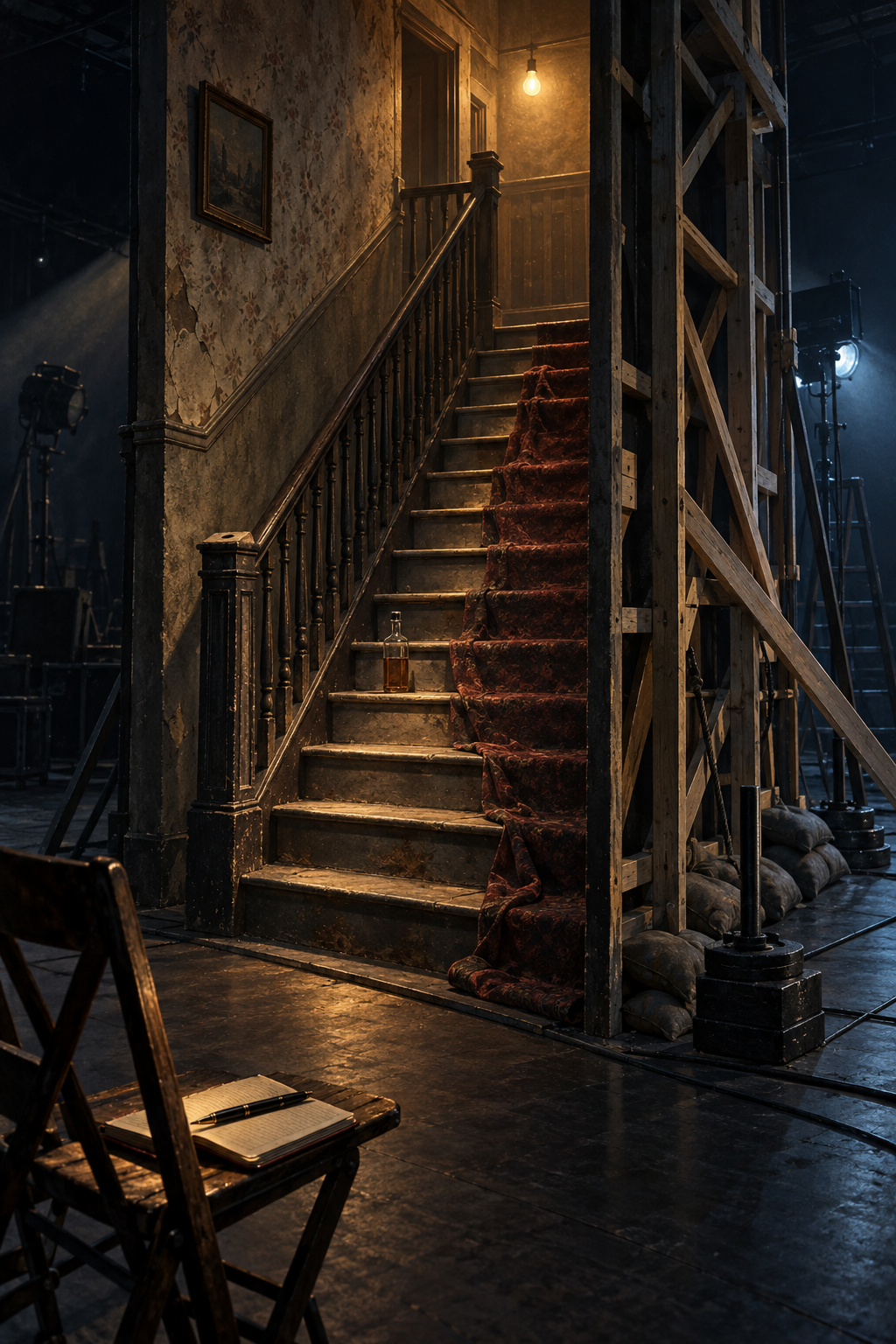
The tenement on Stage 4 was two flights of pine and plaster braced from behind with lumber nobody photographed. Dane Ruddick came down it with his hat in his left hand and his right on the rail, took the landing turn too fast the same way he had taken it three times already, and Corky called cut before he reached the bottom.
"Vee."
"Hat was in his right in the master," Vivian said.
"I know what was in his right."
"You said Vee."
Behind the camera Ludo Marek laughed, one syllable, and went back to doing something unkind to the matte box.
She wrote it down regardless. 4:51. Runner rolled off the treads for the dolly. Newel finial struck, cracked in take two, props to replace. Practical burning on the third-floor landing because Ludo wanted something hot in the top of frame. Ruddick's whiskey standing a half inch under the seam of the glass, undrunk.
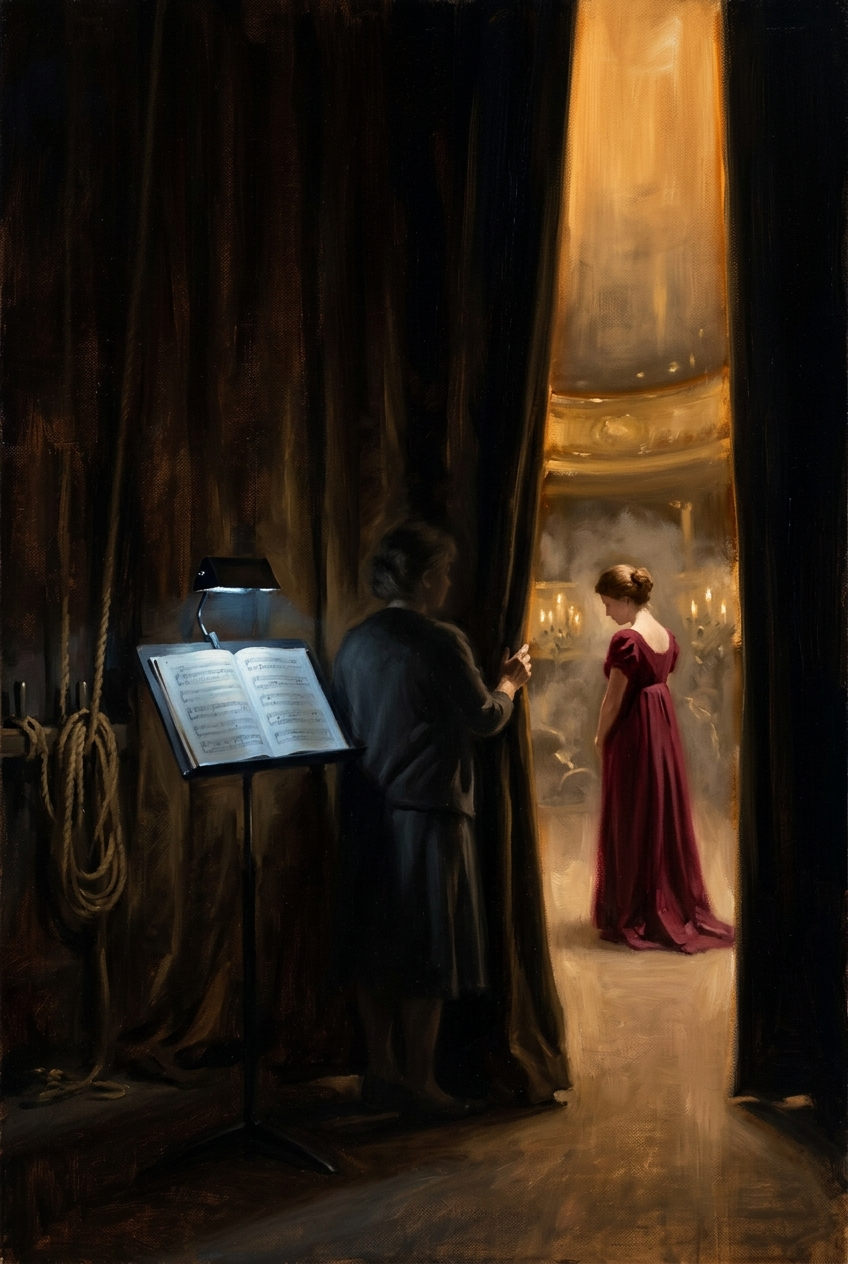
Nineteen years. Sixty-one pictures. Her hand had not changed since the second Roosevelt administration and neither had the work: know everything, hold it, surrender it only when asked, and then only the part that was asked for. Script supervisors did not go on the crawl. Comet Pictures put the caterer's brother-in-law on the crawl and it had never once occurred to anyone in the front office that this was strange.
Gil Shearing came up the aisle with the out-time sheets under his arm, apologizing with his shoulders before he opened his mouth.
"Miss Cresso."
"Vivian."
"Vivian." Five weeks of Miss Cresso. He would say it again tomorrow. "Can I ask you something screwy."
"You can ask."
He half turned the clipboard toward her, thought better of it, and kept it against his chest. "M. Coe. Grip. He's been on the sheet since the second week."
"And?"
"I've signed him out eleven times. I've never seen him."
Props went up the ladder with the new finial in a paper sack. Vivian watched him get the angle wrong twice.
"There are two hundred people on this lot," she said.
"There are thirty-nine on this picture." He said it lightly, and then he didn't laugh, which was how she knew he had been carrying it around for a while. "Four of them I've never laid eyes on. Coe. Nadler. A Ruth Sennet. One more I can't read. I get out-times for all four, every single day, and Boyd initials them, and the payroll goes downtown Friday."
"Then Boyd knows."
"Yeah," Gil said. "That's the screwy part."
He was twenty-six and he had the kind of face that gave away the ending of every thought he had. He had come to Comet from a Signal Corps unit in Yokohama and he still stood like a man expecting to be inspected. She had watched him learn the floor in five weeks, which was four weeks faster than most, and she had not told him so.
"Gil."
"Ma'am."
"If you're going to keep a question, keep it in writing. Times. Dates. Nobody on this lot believes a man who remembers."
He grinned at that, and she saw him decide it was a joke, and she let him.
They lost the light at six, which meant nothing on a stage, but Corky observed the ritual anyway. He came off his chair with his collar open and found Gil at the bottom of the stairs.
"Monday," Corky said. "I want the stairwell Monday."
"Monday's the dress house on Two."
"I want the stairwell."
"Mr. Vane, the dress house is struck Tuesday, we can't"
"Then unstrike it." Corky put his hand flat on Gil's chest, not hard, the way a man does when he wants witnesses to see that he did not push. "You know what's wrong with this outfit? Everybody's got a piece of paper and nobody's got a picture."
Gil looked at the hand until it came off him. Twelve people watched and eleven of them went back to coiling cable.
Boyd Mellis locked Stage 4 at 6:52. He was the last man out every night of every picture he had ever run. He had a ring of keys he kept on a shoelace instead of a chain because a chain wore holes in his pocket, and a green cloth ledger under his arm, and a way of standing in a doorway that made people finish their sentences faster. He was forty-eight. Vivian had worked eleven pictures with him and could not have said where he lived.
"Night, Vivian."
"Night, Boyd."
Thursday she started a new book.
The old one was full through the back cover, so she squared it away in the drawer Hap Dietz had built into her chair in 1946 as a joke and she had used every day since. Spine first, the way she always set them, so the pages faced the dark. Then she wrote the date at the top of a clean page and felt what she always felt, which was nothing in particular, and got to work.
The new setup was the wide from the bottom of the stairs. That meant the runner went down flat on the treads because it would be in frame for two flights. It meant the practical on the third-floor landing got struck, because a hot bulb in the top of a wide is a flare and Ludo would have thrown it into the alley himself. It meant the new finial, which props had turned out of pine that was a full shade paler than the rest of the newel, and which Ludo swore he could see and Corky swore he couldn't.
Vivian wrote all three down. Runner flat, full two flights. Landing practical struck. Finial replaced, new stock, reads light, L. Marek objects.
They got the wide in three, which nobody expected, and Corky was so pleased he let them go at six.
Gil caught her at her car on the Gower side with his jacket over his arm and his tie already off.
"I'm going to the front office Monday," he said.
She got her door open and did not get in. Somebody on Stage 7 was running a saw.
"With what?"
"With eleven out-times in my handwriting for a man who doesn't exist." He was trying to sound casual and it was a bad performance, the kind Corky would have printed anyway. "I wrote it down. Like you said. Times and dates."
"That wasn't advice, that was a habit."
"It was good advice."
"Gil." She had her hand on the roof of the car and she took it off. "There's four names. You want to be right or you want to know what you're right about?"
"What's the difference?"
She thought about it honestly, because he deserved that, and honestly she did not have an answer that would fit in a parking lot.
"Ask Boyd," she said. "Before Monday. Ask him to his face and watch what he does with his hands."
She had meant it as protection. She would think about that sentence for a long time afterward, in the specific way she thought about things, which was without decoration and without relief.
Friday morning there was a radio car on the lot and a man in a hat standing where the caterer usually stood.
They had found Gil Shearing at the bottom of the tenement stairs on Stage 4 at ten past seven, by the night watchman, who had not gone in at all on his midnight round because the stage was locked and a locked stage is a checked stage. Broken neck. Two flights. A half pint of rye, most of it gone, standing on the third tread up.
The detective's name was Dowd and he had the tired courtesy of a man who had already decided. He talked to Corky for twenty minutes and to Boyd for forty and to Vivian for four.
"You're the script girl."
"Script supervisor."
"You see him after wrap?"
"In the parking lot at six-ten. He was going home."
"He say anything?"
Vivian looked past Dowd's shoulder at the stairs, which she had been looking at since seven-thirty, which was the entire reason she had not yet said anything to anyone at all.
"He said good night," she said.
The runner was rolled back off the treads.
The practical on the third-floor landing was burning.
The finial was gone off the newel post, and the raw screw hole in the top of it had been rubbed with something to take the pine-fresh look off, and it had not quite worked.
She stood in the aisle with her arms crossed and read the set the way she read it forty times a day, and the set said Wednesday.
Not Thursday. Not the day he died. Wednesday, four-fifty-one in the afternoon, page one-eleven of a book that was lying in a drawer nine feet from where she was standing.
Dowd's theory, delivered in the doorway while he put his hat back on, was that Shearing had come back to the stage after hours with a bottle, gone up to strike the hot landing lamp, which was the kind of thing a conscientious second AD would do, and caught his shoe on the rolled edge of the runner on the way down.
It was a good theory. It accounted for the lamp. It accounted for the runner. It accounted for everything except that the lamp had been struck at ten in the morning on Thursday and the runner had been flat on the treads for eleven hours before Gil Shearing ever drove off that lot.
Somebody had built a scene.
She waited until they took him out and the crew went to lunch and the stage was as empty as it ever got. Then she went to her chair and opened the drawer.
The old book was in it. It was lying spine out.
Vivian sat down and put her hands in her lap and looked at it for a while, because the thing about a body of work is that it is also a body of habit, and she had not set a book in that drawer spine out since Truman took office. She knew the shape of her own hands in that drawer better than she knew her own face.
She took it out with a handkerchief, which was theatrical and which she did anyway, and opened it to the last filled page. One-eleven. Wednesday. 4:51. Runner rolled off the treads for the dolly. Newel finial struck. Practical burning, third-floor landing.
Somebody had needed to know what the stairs were supposed to look like. Somebody who understood that on a working stage there is exactly one record of the state of the world, and it is not the photographs and it is not the call sheet, it is a woman's handwriting in a two-bit notebook nobody has ever asked to see.
So he had looked it up. He had done his homework. He had dressed the set to match the book, and he had done it carefully, and he had done it to the wrong page, because Thursday's book had gone home in her bag and the one in the drawer ended at Wednesday.
He had cut to the wrong shot.
There was the other thing too, and she went and found it, because being right was not the same as knowing what you were right about.
Three weeks back. Scene 31, the bar. They had been short a body for the deep background and Corky had grabbed whoever was standing nearest, which was Gil, and props had put a glass in his hand, and Gil had handed it back. Vivian's log for that afternoon, because she logged what was in the glass the way she logged what was in the hand:
G. SHEARING (x, bkgd L), glass: cold tea no ice. Does not drink. Match for coverage.
A man who does not drink does not carry a half pint of rye onto a locked stage at night. And a man who is going to fake one does not know that, unless he is the kind of man who reads the book.
The out-time sheet for Thursday was in the production office in the second drawer and she read it standing up. Thirty-nine names. Gil's own initials at 6:12, in Gil's own hand, which was the hand of a man who had been taught to make the number seven with a bar through it.
At the bottom, below the line, in printing so square it could have been drafted: M. COE, 6:40. J. NADLER, 6:40. R. SENNET, 6:40. And one more she could not read, 6:40.
Four men who were not there, signed out forty minutes after the last man who was.
She put the sheet back and squared it and closed the drawer with her hip, and went and did the afternoon, because the afternoon was scene 72 and the picture did not stop for anything, including this.
Boyd Mellis locked Stage 4 at 6:48 that night. Vivian was standing under the tenement stairs when he came back in at ten past seven with his shoelace of keys in his hand.
He stopped when the work light found her. He did not do any of the things a man does in a picture. He looked at her, and then he looked up the stairs, and then he came over and set the green ledger down on the third tread, where the bottle had been, and sat two treads above it with his forearms on his knees.
"Vivian."
"You dressed it to Wednesday," she said.
He was quiet long enough that she heard the blower on Stage 3 cycle twice.
"The lamp," he said finally.
"The lamp and the runner and the finial. Three for three. You were very thorough, Boyd. You went to the book."
"I went to the book." He said it the way a man reads back an order. "I thought, there's a record of this room. There's a record of every room on this lot. If the police ever go looking, the room has to say the same thing the record says."
"It did. It said Wednesday."
Boyd Mellis put the heels of his hands against his eyes and left them there a moment and took them away, and his face when it came back was the same face. That was the thing about him. It had always been the same face.
"He came to the office at half past six," he said. "He'd been sitting in his car working himself up to it. He asked me about Coe."
"And you told him."
"I told him." He almost smiled. "That was the mistake. I could have told him it was a clerical thing and he'd have gone home and probably let it lie. I'd had six months to think up a lie and I didn't use it. I stood there in my own office and I told a twenty-six-year-old kid the truth, because I wanted one person on this lot to know."
"Say it to me, then."
Boyd picked up the ledger and did not open it.
"Marvin Coe is a man named Abe Kessler who wrote four pictures for Metro and hasn't been able to sign his own name to a grocery list since forty-seven. Nadler is a cutter. Ruth Sennet is a Ruth Sennet, she's a script girl, Vivian, she did eleven years at Republic and her boy's got a leg in a brace and she can't get on a lot to save her life. The fourth one I won't say out loud, not to you, not tonight."
"They're on the payroll as grips."
"They're on the payroll as grips. They get an out-time because a man who doesn't get an out-time doesn't get a check. They get sixty-one dollars a week. It comes out of the overage on the location days we don't take." He shrugged, and it was the shrug of a man reciting a ledger, which was what he was. "I've been doing it since the picture before last. It's four families. That's the whole crime. It's four families eating."
"It's a felony."
"It's eleven felonies," Boyd said. "I've counted."
"And Gil was going to the front office."
"Monday." He looked at the tread under his shoe. "He wasn't even angry. That's what I couldn't get through to him. He kept saying, Mr. Mellis, if it's honest then it survives the light. Twenty-six years old. He came up those stairs after me still saying it."
"Why the stairs?"
"Because I walked away from him and he followed me and I wanted the stage because the stage is where I can hear myself think." His hands had come together and he was turning his own wedding ring, a man doing arithmetic with his fingers. "He got hold of my sleeve on the landing. That's all. He got hold of my sleeve and I took it back."
"You pushed him."
"I took my arm back," Boyd said, and then, after a moment, in a completely different voice, one she had never heard out of him in eleven pictures: "I pushed him."
The blower on Stage 3 cycled again.
"I stood down here for about an hour," he said. "I didn't touch him. I want that on the record, whatever the record turns out to be, I did not touch that boy after. Then I went and got the bottle out of Hap's box and I went and got your book."
"Why."
"Because that's my job." He said it flatly, with no defense in it at all, and that was somehow the worst thing he said all night. "Thirty years. Somebody hands me a mess and I dress it and I budget it and I make the day. I didn't decide to do it, Vivian. I did it the way you write down which hand the hat's in."
She stood there under two flights of pine and plaster braced from behind with lumber nobody photographed, and she thought about a man in a doorway who made people finish their sentences faster, and a boy who stood like he expected to be inspected, and about the fact that no one at Comet Pictures had ever once asked her to see the book.
"Give me the ledger," she said.
He gave it to her without a word. Then he sat on the stairs and waited to be told what was going to happen to him, and she did not tell him, because she had not decided, and because after nineteen years of not saying she found she was not going to start by saying something she had not checked.
She went home to Cherokee Avenue where nineteen years of notebooks stood in orange crates along the wall of a room she used for nothing else, and she put the green ledger on the table under the lamp, and she sat down with her good pen and a block of typing paper at a quarter to nine on a Friday night.
Ellen Shearing lived in Lomita. Gil had written the address on the inside cover of the out-time clipboard in case anybody needed it, which was the sort of thing he did.
Vivian copied the pages.
She copied page one-eleven entire, Wednesday, 4:51, the runner and the finial and the burning lamp, and she copied Thursday's page entire, the runner flat and the practical struck and the pale pine, and she copied scene 31 from three weeks back, cold tea no ice, does not drink. She copied the time the stage was locked Thursday night and the time it was locked Friday night and the fact that the book in the drawer had been lying spine out on Friday morning and what that meant, in eleven words, without adjectives.
Then she copied the out-time sheet for Thursday, thirty-nine names, in her own hand, in order, with the times.
She left out four.
It took her until half past one, and it was not a difficult decision and she did not pretend afterward that it had been. Sixty-one dollars a week and a boy with a leg in a brace. The four names would not hang Boyd Mellis and they would not unhang him, and they would put four people into a filing cabinet in Washington that they would never get out of again.
But it was a false record. That was not a thing she was able to make untrue by having a reason. A false record made by a woman whose entire working life had consisted of the proposition that the world is exactly as it is and somebody ought to write it down.
She addressed the envelope to Mrs. Ellen Shearing and she did not include a note, because a note would have been asking for something, and she was not asking Ellen Shearing for anything. What the woman did with it was going to be the woman's business. Vivian had kept other people's records for nineteen years. She had never once been the one who decided what the picture was about.
She dropped it in the box on Highland on her way in Monday morning and got to Stage 4 at five past seven.
They were up on the dress house on Two after all, which meant a redress and an hour of nothing, so she sat in her chair with the drawer Hap Dietz had built her as a joke and opened the new book to a fresh page and wrote the date. Boyd Mellis came through at twenty past with the call sheets and did not look at her and put one on her chair arm the way he had put one on her chair arm eleven pictures running.
Then, underneath the date, very small, in the outside margin where the page gets trimmed and nobody has ever looked in the history of the business, she wrote:
Copy sent 9/22. Four lines omitted. This book is right; the copy is wrong, on purpose, and I knew it when I made it.
She squared the book on her knee. Down on the floor Ludo was arguing with the gaffer about a flare, and Corky had come in laughing at something, and Dane Ruddick was standing at the bottom of the stairs with his hat in the wrong hand again, waiting for somebody to tell him.
"Vee," Corky said. "Which hand."
Vivian turned to the page and told him.
More from Short Stories