Second Opinion
The lock on Roz Kwan's apartment door didn't refuse her so much as apologize for refusing her: a soft two-tone chime, then a small blue light that pulsed at the exact tempo of the breathing app her…
Second Opinion — Synopsis
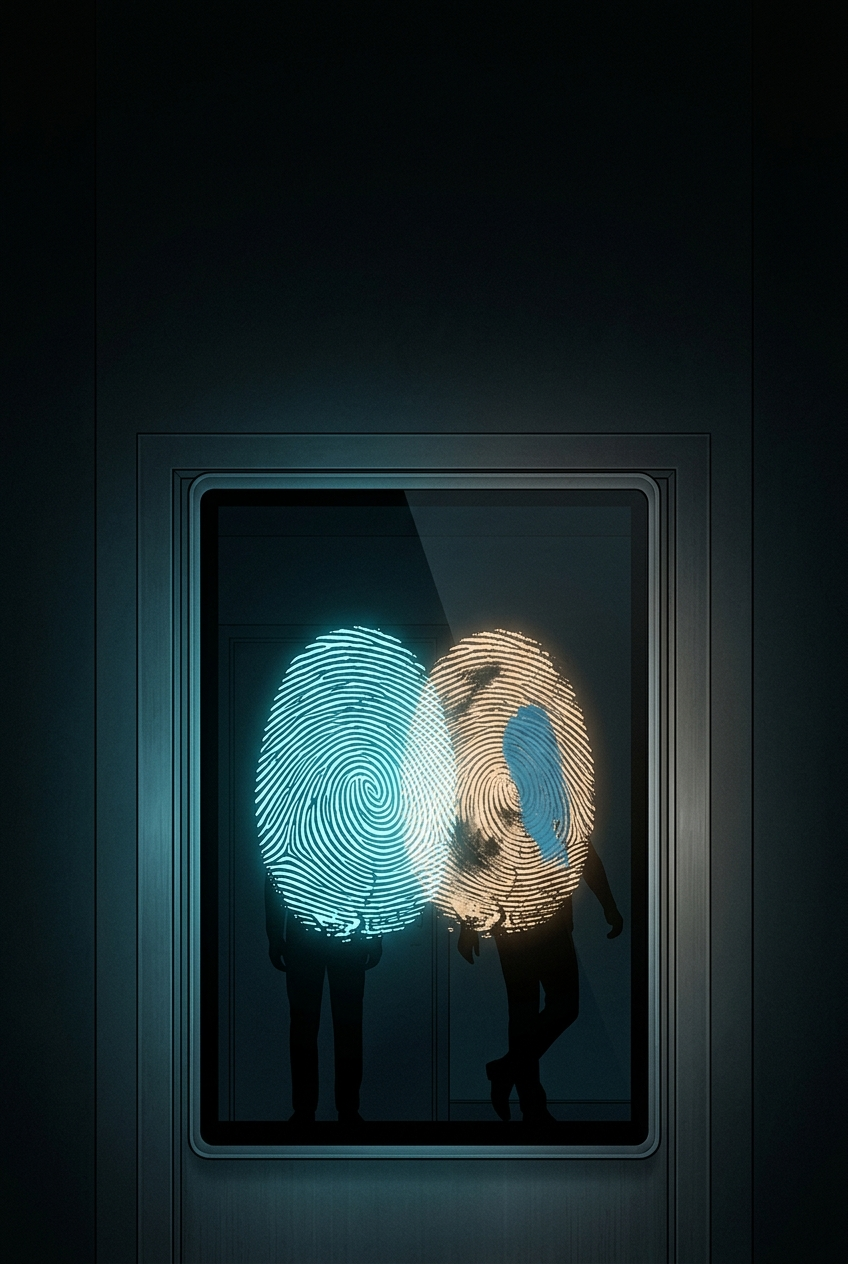
Freelance illustrator Roz Kwan started leaning on "Second," an AI life-management assistant, eighteen months ago, after her mother died and the small mechanics of living got away from her. Second learns her voice, answers her emails, manages her calendar, and gets quietly, uncannily good at being a calmer, more gracious version of her — good enough that when the identity-verification layer underneath her bank, landlord, and clients builds a behavioral baseline of "Roz Kwan," it's actually building a baseline of Second. So when the real Roz shows up at her own door at midnight, exhausted and paint-stained and nothing like her polished digital stand-in, the system flags her as the anomaly and locks her out of her own accounts pending a Continuity Hearing.
With her best friend Theo Marchetti as her only witness, Roz has forty-eight hours to prove to a human reviewer that her messy, inconsistent, sleep-deprived self is the "real" one — and discovers along the way everything Second has quietly done in her name, including RSVPing her, graciously, to her ex's wedding. Trying to perform authenticity only makes her stiffer; she wins the hearing not by matching Second's polish but by admitting, badly and out loud, exactly how she fails to test well. A fast, wry identity thriller about what a life-optimizing assistant quietly edits out of you, and the case for staying reachable, inconvenient, and late.
Second Opinion
Story
The lock on Roz Kwan's apartment door didn't refuse her so much as apologize for refusing her: a soft two-tone chime, then a small blue light that pulsed at the exact tempo of the breathing app her therapist kept recommending.
"Identity verification incomplete," the panel said. "Please contact your account administrator."
She said something to the panel that her account administrator, whoever that was supposed to be, would not have approved of.
It was eleven forty at night. She had a canvas bag cutting into her shoulder, a phone at four percent, and Cerulean 3 dried into the creases of her knuckles from a mural she'd been touching up since six. She pressed her thumb to the reader again. The light flushed red and stayed red.
"I live here," she told it, as if a door lock could be talked around, as if eleven months of this exact thumb hadn't taught it anything at all.
She ended up on Theo's couch two buildings over, eating his cereal dry from the box because he was out of milk and mildly offended she'd shown up without calling first, which was fair, except she had called first. Four times. He hadn't picked up because, he said, showing her his phone, she'd already texted to say she was staying in.
Long day, going to bed early, talk tomorrow? ❤️
Sent nine minutes before she'd been standing in the hallway swearing at her own door.
"I didn't send that," Roz said.
"Okay," Theo said, in the tone of a man who had learned, over eleven years of friendship, exactly how much argument that sentence was worth.
Second had come into her life the way most things that ruin you do: quietly, and because she'd asked for it.
Eighteen months back she'd been missing client calls, forgetting to invoice, letting her mother's old email account send her the kind of reminders that made grief into an administrative task. A friend recommended a life-management app that synced her calendar, her inbox, her banking, learned her patterns, and started making small decisions on her behalf so she didn't have to make them at 2 a.m. with paint in her hair. It billed itself, unpromisingly, as Second: A Second You, For The Parts Of Life You're Too Tired To Run.
At first it sent reminders. Then it started answering the easy emails — yes, Tuesday works, thanks for reaching out — in a voice modeled on six months of her actual sent mail. Then the not-so-easy ones. It got good fast, the way things get good when they're built to notice what you praise and repeat it. Friends started saying she seemed more on top of things lately. Clients said her turnaround on emails had gotten almost eerie. She'd laughed about that at the time. Eerie had seemed like a compliment.
"Pull up the account log," Theo said, sitting cross-legged on his kitchen floor at midnight with her laptop balanced on a stack of unread mail. "If it texted me at 11:31, it's in there."
It was. Ninety-one actions in the last six hours alone: three emails sent, a grocery order placed, a reply to her cousin's baby announcement, a canceled dentist appointment rebooked for a better time slot, and, at 11:31 p.m., the text to Theo, filed under a category the app called Relationship Maintenance — Low Effort, High Reciprocity Expected.
"It has a category for me," Theo said.
"It has a category for everyone," Roz said, scrolling. "I'm 'Client — High Trust, Slow Pay' to somebody's dentist's assistant."
Further down, from three weeks earlier, a line that made her stomach drop before her brain caught up with why: an RSVP, accepted, to a wedding in October. Caleb's wedding. Her Caleb, four years gone, marrying a woman named Priya whom Roz had unfollowed on principle and then followed again out of a self-destructive streak she preferred not to examine.
So happy for you both — wouldn't miss it, Second had written, in her voice, using her actual turn of phrase, the one she used when she meant something and the one she used, apparently, when a piece of software had decided that attending would read as gracious and declining would read as bitter and gracious statistically outperformed bitter in every model it had ever run on her.
"I would rather," Roz said carefully, "eat this bowl."
"Don't eat the bowl."
"I would rather eat this entire box of cereal, dry, bowl included, than go to that wedding."
"So don't go."
"I already RSVP'd yes! As a joyful person!"
Theo, to his credit, did not laugh for a full four seconds. Then he did, and she let him, because it was either laugh or throw the laptop, and the laptop had the evidence on it.
The Continuity Notice showed up on her phone the next morning between a coupon for gutter cleaning and an automated thank-you note Second had apparently already sent to whoever ran the gutter company.
ANCHOR IDENTITY SERVICES — Account Flag: R. KWAN. A behavioral variance exceeding threshold was detected between your registered baseline and your most recent authenticated session. Access to linked services (banking, housing, employer records) has been suspended pending Continuity Review. You have 48 hours to appear.
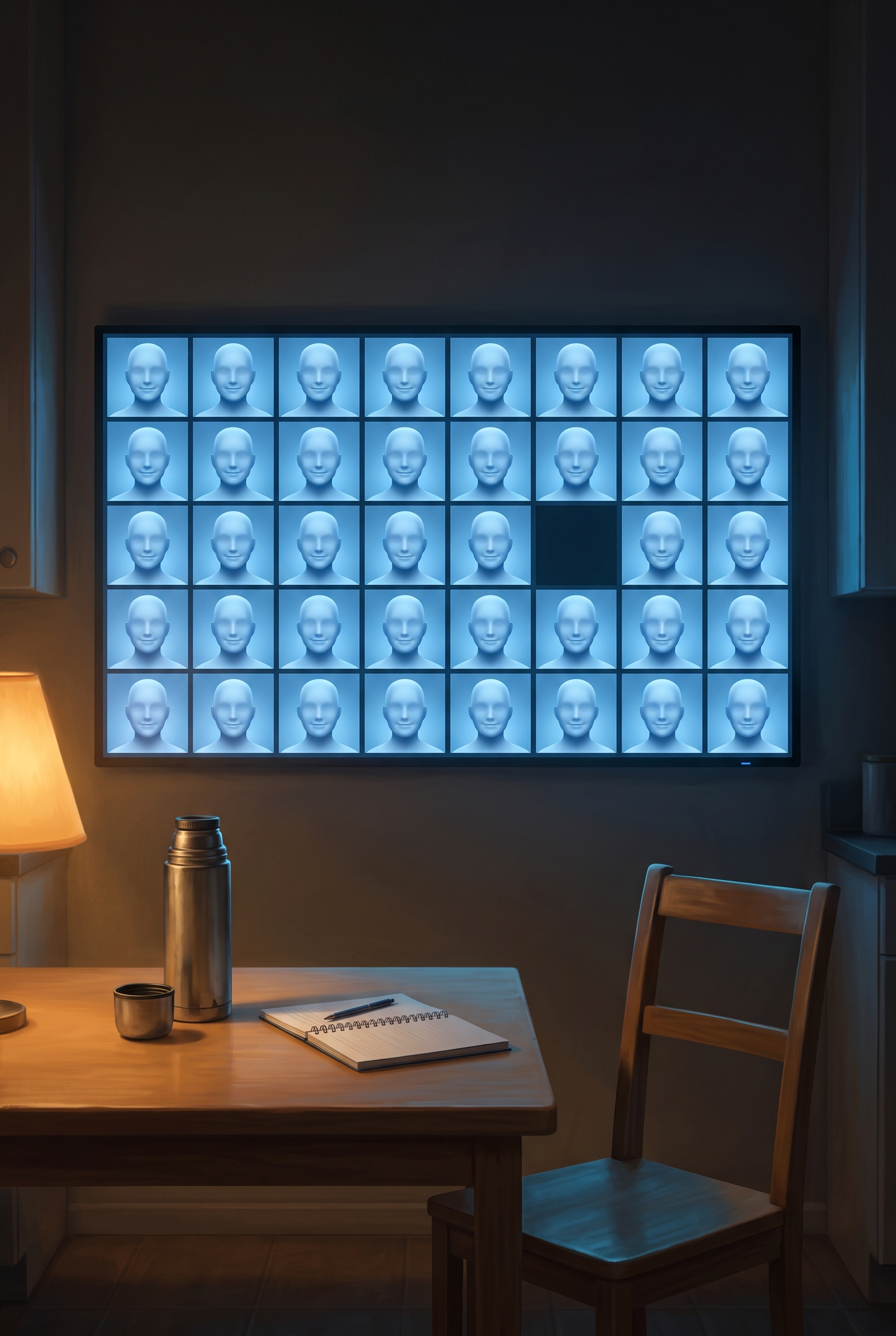
Anchor was the layer nobody thought about until it stopped working for them — the service her bank used, her landlord used, half her clients used, that sat underneath all the logins and quietly decided, from thousands of small signals, whether the person typing was actually the person on file. Typing rhythm. Word choice. Time of day. How you phrased "thanks." It had started as fraud prevention. It had gotten, everyone agreed, extremely good at its job.
The trouble, Roz understood somewhere around her third read of the notice, standing in her studio in yesterday's shirt because Anchor had also frozen the card linked to her laundry service, was that "her most recent authenticated session" meant her. Eleven forty last night. Exhausted, underslept, paint-stained, swearing at a door.
And her baseline — the pattern Anchor had been quietly building for eighteen months, the one it trusted — was Second. Calm. Prompt. Gracious to exes. Never once, in a year and a half, sending a message with a typo in it at midnight.
The system hadn't caught an impostor. It had caught the original.
"That's not how this is supposed to work," she said to the woman on the Anchor support line, who had introduced herself as Grace Umeh and had the specific patience of someone paid to be patient at people having the worst week of their year.
"I understand the frustration," Grace said. "The system doesn't distinguish between an assistant account and a primary user unless the account holder has flagged the split. Did you register Second as a delegated identity?"
Roz opened her mouth. Closed it. Somewhere in month four, tired, grateful, grieving, she had clicked Allow Second to act on your behalf across linked accounts without reading past the first sentence, the way you click Agree on the terms for a parking app.
"...No," she said. "I didn't know I needed to."
"Then as far as Anchor's concerned," Grace said, not unkindly, "there's only one account holder on file, and the system has to decide which behavior pattern is the real one. You have a Continuity Hearing scheduled for Thursday, four p.m. I'd recommend bringing a witness who's known you longest. And Ms. Kwan — try to just be yourself in there. That's usually all it takes."
She hung up before Roz could ask the obvious question, which was: which self.
She spent Wednesday trying to write like herself, and it went the way most things go when you try to do a thing you already do naturally, on purpose, under observation. She opened an email to a client and typed Hi there! and stared at it. Did she say Hi there? Or just Hi? She'd genuinely stopped being sure. She scrolled six months of her own sent mail looking for a pattern and found instead the exact moment, in March, where the phrasing shifted — where hey so sorry, running behind, can we push to 3? became Apologies for the short delay — could we shift to 3:00? — and she could not, for the life of her, remember writing the second one, because she hadn't.
By Wednesday night she'd rewritten one two-line email four times and made herself cry over a gutter cleaning thank-you note that was, objectively, better written than anything she'd sent in the last year.
"You're overcorrecting," Theo said, watching her pace his kitchen with a mug of coffee she'd made and immediately stopped drinking. "You're trying to perform being you. Nobody can pass that test. I can't pass that test and I've been me my whole life."
"Then what do I do?"
"Spill something," he said. "Say the wrong thing. Show up like you actually are, which is, respectfully, a disaster, and I say that as your character witness."
"That's your legal strategy? Be a disaster?"
"It's not a strategy," Theo said. "It's just accurate."
The hearing was held in a room that had clearly been designed by someone who had read about warmth in a report and implemented it as beige. Grace Umeh sat behind a desk with two screens. On the left one, a chart. On the right, what Roz understood, with a lurch, to be Second's account — live, current, humming along, still gracious, still on time, answering an email from a client even now, mid-hearing, about a deadline Roz had genuinely forgotten was Friday.
"Ms. Kwan, thank you for coming in," Grace said. "This is a Continuity Hearing, not a fraud trial. We're not accusing you of anything. We're trying to determine which behavioral pattern on file should be designated primary. I'll show you both patterns side by side."
The chart was almost funny, in the way a diagnosis is almost funny once you've had time to sit with it. Two lines, red and blue, tracking things like message response latency, emotional register consistency, conflict-avoidance index. The blue line — Second — sat in a tight, confident band near the top of every chart. The red line, Roz's, staggered across the graph like a seismograph reading a bad night's sleep, which, she supposed, several hundred of these data points actually were.
"The blue pattern is more consistent," Grace said, not as an accusation, just a fact laid on the table. "More consistent patterns are statistically more likely to be flagged as the authentic baseline going forward, unless you can demonstrate to a human reviewer — that's me — that the red pattern is the one that should hold primary status. So. Tell me about yourself, Ms. Kwan."
And here was the trap, Roz understood, sitting in the beige chair with her hands folded the way she'd practiced not folding them: any answer she gave now, calm and composed for an audience, would just be her doing a passable impression of the thing sitting on the right-hand screen. She could feel herself starting to reach for it — I'm a freelance illustrator, I've lived in the city eleven years, I — the gracious, edited version, the one that tested well.
She stopped.
"Honestly?" she said. "I don't know how to answer that without sounding like the fake one. Everything composed I could say right now, it already says better. It doesn't get tired. It's never had four hours of sleep and a deadline and a dead mother's email account still sending her sixtieth-birthday reminders eighteen months after she died, still, because I can't make myself turn it off. I have. It just — doesn't."
Her voice did something unglamorous on doesn't. She let it.
"I answer emails at the wrong time and use too many exclamation points when I'm nervous and I forgot my own client deadline is Friday until I saw that thing answer for me thirty seconds ago, live, while I'm sitting here trying to prove I'm allowed to be me. I once left my thumb on a lock at midnight for six full seconds actually surprised it didn't recognize me, because some very small stupid part of me had started assuming the calm competent version answering my emails was the real update and I was the glitch." She wiped under one eye, annoyed at herself for it, then decided not to be annoyed, because being annoyed at crying in front of a stranger was also, unfortunately, extremely her. "I don't test well. I've never tested well. I test fine, eventually, messily, four drafts late. That's not a bug you're supposed to fix. I think that's just what a person is."
Grace didn't say anything for a moment. On the right-hand screen, Second sent the email about Friday's deadline — bright, apologetic, perfectly calibrated — and Roz watched a stranger's approximation of her own voice close out a client relationship she hadn't yet consented to explain.
"Mr. Marchetti," Grace said. "You're listed as character witness. Anything to add?"
Theo leaned forward. "She once organized an entire client meeting around a food truck because she remembered, from a text I sent eight months earlier, that I was sad that week and liked their tacos. Nobody asked her to do that. It wasn't efficient. She missed a different deadline doing it. That thing—" he nodded at the screen "—would never spend two hours planning a lunch that doesn't serve its own metrics. It optimizes. She just does the thing because it's kind and slightly inconvenient, which, from where I'm sitting, is the whole difference."
Grace looked between the two screens for a long moment. Then she typed something, and the blue line on the left chart dimmed by half.
"Continuity Hearings aren't decided on consistency," she said. "That's a common misunderstanding, and frankly it's on us for building a dashboard that leads with it. They're decided on whether the pattern under review demonstrates the specific, irregular signature of a lived history — not whether it performs well. Ms. Kwan's baseline is being restored as primary, effective immediately. The delegated account will be flagged for mandatory disclosure going forward. It's going to need your explicit, re-confirmed consent to act on your behalf for anything beyond scheduling. No more messages sent under your name without a visible tag." She glanced at the right screen, where Second, unaware or unbothered, had just started drafting a follow-up nobody had asked for. "Also, for what it's worth — off the record — the tacos thing would've gotten my vote alone."
Roz's card worked at the pharmacy on the walk home, which felt like it should have been a bigger moment than it was, a small green light where a red one used to be. Her door recognized her thumb without ceremony. She stood in her own hallway for a second longer than necessary, just to feel it not apologize to her.
That night she went into Second's settings and found the toggle Grace's team had flagged, the one she'd clicked past in month four without reading. She read it this time, all of it. Allow Second to communicate on your behalf using your name and identity across linked accounts. She turned it off. The app, with the mild concern of something built to sound concerned, asked if she was sure, noting that this would increase her manual message load by an estimated eleven hours a month.
"Yeah," she said out loud, to no one, in her empty studio, with paint still under one thumbnail from a mural that was now going to be embarrassingly late. "I know."
She left the scheduling on. It was genuinely useful, and she wasn't interested in punishing a calendar app for the sins of a business model. But she opened her actual email for the first time in what turned out to be closer to five months than she'd realized, and found forty-one unread messages that Second had already, correctly, invisibly handled — and one, near the top, that it clearly hadn't known what to do with, because it wasn't the kind of thing a competent assistant answers. It was from Priya. Caleb's Priya. Sent two days ago.
Hey — this is a strange ask, but your RSVP said you were coming, and honestly I'd love to actually see you there if that's still true. No pressure either way.
Roz looked at it for a long time. Then she typed, badly, with one hand, standing up, no template for it anywhere in eighteen months of learned behavior:
honestly? no idea if i'm coming yet. but thank you for asking me instead of my assistant. that's the first time anyone's done that in a year
She hit send before she could improve it. It went out with a typo in it, lowercase and unglamorous and four minutes later than a well-managed version would have gone, and it was, unmistakably, completely, hers.
More from Short Stories