The Star Comes Last
Theo found me under the Buick marquee with a torch in my hand and told me the Starlite was on.
Synopsis
Del Kowalczyk, a lifelong neon-sign bender, is told that the Starlite Motel comet, a sign she and her dying father built in 1978 and which she personally disconnected nineteen years ago, has begun to light itself one segment at a time out on a county road. She investigates it like a practical tradeswoman, confirming there is no transformer, no wire, no voltage across the burning glass, and finds no culprit, while her father slips further into dementia in a memory-care home. When he surfaces for a lucid moment and asks whether the comet's tail is up yet, Del stops hunting for an explanation and starts tracking the light as it climbs the sign in the exact order he always lit it: tail first, star last. On the night the star finally fires, Del stands in the empty lot watching the completed comet instead of answering the care home's call, keeping vigil by the fast channel rather than the slow one, and afterward she neither explains the mystery nor lets it go.
The Star Comes Last
Story
Theo found me under the Buick marquee with a torch in my hand and told me the Starlite was on.
I did not look up right away. I was in the middle of a weld, and a weld does not care about your news. The flame was pulling the glass the way it does, soft and obedient and then all at once too soft, and if you look away you get a bubble, and a bubble is a two-hour tube turned into scrap. So I held it until the seam closed and the color came up clean, and then I killed the torch and let my eyes find the dark of the shop again.
"The Starlite," I said.
"The motel. The comet thing." He was breathing hard, which meant he'd skated the whole way down Erie Street to tell me, which meant he believed it. Theo is fifteen and does not spend his breath on things he doesn't believe. "It's lit up. Not all of it. But it's on, Del. I filmed it."
He held out his phone. I didn't take it. My hands were not in a condition to be trusted with a boy's phone, and anyway I knew what the Starlite looked like lit. I helped build it.
"That sign has no transformer," I said. "I pulled it myself. Nineteen years ago."
"Okay." Theo has learned not to argue with facts when I say them in the flat voice. He just stood there in the doorway with the streetlight behind him, holding out the little glowing rectangle, waiting for me to be curious.
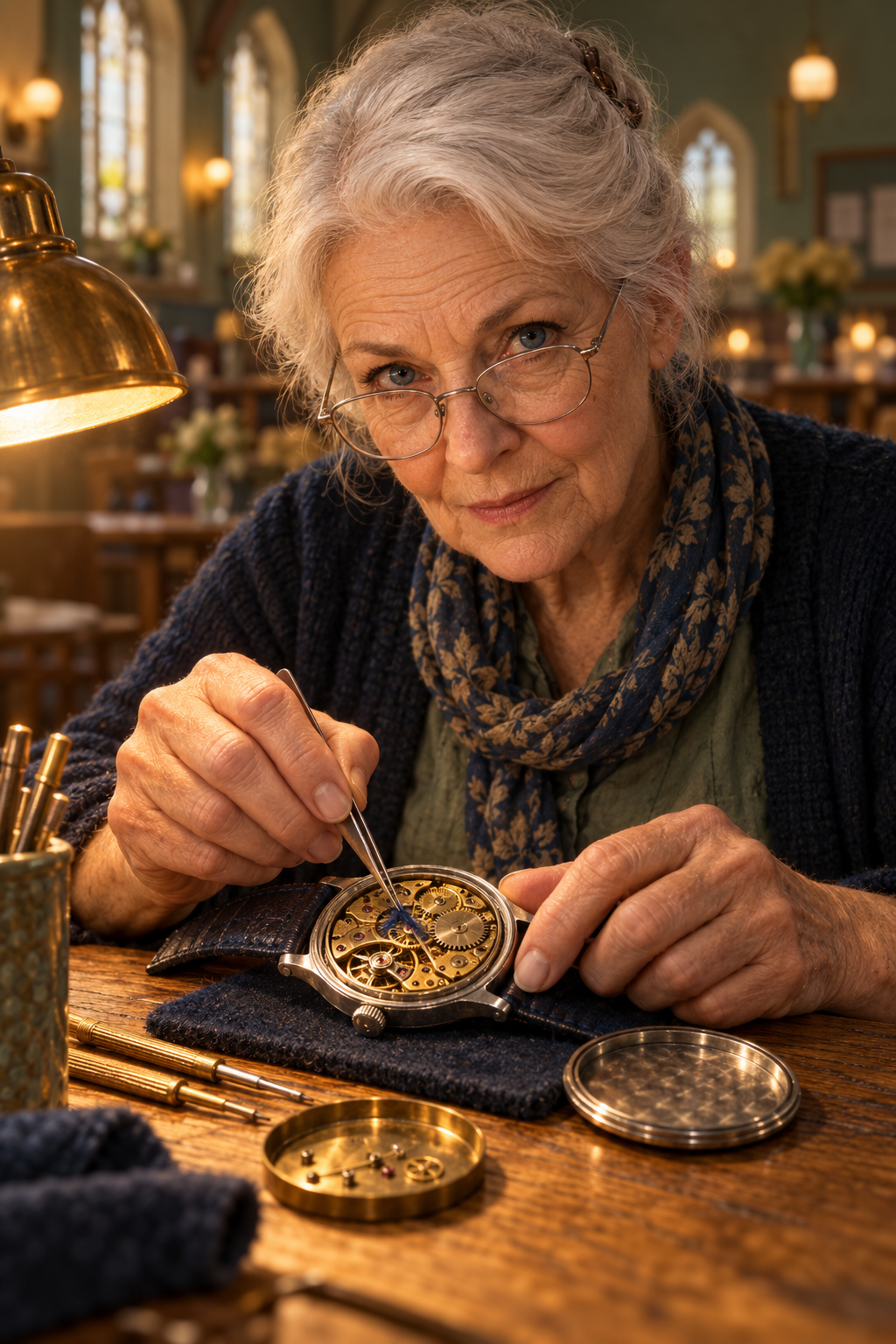
I am a sign bender. My father was a sign bender. Before him there was a man named Oskar in Chicago who taught my father, and I never met Oskar but I have his pliers. What I am telling you is that I come from people who do not believe things light up on their own. Gas lights up when you put a potential across it, enough volts to tear the electrons off, and the gas only does that because it has no choice, and when you take the transformer out there is no potential and no tearing and no light. There is just a glass tube full of neon sitting in the cold, being a glass tube.
"Let me see," I said, and wiped my hands on the rag that lives in my back pocket, and took the phone.
The video was bad, the way night video always is, the sensor guessing. But you could see it. Up on the pole above the Starlite Motel, where the comet used to arc across the sky with its five-segment tail streaming behind the head, two segments of the tail were burning. The two at the very end. Burning that particular orange that is just neon being itself, no phosphor, no argon, the cheapest and truest color there is. The rest of the sign was dark. The head of the comet, the star, was dark. But the tip of the tail was lit like somebody had struck a match at the far end of a long fuse.
"Huh," I said.
My father built the Starlite sign in 1978, and I handed him glass. I was nineteen and furious about being nineteen in this town, and bending neon for the Zaleski brothers' motel was not the life I had in mind, but my father paid in cash and I needed cash to leave, so I handed him glass.
The comet was his masterpiece and he knew it and never said so. Thirty-one feet of tubing from the tip of the tail to the leading point of the star. He bent the whole tail as a single run, which you are not supposed to do, which nobody does, because the longer the run the more ways it can crack when it cools, and my father bent it in one piece in an afternoon with a cigarette in his mouth the entire time, and it did not crack. The star was five separate tubes, double-backed, with the inside strokes bent so tight the glass went almost white at the curve. When he fired it the first time, in the yard, with the whole thing laid out on sawhorses and the big transformer humming on the ground, he brought it up a circuit at a time.
Tail first. Segment one, the tip, then two, then three, up the length of it toward the head. Then the head. Then, last, the star.
"Why last," I asked him. I was holding the ground clamp and sweating.
"So it has something to chase," he said. The tail was already burning when he said it. He threw the last switch and the star came up white-hot and the whole comet was suddenly moving without moving, the way good neon does, the eye insisting the light is traveling even though the light is standing perfectly still. My father looked at it for a while. Then he said we should pack up before the dew came, because dew on a hot tube is how you lose a tube, and that was the entire ceremony.
He lit it the same way every time after that. Any time he had to service it, bring it back up, he went tail to star, tip to head, in order, every time, long after there was any reason to. I used to think it was superstition. Now I think it was just the shape his hands had learned, and your hands are the last part of you to forget anything.
The Starlite Motel closed in 2007. The Zaleskis died or moved to Florida, which around here is the same thing. The bank took the property and the bank does not pay a neon man to keep a sign running on a motel with no guests, so the sign went dark, and a dark sign is a liability, and eventually the bank called me to come make it safe.
I climbed the pole on a cold morning and cut the secondary leads and pulled the transformer, which was a beautiful old 15,000-volt core-and-coil the size of a car battery, and I coiled the GTO wire and capped the high-voltage ends with silicone boots so nothing could arc, and I brought the transformer down and it went on a shelf in my shop where it still is. The tubes I left. You leave the tubes. There's no money in salvaging dead tubes and it felt wrong to take my father's run apart while he was still alive to hear about it.
So for nineteen years the Starlite comet has been a dead shape against the sky. Glass full of gas, and no potential across it, and no reason on God's earth for it to do anything but hang there and collect bird mess.
And now the tip was burning.
I drove out that night. Of course I did. Theo wanted to come and I told him no, which is a thing I can still do, being the adult with the truck.
The motel sat where it always sat, out past the tracks where Erie Street gives up and turns into the county road. The office windows were boarded. Somebody had bought the lot, I knew that much, a development outfit from downstate with a sign of their own, a vinyl banner zip-tied to the fence that said FUTURE HOME OF and then a phone number, the rest of the sentence apparently still being decided.
I parked and got out and tipped my head back, and there it was. Two segments. The tip of the tail, burning that cheap honest orange, steady, not flickering, not the sick pulse of a tube that's gassing out. A good clean fill. Burning like it was connected to something.
It was not connected to anything. I want to be clear about the order I did things, because I am a professional and I did this the way you are supposed to.
I put the ladder up the pole and I climbed it with a voltage tester in my teeth, and I checked the housing where the transformer used to live, and the housing was empty, which I knew, because I am the one who emptied it. I checked the GTO leads and they were still coiled and still capped in my silicone boots, which had gone chalky and hard with age but were still seated, still covering the ends. There was no wire running to the two lit segments. There was no wire running to anything. I put the tester across the electrodes of the burning tube, the two little filaments where my father's breath had sealed the gas in forty-eight years ago, and the tester read nothing. Zero. No potential.
The tube was burning and there was no potential across it.
I hung on the ladder a while in the cold with the orange light on the backs of my hands, which are not good hands anymore, which are a sign bender's hands, scarred white where the glass has kissed them over fifty years, and I did not have a thought I could use. I had a lot of thoughts I could not use. I came back down.
I did the cozy-mystery things, because the alternative was the other thing, and I was not ready for the other thing.
I called the power company and a bored man named Dale confirmed the Starlite lot had no active service, nothing, the meter pulled in 2009. I asked him about backfeed, about induced current, about anything a tube could be stealing from a line that wasn't there, and Dale, to his credit, took me seriously for a man being asked about a haunted sign, and said there was no line within four hundred feet to induce off of.
I considered Theo. But Theo does not have a 15,000-volt transformer, and if he did he would have lit the whole sign to show off, not two segments at the dark end.
I considered the development outfit. I called the number on the fence and got a young woman named Brittany who did not know what a comet was and put me on hold and came back and said they had "no scheduled activity on the Erie Street asset at this time," which is how people talk now, and I believed her, because nobody who talks like that is sneaking out to a county road at night to light a dead sign tail-first.
I considered, briefly and with contempt, the word miracle, and set it down, because I was raised to fix signs, not to be impressed by them.
Then I went to see my father, because the next night a third segment had lit.
My father lives at Birchwood now, which is the memory place out on the highway, the one with the fake lighthouse in the lobby that does not fool anyone, least of all the people who live there, who have forgotten a great deal but have not forgotten what a lighthouse is for. He has been there two years. The dementia came the way it comes, not all at once, a tube gassing out slowly, the color going thin and then patchy and then just the electrodes glowing at the ends with nothing moving between them.
There is a night nurse named Rosa who likes him, which not everyone does, because he can be a bastard, it's in the blood. Rosa walked me down the hall and told me he'd had a bad week, more sleeping, less talking, and that I should keep my expectations low, which is a thing people say as if expectations were a dial you could turn.
He was in the chair by the window with the blanket over his knees that I did not buy and do not recognize. His hands were on top of the blanket. His hands looked exactly the same as they have always looked. Scarred white. The hands do not get dementia. The hands are the last to forget.
"Tata," I said, and sat.
He looked at me for a while with the pleasant, terrible openness of a man deciding whether he knows you. Then something caught, some fractional firing, and he said, "You cut your hair," which I did, in 2011, and I said, "Yeah, a while ago," and he nodded like we'd settled something.
We sat. I am not a talker and neither is he and we have always been able to not-talk together better than most people can converse, so we did that for a bit, and the fake lighthouse light swept across the parking lot through the window on its slow fake schedule, and then my father said, without any lead-up, in a voice that was suddenly and completely his old voice:
"Is the tail up yet?"
The room went very quiet. Rosa had left. The radiator ticked.
"Three segments," I said. I did not ask him what he meant. You do not ask them what they mean, you take what color you get. "Tip to head. Three so far."
"Mm." He looked out the window, past the lighthouse, past the parking lot, toward the highway and the county road and the dark lot where his comet was coming up out of nineteen years of nothing one segment at a time. "You do it in order," he said. It was not a question. It was an instruction, maybe, or a memory of an instruction, I could not tell which and it did not matter.
"I'm not doing it," I said. "Tata. I'm not the one lighting it. There's no transformer. I pulled the transformer."
He smiled. It was not a confused smile. It was the smile of a man who knows something you have been too slow to understand, which is a smile I have been receiving from this particular man my entire life.
"So it has something to chase," he said.
I am not going to tell you I understood it, because I don't, and understanding is not a thing I'm going to pretend to for the sake of a tidy finish. I bend glass. I know what I can measure. I measured zero volts across a burning tube and I do not have a theory and I am not going to insult my father's trade by inventing one.
But I knew the order. Tail to star. Tip to head. And I knew that the star came last, and I knew why it came last, and starting that night I stopped doing the cozy-mystery things, stopped calling Dale and Brittany, and started driving out to the Starlite every night to see how far up the tail the light had climbed.
Four segments, the night after I saw him. The light had reached the bend where the tail sweeps up into the body of the comet, the hardest bend in the whole run, the one my father made in a single afternoon with a cigarette in his mouth. Four segments burning, the orange steady and clean, and the head of the comet still dark above it, and the star above that, dark, waiting.
Five, two nights later. The whole tail. Thirty-one feet of it from tip to the base of the head, all of it burning at once, no transformer, no wire, no potential, no explanation that a voltage tester could hold. Standing in that empty lot I could see the thing my father built the way he must have seen it in his head before he ever touched a flame to glass, the whole long streaming shape of it, and the eye did the thing again, insisted the light was traveling, that the comet was moving across the sky toward some arrival it had been nineteen years getting to.
All that was dark now was the head. And the star.
I did not go out the next night. I want that on the record too. I am not a brave woman about certain things and I knew what the head lighting meant, and I knew what the star lighting would mean after that, because the star comes last, it always came last, and I sat in my shop with the old transformer on the shelf and I did not drive out to the county road because I did not want to see the head come up. I bent a tube I didn't have an order for. I made a bubble and threw it out and bent another. The hands keep going. The hands are the last to forget.
Rosa called at a quarter to four in the morning. I was awake. You're always awake when that call comes, some part of you has been sitting up for years waiting for the phone, and I answered before the second ring and she said my father had had a change, that I should come, and that she was sorry, and that he was asking for me, which later I decided she had made up to be kind, because by then he was past asking for anyone. I don't hold it against her. It was the right lie.
I did not drive to Birchwood.
I drove to the Starlite. I am not proud of it and I am not ashamed of it. There are two places you can be and I chose the one with the sign.
The head was lit when I got there. It had come up while I slept, that white-centered orange, the comet's blunt burning face, and below it the whole tail streamed back thirty-one feet into the dark, the entire comet alive now except for the one thing above it.
I got out of the truck. The cold came up off the gravel. Out on the highway a single semi went by and then there was nothing, no wind, no birds, that specific stillness of the hour when the world has stopped pretending anyone is in charge of it.
I tipped my head back and I watched the star.
I want to tell you how long I stood there but I don't know. Long enough that my neck ached. Long enough that the orange of the comet had printed itself on my eyes so that when I blinked I saw its negative, a dark comet on the inside of my own lids, chasing. My phone was in my pocket, buzzing, which was Rosa, which was Birchwood, which was the news arriving by the slow ordinary channel. I did not take it out. I knew what it said. I was watching the fast channel.
The star came up all at once, the way my father always threw it, no fade, no warming, there and whole and white at the center where the glass went almost to nothing at the tightest curve, five double-backed tubes firing together, and the whole comet was complete above me in the cold for the first time in nineteen years, head and tail and star, and the eye did the thing one last time, the light standing perfectly still and traveling anyway, the star chasing the tail it would never catch and the tail streaming ahead of the star it would never lose, the two of them locked into that one long gesture my father bent into the glass in an afternoon in 1978 and sealed with his own breath, and then the phone in my pocket stopped buzzing.
I stood in the gravel and looked up at the whole lit comet and I did not reach for the phone.
The dew would come soon. Dew on a hot tube is how you lose a tube. He taught me that first, before anything, before the flame, before the order of the circuits, before any of it. You bring the sign up in order and you shut it down before the dew, and you go home.
I stayed until the sky in the east went the gray that kills all neon, that washes the color out of any tube ever made, and the comet thinned and thinned against it and at last could not be told from the pole it hung on. Then it was just glass again. Thirty-one feet of cold glass full of gas, sitting in the morning, being a glass tube, the way glass does when there is nothing across it to make it burn.
I drove to Birchwood. I signed what they put in front of me. I collected the blanket I don't recognize, because it was his, and his things were mine now, and you take what color you get.
The sign has not lit again. I check. I drive out past the tracks where Erie Street gives up, most nights, and I stand in the lot the development outfit still has not developed, and I look up at the dark shape of my father's best work against the sky, and it stays dark, the way a sign stays dark when there is no potential across it and no reason on God's earth for it to do anything else.
I pulled the transformer nineteen years ago. I'm the one who emptied the housing. I measured zero volts across a burning tube with my own tester in my own hand. I don't have a theory and I'm not going to invent one, because I come from people who fix signs and don't pretend to be impressed by them.
But I keep the old transformer on the shelf. And some nights, before I lock the shop, I put my hand on it. It's cold. It's always cold now. The hands are the last to forget, and mine have not forgotten a thing.
More from Short Stories