Number, Please
The oath was printed on a card no bigger than the ace of spades, and Ruth Pike had signed hers in 1931 with a fountain pen Miss Fenn kept in her desk for that purpose and no other.
Number, Please — Synopsis
On the night of January 26th, 1937, with the Ohio River sixty-one feet at the Mercer Bridge and rising, Ruth Pike runs the two-position switchboard above Vollmer's store in Aldrich Landing, Kentucky, alone. She has worked the board six years under a signed oath of secrecy, and she is good at it in the specific way the job demands: she knows everybody's business and carries none of it. In the chief operator's desk drawer sits an unfilled reference form for a job on the Cincinnati night board, the only exit she has, and the only thing that can grant it is Miss Cordelia Fenn's signature.
Riding a bad toll circuit past midnight, Ruth overhears Carrow Brede, tile works owner and drainage board member, confirm with a Louisville engineer that the Rowan levee will be dynamited at first light to draw the crest off Marbury, nine thousand people downstream. The low ward of Aldrich Landing, eleven hundred people, will go under without warning, because warning them means armed men on the levee and a delay that drowns Marbury instead. Miss Fenn catches her listening and refuses to hear what was said, holding the oath as absolute and admitting she has held worse. At twenty minutes to four, while Fenn is in the flooded cellar stacking battery racks on crates to keep the exchange alive, Brede calls Louisville again. Ruth never speaks a word of what she knows. She takes three spare cord pairs and bridges his private toll call onto the fourteen-party low ward line, the constable's line, and the parsonage, rings the five-long fire signal so every receiver comes off its hook, and lets Brede say it himself to nineteen listening ears.
The chapel bell starts at four. The town gets out with feed sacks and lamps; Ruth's father takes the long-idle ferry Josie B. off the bank for the first time since the bridge put him out of work in 1931 and runs her nine hours against the current. One man drowns going back for his hogs. Shotgun men hold the levee crown until the constable talks them off it one at a time, and the charge goes in three hours late, which costs Marbury a number that Brede tells her, to her face and without raising his voice, they will both carry for life. Miss Fenn discharges her by the book on February 4th, says she is not sorry and has not slept, and then fills out the Cincinnati form: a reference that sets down Ruth's excellence and Ruth's offense with equal plainness and explicitly declines to weigh them. A historical disaster story about the difference between a secret and a warning, and about what it costs to be the only person in town who hears everything.
Number, Please
Story
The oath was printed on a card no bigger than the ace of spades, and Ruth Pike had signed hers in 1931 with a fountain pen Miss Fenn kept in her desk for that purpose and no other. I will not repeat, disclose, or make use of any communication or any portion of any communication passing over the lines of this company. Six years later Ruth could still recite it without looking, the way she could recite the Apostles' Creed, and with roughly the same quantity of belief.
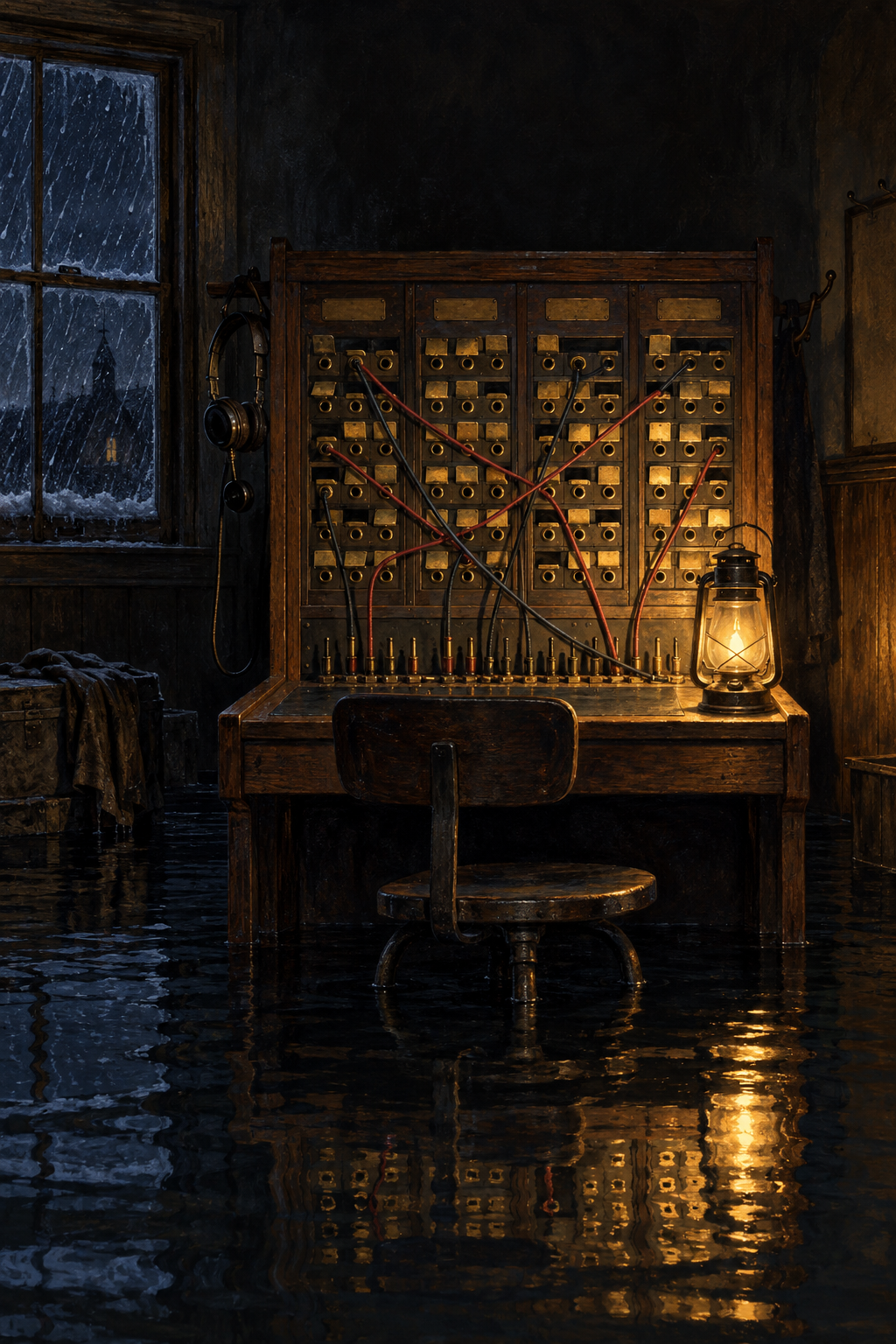
The Aldrich Landing exchange sat over Vollmer's store on Water Street: two positions, a hundred and eighty-one subscribers, and a coal stove that heated the half of the room where nobody sat. The board smelled like hot shellac. The cords smelled like gutta-percha and other people's hands. On the night of January twenty-sixth the gauge at the Mercer Bridge read sixty-one and four tenths, flood stage being forty, and the sleet coming across the river was the kind that went sideways and found your collar no matter which way you turned.
Ruth had the night alone because Dovie Kress lived out past the Rowan Bottoms and the Bottoms road had gone under at suppertime. Miss Fenn was in the back room with the ledgers, which is where Miss Fenn went when she intended to be available without being present.
Drop fourteen fell. Ruth brought the answering cord up.
"Number, please."
"Ruthie, is that you? Is the bridge open?"
"The bridge is open, Mrs. Tandy. The approach on the Ohio side is not."
"Well then it isn't open."
"No ma'am," Ruth said. "It is not."
That was most of the night. People did not call to ask for numbers. They called to ask the board, because the board was the only thing in town that knew more than they did, and Ruth gave them the gauge and the road and the weather and told them nothing else, because everything else she knew had come to her over a wire.
She knew that the Sowders girl had telephoned a man in Ashland four times since Christmas and that the man's wife had answered twice. She knew Reverend Tuel had wired for money and been refused. She knew, because the toll operator in Louisville was a talker, that Louisville itself was in bad shape, that the water plant had quit, that WHAS had been broadcasting since Sunday without going off, and that the Red Cross was putting cots in a tobacco warehouse. None of it was hers. All of it lived in her head like furniture in a house she was only renting.
In the drawer of Miss Fenn's desk, under the ledgers, was a form from the Cincinnati and Suburban Bell Telephone Company requesting a statement of character and competence for one Ruth E. Pike, applicant, position of operator, nights. It had come the ninth of January. It had been in the drawer eighteen days. Ruth had not asked about it and Miss Fenn had not mentioned it, and the two of them had conducted that silence with great skill, the way they conducted everything.
At ten minutes past eleven, drop sixty-one fell. The tile works.
"Number, please."
"Get me Louisville," Brede said. "Engineer's office, the district line. You've got the number."
She had the number. She pulled the toll trunk, and the trunk was rotten, hissing like fat in a pan, the way every long line east of Louisville had been hissing for three days. Company rule said an operator stayed on a poor toll circuit to monitor transmission. Company rule also said she monitored transmission and nothing else, and Ruth had always understood those to be the same sentence.
She kept the key down.
"That you, Carrow?" A young voice, Louisville, tired past politeness.
"It's me."
"Chief signed it at six. It goes in the Rowan levee at first light. They've got the charges set on the county side already, two men been out there since dark in a johnboat."
"Three to two," Brede said. "Thursday. I'd like that in the minutes."
"It's in the minutes." Paper sound. "Mr. Brede, I want to know who tells the Landing."
"Nobody tells the Landing."
"Somebody has got to tell them."
"You tell the Landing," Brede said, "and there will be forty men sitting on that levee by midnight with shotguns and lanterns, and then I have got a dead man on top of a drowned town. They get told when it's done. They can be as sore as they like at ten o'clock in the morning."
"Yes sir."
"Nine thousand in Marbury," Brede said, to nobody, in the voice men use when they are arguing with themselves and want a witness. "Eleven hundred here. And my works sit in the low ward same as everybody's house, so don't anybody explain my own arithmetic to me."
Ruth pulled the key up. She sat with her hands flat on her knees under the board where nobody could have seen them shake, which was fortunate, because Miss Fenn was standing in the doorway of the back room with a ledger against her hip.
"How long," Miss Fenn said.
"The circuit is poor."
"How long, Ruth."
"The whole of it," Ruth said.
Miss Fenn came and stood behind position two. She was sixty-one years old and had been a telephone operator since there had been such a thing to be, since the Landing exchange was a wooden box in a hardware store and you cranked a magneto to raise anybody at all. She smelled of the violet cachous she kept in a tin and she had never in Ruth's presence raised her voice.
"Sixty-one is the tile works," she said.
"Yes."
"I am not going to ask you what was said."
"I know it."
"Do you know why I am not going to ask?"
"Because you'd have to hear it," Ruth said.
"Because I would then know it," Miss Fenn said, "and a thing two people know is loose in the world. You have got hold of something and you are going to want very badly to put it down somewhere. There is no place to put it down. That is the entire nature of this work and it is why they pay us eleven dollars a week to do it and not a girl off the street."
"Miss Fenn." Ruth turned around on the stool. "If you were to hear a man on this board arrange a murder. Not a figure of speech. A murder, at an hour, with a name."
"I have heard worse than you are imagining," Miss Fenn said, "and I have held it, and I am still holding it, and I will hold it until I am dead, and if you ask me one more question along that line I will put you off this board tonight and run it myself." She set the ledger on the shelf, very square, aligned with the edge. "Mr. Kress on ten wants Marbury. I heard the drop."
By one in the morning the water was in the store below them. Ruth heard it start, a sound like somebody dragging a sack across the boards, and then the smell came up through the floor, which was not a river smell. It was the smell of a cellar's worth of coal oil and brine and hog feed getting acquainted.
The battery room was in that cellar. A hundred and forty cells of wet lead in racks, and when they went under the board went dead, and when the board went dead the town had no voice at all. Miss Fenn went down the inside stairs at half past one with a lantern and a crowbar and began building the racks higher on shipping crates, alone, in water to her knees, sixty-one years old, in a skirt.
Ruth ran the board.
She rang Marbury for the Kresses and Ashland for the Sowders girl and she did not think about the Sowders girl's business for one second, which was a thing she had gotten good at, the way a butcher gets good at not thinking about a hog. She took a call from the constable, Hollis Meed, who wanted to know if the Bottoms road was passable and was told it was not. She took a call from a man in Cincinnati who wanted his mother and whose mother's line had been dead since Sunday, and she said so four times in four different arrangements of words, and he kept saying try it again, and she tried it again, and the drop did not come up, and finally he said thank you, miss, in a voice that had given up, and she sat for a moment afterward with the cord in her hand.
At twenty minutes to four, drop sixty-one fell.
She looked at it for what she would later decide was three seconds and was probably one.
"Number, please."
"Louisville again," Brede said. "Same party. And operator, the circuit was sour as milk, so ride it."
"Yes sir."
She put him through. Then she took cord pair five, the spare, and she plugged one end into the multiple jack for sixty-one at the far end of the face, the second appearance the company had installed in 1929 when they put in the second position and nobody had used in three years.
She put the other end into fourteen.
Fourteen was the low ward party line. Fourteen subscribers on one pair of wires: Vollmer's, the Cundiffs, both Sowders houses, the Kresses, the parsonage, the school, the rest of them, every dwelling below the Rowan levee that had a telephone at all. She threw the ringing key and gave them five long rings, which in Aldrich Landing meant fire, and which no operator had sent since the livery burned in 1924.
Then she pulled pair six and bridged sixty-one onto nine, which was Meed's house, and rang it plain.
The receivers came off their hooks. She could hear them come, one after another, a soft clatter of little wooden houses opening, and with each one the line went thinner, the voices on it losing body, going tinny and far, fourteen and then fifteen and then nineteen ears drinking the current down.
"Operator," Brede said. "Operator, there's somebody on this line."
Ruth said nothing.
"Sir?" said Louisville, who could not hear the clicks, who was in a warm office two hundred river miles upstream with a good local circuit and a desk lamp. "Mr. Brede, I've got the powder crew on the other wire, they want to know is it still first light or is it now, because the current at the levee is taking their boat and they'd as soon do it and go home."
"Operator, I hear breathing on this line."
"Sir?"
"First light," Brede said. "God help me. First light, the Rowan levee, the county side, and you tell your chief the vote was three to two and that I will sign the paper with my own hand in front of anybody who wants to watch me do it."
Ruth pulled the cords. All three pairs, one two three, and the jacks let them go with the small dry sound they always made.
Then she sat in a room over a flooded store with a headset on and listened to nothing while the coal stove ticked, and she understood clearly and without any particular feeling about it that she had just ended her life as she had arranged it, and that she had eleven dollars a week and two hundred and fourteen dollars in a Prince Albert tin and no reference and no profession, and that in about ninety seconds every drop on the face of the board was going to fall at once.
It took forty.
What she would remember afterward was not the noise but the order of it. The drops came up in a run, left to right, like something walking along the board. She answered as fast as her hands would go and there was nothing to answer, only people saying the same four or five sentences into her ear and her saying I can't tell you that and I can't tell you that and the gauge at the bridge is sixty-three and two, until Hollis Meed came on nine and said, "Ruth. Was that the tile works I heard."
"I can't tell you that."
"That's fine," Meed said. "That's fine, honey. Ring me the parsonage."
She rang him the parsonage, and eight minutes later the bell at Ebenezer Chapel started up and did not quit for two hours, and the low ward came out of its houses into the sleet at four in the morning with lamps and children and feed sacks of whatever they had decided in ninety seconds was worth carrying.
Some of it went wrong immediately. Loma Sowders' people went south on the Bottoms road, which was under, and had to be brought back. A dozen men went out to the Rowan levee with shotguns, exactly as Brede had said they would, and sat on the crown of it in the dark daring a johnboat to come near, and the johnboat did not come near, and the charge did not go in at first light. Ort Cundiff went back for his hogs twice and the second time did not come back, and they found him on the twenty-eighth against the fence of the school lot, and he is the only name on the Aldrich Landing side of it, and Ruth learned it that afternoon from a woman who told her the way you tell the operator, as news, as a thing to be passed on.
And her father took out the Josie B.
Alton Pike had run the Landing ferry for twenty-six years and had not run anything since the Mercer Bridge opened in 1931 and put him out of the river business at fifty-one years of age. The boat had been tied at the foot of Water Street since then with a tarp on her, and he had kept the engine oiled the way a man keeps a grave. He had her off the bank by half past five in the dark with no lights and he ran her against that current for nine hours with the water full of fence rail and dead stock and one piano, and he took people off porch roofs and out of the second-story windows of the Kress house and off the crown of the Rowan levee where the shotgun men sat with their hands too cold to hold anything, and when Ruth saw him at noon he had a rope burn across his palm and he was the happiest she had seen him since her mother died.
The charge went into the Rowan levee at ten minutes past nine, after Meed walked out on the crown and talked the shotgun men off it one at a time by name. Three hours late.
The board died at four in the afternoon. Miss Fenn had bought them eleven hours out of that cellar with a crowbar and some shipping crates, and then the water came over the top cell and the whole face of the board went quiet at once, and Ruth took the headset off and set it on the shelf and found that her right ear had a groove in it like a wedding band.
Brede came to the schoolhouse on the ridge on the thirtieth.
Ruth was ladling beans. He stood in the line like anybody, and when he got to her he did not raise his voice, because that was not the kind of man he was, which was the part she had not understood on the telephone and understood now.
"Three hours," he said.
"Yes sir."
"They crested at Marbury at a quarter past eleven. There is a number for what those three hours bought over there and I am going to be given that number by the middle of next week, and I am going to carry it the rest of my life." He held his tin plate steady. "I wanted you to know that you are going to carry it too, because I do not believe you have thought about it yet, and it would be a shame for it to come at you sideways in ten years."
"I've thought about it," Ruth said.
"When."
"While I was doing it."
Brede looked at her for a moment. Then he said, "Well," and took his beans and sat down with the rest of them, and that was the only conversation she ever had with him. He lost the tile works. He rebuilt it in 1939 on the ridge, which is where it still is.
Miss Fenn discharged her on the fourth of February, in the back room, with the water down to the second step and the whole building smelling of the inside of a cistern.
She did it properly. She read the oath aloud off the card, Ruth's own card with Ruth's own signature on it in 1931 ink, and then she read out the company's rule 14b concerning the connection of subscriber lines, and then she said, "On the morning of the twenty-seventh of January you bridged a private toll conversation onto lines fourteen and nine. Is that correct."
"Yes."
"You are discharged." She put the card down. "I want you to understand that I am not sorry, and that if I had caught you at it I would have pulled those cords myself with my own hand, and that I have not slept since and it is not on account of my back."
"Yes ma'am."
"Did you weigh Marbury."
"I weighed it," Ruth said. "I got the wrong answer or the right one. I won't ever know which, and neither will he, and neither will you."
"No," Miss Fenn said. "That is correct. That is the only honest thing anybody has said to me in eight days."
Then she opened the desk drawer and took out the Cincinnati form, which had been in there twenty-six days, and she sat down and uncapped the fountain pen she kept for one purpose, and she filled it out at the pace of a woman doing sums.
She blotted it. She read it twice. She folded it into the envelope and did not lick the flap, and she held it out.
"Read it or don't," she said. "Either way don't come back in here, because I can't have you in this room."
Ruth read it on the bench at the Marbury depot on the eleventh, waiting on a train that was four hours down on account of track.
Ruth E. Pike worked the Aldrich Landing board six years and ran it alone nineteen hours during the high water of January 1937, in a building with the river in the cellar. She is the finest operator I have trained and I have trained forty. On the morning of the twenty-seventh of January she deliberately bridged a private toll call onto two subscriber lines, one of them a fourteen-party line, and for this I discharged her the same week. She will not hold a secret she believes will cost a life. I have set down both of these facts because both of them are true and I decline to weigh them for you. Employ her as you think best.
C. Fenn, Chief Operator
The woman in Cincinnati read it twice, in front of her, in an office with a radiator that knocked. She folded it and set it under a glass paperweight with a violet in it.
"Well," she said. "We'll want you on nights."
The Cincinnati exchange had ninety-six positions and a floor that did not smell like anything at all. In the third week a drop fell in front of her and she brought the cord up and said, "Number, please," and a woman asked for a number in Covington, and Ruth gave her the number in Covington, and the whole transaction took eleven seconds and not one part of it belonged to her.
Her father wrote twice that spring, in pencil, on the backs of ferry manifests he had no other use for. Both letters were about the river and nothing else. She kept them in the tin with Miss Fenn's letter and what was left of the money, and she answered them the same way.
More from Short Stories