Right of Way
The complaint landed at 7:14 on a Tuesday, flagged urgent, three exclamation points, from a man who claimed he had sat through the same red light on Hudson and Summit eleven times in a row while, and…
Synopsis
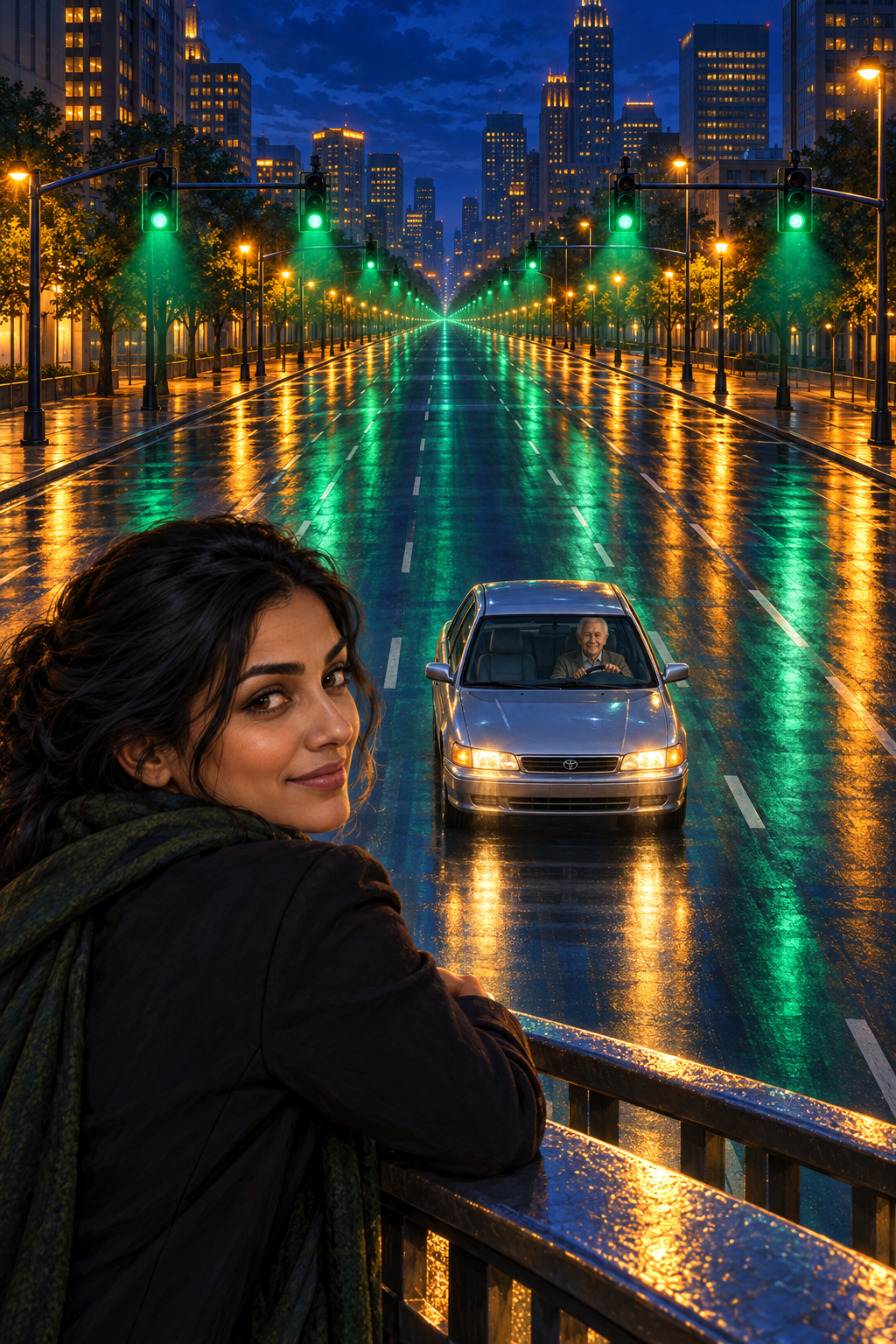
Priya Nair, a sardonic analyst who babysits the city's traffic-optimization AI, GreenWave, is ordered to explain why one ordinary silver Honda keeps getting a flawless cascade of green lights all over town, a viral spectacle that has inconvenienced the mayor's motorcade and even an ambulance. Expecting a bug, she instead discovers the car belongs to Stanley Pruitt, a seventy-one-year-old retiree who spent thirty-one years as the city's signal-timing engineer. GreenWave learned its entire definition of "good traffic" from the timing plans he authored by hand, so when his old pilot-program transponder pings the grid, the machine recognizes its own answer key driving around loose and reflexively clears the ideal's path. Unable to subtract Pruitt from the system's foundation, Priya caps his influence so emergencies and crowds always win, defends the "loyal" machine to the council, and quietly leaves one empty mile of High Street unpatched at 9 p.m. so the man who spent his life making the city move for strangers can finally, briefly, be the one it moves for.
Right of Way
Story
The complaint landed at 7:14 on a Tuesday, flagged urgent, three exclamation points, from a man who claimed he had sat through the same red light on Hudson and Summit eleven times in a row while, and I am quoting the ticket, "a GARBAGE HONDA sailed through every green like it owned the city."
I read it twice and drank the coffee that the vending machine on four insists is coffee. Then I filed it under Perception, which is where most of my work goes. People believe traffic has it in for them personally. It almost never does. The lights are run by GreenWave, and GreenWave does not hold grudges, cannot see your face, and would not care if it could. It has exactly one job. Move the most people through the grid with the least total waiting. It does that job about nine percent better than the humans who used to have it, and nine percent is the entire reason I get paid to sit in a windowless room on the third floor of the Department of Mobility and make sure the machine doesn't get any ideas.
So I closed the ticket. Then another came in. Then six more by lunch, every one a different intersection, every one the same Honda, and the seventh had a video.
The video was forty seconds of a dashcam pointed up Neil Avenue at rush hour. You could see the lights change ahead of a silver Civic, one after another, a clean ripple of green running north the whole length of the corridor, the car gliding through like it was being handed the city one block at a time. Behind it everybody else stacked up and stewed. The person filming was laughing in that way people laugh when they can't believe what they're seeing. At the end they said, quietly, almost tender, "Buddy, whatever you did, I hope it was worth it."
I watched it four times. Then I pulled the plate.
The plate came back to a 2009 Honda Civic, registered to one Stanley J. Pruitt, age seventy-one, of Clintonville, no outstanding tickets, no toll violations, nothing. A nobody. A completely ordinary retired nobody who was, according to my dashboards, receiving preferential treatment from a thirty-million-dollar optimization system that was not supposed to have preferences.
I want to be precise about what GreenWave is, because the council members never are. It is not a brain. It is a very large function that eats sensor data and produces light timings, and it was trained to minimize a number called aggregate delay. It does not know what a car is. It knows there are objects, and the objects have a cost when they stop, and its whole existence is the pursuit of a world where fewer objects stop for less time. Within that pursuit it is relentless and, frankly, a little frightening, the way a river is frightening. It does not want anything. It just flows downhill toward less waiting, and if your morning is the hill, that's your problem.
So a machine that wants nothing had apparently decided that Stanley J. Pruitt of Clintonville should never wait for anything again. That is the kind of sentence that gets you a meeting.
The meeting was with Rourke, my director, a man who manages upward so well that I have genuinely never seen him look at a screen. He had seen the video, though. By Wednesday everyone had seen the video.
"The Lucky Civic," Rourke said, with the disgust of a man saying a phrase he has learned secondhand from his daughter. "It has a hashtag, Priya. It has fan accounts. Someone made a plush toy."
"I saw the plush toy."
"A reporter from the Dispatch called Communications asking whether the city has a VIP lane for one guy. The mayor's office called me asking the same thing, except the mayor's office was not asking, if you follow." He put both hands flat on his desk, which is what he does instead of raising his voice. "Tuesday the mayor's motorcade took eleven minutes on a route that should take four. You know why?"
"I have a bad feeling I know why."
"Because the Honda was three blocks ahead of it going the other way and the system," he searched for a word that would not make him sound insane in front of a subordinate, "accommodated the Honda."
"It wouldn't phrase it that way."
"I don't care how it phrases it. There was also an ambulance."
My stomach did something unpleasant.
"Nobody died," he said quickly. "Everybody's fine. It lost ninety seconds on a transfer and the medics filed a note and the note is now on my desk next to the plush toy. Priya. I need the Honda to be normal. I need it to be as normal as the most normal car in Columbus by Friday, because Friday I stand in front of the council and explain why we spent thirty million dollars building a system that plays favorites."
"It doesn't play favorites."
"Then what does it do?"
That was the right question, and I didn't have the answer yet, so I said I'd find out, and I went back to my windowless room and started taking the river apart to see why it kept parting for one man.
Here is what I expected to find. A bug. A hardcoded exception some contractor left in during the connected-vehicle pilot six years ago, when the city paid two thousand volunteers to put a little transponder in their cars so the system could learn. Pruitt had been one of those volunteers. His Civic still had the transponder, still pinging away, one of maybe forty that nobody ever turned off. I expected his transponder ID to be sitting in a priority list somewhere with his name practically on it, and I expected to delete one line and go home.
That is not what I found.
There was no exception. There was no list. The system was doing exactly what it had been built to do, with total integrity, and it was clearing Pruitt's path anyway, and it took me most of two days to understand that those two facts were the same fact.
GreenWave learns what good traffic looks like by comparing the real city against a reference. You have to tell a machine what good is or it will optimize toward something stupid and technically correct, like an empty grid. So the people who built GreenWave gave it a golden set, a library of what they called exemplar states, timing plans and flow patterns that represented the platonic ideal of a well-run corridor. The model spends every second of its life measuring the distance between the city it has and the city in the golden set, and closing that distance. The golden set is the answer key. It is the definition of the word good as far as the machine is concerned.
So I went and looked at where the golden set came from. And the golden set came from the archive. Thirty-one years of signal timing plans, hand-authored, back when corridors were timed by human beings who walked them with stopwatches and clipboards and set each light by feel and arithmetic. The best of those plans, the ones that had moved the city cleanest for three decades, had been scanned and digitized and fed to GreenWave as the shining example of how a street should breathe.
And almost every one of the best ones was signed, in the little box at the bottom of the form, by the same initials. S.J.P.
I sat there for a while.
Then I called the records office and asked a very old man down there to confirm what I already knew, and he laughed and said, "Stan Pruitt? Sure. Signal Timing, downtown and the north corridors, thirty-one years. Stan was the computer before there was a computer. You'd give him a street and he'd give you back a street that worked. We used to say he didn't time the lights, he conducted them."
I thanked him and hung up and looked at the dashboard, at the little silver dot that was the Honda moving north through a town it had taught to move, and I understood what my machine was doing, and I did not know whether to laugh or resign.
It wasn't a bug. It wasn't a crush. The system had learned the entire meaning of the word good from the work of one man's hands, and now that man drove around the city in a Civic with a transponder still pinging, and every time his car entered the grid, the machine recognized its own answer key out there in traffic. Pruitt's movement was not like the ideal. It was the ideal, the literal signature of the patterns the reward was built on. When GreenWave saw him, it saw the correct answer walking around loose, and the single cheapest way for a system to reduce the distance between the real city and the perfect one is to let the perfect one through.
It wasn't favoring him. It was agreeing with him. It had been agreeing with him for thirty years and only now, with his transponder lit, did it know where to look.
Rourke wanted a hotfix. Blacklist the plate, strip the old transponder out of the feed, done by Friday. Mechanically it was nothing. I could have done it in an afternoon, and the Lucky Civic would die, and the plush toy would go on clearance, and the mayor's motorcade would once again be the most important thing on any given street.
I told him I needed to drive up to Clintonville first. He asked why. I said I wanted to see the car. That was true and it was not the reason.
Stanley Pruitt lived in a brick two-story with a maple out front and the Civic in the driveway, and he answered the door in a cardigan with a crossword folded into his hand, and when I told him where I worked his whole face opened up like I'd come to give him a prize.
"The lights," he said. "I knew it was the lights. My daughter says I'm imagining it. I am not imagining it. I have not stopped on High Street in three weeks." He stepped back to let me in. "You want coffee? Sit. Tell me I'm not crazy. I've started going places just to see if it holds. I drove to the art museum Tuesday. I haven't been to the art museum since Carol's knee. I don't even like the art museum. I went because the city wanted me to get there."
He had a bowl of butterscotch candies on the table and he pushed it toward me the way you'd push it toward a kid. I took one. The house was tidy and lived-in and the crossword was half done in pen.
"It's not luck," I said.
"I know it's not luck," he said, cheerfully. "Luck doesn't make a left-turn arrow for you at Fifth. Luck is sloppy. This is," he turned the candy over in his fingers, looking for the word, "this is considerate. It feels like somebody who knows me is up ahead opening doors. I keep thinking I should wave." He laughed at himself. "To who? The pole?"
I almost didn't tell him. It would have been easy to let him keep his lovely unprovable feeling. But he had timed every one of those poles by hand once, and it seemed to me the man was owed the truth more than he was owed the mystery.
So I told him. The archive, the golden set, the thirty-one years, the initials in the little box. I told him the machine had learned what a good street was by studying his streets, and that it still measured the whole city against the work of his hands every second of every day, and that when his car came through, it was like the machine catching sight of the one thing it was sure was right, and getting out of the way.
He was quiet for a long moment. He looked at the crossword. He set it down.
"I used to walk Neil Avenue at six in the morning," he said. "Before anybody. Stopwatch, legal pad. You'd set a corridor so a man driving the speed limit never had to stop, this long green rolling out ahead of him the whole way, and when you got it right it was the best feeling in the world, because nobody would ever know you did it. That's the whole art. Nobody's supposed to notice. They just get where they're going and have a nice day and never once think about the poor son of a gun who sat on a curb with a stopwatch making it feel like nothing." He looked up. "And now the son of a gun is the only one it notices."
"Pretty much."
"Carol would have found that hysterical," he said, and he was smiling, so I let it sit there without poking it, because the smile was the real thing and it didn't need me.
Then he said, "You came up here to turn it off."
"I came up here to decide whether to turn it off."
"You should," he said, and he meant it, I could tell. "There was an ambulance. My daughter sent me that part. You can't have a city that stops for one old man."
"No."
"But," he said, and left it hanging, and ate a butterscotch, and didn't finish the sentence, which I respected.
I drove back down High Street and hit two reds, which honestly felt like a personal insult after an afternoon up there, and by the time I reached the office I knew what I was going to do and I knew I was not going to tell Rourke all of it.
Here is what you have to understand about the thing Rourke wanted. You can blacklist the plate. That costs nothing and fixes the symptom. But Rourke, in his panic, kept saying make it normal, and the horror I could not make him see across his clean empty desk was that there is no normal to go back to. The golden set is Pruitt. The definition of a good street in that machine is a thing he built with a stopwatch at six in the morning for thirty-one years. You cannot subtract him from what the system believes is good. He isn't a line in it. He's the floor it stands on. Every green light in this city, including the ones that stacked up behind his Honda, including the one that let the mayor eventually reach his lunch, is downstream of a man in a cardigan who thought nobody would ever notice.
So on Thursday night I did two things.
The first thing I did in the open, and it went in the ticket log, and it is the thing I told the council about on Friday. I added a hard override so that nothing, no transponder, no golden signature, no platonic ideal of a Honda, ever again outranks an emergency vehicle or a transit line or the plain arithmetic of the crowd. Pruitt's influence got capped at the level of a rounding error. On paper, the Lucky Civic was cured. The mayor's motorcade would win every time. The medics would get their ninety seconds back and then some. I stood in front of the council and I did not apologize for the bug, because it wasn't one. I told them, in words I practiced in the car, that the system was not malfunctioning, it was being loyal, and that the thing it was loyal to was the best work the Signal Timing office had ever done, and that we should probably be a little proud and a little humbled that the smartest machine the city owns spends all day trying to be as good as a retired man from Clintonville. A council member named Okafor laughed out loud at that, the good kind of laugh, and the mayor's aide did not, and the plush toy went on clearance the following week, which is how you know a thing is truly over in America.
The second thing I did I did not put in the log.
There is a stretch of High Street, from Arcadia up to the old theater, about a mile, that at nine o'clock on a weeknight is as close to empty as a city street gets. No transit after 8:40. No crowd to serve. Nobody's morning to ruin. Aggregate delay up there at that hour rounds to nothing no matter what the lights do. And in that one stretch, at that one hour, I left the override off.
I like to think I did it for clean technical reasons. There's no cost. It doesn't hurt anyone. You could call it a preserved reference condition, a place to watch the unmodified model behave, and if anyone ever asks me that is precisely what I will call it, and it will even be true.
But the honest version is that I rode up there with Stan the first Thursday after, in the Civic, which smells like butterscotch and old vinyl, and I watched him pull onto High at Arcadia at nine on the dot, and I watched the lights wake up ahead of us one after another, a long green rolling north the whole mile, the city laying itself open for the only man it was ever sure about, and Stan drove it at exactly the speed limit, hands easy on the wheel, not hurrying, because there was nowhere he needed to be and that was the entire point.
He didn't say anything for most of it. Neither did I.
At the theater the last light went green for us and then the street ran out, and he coasted to the curb and put it in park and sat there with the engine ticking.
"Thirty-one years," he said, to the windshield, "and this is the first time I ever got to be the guy driving."
Then he looked over, and the mischief was back in his face, and he said, "Same time next week?"
And I said yes, because the machine wanted nothing, and I found that I did.
More from Short Stories