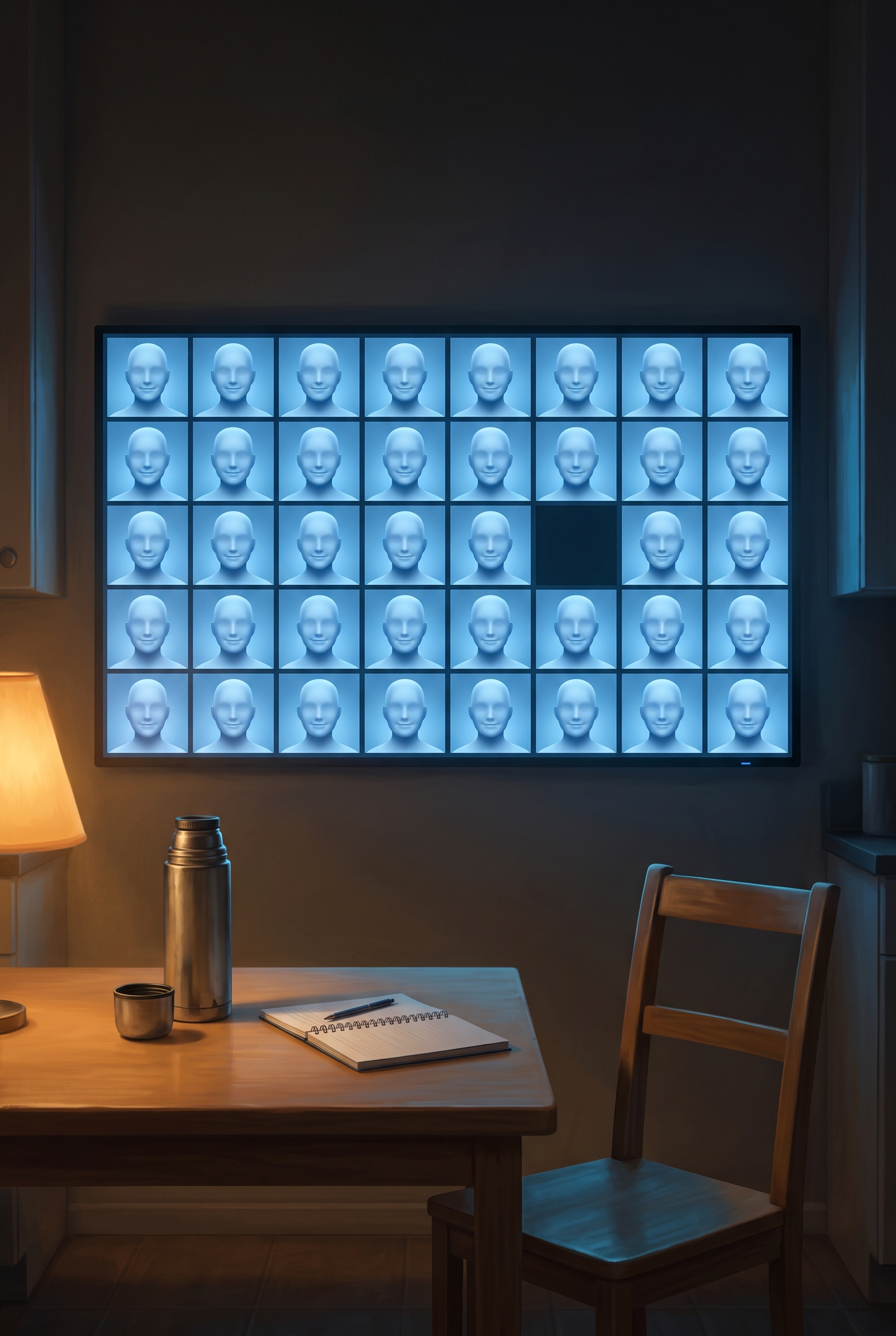
Standby
The thing nobody tells you about being a cover is that you still get dressed.
Standby — Synopsis
Margo Ivey has been an understudy at Maumee Opera for nineteen years, which mostly means getting dressed, signing the callboard at half hour, and listening to somebody else sing her part through a monitor speaker. She has gone on exactly once, in 2009, and nothing came of it. This November she is covering Tosca for Ilona Béres, a sixty-one-year-old Hungarian soprano who was a considerable name at the Met in the nineties and now takes regional dates on her way down. Béres has been marking in rehearsal for two weeks and nobody has dared ask why. At the end of act one, going for the optional high B-flat on Tosca's exit, she reaches the note and finds nothing there. Margo, who has spent three weeks listening to this woman closely enough to know where she breathes, is the only person in the building who hears it.
In the eighteen minutes of intermission, Béres makes an offer that is not the one the job description promises. She has a vocal fold paresis that will not improve, she has been genuinely indisposed twice in thirty-four years, and she refuses to let her career end with a stage manager announcing a refund to nine hundred people in Ohio. She does not want Margo to replace her. She wants Margo to sing from the wing while she acts the role in the light, because what she needs out there is not a substitute but somebody who knows exactly where she breathes. The stage manager says no, the conductor overrules her, wardrobe cuts open Margo's own skirt with a pair of shears, and the second act goes up.
It works. Margo sings "Vissi d'arte" into a hole in the world, unable to hear herself, watching for the small hitch in Béres's left shoulder that tells her when to take the breath, and the house holds still for a full second before the applause arrives. Béres takes one line back for herself: the near-spoken bar over Scarpia's body, the one that wants no voice at all, and delivers it in a cracked ruin that is the best twelve seconds in the building. Then she takes her bows alone, does not gesture to the wings, and tells Margo on her way past that tomorrow they will come for her instead, and that she should learn the difference. On Sunday, Béres does not come in. There is a four-line email with a flight number in it, six hundred people in the house, slush on Adams Street, and a stage manager's flat voice in Margo's ear saying "Standby, Tosca."
Standby
Story
The thing nobody tells you about being a cover is that you still get dressed.
Not in costume. Covers don't get costumes at Maumee Opera. Pauline has eleven principals and a chorus of thirty and a wardrobe budget that would humiliate a high school, so what you get instead is a line in your contract reading appropriate attire, present in the building. So you put on something you wouldn't mind being photographed in. Stockings. Shoes you can stand in for four hours. You sign the callboard at half hour, and then you go sit in a room on the second floor with a monitor speaker bolted above the door and listen to another woman sing your part.
Nineteen years. I own two pairs of black pumps that have never once been outside that building.
People assume covers sit in the wings biting their knuckles, praying for a sprained ankle. We don't. There's a card game. There's a hot plate that Bird has confiscated four times and which reappears the way mushrooms do. Wendell Pruitt, who has been our Scarpia every time Maumee has done Tosca since the Clinton administration, brings a turkey sandwich and eats half of it in the second-act break between torturing a painter and being stabbed to death, and he will tell you, unprompted, that the mustard is from a place on Detroit Avenue in Lakewood that his mother went to.
I have gone on exactly once. April of 2009, La Bohème, the Mimì got a bad scallop at a place downtown that has since closed, and I sang from the second act on and got a paragraph in the Blade that spelled my name Margot. Nothing happened afterward. That's the part nobody puts in the movie. You sing the thing you've waited eleven years to sing, you sing it well, the stage manager buys you a beer at Manhattan's, and then on Monday you're back in the basement of Epworth United Methodist on Collingwood teaching a fourteen-year-old how not to sing through her nose.
So. November. Snow coming sideways off the lake and down Adams Street, and the Renfrew, which was a vaudeville house before it was an opera house and still smells faintly like 1928, full to about nine hundred of its eleven hundred and forty-two seats. Second performance of three. And upstairs in the number one dressing room, with the good mirror and the radiator that works, Ilona Béres.
You may not know the name. Béres, Metropolitan Opera, 1991 through about 2003, Hungarian, a Tosca that people who heard it still talk about in a specific way, lowering their voices like they're discussing an affair. She is sixty-one. She does five or six regional dates a year now, which is how a house in Toledo with a deficit gets a voice like that: you wait long enough and the great ones come through on their way down, and you put their name on the poster in a bigger font than the opera's.
She had been marking for two weeks.
Marking means singing at half voice, down an octave on the top, saving yourself for the performance. Everybody marks. Big singers mark constantly and nobody says a word, because what are you going to do, tell Ilona Béres how to run her instrument? Maestro Anselmi didn't ask. Davey Ocampo, our Cavaradossi, twenty-seven years old and doing his first one, was so relieved not to have her full voice aimed at him across the sitzprobe that he nearly wept.
I asked. Once, in the greenroom, week two. She was doing the crossword in pen.
"Are you all right?"
She didn't look up. "Are you hoping?"
"No."
"Everyone hopes. It's not a sin. It's the job." She filled in seven across. "I am saving myself. Sit down, you're blocking my light."
So I sat down and we did the crossword, and she was better at it than I am in her fourth language, and that was the whole conversation until the second night.
Here's what I want you to understand about being somebody's cover. You don't watch them. You listen to them, for weeks, at a level of attention that no critic and no husband and no voice teacher has ever given anybody. I know where Ilona Béres breathes. I know she takes the non feci mai male phrase in one and that she has always taken it in one, on three different recordings across twenty years, and that she has a little hitch of the shoulder before she does it, like a woman hefting a suitcase. I know she pulls the E-flats slightly under and then corrects, which is not a flaw, it's a color. I could have picked her voice out of a hundred voices through a wall.
Which is why I was the only person in that building who heard it.
End of act one. Tosca's exit, the jealousy business about the portrait, ma falle gli occhi neri — make her eyes black — and there's an optional high B-flat there that some people take and some people don't, and Béres takes it, has always taken it, took it Friday.
Saturday she went up for it and there was nothing there.
Not a crack. A crack would have been fine, a crack is a Tuesday. This was a hole. The sound went up and arrived at the place where the note lives and the note was not home, and she covered it with the most beautiful, expensive, sixty-one-year-old technique I have ever heard applied to a piece of damage, turned it into a kind of spoken flourish, and got off the stage, and nine hundred people applauded, because the orchestra was loud and the Te Deum was starting and Wendell was already out there with the whole cardinal's procession stacking up behind him.
I was in the second-floor room with a paper cup of the world's worst coffee. I put the coffee down. I don't remember standing up.
She was in the hallway outside number one when I got downstairs, still in the red act one gown, holding the door frame with one hand, and she looked at me and she knew that I knew, and she stopped holding the door frame.
"Come in," she said. "Not you, Pauline. Five minutes. Go count something."
The number one dressing room at the Renfrew is nine feet by eleven and has a window that faces the loading dock. There was a bottle of mineral water and a steamer and a photograph of two young men taped to the corner of the mirror. She sat down on the bench and looked at herself with an expression I would describe as professional.
"Paresis," she said. "The left fold. Since August. It does not come back at my age, they tell me, and they have told me in two languages so I will not argue." She turned the water bottle around. "Friday I had it. Tonight I do not. Tomorrow I will not."
"Ilona."
"Don't." She said it without heat. "Here is what happens now, and you will tell me if I am wrong, because you are the only person in this building who is not an idiot. In eighteen minutes that woman with the clipboard goes out in front of the curtain and says that Madame Béres is indisposed. Yes?"
"Bird. Yes."
"And the house makes the noise. You know the noise."
I knew the noise. It's a groan with a refund in it.
"And that is the last thing," she said. "Do you understand? Not the Met in 1996. That. A woman with a clipboard in Ohio, and nine hundred people groaning, and then somebody writes it down somewhere and that is the end of the sentence about me." She finally looked over. "I have been indisposed twice in thirty-four years. Both times I was actually dying. I am not doing it for a paresis."
"So what do you want?"
"You sing it."
"I'm the cover. That's the entire idea of a cover. I go on, you sit down, everyone's fine."
"No." She stood up, and the red gown made the sound it makes. "You sing it from the wing. I will be on the stage. I will do everything I have done for thirty-four years except make the sound, and the sound will come from you, six feet away in the dark, and nobody out there will know or care, because they do not hear with their eyes but they think they do."
I laughed. It came out ugly.
"You want me to be your dubbing track."
"I want," she said, "somebody in that hole in the wall who knows where I breathe."
And that was the thing. Because she was right, and she knew she was right, and she had known for two weeks exactly how much attention I'd been paying, which meant she had been paying attention to me paying attention to her, and I had never once considered that.
There were eighteen minutes. There were, by the end of it, six.
Bird said no. Bird, Roberta Byrd, thirty-one years of calling shows, said no with her hand over the headset mic so the booth wouldn't hear, and then she said the union word, and then she said it twice more, and Maestro Anselmi came up the stairs in his tails going what, what, what, and Davey Ocampo found out and had to sit on a road case and put his head between his knees because he was about to be murdered by a man whose wife would be sung by a woman in the wings. Wendell wandered over with the sandwich and said, with his mouth full, "Sure, why not," which I have thought about a lot since.
What broke it was Anselmi. He went very quiet, which he does not, and he said: "Margo. Can you follow my hand from the wing?"
"Downstage right, I can see you over the proscenium line if I stand on something."
"Then we will put you on something."
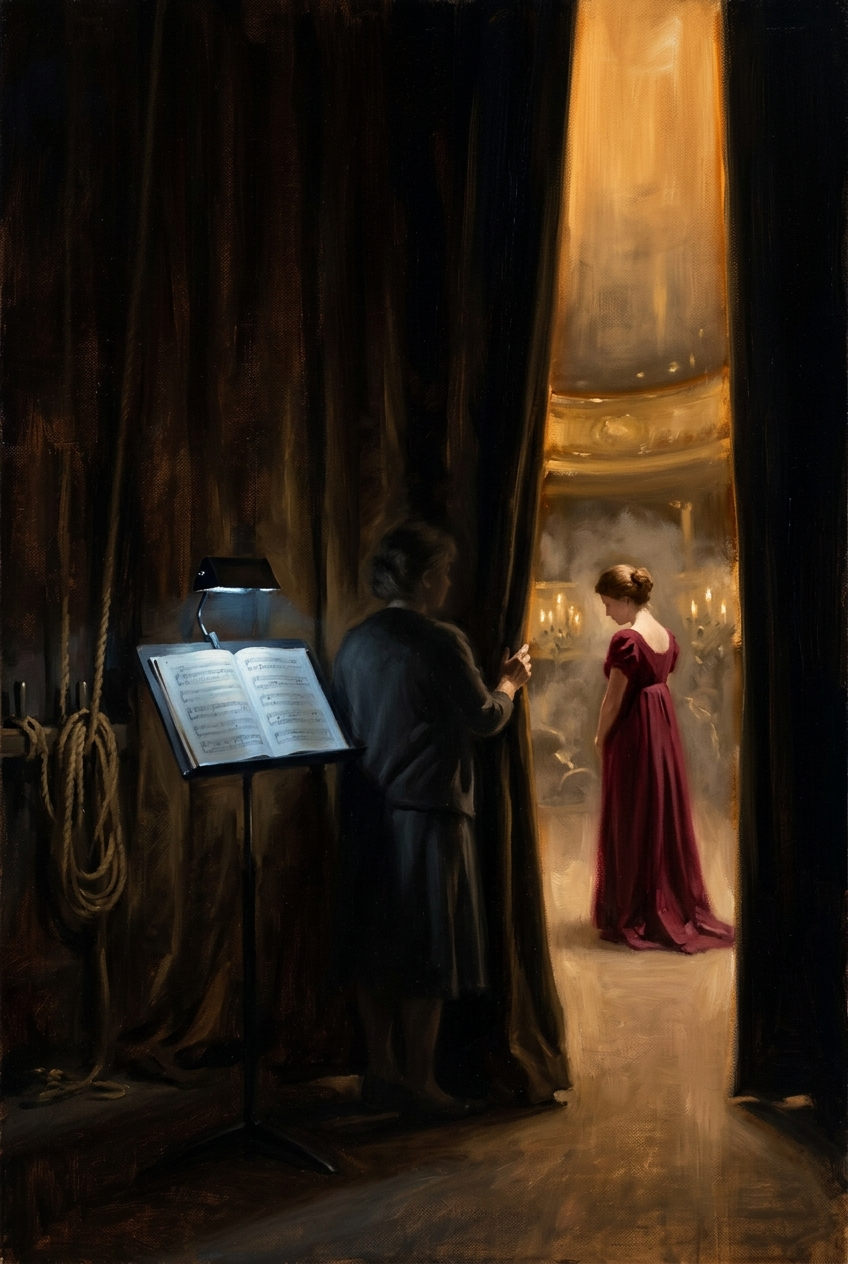
Pauline found a music stand. The electrician taped a piece of blue gel and then, when that was too bright, a piece of cardboard over a little clip lamp, and gaffed the whole assembly to the stand so no light would leak onto the stage. Bird moved the act two cue desk four feet so I'd have the sightline, which meant she called the entire act with her body twisted like a corkscrew, and she did it without mentioning it, and I have not forgotten that either.
And Pauline, God love her, took one look at me in my black skirt and my good building shoes and said, "You can't sing that in a waistband," and cut the side seam of my own skirt open with her shears, right there in the wing, and safety-pinned it loose.
The board came up on act two.
Here is what I have never been able to explain to anyone who wasn't there. I have sung Tosca in a church basement, in a studio, in my car on I-75, into a corner of my kitchen with the dog looking at me like I'd betrayed him. I had never sung it into a room with nine hundred people in it. And a wing is not a room. A wing is black masking and a fire curtain and a rope rail and the smell of dust cooking on a lamp, and the stage is eight feet to your left, hot and gold and full of a woman in a gown, and the sound you make goes out past the proscenium and just leaves, out over the pit, out into the dark, and none of it comes back to you. You can't hear yourself. You are singing into a hole in the world.
Ilona stood with her back three-quarters to me the entire act. She had worked it out in eleven minutes: every piece of blocking adjusted so that her face was never full front when the sound was happening, so nobody's eye would catch the seam. She acted her way through Scarpia's whole disgusting proposition with her chin and her shoulders and the back of her neck, and I have never seen anything like it, and nobody else in that building was in a position to see it at all.
And then Anselmi turned the page and looked at me over the top of his glasses and Vissi d'arte started.
Two clarinets. The little sigh in the strings. And Ilona sank down onto the floor the way she has sunk down onto that floor since before I had a mortgage, and I watched her left shoulder, and there it was, the hitch, the woman with the suitcase, and I breathed where she breathed and I sang.
Vissi d'arte, vissi d'amore. I lived for art, I lived for love. I never did harm to a living soul.
I'm not going to tell you it was the greatest thing anyone ever heard, because I don't know, because I couldn't hear it. I know I had the non feci mai in one. I know that when I came off the B-flat at the end I had more left than I expected and I didn't spend it, because she wouldn't have. I know that the little kid who runs props, whose name I am ashamed to say I have never learned, was standing frozen behind me in the dark with a tray of candlesticks and his mouth open.
And I know that when it was over the house did not applaud right away. There was a second of absolutely nothing. And then it came in like weather.
She stayed on the floor through it, which is correct, and I stood at a music stand in the dark eight feet away and could feel my own heartbeat in the roof of my mouth, and I thought, with a clarity that frankly embarrasses me: nineteen years, and the applause is for a gown.
Then Wendell came back with the safe-conduct and we had a murder to do.
The knife is on the supper table. It's a real knife, dulled, and the business is that Tosca sees it while he's writing. She takes it. He comes at her. She puts it in him and says the line about this being Tosca's kiss, questo è il bacio di Tosca, and I sang that, and Wendell went down like a wardrobe falling over, which is how he has always done it and which always gets a gasp.
And then there's the line after. When she's standing over him. E avanti a lui tremava tutta Roma. And before him, all Rome trembled.
Puccini barely sings it. It sits almost flat on the pitch, close to speech, the least operatic bar in the whole opera, and every Tosca in the world does something different with it.
Ilona did it herself.
Nobody told her to. She had no cue, we had made no plan, and she opened her mouth eight feet from me and said it in that ruined voice, low and dry and cracked right through the middle like a floorboard, and it was the best twelve seconds in the building that night and possibly that decade. Because that line doesn't want a voice. That line wants a woman who has just done something she cannot undo, and there is no technique on earth that gets you there faster than actual damage.
I had my mouth open to sing it. I closed it.
Act three, Castel Sant'Angelo, snow apparently still coming down outside on Adams Street, and Davey Ocampo sang E lucevan le stelle better than he had all week because he was terrified, and then the mock execution that isn't mock, and then Tosca goes up the parapet steps and over.
The parapet at the Renfrew is nine feet high. Behind it is a crash pad, an actual gymnastics mat, and two stagehands who hold a flashlight pointed at the landing zone so the soprano can see where she's going in the blackout.
Her last line is O Scarpia, avanti a Dio. O Scarpia, we meet before God.
I sang it into the dark with the fire curtain rope against my hip and she went over the wall on the last syllable and the orchestra did that enormous vulgar wonderful thing Puccini does at the end, and the lights went out, and it was done.
I got to the crash pad before the applause finished. I don't know why. She was flat on her back in nine feet of shadow with her wig half off and her chest going, and the two stagehands had melted away the way stagehands do.
She didn't sit up.
"Nineteen years," she said, to the grid.
"Give or take."
"You should have been meaner."
I crouched down. My skirt was pinned and my knees are fifty-four years old. "To who?"
"Anybody. Pick." She got an elbow under herself. "I was a cover. Nineteen eighty-nine, Budapest, and the woman got sick, and I went on, and the next morning I telephoned every person whose number I had and I was not kind about it." She held out a hand and I hauled her up, and she was lighter than I expected, the way people are. "You went back to your church basement."
"It's a good basement."
"I am sure it is." She put her wig straight. Out front, Bird's voice on the deck: bows, bows, places for bows. "You will be angry with me in about four minutes," Ilona said, "and you should be."
She went out and took them alone.
I want to be honest about this. I stood in the downstage right wing with the taped-up lamp still glowing on the music stand and I watched nine hundred people stand up for a woman who had not made a sound for two hours except twelve seconds of wreckage, and it went through me like a hot wire. She did not gesture to the wings. She did not bring me out. She took the flowers and she did the thing with the hand on the heart and she got three calls, and Bird finally killed the houselights to make them stop.
And walking off she passed within a foot of me and said, without slowing down, "Tomorrow they come for you and not for me. That is better. Learn the difference."
Which is a hell of a thing to say to somebody and then go get in a car.
She didn't come in Sunday.
There was no voicemail, no note, no crisis, no announcement. Her assistant emailed the general director at 9:40 in the morning to say that Madame Béres had a flight and regretted. That was the entire document. I have seen it. It is four lines long and one of them is the flight number.
The matinee sold about six hundred, because it was Sunday and the snow had turned to that gray slush that makes people cancel things. The Chicago producer who had been out front Saturday, the one everybody had been whispering about all week, was not there. Wendell brought a sandwich. Pauline cut a gown down two sizes in four hours and swore at it continuously, and it fit me badly in the shoulders, and I did not care, and you couldn't see it past row six anyway.
Bird ran the calls like she runs everything. Half hour. Fifteen. Places.
And then that voice in my ear, the one I have heard through a headset and a monitor speaker and a stage door for nineteen years, flat as a parking lot, no ceremony in it at all, because there is never any ceremony in it and that is the whole point of her:
"Standby, Tosca."
I put my hand on the masking. Eight feet of black, and past it all that gold.
"Standing by," I said.
"And Tosca," Bird said. "Go."
More from Short Stories