The Spun-Sugar Horse
Josie Calloway had frosted close to four hundred wedding cakes in her life, and she had learned that the topper always arrived last, in its own box, handled like something with a pulse.
The Spun-Sugar Horse — Synopsis
Third-generation baker Josie Calloway is building the biggest wedding cake of the year in Miller's Ford when the Historical Society loans the bride an antique cake topper: a carousel horse cast entirely in spun sugar. Josie recognizes it instantly from a photograph hidden in her grandmother Dot's recipe box, a picture of Dot at a 1985 bake-off holding the very same horse, one hand raised in triumph and the other hidden out of frame. Dot won't explain why the topper is hers, only that it isn't the Historical Society's to lend, and she hasn't spoken to her onetime best friend and baking rival, Mavis Tibbett, in over forty years.
Digging deeper, Josie finds an unsent letter from 1985 tucked beneath the photograph: Dot's own topper cracked the night before the contest, she borrowed Mavis's identical twin off her porch meaning to swap it back before morning, and the town's judge, Eugenia Praxton, caught her holding both horses at midnight and decided what she'd seen before Dot could explain. The rumor of sabotage reached Mavis before Dot's apology did, and the friendship never recovered. When Josie brings the letter to Mavis, she learns Mavis has her own piece of the truth: Eugenia's diary, inherited and unread for years, admits she never gave Dot the chance to defend herself and regretted it in private for the rest of her life.
With the wedding two days away, Josie maneuvers the two elderly women into the same room, and it's not a scheme that finally closes the gap, just an early morning, two cups of coffee, and the four sentences that should have been said in 1985. Dot and Mavis lift the horse onto the wedding cake together on Saturday, the rift mended not by revelation but by two people finally asking each other to their faces instead of deciding things about one another from a distance. A warm, briskly plotted small-town mystery about a forty-one-year misunderstanding, and the particular stubbornness of people who would rather keep a secret forever than risk being wrong out loud.
The Spun-Sugar Horse
Story
Josie Calloway had frosted close to four hundred wedding cakes in her life, and she had learned that the topper always arrived last, in its own box, handled like something with a pulse. So when Faye Praxton set a crate the size of a bread loaf on the bakery counter at eight in the morning and said the Historical Society was "just thrilled" to loan it for Cordy Tibbett's wedding, Josie expected brass. Maybe porcelain doves. People liked doves now.
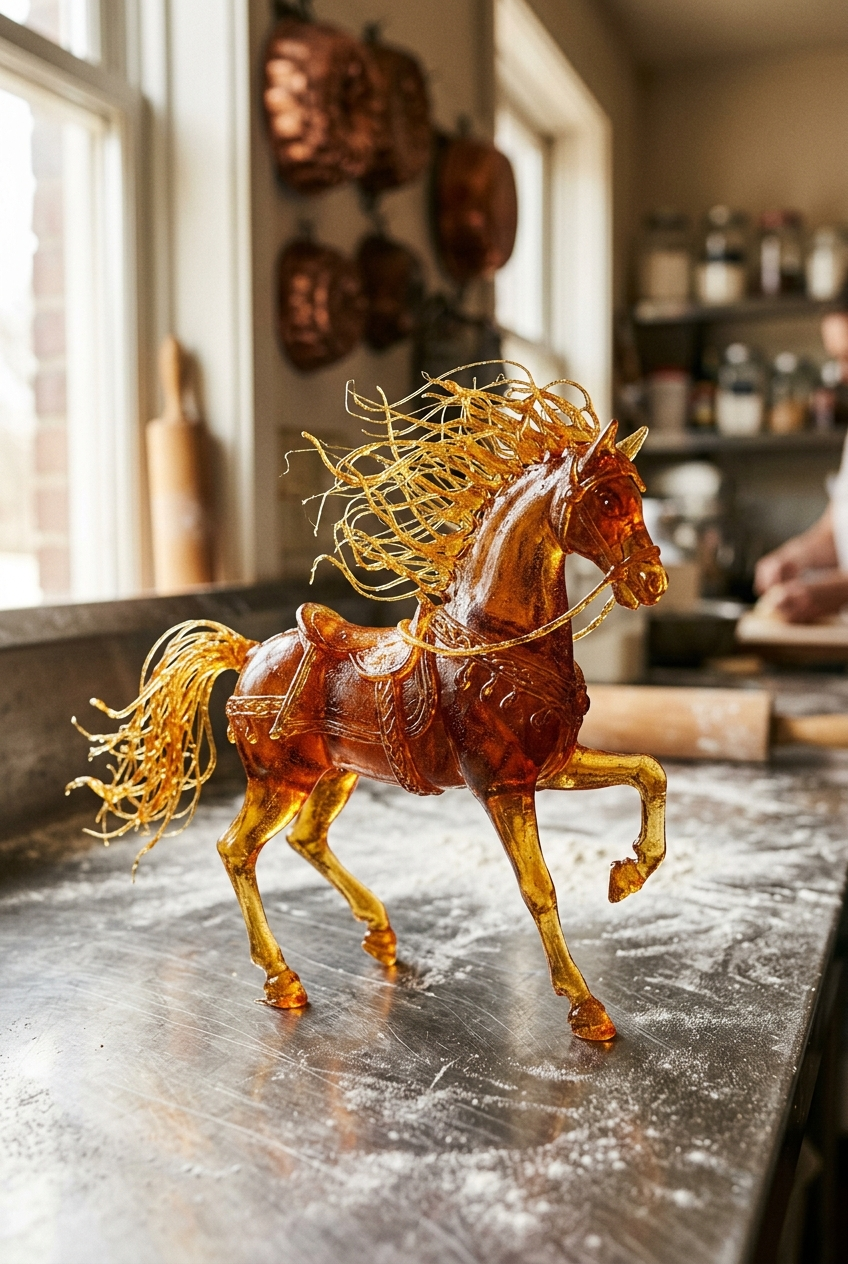
It was a horse. A carousel horse the length of her hand, cast whole in spun sugar gone the deep amber of old varnish, its mane a frozen storm of threads no thicker than fishing line, one foreleg lifted mid-gallop. Under the shop's fluorescents it looked less like candy than like something that had been alive once and caught by cold instead of death.
Josie had seen it before. Not behind museum glass. In a photograph rubber-banded to the bottom of her grandmother's recipe box: a young woman at a 1985 church-basement bake-off, cake held high, this exact horse rearing off the top of it, one hand raised in triumph and the other kept carefully out of frame.
"Careful," Faye said, misreading the pause as awe rather than recognition. "Sugarwork that old is basically glass. My grandmother kept it wrapped in wax paper for forty years."
"Your grandmother," Josie repeated.
"Eugenia Praxton. She judged the county fair for two decades. This piece came to the Society with the rest of her effects in the nineties, a 'found in storage' donation, the accession card says. Nobody's ever been sure where it started out." Faye smiled the bright, slightly anxious smile of a woman who had grown up being told her grandmother's legacy needed defending. "Cordy specifically asked for it. Sentimental value, apparently, though for the life of me I can't think why a horse belonging to my family would be sentimental to hers."
Josie could think why. She just didn't have the first idea how to say it before nine in the morning to the person whose bakery board Faye also sat on.
"I'll keep it in the walk-in until Saturday," she said instead. "Cold and out of the light."
"Perfect." Faye paused at the door, coat half on. "Your grandmother still doing the little iced roses for the top tier? Cordy's mother swears by them."
"She'll do the roses," Josie said, and did not say: she is going to take one look at this horse and either laugh or throw something, and I genuinely don't know which.
Dot Calloway was eighty-two, four foot eleven in her orthopedic clogs, and had run Calloway's Bakery for fifty-one years before handing the ovens to her granddaughter and keeping, by unspoken treaty, exactly two jobs: the buttercream roses and the right to criticize everyone else's crumb coat. She came in at eleven, as she did most days, ostensibly to check the wholesale bread order and actually to needle Josie about whatever Josie had done differently that week.
Josie had the horse out on the steel table when Dot walked in, turning it under the light with the careful two-finger grip you'd use on a soap bubble.
Dot stopped in the doorway. She did not gasp. She did not drop anything. She set her purse down on the flour bin with the exact controlled deliberateness of someone putting down a weapon before a search, and said, "Where did that come from."
"Faye brought it. It's the Society's. Cordy wants it on top of the wedding cake Saturday."
"No," Dot said.
"It's already on the invoice, Grandma."
"Then take it off the invoice." Dot had not come one step closer to the table. She was looking at the horse the way you'd look at a photograph of someone you'd buried. "That's not the Society's to lend."
"Whose is it, then?"
"Mine." Dot picked her purse back up, hooked it over her arm like a woman leaving a room she had decided not to be in anymore. "Or it was, before somebody decided otherwise. Tell Faye to bring back her own grandmother's dishware and leave mine alone."
"That's not an answer, that's a — Grandma." Josie came around the table. Dot was already at the door. "You realize you can't just say 'mine' and walk out. There's a photo of you holding this exact horse at some bake-off in 1985, I found it in your recipe box years ago and never asked because it wasn't any of my business, but it is my business now, because I have a hundred and forty guests coming Saturday and a topper I cannot in good conscience put on a cake if it's stolen property."
"It isn't stolen." Dot's hand was on the door. "It's mine. Those aren't the same sentence, Josephine, and I'll thank you to learn the difference before Saturday." The bell over the door rang, too cheerful for the moment, and she was gone, walking fast for a woman with two replaced knees, down toward the corner where Fig Street met Orchard and neither of them, Josie realized, led anywhere near her grandmother's apartment above the shop.
The recipe box lived on the highest shelf of the pantry, a battered green tin that had held index cards of icing ratios since before Josie was born. She'd inherited the habit of going through it whenever she couldn't sleep, less for the recipes than for her grandmother's handwriting, the small looping gs that hadn't changed since 1962.
The photograph was still rubber-banded where she remembered, curled at the corners, a strip of dried-out rubber crumbling against the paper. Dot, twenty-two, hair in the kind of high-teased style nobody's done a favor by bringing back, holding a two-tier cake with the horse rearing off the top exactly as it did now. Behind her, out of focus, another cake sat on the judging table, its topper missing, a raw pale patch of frosting where something had been.
Josie had always assumed the empty patch was just bad photography. She looked at it now for a long time.
Underneath the photo, deeper in the tin than she'd ever bothered to dig, her fingers found paper that wasn't a recipe card. A folded sheet, brittle at the creases, in her grandmother's hand, dated October the fourth, 1985. It began Mavis — and had never, judging by the lack of any envelope, been sent.
Josie read it twice standing up before she made herself sit down.
Mavis —
I know you won't read this and I'm writing it anyway because I can't sleep and the alternative is sitting here hating myself in silence, which I've tried and it doesn't work either.
You have to know by now that I didn't sabotage your cake. I took the topper. There's a difference and I understand if it doesn't feel like one to you right now, but here it is: mine cracked at ten o'clock the night before, straight through the near hind leg, four hours' work in pieces on my kitchen table, and I panicked. You and I made those horses the same week off the same instructions, from the same traveling man who taught us both the pull in his one afternoon in town, and they came out close enough that from six feet they might as well be twins. I told myself I'd borrow yours off your porch, set it on mine to buy myself till morning, and swap them back before either of us woke. I got as far as your porch. Eugenia Praxton was on her way home from the church and saw me standing there with a horse in each hand at midnight, and by the time I opened my mouth to explain she had already decided what she'd seen. She told the judges before I had breakfast. She told your mother before I'd finished the walk home.
I never got to tell you it wasn't your topper that cracked. It was mine. I never got to tell you I meant to give it back. By the time I found the nerve to knock on your door you'd already heard from three people that I'd wrecked your work out of spite because I was scared of losing to you, which is the one part of the whole ugly story that was true, and I think that's why you believed the rest.
I'm not asking you to forgive it. I'm asking you to know it. I kept the horse — yours, not mine, mine's in a drawer in three pieces where it's been for two weeks — because I didn't know what else to do with a thing I couldn't give back without saying out loud what I'd done, and every year I kept it a little longer it got harder to say anything at all. I don't expect that to make sense to anyone but me.
I'm sorry. For what it's worth, which I know by now is nothing, I have never once in forty years liked winning something more than I liked baking next to you.
— D.
Josie sat with the letter a long time in the small closed-in quiet of the pantry, the walk-in humming next door, and thought about a woman who had kept a stolen thing for forty-one years rather than say four true sentences to her best friend.
Mavis Tibbett answered her own front door before Josie finished knocking, which suggested she'd seen her coming from the front room window, which suggested Miller's Ford had already told her Josie Calloway had been asking around town about 1985.
"If you're here about the horse," Mavis said, "I already told Faye, it goes on Cordy's cake or the cake doesn't get a topper at all."
"I found a letter."
Mavis's face did something small and involuntary, there and gone, the particular flinch of a person braced for one thing and hit by another. She didn't invite Josie in. She came out instead, onto the porch, and shut the door behind her the way you'd shut it on a conversation you didn't want overheard by your own furniture.
"She never sent it," Mavis said. It wasn't a question.
"No."
"I know that because I found the same story a different way. Eugenia's diary came to me and Faye both when she died. We divided the boxes and never actually looked in either, and I finally opened mine two winters ago." Mavis's mouth pressed thin. "October the third: D. Calloway on the Tibbett porch at midnight, one horse in each hand. Told the judges what I saw before she could get her story straight. October fourth: Dot came by. Wouldn't let her past the step. Should have." She looked out at the street instead of at Josie. "Should have. Eugenia wrote that in her own diary and never once said it to my face while she was alive. She let me spend forty years thinking my best friend wrecked four hours of my work out of spite, when the whole time she had it written down in her own hand that she never even gave Dot the chance to explain."
"Did you know Dot's topper was the one that broke? Not yours?"
"I know it now." Mavis's laugh had no humor in it, just air. "I've had the actual horse, my horse, the one she really did take off my porch, sitting in a glass case at the Historical Society for thirty years, on loan from my own late husband's effects if you can believe the paperwork trail, and never once put it together that the one in Eugenia's storage was the twin. Two horses. One judge who saw a woman holding both and decided which story to tell before anybody asked her." She sat down hard on the porch step, all at once, like a woman whose knees had finally been told the news her head had known for two winters. "I've been angry at the wrong person since I was twenty-three years old, Josephine. I don't know what to do with that. It doesn't come with instructions."
"Cordy's wedding is Saturday."
"I know when my own granddaughter's wedding is." But some of the flint had gone out of it. Mavis looked up at her, and for a second Josie saw exactly what a photograph from 1985 would have looked like if someone had thought to take one of both women instead of just the winner. "What would you have me do. Walk over there and say forty years, never mind, put the kettle on?"
"I'd have you tell her the same four sentences she never got to tell you," Josie said. "She's eighty-two. So are you. I don't know how many Saturdays either of you are planning on having left, but I'd hate for the count to run out on a story that isn't even true."
Dot would not come to the phone, would not come to the door, and eventually, out of what Josie suspected was sheer bakery-schedule stubbornness, since Saturday's cake had four tiers and the roses weren't going to pipe themselves, came down to the shop at six the next morning, an hour before opening, expecting an empty kitchen and finding Mavis Tibbett sitting at the steel table with two cups of coffee, one already poured for her.
Josie, listening from the walk-in with the door propped an inch, in flagrant violation of every instinct she had about minding her own business, heard her grandmother go completely silent for four full seconds, which for Dot Calloway constituted a scream.
"I read Eugenia's diary," Mavis said, before Dot could turn around and leave. "Both entries. I know it was your topper that broke. I know you came to my door to say so and I wouldn't let you past the step." A pause, the particular kind that costs something to hold. "I've been furious at you for the wrong forty-one years, Dorothy, and I would like the coffee to still be warm when you decide whether you're going to sit down or not."
Nobody, as far as Josie ever established afterward, saw exactly how long her grandmother stood in the doorway of her own kitchen deciding. Long enough for the coffee to go from warm to merely drinkable. Not so long that Mavis got up and left.
What Josie heard, propped against the walk-in shelving with a case of butter going soft in her arms because she'd forgotten she was holding it, was her grandmother's chair scraping out, and then, after another silence: "I kept your horse forty-one years because I didn't have the nerve to knock a second time. You should know it's not even the same one that broke. That's in three pieces in a drawer upstairs I haven't opened since Reagan."
"I don't want the broken one," Mavis said. "I want the whole one on my granddaughter's cake Saturday, and I want you doing the roses, same as you were always going to, and I would very much like it, Dorothy, if you'd stop standing in doorways deciding things about me without asking first. It's a bad habit and you've had it since 1985."
"You could stand to work on your own," Dot said, and it came out rough, not quite steady, and Josie realized with a small private lurch that her grandmother was, for the first time in Josie's whole memory of her, close to crying in front of another human being. "You never once, in forty-one years, drove over and asked me to my face."
"No," Mavis said. "I didn't. I'm asking now. Is that going to have to be enough?"
Josie set the butter down very quietly and went to go find something to do in the front of the shop that badly needed doing.
The wedding was, by the general consensus of Miller's Ford, the best one anybody could remember, and not entirely for reasons that had to do with the bride and groom, who were lovely and largely beside the point once word got around about the cake. Cordy cut the top tier herself, the spun-sugar horse lifted carefully aside first by two sets of hands, Dot's and Mavis's, working together with the unhurried, wordless coordination of people who had once learned the same pull of sugar from the same traveling confectioner on the same long-gone summer afternoon, and had simply spent forty-one years forgetting they still knew how to move around each other without looking.
Faye Praxton came up afterward, glass of champagne in hand, to ask Josie, carefully, the way you ask a question you're not sure you want fully answered, whether there was more to the horse's story than "found in storage," and Josie told her most of it, the true parts, leaving out only the four sentences that belonged to Dot and Mavis alone. Faye went quiet for a while, turning her glass, and then said her grandmother's diary was still in a box in her own front closet, unread since the funeral, and maybe it was time she opened it too.
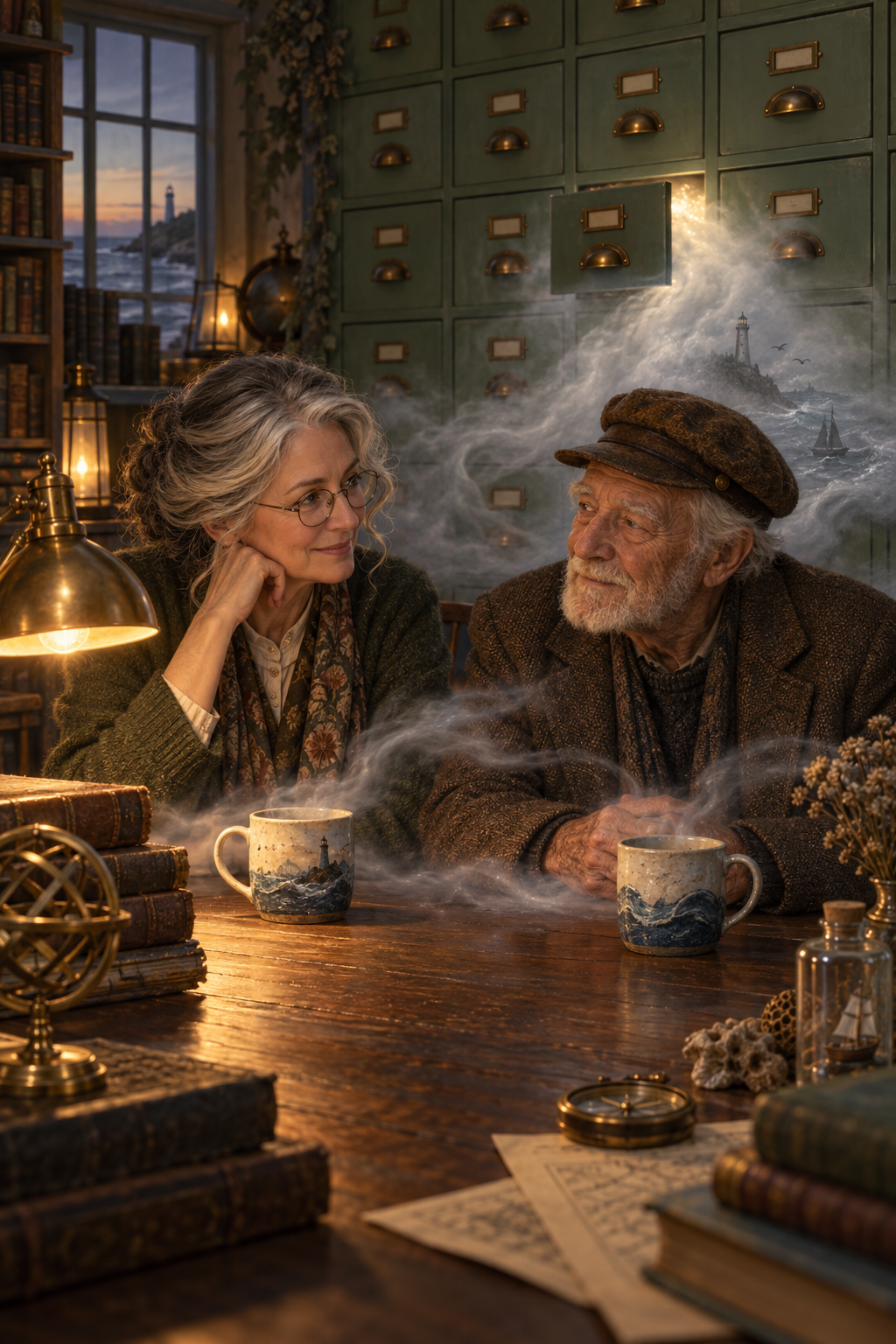
Later, when the tables had mostly cleared and somebody's uncle had gotten the band to play one more slow number than the schedule called for, Josie found her grandmother and Mavis sitting together at the edge of the dance floor, not dancing, just watching, two coffee cups traded for two glasses of the cheap good champagne, talking in the low unhurried register of people who had, against every reasonable expectation of either of their lives, gotten a second half of a conversation they'd assumed was over in 1985.
"You'll do the roses again next year," Dot was saying, not quite a question. "For the granddaughter after this one."
"If I'm still standing," Mavis said. "And if you've learned to hold a piping bag properly by then, which after fifty years I have my doubts about."
"I taught you everything you know about a piping bag."
"You taught me everything you think I know," Mavis said, and Dot laughed, a real one, loud enough that two people at the next table turned around, and Josie stood at the edge of the dance floor with a tray of champagne she'd forgotten she was carrying and thought that whatever else came of Saturday, it had been worth every stolen sugar horse in the county to hear that particular sound come out of her grandmother again.
She still had the letter. She decided, watching them, that she'd give it back to Dot unread by anyone else, ever, folded into the same green tin it came from. Some things were worth keeping exactly where you found them, once they'd finally done their work.
More from Short Stories