The Long Grab
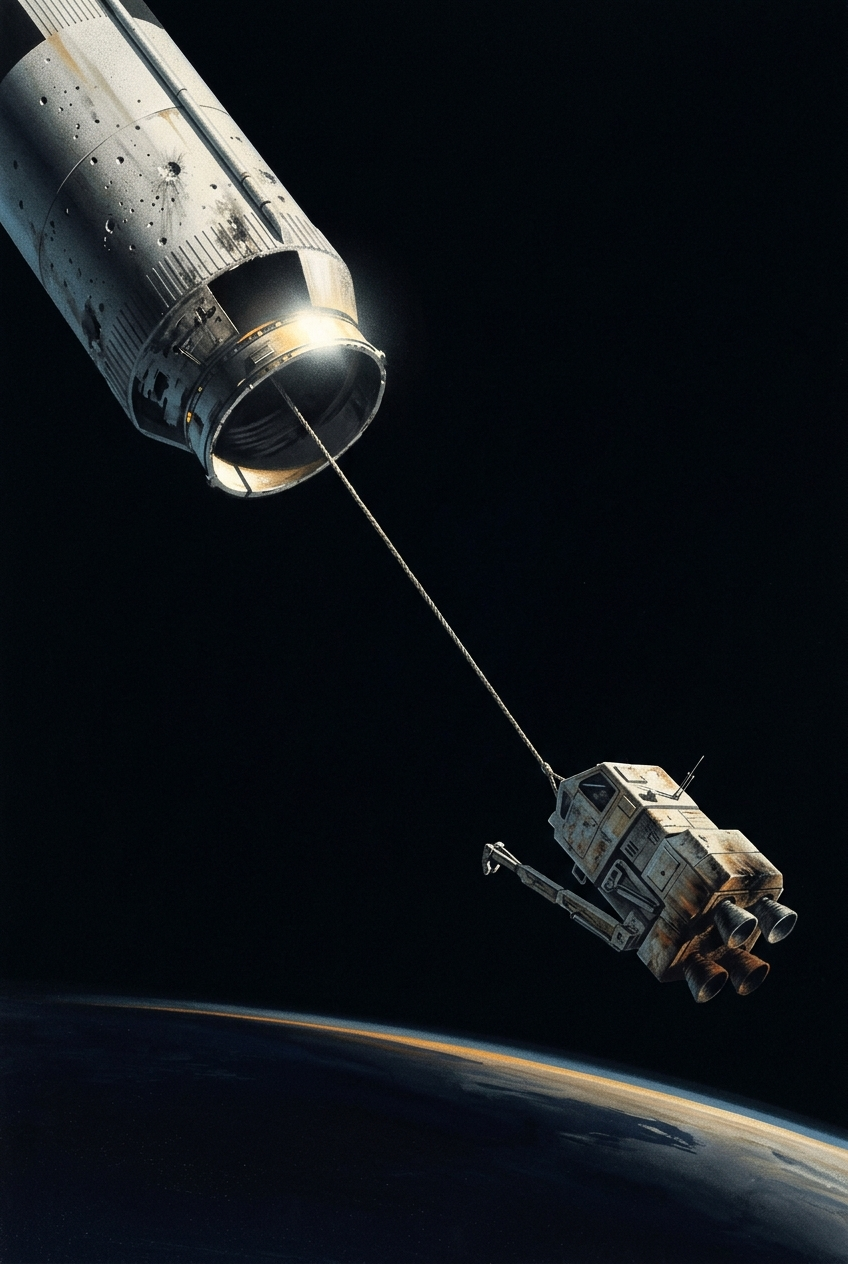
The booster had been dead for thirty-one years and it still would not hold still.
Synopsis: The Long Grab
Nadiye Brandt has spent twenty-two years flying a debris tug, hauling dead hardware out of the congested 780-kilometer shell for an insurance syndicate that would rather pay eleven million a tonne than eight hundred. On what is already scheduled to be her last flight, her cumulative radiation dose is at 98.6 percent of career limit, and her second-seat, Marisol Quiroga, has quietly taken a desk job neither of them will mention out loud.
Their target is a thirty-one-year-old booster stage that turns out to be tumbling four times faster than the tasking claimed. The safe procedure, forty minutes of contactless braking followed by a routine net capture, needs sixty-five minutes they do not have: a fresh fragment cloud from a collision over the Barents crosses their box in forty-one. Leaving means the booster gets hit, sheds thirty-eight thousand trackable fragments and a third of a tank of unburned hypergolics, and closes the shell for a century.
That leaves one option, a hard tether capture at the tumbling body's percussion point, which is in no manual because it killed two people aboard the Petrel in 2041. Brandt was the pilot on that flight and has not touched a live tumble since. She and Quiroga take the grab. It half works: the clamp bites clean, then the payout drum jams at sixty meters, and while Brandt flies the whipping arc alone from the front of a ship rated for a quarter of the load it is carrying, Quiroga feathers a glowing brake housing by hand on a shouted count. Somewhere around the seventh turn Brandt calls her by a dead woman's name. Neither of them mentions it.
They save the corridor with four minutes to spare, and Brandt comes home retired by the dose. The story ends on paperwork: the debris catalog demands a mandatory free-text maneuver name, and Quiroga does not type "net."
The Long Grab
Story
The booster had been dead for thirty-one years and it still would not hold still.
Brandt watched it grow on the forward plate. A matte grey cylinder eleven meters long, going end over end and rolling at the same time, the two motions arguing with each other. Sunlight came off the interstage collar about every two and a half seconds. A flick, a flick, a flick, like somebody in a dark room working a lighter that wouldn't catch.
"Tasking says one point one degrees per second," Mari said.
"Tasking was written by a man who's been dead nine years."
Mari ran it again anyway, because she was twenty-six and still believed an instrument could be talked out of a number. It came back four point two on pitch, one point eight on roll, and a precession the software labeled INDETERMINATE before offering, helpfully, to file it as a defect.
The Cormorant was nineteen years old and smelled like hot dust and the inside of a thermos. She had been built to catch things that had the decency to spin slowly: a Kevlar net on a spool, four hundred meters of braided tether, a payout drum with an eddy brake, and a drag kit the size of a suitcase that unfolded into ninety square meters of aluminized film and pulled whatever you bolted it to down into the air over about eighteen months. That was the whole business. Sorrel Underwriting paid eleven million a tonne to take mass out of the 780 shell because Sorrel had written policies on four hundred birds up there and would rather pay eleven million than eight hundred.
Mari was working the pre-capture form while they closed, because the catalog would not let you file one afterward. She did it the way she did everything, fast and one-handed, the other hand drumming three fingers on the seat frame. "MANEUVER_CLASS," she said. "Free text. Mandatory. Thirty-two characters."
"Put net."
"It always says net."
"Because it's always a net."
Mari typed net. "Somebody filed one as YEET in 2049. It's still in there. You can pull it up. Permanent record of the species."
Brandt did not answer. She was watching the collar come around and go away, come around and go away, and she was counting it without meaning to, the way you count a dripping tap.
You could net a tumbling object. That part was easy. The net didn't care. The trouble started about nine seconds later, when eight tonnes turning at four degrees a second discovered it was tied to a two-tonne tug by four hundred meters of rope. Then the rope was a lever and the tug was the short end of it.
"Brake standoff," Mari said, reading Brandt's silence correctly. "Eighty meters, forty minutes, eddy current takes the spin under one, then we net it like people."
"Forty minutes of brake. Then twenty-five to close, net, tether and kit."
"So sixty-five." Mari did not look up. "We've got ninety."
They had forty-one.
Bettencourt came up on the loop at 11:04, and Brandt knew from the first syllable, because Anneke Bettencourt had a voice like a hand on your shoulder and she only ever used it when she was about to take something away from you.
"Cormorant, Kerikeri. Stop your closure."
Brandt stopped her closure. Four hundred and ten meters, drifting in at nothing. "Go."
"Fresh CDM. Nine minutes ago a Delta-K fragment took a weather bird apart over the Barents. Cloud's still expanding and the trailing edge crosses your box in forty-one minutes. Probability of collision for your vehicle is four in ten thousand and climbing while I talk." A pause. "Recommend you clear to a lower shell and we retask next quarter."
Mari had already put the cloud on the plate, a smear of amber dots stretched along the track like a thrown handful of sand. Brandt looked at it and then looked past it at the booster, flick, flick, flick, and did the other arithmetic, the one nobody at Sorrel ever asked for.
"Anneke. What's the fragment yield on that thing if the cloud hits it instead of us."
The pause was longer than the light lag.
"Thirty-eight thousand over a centimeter," Bettencourt said. "Plus the hypergolics. It's got a third of a tank of unburned aerozine in it."
"And that closes the shell."
"Hundred and twenty years, best model."
"So we're not retasking it next quarter."
"Cormorant, I'm aware."
Mari had gone very still in the second seat. She was good, better than Brandt had been at that age, and Brandt could hear her running the same loop and arriving at the same closed door. Sixty-five minutes of work. Forty-one minutes of sky.
"There's another way to take the spin out," Brandt said.
She said it to the plate rather than to either of them, and she heard Bettencourt's breath go out over eleven hundred kilometers of hardware.
"No," Bettencourt said.
Mari looked over. "What other way."
"You don't de-spin it first. You let it de-spin itself into the tether." Brandt brought the boom up on the secondary, six meters of arm with a clamp head on the end of it, and woke the actuators. "Angular momentum has to go somewhere. Usually you bleed it off with the brake because that's slow and slow is safe. But you can dump it straight into the tether if you put the clamp on at the right place at the right instant. There's a point on a tumbling body where the local velocity goes to zero relative to you. It moves. You have to meet it."
"The percussion point," Mari said slowly.
"That's the textbook word."
"What's yours?"
"The long grab."
"Cormorant." Bettencourt's voice had changed. "Okie."
Nobody else called her that. Brandt let it sit there in the cabin for a second like something dropped on the floor that neither of them was going to pick up.
"Has anyone done it," Mari said.
Bettencourt answered instead, flat, official, reading it off something. "Petrel, twenty forty-one. Eight hundred and four kilometers. Crew of three, two fatal."
Nobody said anything. The pumps ticked, and aft the thermal loop clicked over and started running cold, because the Cormorant did not care about any of this.
Mari did the math. Brandt watched her do it: the year, the seat count, the words crew of three and two fatal, and then her eyes came around and Brandt met them and held them, because if you were going to fly with somebody you owed them your face when they worked it out.
"You were the third."
"I was flying."
"And it didn't work."
"It worked." Brandt's hands were doing the pre-grab on their own, throttle authority up, reaction wheels spun to bias, boom out of its cradle. "The brake locked instead of feathering. Put the boom back through the habitat wall at about eleven meters a second. Mikhel and Sunniva were on the aft deck stowing the net." She got the clamp head to answer, green, green, green. "The inquiry found the drum. Manufacturing defect, eight units recalled, one of them was ours. That's all in the file if you ever want to read it, and you won't."
"Brandt."
"Twenty-two years I've flown nets. I have never once put a clamp on a live tumble." She checked the boom clearance and found it, seven degrees, fine. "That's not modesty. That's just what the number is."
"Cormorant," Bettencourt said, "for the log, I am not authorizing a hard tether capture."
"Understood."
"I can't authorize it. The form doesn't have a box. That's a different sentence than the one you just heard."
"I know what sentence it was."
"There's one more thing and then I'll shut up." Papers, or the sound people make when they wish there were papers. "Your cumulative dose is at ninety-eight point six percent of career. You cross the anomaly at eleven twenty-two. You stay in that box for this and you come down retired, today, permanently, whether or not you were planning on one more."
Brandt looked at the number on her own panel, which she had been looking at for eleven weeks.
"Anneke," she said. "I come down retired anyway."
She did not look at Mari when she said it. Mari's name was not on the Q4 roster. Brandt had seen it three days ago, or rather had seen where it wasn't, in a crew manifest she'd opened for an entirely different reason, and had scrolled past twice to be sure, and had closed. Sorrel Underwriting hired out of the tugs. Everybody knew that. Sorrel paid four times better and the chairs were nicer and nobody at Sorrel had ever been asked to sign a dose waiver. It was the correct decision and Brandt intended to go to her grave without ever once saying so out loud.
"Mari," she said instead. "This is a two-person job and I'm not doing it with somebody who's along for it. Say go or say no."
Mari looked at the booster. Flick. Flick. Flick.
"How close do you have to be."
"Two point one meters at the collar."
"Jesus."
"Say go or say no."
"Go," Mari said.
She flew it the way you fly anything that will kill you, which is slowly and with your whole attention, in a state that has no name and doesn't feel like much of anything while it's happening.
Four hundred meters to eighty took six minutes. Brandt came in along the precession axis, which was the only part of the motion that held still long enough to be useful, and by sixty meters she could see the booster's skin properly for the first time: aluminum gone chalky, the paint scoured off the sunward face in a long comet-tail streak, thirty-one years of micrometeorite pitting that made it look sandblasted. Somebody had stenciled a serial on it in 2035 in a factory in Samara and the stencil was still there and Brandt would have bet money nobody in Samara had thought about it since.
"Collar presents one point one seconds out of every two point five," Mari said. "Zero-velocity point tracks up the collar about forty centimeters during the window. It's not a spot. It's a line."
"Give me the line."
Mari put it on the plate, a short green stroke crawling up the collar, appearing, vanishing, appearing. Her left hand lay flat on the seat frame and was not moving.
At twenty meters Brandt stopped and just watched it for four full cycles, and let the rhythm come into her hands. It was not a thing you could compute in the moment. You had to let the tumble get into your arms and then you had to move when your arms said so, which is a hell of a way to run an eight-tonne rendezvous and is also the only way anybody has ever done it.
"Eleven twenty-one," Mari said. "Anomaly in sixty seconds."
"Okay."
"You want to wait for it to pass?"
"No."
At eight meters the forward plate went to noise for a second and cleared, and the dose meter on her left started ticking up the way a taxi meter does in traffic, and Brandt did not look at it. Boom out. Clamp head open. The collar came around.
Four meters. The Cormorant's RCS fired in little coughs, hold, hold, drift down, hold.
Two point four. Two point two.
The collar came around and the green stroke lit and Brandt did not think anything at all, she just put her hand forward, and the boom went out, and the clamp came down on the lip of the interstage collar and bit.
The whole ship rang like a struck pipe.
"Contact hard," Mari said, and her voice was up an octave and perfectly steady, which Brandt would remember later as the single most impressive thing she had ever heard another human being do. "Clamp green. Tether paying. Brake at ten percent."
"Feather it up. Slow."
"Fifteen. Twenty. Spin's coming down, four point two to three point nine, three point six."
The booster turned and the tether came off the drum, and the Cormorant swung out and around on the end of it like a bucket on a rope, and all of that was supposed to happen. Brandt rode it with her hands loose. Three point one. Two point eight.
At sixty meters of payout the drum stopped.
It did not slow. It stopped, and Brandt felt the tether go hard through the whole frame of the ship, through the seat, through her back teeth, and the Cormorant came around on the end of it and the stars in the forward plate began to move sideways in a way they were not built to move.
"Drum's jammed," Mari said. "Brake's at twenty and it will not pay."
"Lateral one point four g," the panel said pleasantly. The Cormorant was rated for four tenths.
Brandt went to the RCS and started flying the arc. That was the only thing left: if the tether went hard over, past ninety, the lever would fold the ship, so she had to burn crosswise and keep the Cormorant out on the swing, chasing a line she could not see, on a ship that was screaming, while the fuel went down in gulps.
"Manual wheel's on the drum housing," she said. "Aft lock, port side, red, it's the only red thing back there."
"I know where it is."
"You'll be feathering by hand against sixty meters of loaded tether and it will try to take your fingers. Use the heel of your hand. Quarter turns. On my count and nothing else."
Mari was already out of the seat.
Then she was in the tunnel, and then she was gone, and Brandt was alone in the front of a ship that was being swung in a circle by something eight times its weight, flying with her hands while somebody else was back there in the dangerous part.
"At the wheel," Mari said. Her voice came thin through the intercom and there was a lot of noise behind it.
"On three. Quarter turn. One. Two. Three."
Something let go with a bang and the Cormorant lurched and the lateral came off half a g.
"Paying," Mari said. "God, it's hot."
"Again. One. Two. Three."
"Paying."
"Again."
"Paying." A gap, and breathing in it. "Brandt, the housing's glowing."
"How much."
"Dull red. I can see it through the glove."
"Then use the other hand. One. Two. Three."
They did it eleven times. Somewhere around the seventh Brandt lost the numbers entirely and was flying on nothing but the feel of the swing, and she heard herself say the count and then say a name, and the name she said was Sunniva.
The intercom did not say anything about that.
"Again," Brandt said.
"Paying. Spin's under one."
At one degree a second the drag on the drum finally did what drums do, and the rest of it went out gently over four minutes, the Cormorant and the booster settling into a slow shared wheel like two people who have stopped arguing and can't remember why they started. Brandt reeled in to forty meters. Mari came back up the tunnel with her hands shaking and both gloves scorched black across the palms and got the drag kit out on the boom and bolted it to the collar without being asked and without saying one word about anything.
Kit armed. Film deployed, ninety square meters of it going out silver and crinkled in the sun like a sheet shaken over a bed.
"Sail's out," Mari said. "Eighteen-month decay, nominal."
"Release."
The clamp let go. The booster went away from them, dead, docile, dragged, with a three-hundred-year problem reduced to a year and a half.
"Cormorant, Kerikeri." Bettencourt sounded like she had been holding something in her chest for a while. "Cloud's trailing edge in four minutes. Get out of there."
Brandt got out of there.
At 12:40 they were two hundred kilometers lower and coasting, and the ship had stopped making noises, and Mari sat with her ruined gloves in her lap and looked at them.
"Ninety-nine point four," Brandt said, to the dose meter. "Well."
"Is that it, then."
"That's it."
"Today was your last one."
"Today was my last one."
Mari nodded slowly. Then she pulled the panel over and opened the post-capture form, because the catalog would not let you not, and because there is nothing in the world so stubborn as paperwork that has outlived the people who designed it.
She went down the fields. Mass: 8,140 kg. Altitude at capture: 781.2 km. Method of disposal: passive drag. Crew: 2. Dose event: yes.
Then MANEUVER_CLASS. Free text. Mandatory. Thirty-two characters.
She did not type net.
Brandt watched her not type it. Mari sat with her burned hands over the keys for a while.
Then she typed: Aregui-Holt maneuver.
Brandt reached across and fixed it. Two r's, no u. Arregi. She had carried those two names for twenty-two years and had never once had to spell them, and it took her a second to be certain, and she was certain.
Then she sat back and let Mari hit the key.
The form accepted it. Somewhere on the ground a database wrote nineteen characters into a field it had been given for no good reason in 2031 and had been waiting on ever since.
"There's a Q1 tasking board," Mari said, to the panel, not to her. "Goes up Thursday."
"There usually is."
"I'll look at it."
Brandt did not say anything, which was the right answer. Outside the plate the terminator came up over the Barents and took the light off the water in one long stroke, and the Cormorant went into the dark ticking as she cooled.
Mari put her gloves in the waste sleeve and got out the checklist for the burn.
More from Short Stories