The Understudy
Design brief
In a 1970s London repertory theater where every witness is a trained actor, the only mystery harder than who killed Edmund is telling who's performing their alibi.
Date: 2026-07-06 Genre: detective mystery Platform: PC (Windows; keyboard & mouse, full controller support) Status: Concept
Target player
Fans of Disco Elysium and The Wolf Among Us who want investigation driven by psychological acuity rather than item collection. Players who loved L.A. Noire's interrogation premise but found its microexpression minigame too technical and sterile. Theater enthusiasts and readers of Patricia Highsmith or P.D. James who want a mystery with literary interiority. They are comfortable with slow, text-heavy games, they take notes while playing, and they find satisfaction in reading people — not solving physics puzzles. They want to feel perceptive, not just systematic.
Core loop
30-second loop: Observe an NPC's Performance State indicator and behavioral tells, choose a conversation option — push, accept, redirect, or stay silent — and watch how the character's state shifts in response. Decide whether to cash in a specific piece of evidence now or hold it for a more vulnerable moment.
30-minute loop: Build a contradiction between two witnesses' statements; investigate the physical space to rule out or confirm alibis; decode a page of Edmund's annotated rehearsal script to unlock a new conversation thread; update the Prop Room timeline with a correctly-placed object and read the revelation it unlocks. Each loop cycle closes one open question and opens two new ones, with the net effect of converging toward an accusation.
Systems
- Performance Meter: Every NPC exists on a real-time three-state scale — In Character (actively constructing a narrative), Cracking (emotional leakage breaking through), Raw (brief, genuine accessibility before defenses reassemble). The player reads behavioral tells: dropped theatrical register, topic avoidance patterns, prop fidgeting, involuntary tense shifts in speech. Timing an intervention correctly opens deeper conversation branches; misjudging it closes the witness for that scene.
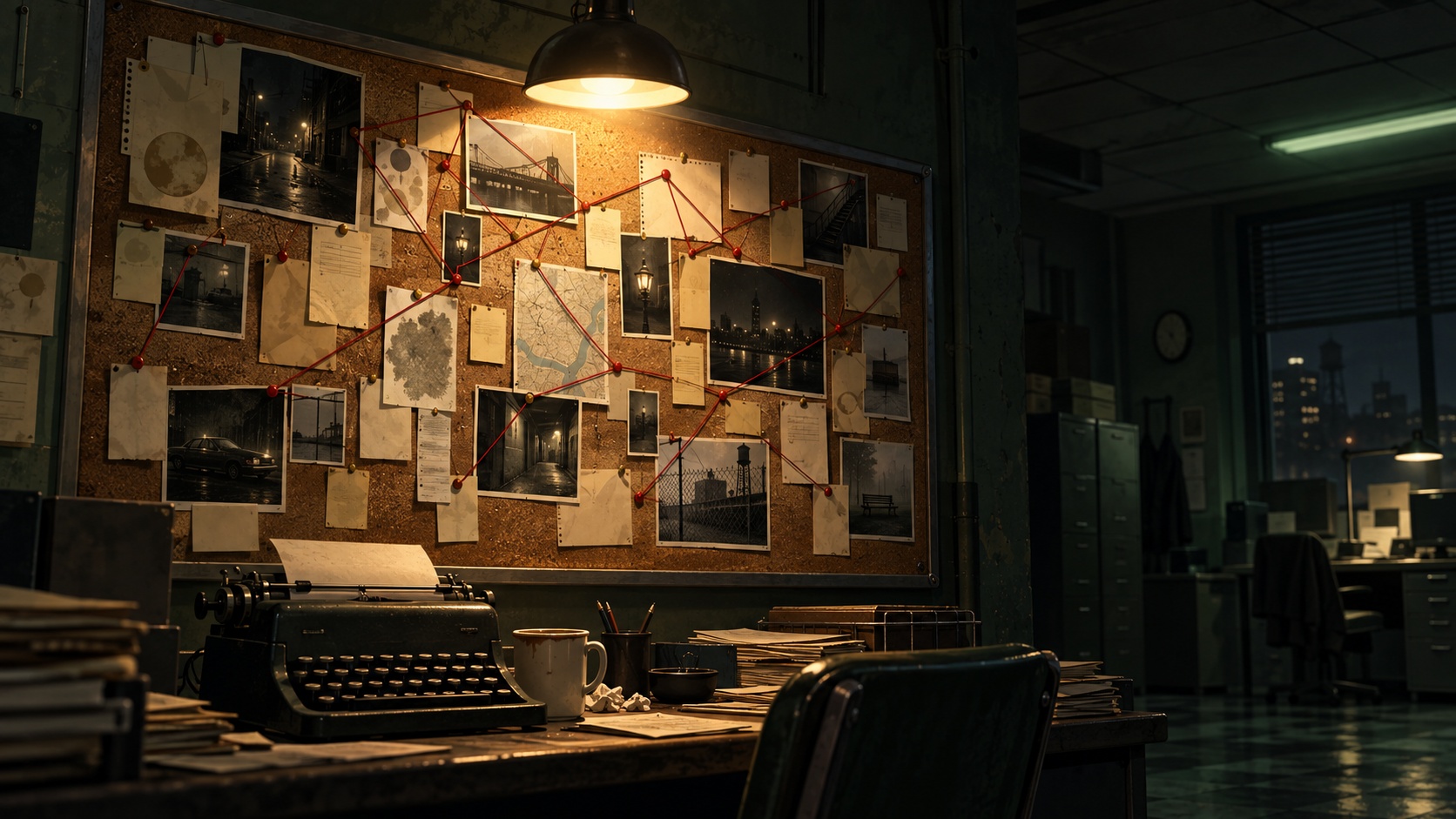
- Testimony Web: All gathered statements are tracked as nodes in a visual web. Contradictions generate tension lines between nodes; each unresolved tension is a lead. Resolving one tension triggers cascading reveals that unlock new threads with other characters, so the investigation never stalls — it accelerates.
- Prop Room Reconstruction: A spatial timeline puzzle in which players place props back into their confirmed pre-murder positions using prop-master cue sheets, blocking notes from Edmund's script, and witness testimony. Each correctly-placed object unlocks a deduction: the staging of the "accident" was deliberate, and each object placement narrows the pool of people who could have done it.
- Script Marginalia: Edmund's heavily annotated rehearsal script is recovered in fragments. His director's shorthand — blocking notation, casting asides, crossed-out rewrites — doubles as cryptic character assessments. Players learn to read his theatrical code to understand his suspicions about his own company, effectively using the dead man as a posthumous investigator.
- Reputation Economy: Constance's credibility as a journalist affects witness behavior. Publishing a speculation piece closes off two cast members permanently; sitting on a solid lead too long triggers the theater's director to authorize reopening, clearing the prop room and destroying physical evidence. Players must manage when to act, not only what to do.
- Backstage Geography: The Meridian's layout is evidence. Shared dressing room walls make eavesdropping plausible for some witnesses. The fly system above the stage requires two operators. Certain sightlines from the wings render specific alibis physically impossible. Players navigate the building and internalize its logic — the architecture is alibi-checking tool as much as it is atmosphere.
Progression
Act I — The Accident: The police believe Edmund fell and struck his head. Constance has two hours before the venue closes and the cast disperses. Players roam freely, building initial impressions. End condition: identify the first major contradiction that proves this was staged.
Act II — Opening Night Pressure: The theater's director wants to open tomorrow as scheduled. Evidence windows close as cast members barricade themselves in final rehearsal. Players must prioritize, using the Reputation Economy carefully. Mid-act revelation: Edmund's script reveals he had already identified his likely killer — and said nothing.
Act III — The Curtain Call: Constance confronts the killer in a private scene. The accused must perform their innocence one final time. The player identifies the single moment the performance cracks, selecting the correct behavioral tell from what they have learned about this character across the whole game. The game ends on Constance's article, its tone determined by how much the player discovered about Edmund's own culpability.
New Game Plus: A second playthrough adds a parallel perspective layer — Edmund's own observations and diary entries from the fortnight before his death, retrofitted into scenes the player has already cleared. This recontextualizes motive without changing the facts, offering a morally complex replay.
World & setting
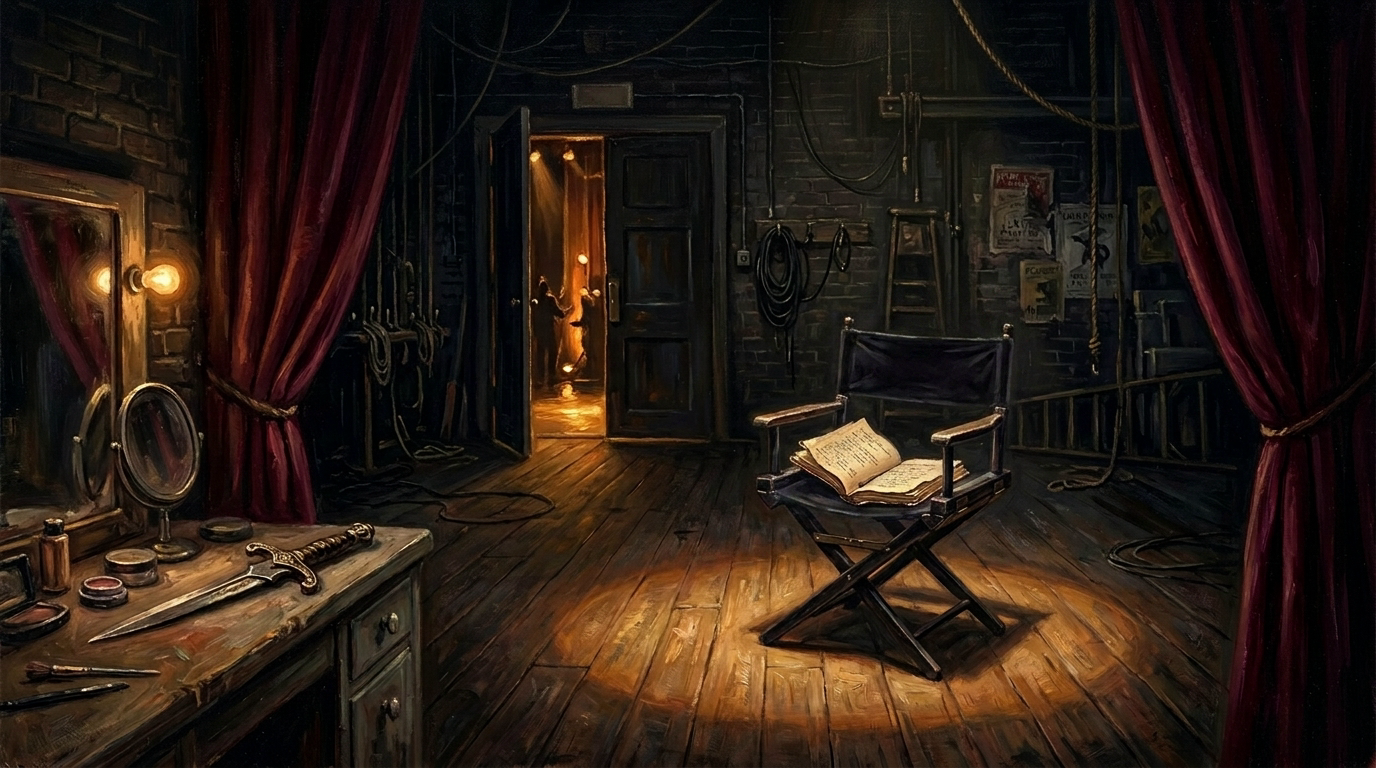
The Meridian Theatre, London, 1973. Edmund Hargreaves — 55, celebrated stage director and actor, known for his precision and his cruelty — is found dead in the prop room the night before opening a production called "The Inheritor," a drawing-room drama about a poisoning in an aristocratic family. The irony is not lost on anyone.
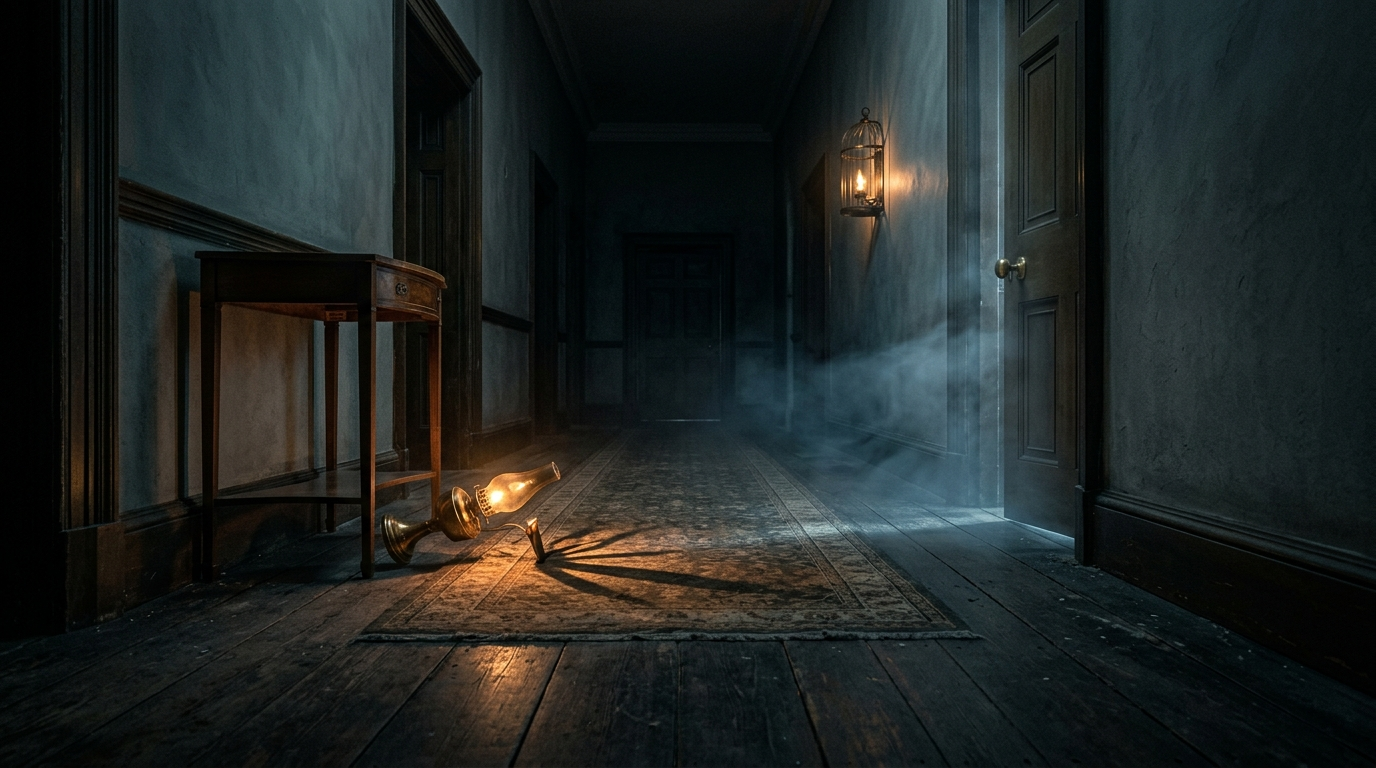
The theater is a closed world: three floors of cramped offices, dressing rooms with walls too thin for secrets, a flies gallery nobody likes to climb, a green room with a thirty-year-old electric kettle. The cast and crew are a repertory company — they have worked together for years, accumulated grievances, traded loyalties. The setting's art direction is warm amber footlights against velvet black, the controlled glamour of the stage contrasted with the clutter and grime of the wings. Tone is measured and literary — not gothic horror, not hardboiled noir, but the cool intelligence of a Highsmith novel, attentive to class, ambition, and the small violences people commit to survive inside institutions they cannot leave.
Differentiators
- Performance-as-Epistemology: The Performance Meter is not a minigame — it is the fundamental investigative premise. Every witness is both a potential liar and a professionally trained performer, which means the normal detective heuristic ("spot the liar") is insufficient. The player must distinguish between performing for Constance and performing for themselves: people lie to others, but also to protect a self-image they cannot afford to abandon.
- Theatrical Milieu: No detective game has been set inside the working backstage of a theater company. The setting generates a natural closed-room structure and a ready-made ensemble cast with legible, competing motives — jealousy over casting, artistic pride, ambition blocked by the victim — without requiring elaborate worldbuilding. The rules of the theater world do the work.
- The Director as Posthumous Detective: Edmund's annotated script as the primary physical artifact is a novel mechanic — the victim becomes an active intelligence source. Players essentially collaborate with the dead man to solve his own murder, which creates emotional stakes unusual for the genre.
- Intimacy Over Width: Eight to ten named characters, one building, one evening. Against the genre trend toward branching open-world investigations with case boards that sprawl across dozens of threads, The Understudy commits to depth of character over breadth of case. Every NPC has a complete arc; no character exists only to deliver a clue.
- The Moral Undercurrent: The killer's motive is entangled with Edmund's own documented cruelties as a director — the suppression of younger talent, the appropriation of credit, the casual exercise of power. The game does not exonerate the killer, but it does not permit clean catharsis either. Constance's final article can take multiple tones, each honest, and the player chooses which truth to foreground.
Monetization notes
Premium single-purchase at $18–22 on Steam, GOG, and itch.io. No early access — the tight, authored mystery would be damaged by incomplete-build exposure. One paid story DLC at $8–10 ("The Second Act") adds a cold case in a different theater company with a new cast, reusing the engine and all systems. The annotated script mechanic lends itself to a physical collector's-edition prop replica (a printed facsimile of Edmund's script pages) as a pre-order incentive — high shareability on social. Market opportunity: the detective game audience is demonstrably enthusiastic and purchasing (2025 was the genre's biggest year per PC Gamer's own retrospective); the $18–22 premium band for authored single-player PC mystery games is well-established by Her Story, Golden Idol, and similar titles.
Accessibility notes
- Fully remappable keyboard/mouse and controller bindings, including one-handed control profile
- Subtitles for all spoken dialogue with speaker labels, adjustable font size (small/medium/large/XL), and adjustable background opacity
- Colorblind-safe palette throughout: the Performance Meter communicates state via shape and icon, not color alone; all tension-line states use shape+pattern differentiation
- "Journalist's Notes" hint mode contextualizes what Constance already knows without revealing next steps — scaffolded, not hand-holding
- Screen reader support for all menus and UI overlays
- Scalable UI with percentage-based size adjustment
- No photosensitive content: no strobing, no rapid flashing; lighting is warm tungsten throughout
- Optional slow-mode for conversation timing (Performance Meter state changes happen at reduced speed)
- Director's Commentary mode on second playthrough, discussing design decisions without spoilers for first-time players
Risks
- Niche appeal from setting and pacing: The theater milieu and literary pace will limit mainstream discoverability. Mitigation: build the first 30 minutes as the most universally accessible content; run a Steam Next Fest demo; position as "if you liked Disco Elysium's character depth or Her Story's intimacy."
- Performance Meter subjectivity: Players may find the tell-reading feedback inconsistent, leading to frustration. Mitigation: provide multiple tell types (verbal, behavioral, physical, positional) so no single read is decisive; soft accessibility mode makes tells more pronounced; avoid any single-solution bottlenecks.
- Writing dependency: An ensemble-driven mystery lives or dies on the quality of twelve distinct character voices. Mitigation: hire or partner with an experienced narrative designer from pre-production; budget 6+ months for writing and iterative dialogue testing; playtesting focused on character believability, not puzzle correctness.
- L.A. Noire comparison fatigue: Players and press may reach for "it's L.A. Noire but in a theater" as a shorthand that undersells the design. Mitigation: demo aggressively and early; lead communication with the writing quality and moral complexity, not the mechanic label; position L.A. Noire as a proof-of-concept the genre is ready to evolve past.
- Scope creep in ensemble depth: Ten characters at the depth the design requires is genuinely ambitious. Mitigation: lock the cast list before writing begins; apply a consistent depth specification to every character simultaneously; cut ensemble members before adding complexity to existing ones.
6-week prototype plan
- Week 1: One character (Stage Manager Phyllis Arnott) and one dressing room scene in a placeholder environment. Implement the Performance Meter as a visible debug overlay with manual state-switching. Goal: does the core observe/time/intervene mechanic feel satisfying in isolation?
- Week 2: Add the Testimony Web system with three initial nodes. Build one contradiction between Phyllis and a second placeholder character. Goal: does resolving a contradiction through investigation feel like real deduction rather than inventory management?
- Week 3: Build the Prop Room Reconstruction puzzle for five objects with prop-master cue sheets as the primary clue source. Integrate one story revelation triggered by correct placement. Goal: does the spatial puzzle feel like investigation or like an adventure game fetch quest?
- Week 4: Polish the full Phyllis conversation arc — eight exchanges, all three states reachable, no dead ends. Add scratch voice acting for Phyllis's Raw-state dialogue only. Goal: does the character feel alive? Do players want to understand her?
- Week 5: Add a third character with a full arc; implement the Reputation Economy with a single triggered consequence (one witness closes off after a premature publication). Build the full Meridian ground floor layout with navigable rooms and confirmed sightlines. Goal: does the closed-room structure produce spatial deduction naturally?
- Week 6: Vertical-slice playtest — three characters, the Prop Room, two pages of Edmund's annotated script, and Act I's primary revelation. Playtest with 8–12 participants. Primary success metric: do players report feeling clever when the contradiction resolves? Secondary: do they want to keep playing?
Genre references
- The Case of the Golden Idol (Color Gray Games, 2022) — https://www.gamedeveloper.com/business/-the-case-of-the-golden-idol-i-used-frequent-testing-to-improve-its-mystery-solving — Scene-based deduction mechanics and the "aha" moment of filling in correct answers; informed the Prop Room Reconstruction puzzle's feedback design
- Her Story (Sam Barlow, 2015) — https://www.pcgamesn.com/best-detective-games — The power of a constrained, singular investigation tool; letting players construct the narrative feels more intelligent than prescribed paths; informs the Testimony Web's player-driven assembly structure
- DigiTales Interactive: Detective Game Design Problems — https://digitales.games/blog/detective-game-design-problems — Core analysis of story-vs-puzzle gating and the "many channels in, few channels out" solution; directly informs the Performance Meter's single-submission design and the Testimony Web's contradiction-resolution flow
- L.A. Noire (Team Bondi/Rockstar, 2011) — https://www.pcgamesn.com/best-detective-games — Established the interrogation-reading genre mechanic but was criticized for dependence on facial animation technology; The Understudy replaces microexpressions with behavioral/contextual/verbal tells that are designable and accessible without motion-capture fidelity
- Looking Ahead: 5 Mystery Game Subgenres for 2025 (Kinjo Goldbar, Mystery Game Dev Substack) — https://mysterygamedev.substack.com/p/looking-ahead-5-mystery-game-subgenres-for-2025 — Identifies dynamic interrogation as an underexplored subgenre where genuine novelty remains possible; The Understudy offers a non-AI version of dynamic conversation investigation grounded in theatrical psychology rather than procedural generation