Foxed & Found
Design brief
Run a fog-wrapped antiquarian bookshop in a harbour town — source forgotten volumes, restore them to life, and find the one person who needs each book most.
Date: 2026-06-29 Genre: cozy management sim Platform: PC (Windows; keyboard & mouse or controller) Status: Concept
Target player
The player who cried at the end of Spiritfarer, spent forty hours arranging shelves in Unpacking, and wishes Potion Craft had narrative stakes. They want a cozy loop that rewards curiosity and emotional attentiveness rather than optimisation. They read on the train. They're the type who lingers in second-hand bookshops longer than is practical. This is not a farming sim: there are no crops, no seasons-as-treadmill. The itch is curation, connection, and the quiet pleasure of getting exactly right the thing no one else noticed.
Core loop
30-second loop: A delivery crate arrives. Open it, flip through each book. Each volume displays its genre, era, condition tier, and a short excerpt — reading the excerpt reveals its hidden Resonance tag (Grief, Wanderlust, First Love, Defiance, Homesickness, etc.). Tag it, slot it into your mental catalog.
5-minute loop: One or two damaged volumes go to the Restoration Workshop. Three mini-game stages — cleaning (slow brush strokes over a grime overlay), structural repair (page mending with a needle-and-thread puzzle), and aesthetic finishing (gilt edge touch-up, cover conditioning) — each unhurried, with no fail state. Satisfying the way ironing a good shirt is satisfying.
30-minute loop (one day): Open the shop. Customers arrive — each has a surface request ("something for a long sea voyage") and an emotional undercurrent visible only through their dialogue and the town gossip you've accumulated. You scan your cataloged shelves, select a candidate, and present it. A Resonance match triggers a brief story vignette. A mismatch is never punished — the customer takes something adequate, and your read on their state grows sharper. Close the shop. Review the ledger. Bid on next week's acquisition lots.
Systems
- Acquisitions — bid on bundled estate sale lots (contents partially unknown; condition varies), respond to community notice board donations, and track shipping manifests for rare import arrivals. Risk vs. reward: a cheap messy lot might contain one exceptional volume.
- Provenance Research — for books flagged as potentially rare, spend time (a slow-burn research mini-game: cross-referencing your on-shelf reference library) to unearth previous owners, publication history, or hidden marginalia. Provenance raises value and unlocks additional Resonance tags.
- Restoration Workshop — three mini-game archetypes: cleaning (gestural wipe/brush), structural repair (tile-sliding page-join puzzle), and aesthetic finishing (colour-pick and gentle apply). Depth comes from tool unlocks (better brushes, archival glue, Japanese tissue paper), not from punishing failure.
- Catalog & Shelving — build a personal taxonomy on your shelves. Organise by genre, era, mood, or your own invented system. High-organisation shelves let customers self-browse; low-organisation creates the serendipitous stumble — both generate discovery moments, just different kinds.
- Resonance Matching — each customer has up to three stacked Resonance needs (one visible, two hidden). Matching the primary unlocks a vignette. Matching all three is rare and generates a "Landmark Moment" — a longer piece of character writing and a meaningful town-reputation shift.
- The Ledger — light economic layer: acquisition costs, restoration time-as-resource, and pricing psychology (price too high → prestige but slow turnover; too low → volume but "bargain-bin" reputation affects the kind of customers you attract).
- Community Web — the 22 named townsfolk have ongoing lives. A resonance match creates ripple effects: the grieving fisherman donates a sea chart after you find him the right book; the reclusive cartographer opens her door; the harbour master starts leaving you acquisitions tips. The web is drawn on a cork board in the back office.
- Seasonal Acquisition Events — four annual events create supply variety without a punishing seasonal calendar: the Spring Estate Clearance (large messy lots), the Midsummer Sailor Drop (maritime and foreign-language books from returning ships), the Autumn Festival Exchange (community donation drive), and the Winter's Last Shipment (rare imports before the channel trade route closes).
Progression
Year 1 (the inheritance arc): The player inherits the shop in chaos — boxes everywhere, catalog in ruins, reputation at zero. Establish the core catalog, meet all 22 townsfolk, and restore the shop to working order. Unlock the first three shop specialisations (Maritime Archive, Poetry Alcove, Children's Corner) by completing the relevant character arcs.
Reputation tiers — Curious → Known → Beloved → Legendary. Each tier unlocks new acquisition routes (rare collector networks, international shipping contacts), more complex customer emotional states, and new shop wings.
The Missing Chapter — a meta-narrative collectible arc: the previous owner left cryptic marginal annotations in 20 specific volumes scattered across lots and donations. Assembling all 20 reveals the shop's history and a hidden room that unlocks the Rare Maps specialisation.
Year 2+ / Sandbox mode: The Lending Library addition — offer a borrowing service alongside sales. Introduces a new loop (track borrowed books, recover unreturned ones, watch a book travel through three different readers before it comes home) and a new reputation axis with the town.
World & setting
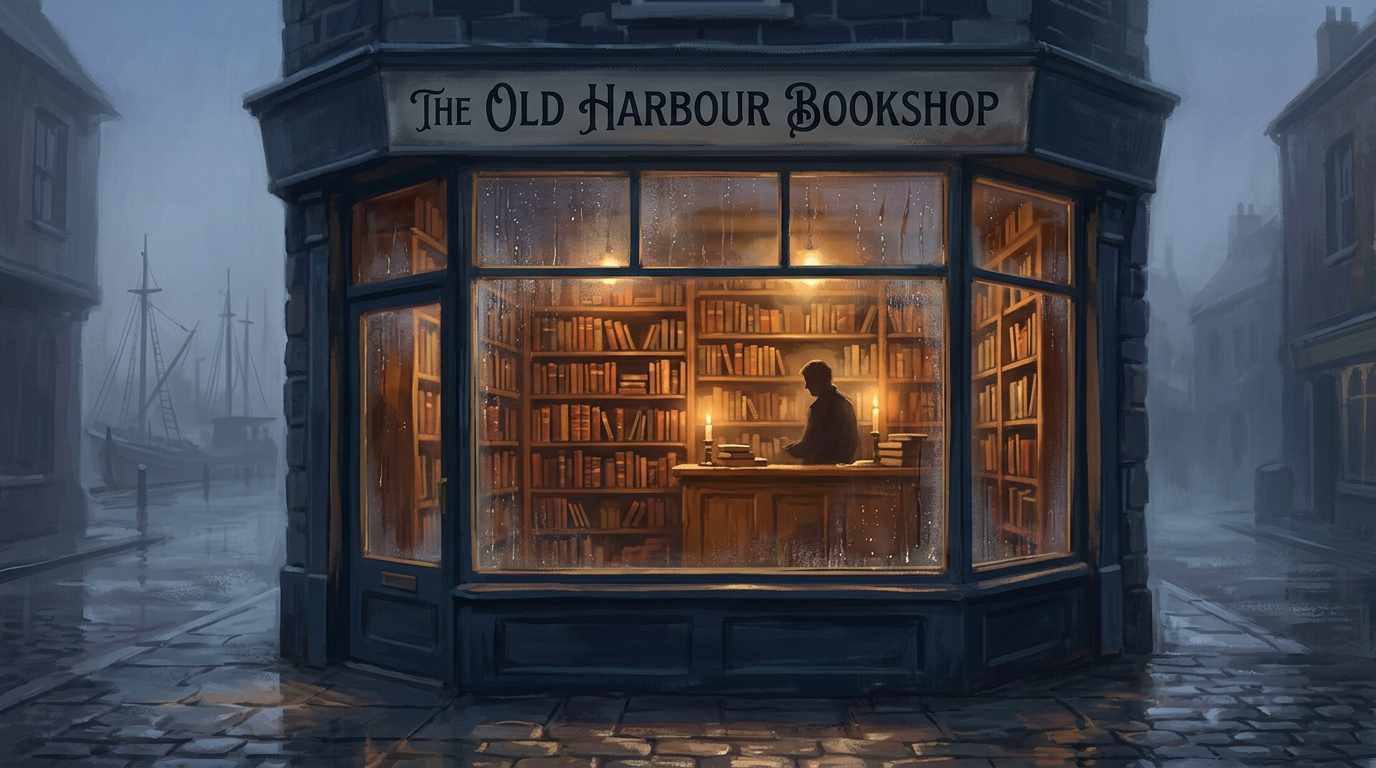
Keldwick is a fictional harbour town in a soft, unnamed early-20th-century register — stone houses, fog-wrapped mornings, fishing boats, telegrams rather than phones. The art direction is painterly and warm: deep navy and pewter-grey exteriors give way to the amber, sienna, and candlelight gold of the shop interior. Characters are hand-drawn with expressive, quietly funny faces. There are no monsters, no antagonists, no political drama — the conflicts are human-scale (the collector who won't sell but needs to; the feuding sisters who both want the same first edition).
The shop is the third place of Keldwick — neither home nor work, but the place people come to think, remember, and be changed quietly. The fantasy the game sells is: being the person in town who knows what everyone needs before they do.
Differentiators
- Resonance Matching as core skill expression — the player's expertise is emotional attentiveness and book knowledge, not resource optimisation; the "win state" of each interaction is a narrative moment, not a profit figure
- Books-as-characters with provenance — rare volumes accumulate personal histories before they're sold; players become attached to specific books and feel the weight of letting them go to the right home
- No farming treadmill — the content engine is discovered human stories and sourced volumes, not crop cycles; directly addresses the most-cited cozy genre criticism (punishing FOMO loops, dark-pattern day timers)
- Restoration as contemplative craft — the workshop mini-games are meditative and mastery-rewarding, not stress-inducing; a quiet counterpoint to the emotional weight of the matching system
- Emergent community narrative — the town's story assembles from curation choices rather than authored quest chains; players become the author of Keldwick's history through the books they find and the people they find them for
Monetization notes
Premium, $18–22 at launch following a 3–4 month Early Access period. The audience (Spiritfarer, Unpacking, Potion Craft fans) values completeness over live service; no cosmetic or progression monetisation. DLC potential is strong: new town chapters (a Mediterranean port, a mountain village archive), new specialisation wings (a Music Archive, a Natural History Room), and book-of-the-year curated lots are all coherent paid additions. The literary/cozy audience has demonstrated willingness to pay full price for narrative-forward sims — Wanderstop, Tavern Keeper, and Spiritfarer all launched at $20–25 and sold well.
Accessibility notes
- Full controller support with button-remapping; mouse+keyboard default
- All mini-games completable without fine motor precision (no timed accuracy windows)
- Colorblind-safe palette (tritanopia, deuteranopia, protanopia modes) — the Resonance tag system uses shape + colour in combination, never colour alone
- Scalable UI (75% to 175%); dyslexia-friendly font option (Atkinson Hyperlegible available as default alternative)
- Content warnings for grief and loss themes with a soft skip option on any vignette
- No fail states anywhere in the game
- No time pressure — the day never ends until the player closes the shop; no countdown timers
- Full subtitles for all voiced content (ambition: fully voiced narrator, à la Hades)
- Motion sensitivity option: disable parallax backgrounds and transition animations
Risks
- Writing-at-scale cost — each book excerpt, resonance match vignette, and character arc generates significant authored text; volume risk is high → mitigation: procedural book excerpt generator seeded from a curated word/phrase library; hand-author only the 30–40 "landmark moment" vignettes
- Restoration mini-game novelty ceiling — three repeated mini-game archetypes may feel thin after 10 hours → mitigation: tool upgrades change the feel of each stage meaningfully; limit restoration to 1–2 books per session to preserve freshness
- Crowded cozy market — Tavern Keeper, Wanderstop, Thrifty Business, and others compete for the same audience in 2025–2026 → mitigation: antiquarian bookshop setting is genuinely unoccupied; lean into the intellectual/literary niche as a brand differentiator
- Provenance research pacing — the slow-burn research mini-game could feel like busy work → mitigation: make it opt-in and reward-scalable (skip it and sell the book for standard price; invest time and sell for 3× with a full-page story)
- Community web legibility — 22 characters with ripple effects may confuse players about what caused what → mitigation: explicit "Town Journal" log records every ripple match clearly; cork-board visualisation of the web is always visible in the back office
6-week prototype plan
- Week 1: Core book data model (title, genre, era, condition, Resonance tag) + inventory grid view; click-to-read excerpt flow with static authored excerpts; basic shop open/close flow
- Week 2: Shelf placement system (drag-and-drop shelving, taxonomy tagging); 8 placeholder customers with simple 2-line dialogue surface wants; basic day cycle
- Week 3: First restoration mini-game (cleaning stage); acquisition screen (lot-bidding with partial visibility of contents); book condition degrades acquisition price if left unrestored
- Week 4: Resonance Matching UI (customer emotional state display); "moment" vignettes on successful match (5 hand-authored samples); basic Ledger with daily profit/loss
- Week 5: Community Web cork board (3 named characters with 2-stage relationship arcs); one seasonal acquisition event (Autumn Festival Exchange); Provenance Research mini-system (2 reference books on shelf)
- Week 6: Vertical slice — Day 1 through Day 30 playable; internal playtest with 5 testers; assess Resonance Matching clarity, Restoration fun, and whether the "letting go of a good book" moment lands emotionally
Genre references
- Wanderstop (Ivy Road, 2025) — https://www.gamesradar.com/games/simulation/wanderstop-is-a-game-about-stopping-burnout-by-taking-on-a-different-hobby/ — demonstrates that narrative-first cozy sims can carry a strong emotional premise without farming; informs the reluctant-protagonist inversion and the importance of the protagonist's internal arc alongside the management loop
- Tavern Keeper (Greenheart Games, Early Access 2025) — https://www.pcgamer.com/games/sim/tavern-keeper-is-the-management-sim-of-my-dreams-and-the-best-thing-ive-played-in-early-access-in-2025/ — "Overwhelmingly Positive" launch proves cozy management sims with deep decoration + simulated NPC world can find a large, passionate audience; informs the Community Web system and the importance of richly simulated characters
- The Last Gas Station (Gambitious, 2025) — https://www.gameindustry.com/news-industry-happenings/why-cozy-management-sims-like-the-last-gas-station-are-winning-over-rpg-and-metroidvania-fans/ — illustrates how small-stakes rhythm ("restock, serve, close") with a streak of unpredictability (the mysterious customer, the strange quiet night) creates the "one more shift" hook; directly informs the Acquisition lot risk system and the Seasonal Event surprise mechanic
- Thrifty Business (Lamiaceae Studio, 2026) — https://www.digitallydownloaded.net/2026/04/thrifty-business-launches-this-may.html — nearest analogue in the object-sourcing/reselling sub-genre; confirms market appetite for "find, assess, sell" loops in a cozy register; informs the lot-bidding acquisition design and the importance of the sourcing hunt as its own satisfying phase
- TheGamer — 10 Best Cozy Management Sims — https://www.thegamer.com/best-cozy-management-sims/ — genre survey confirming that the antiquarian bookshop setting is genuinely absent from the recognised canon; rural/fantasy bias of existing titles creates a clear opening for an early-20th-century coastal-town setting with intellectual themes