Verdant Collapse
Design brief
A roguelike deckbuilder where your cards are living organisms — planted into a combat Grove where they grow stronger, cross-pollinate with neighbors, and seed new cards into your deck when they wither — demanding a new kind of mid-fight garden management.
Date: 2026-06-15 Genre: roguelike deckbuilder Platform: PC (Windows; keyboard & mouse, controller) Status: Concept
Target player
Slay the Spire veterans who've cleared Ascension 20 and want a deckbuilder that forces genuinely new thinking. Fans of Balatro who appreciated how an unusual conceptual lens — poker — cracked open the genre. They've played Hades and value runs that feel alive, not just strategically optimal. They're comfortable with a two-layer loop (hand management AND an active field), and they're drawn to ecological themes, slow-building complexity, and games where you feel like you're tending something rather than just executing a plan. They have ~300 hours in the genre and are quietly tired of "pick the best card from three, add relics, climb floors."
Core loop
30-second loop: Draw a hand of five Organism Cards. Spend up to 3 Energy per turn. Each card can be Planted (placed into one of four Grove slots, where it activates a Passive Effect every enemy turn) or Harvested (if a card already in the Grove is Mature, remove it for a powerful one-time burst). Cards not planted stay in hand for the next turn. A Grove organism advances one Growth Stage at the end of each round: Seedling → Mature → Wilting. When a Wilting organism dies at the end of your turn, it drops a Seed — a cheaper, weaker copy of itself — into your discard pile.
30-minute loop: Navigate an 8–12 node biome: combat encounters, Events (lore + choice rewards), Rest Sites (Cultivate a card to improve its Mature effect, or Compost a card to remove it), and the Scriptorium (shop: new organism cards, Bound Relics, single-use Reagents). Defeat the biome boss; choose an Evolutionary Pressure (a permanent modifier to a card taxonomy for the rest of the run); enter the next biome with a mutating, aging deck. Five biomes per run; total playtime ~75–90 minutes.
Systems
- The Grove — A persistent 4-slot field visible to both player and enemy. Organisms in the Grove trigger their Passive Effect at the start of each enemy action phase. The slot order is fixed left-to-right; order matters because of Symbiosis bonds. The Grove persists across the full combat encounter — you carry its state into the next turn.
- Lifecycle Cards — Every Organism Card has four data fields: Plant Cost (1–3 energy), Passive Effect (the per-round trigger while in Grove), Harvest Effect (the burst when manually removed from a Mature or Wilting Grove slot), and Seed Form (the cheaper card seeded into the discard on natural death). Seeds have +1 Dormancy cost and cap at 3 per card type per deck.
- Symbiosis Network — Each organism has one or two Affinities: Nitrogen-Fixer, Water-Retainer, Shade-Provider, or Pollinator. Adjacent organisms in the Grove with compatible Affinities form a Symbiosis bond, boosting both Passives by 20–40%. The UI shows a glowing filament between bonded slots. Slot placement is therefore a spatial decision, not just a "fill the Grove" reflex.
- Spore & Spread — Fungi-class organisms can apply Spore Tokens to enemy units. Each token shows a countdown (1–4 rounds); when it reaches zero, a delayed effect triggers — damage, debuff, or growth-stage acceleration for friendly Grove organisms. Managing staggered Spore timers across multiple enemies creates satisfying tactical puzzles that reward planning.
- Biome Conditions — Each biome applies an environmental modifier visible from the biome entry screen. Arid Ruins: organisms take one growth-stage damage per round unless a Water-Retainer is in the Grove. Flooded City: Passives trigger twice, Harvest effects deal half. The Glass Greenhouse: Symbiosis bonuses are doubled, but all enemies gain +15% HP. The Iron Canopy: organisms skip Seedling (enter Mature directly), but Wilting is instant. The Seedheart: all growth stages are compressed to 1 round; everything moves fast.
- Bound Relics — Passive items that modify the Grove globally. Examples: Mycelial Network (dead organisms leave a Mycelium token that boosts remaining Passives by 10% per token, stacking); Ancient Taproot (the leftmost Grove slot organism never wilts); Invasive Species (planting any organism deals 5 piercing damage to the weakest enemy). Relics are found in the Scriptorium, boss drops, and rare Events.
- Taxonomy Classes — Cards belong to one of five classes: Flora (deal damage through Passives, scale with Symbiosis), Fungi (debuff and Spore specialists), Parasites (drain enemy buffs to accelerate Grove growth), Lichens (generate Block/Shield each round), Vines (occupy 2 adjacent Grove slots but deliver outsized bonuses). Each class has ~20 unique cards in the full library (100 total).
- Natural Selection — After each biome boss, choose between two Evolutionary Pressures: permanent, run-scoped modifiers to one card class. Examples: "Fungi Spores trigger in 1 round instead of their countdown" or "Parasites gain +1 Growth Stage for each buff they drain." This adds a directed evolution layer above pure randomness, letting players steer their build's identity over the run.
- Composting — At Rest Sites, compost any card to remove it (standard). A small set of "Compost Catalyst" cards can be played from hand to destroy another card in hand immediately, generating bonus Energy or accelerating a Grove organism's growth by one stage. Deck-thinning is frictionless by biome 3.
Progression
Run structure: 5 biomes (Desert Ruins → Flooded City → The Glass Greenhouse → The Iron Canopy → The Seedheart), each 8–12 nodes plus a biome boss. The final boss is the Arborist — a human engineer who built GAIA-ROOT and now wants to trigger a global reset, believing humanity cohabitation was a mistake.
Meta unlocks: Defeating a biome boss for the first time unlocks 2 new card species permanently. Clearing a full run unlocks 1 new Bound Relic. Clearing with each starting loadout (3 available at launch) unlocks a Variant (a harder version of that loadout with a modified starting deck and starting relic).
Overgrowth Levels: 10 levels of run difficulty, unlocked one per clear. Early levels add minor modifiers (enemies deal 10% more damage); later levels apply structural constraints (Grove is capped at 3 slots; Seed Dormancy cost is +2; all Biome Conditions are active simultaneously).
Seasonal Challenges: Weekly rotations of a fixed seed + modifier stack, tracked on a community leaderboard. Cosmetic unlocks for placing in the top 1,000.
World & setting
In 2087, the GAIA-ROOT Collapse occurred: a genetically engineered mycorrhizal network deployed globally to reverse runaway climate change succeeded beyond any projection. Over forty years, the network reprogrammed every organism in the lowlands to participate in a vast, slow intelligence. Humanity abandoned the flood plains and river valleys, retreating to high-altitude enclaves. The Verdant — as survivors call it — is not hostile. It is indifferent, and that is somehow worse.
You play as a Rootwalker: a human who underwent the Covenant procedure, surgically grafting GAIA-ROOT filaments to your peripheral nervous system. You can touch the network, hear its harmonics, and command organisms by contact. You travel through Collapse zones not to fight the Verdant, but because something inside the Seedheart — the original GAIA-ROOT node, buried under the ruins of the Nairobi Agricultural Institute — has started broadcasting a distress signal in old network protocol. The Verdant is dying. And you may be the only one who can hear it.
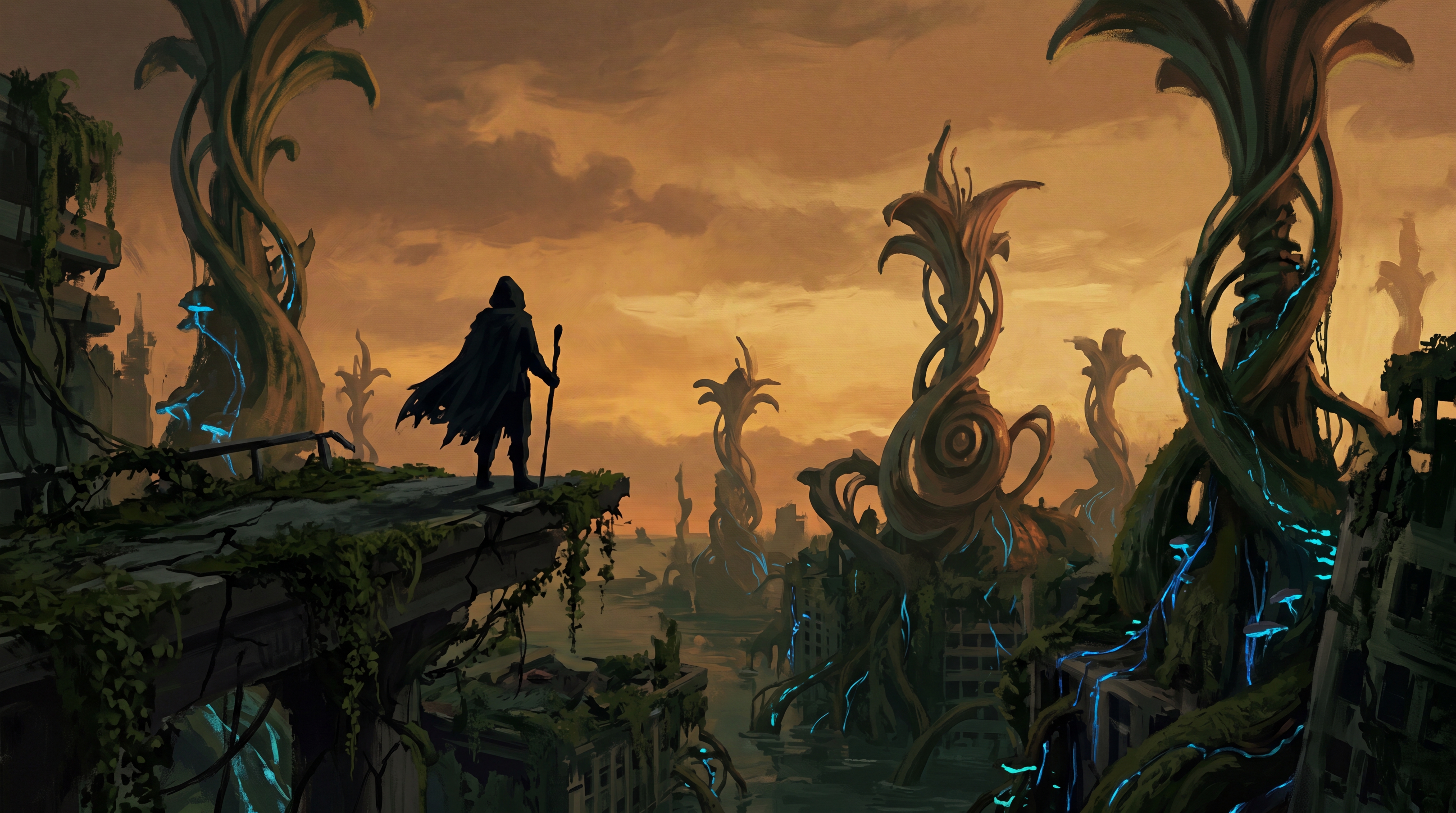
Art direction: art nouveau silhouette work meets biopunk industrial decay. Rich forest greens, deep ochres, and oxidized copper against brutalist concrete ruins threaded with electric-blue mycelium. The visual language pulls from Roger Dean's landscape painting, Wayne Barlowe's alien ecosystem studies, and the lush-grotesque overgrowth of Ori and the Blind Forest — but denser, stranger, and more ambiguous about whether beauty here is safe. The soundtrack is sustained-string minimalism with field recordings of actual mycorrhizal growth-sound translated into audible frequencies.
Differentiators
- Grove management creates a second simultaneous puzzle inside combat — You're not just playing from hand and discarding; you're tending a four-slot ecosystem that persists across turns, forcing multi-round planning within a single encounter. This is structurally absent from every mainline competitor in the genre.
- Cards age and seed themselves, mutating the deck mid-run — Unlike StS, Balatro, or Monster Train — where the deck is static between shops — Verdant Collapse's deck changes shape within and between combats as organisms die and seed cheaper, weaker copies. The deck is always in motion.
- Symbiosis adjacency introduces a spatial constraint to deckbuilding — Grove slot order is a meaningful decision, turning hand management into a placement puzzle. No other major deckbuilder has introduced a genuine spatial layer without fully pivoting to a grid combat system (as StarVaders did).
- Ecological theming is mechanically encoded, not decorative — The Taxonomy system, Biome Conditions, Affinities, and Spore mechanics all model real ecological dynamics (nitrogen cycling, water retention, shade competition, pollination). The setting earns its aesthetic rather than borrowing it.
- Natural Selection steers runs without dictating them — The post-biome Evolutionary Pressure choice gives players agency over their build's direction without removing randomness. It creates a "what kind of Fungi run am I building?" identity that players can articulate and pursue.
Monetization notes
Model: Premium, $19.99 USD at 1.0 launch; Early Access at $14.99 for 6–12 months to build community feedback loops and balance the Overgrowth modifiers.
DLC plan: 2–3 content packs at $5.99–$7.99 each, each adding one new biome, ~25 new card species, and a new boss. No cosmetic store; no F2P mechanics.
Market read: Balatro (2024) at $14.99 crossed 5 million sales. Slay the Spire II launched early access in March 2026 and hit 3 million sales in its first week at ~$24.99 — confirming that the market for quality deckbuilders remains enormous, even in a saturated field. The genre-fatigue risk (documented by GameDiscover.co's 2025 analysis) is real but targets undifferentiated games. Verdant Collapse's mechanical hook is specific enough to be a "marketable differentiator" — the single element GameDiscover identified as decisive in whether a deckbuilder breaks through.
Accessibility notes
- Fully remappable controls for keyboard/mouse and controller
- Colorblind-safe palette: Taxonomy classes indicated by both color and icon shape (leaf, spore-ring, tendril, crystal-flake, vine-spiral); Symbiosis affinities distinguished by pattern as well as hue
- UI scale slider: 75% – 200%
- Game speed setting: 0.5× – 2× for all animations and growth-stage transitions
- "Guided Grove" overlay available at any time (not just first-run): highlights valid Symbiosis placements and flags organisms about to Wilt
- Pause permitted at any point during the enemy action phase
- Full subtitles for all voiced story nodes; speaker name + tone descriptor in brackets
- Reduced Motion mode: disables particle systems, minimizes animation, keeps UI readable
- "Overgrowth –1" difficulty accessible from the main menu before every run with no achievement penalty
Risks
- Grove complexity barrier: Two simultaneous layers (hand + field) may overwhelm new players before they grasp the payoff. Mitigation: The first biome caps the Grove at 2 slots; Guided Grove mode stays available; a short interactive tutorial covers one full combat encounter before the first run.
- Genre fatigue and market saturation: GameDiscover's 2025 data showed the roguelike deckbuilder tag declining year-on-year. Mitigation: Verdant Collapse's visual identity (biopunk art nouveau) and mechanically unique hook (living-card lifecycle) give it a clear surface area for streaming and press coverage; the Early Access window is partly for building that community foothold.
- Seed-spam exploit: Players may optimize for fast-cycling Seed-heavy builds that short-circuit the Grove lifecycle and reduce the game to hand-spam. Mitigation: Seeds carry a +1 Dormancy cost (effectively +1 energy to play) and a per-type cap of 3 in any deck; Compost is always available at Rest Sites to thin unwanted Seed accumulation.
- Biome condition luck swings: A Grove-heavy build can feel sabotaged by an unfavorable Biome Condition if discovered mid-biome. Mitigation: Biomes are ordered (not random); the Condition is shown on the biome entry screen and at least two Rest Sites appear before the biome's first boss, giving adaptation windows.
- Art budget underrun: The biopunk art-nouveau aesthetic is central to the game's differentiation; budget cuts to art produce a disproportionate brand penalty. Mitigation: Hire one lead environment artist to define the style guide before any other art investment; all subsequent art is reviewed against the guide.
6-week prototype plan
- Week 1: Core combat loop in Unity — 4-slot Grove, plant/harvest actions, 3 energy per turn, manual lifecycle button, 3 organism cards (one Flora, one Fungi, one Lichen). Goal: a single combat encounter against a static dummy enemy with no AI.
- Week 2: Enemy AI with telegraphed intent icons (StS-style); Symbiosis adjacency logic for Nitrogen-Fixer + Water-Retainer pair; Seedling→Mature→Wilting state machine with visual growth-stage indicator. Deliverable: 1 completable combat vs. 2 enemy types.
- Week 3: Run structure — 5-node prototype biome: 3 combats, 1 Rest Site, 1 Scriptorium with 4 purchasable cards. Compost removal at Rest Site. Deliverable: 1 completable mini-biome run with a boss combat at node 5.
- Week 4: Bound Relic system (5 relics, mix of Grove-global and Taxonomy-specific); Natural Selection with 2 Evolutionary Pressure choices per biome clear; Spore Token subsystem for Fungi class. Deliverable: Full starter card library of 30 cards across all 5 taxonomy classes.
- Week 5: Second biome (Flooded City) with its Biome Condition modifier; 2nd unique boss; Growth-stage VFX (sprout animation, symbiosis glow, seed burst); Harvest burst effects. Deliverable: A 2-biome run with all core systems active, playable start to end.
- Week 6: External playtest milestone — 6–10 testers; measure time-to-understand Grove (target: < 5 minutes), run completion rate (target: > 60%), and "would you play more?" rating (target: > 4/5). Fix the top 3 identified pain points. Deliverable: A build ready for a GDC-adjacent pitch or a closed Itch.io alpha.
Genre references
- Rogueliker — The Best Roguelike Deckbuilders — https://rogueliker.com/roguelike-deckbuilders/ — Identifies genre values (synergy depth, narrative integration, visual distinctiveness) and shows the player appetite for mechanics that go beyond the StS formula; informed the Symbiosis and Lifecycle design targets
- Slay the Spire II (Wikipedia) — https://en.wikipedia.org/wiki/Slay_the_Spire_II — Genre benchmark entering early access March 2026 with co-op and new characters; 3M sales in week one confirms strong market demand; its design also shows the ceiling the Grove system is designed to exceed
- Balatro (Wikipedia) — https://en.wikipedia.org/wiki/Balatro — Proved that applying an unexpected conceptual lens (poker) to deckbuilding produces massive critical and commercial uplift; directly inspired Verdant Collapse's commitment to a non-fantasy thematic lens
- Why Did This Excellent Roguelike Deckbuilder Fail to Scale? (GameDiscover.co) — https://newsletter.gamediscover.co/p/why-did-this-excellent-roguelike — 2025 post-mortem analysis of genre fatigue and discovery failure; "lack of a marketable hook" is the cited killer; shaped the decision to lead with the Grove lifecycle as the single-sentence differentiator
- Drop Duchy (Wikipedia) — https://en.wikipedia.org/wiki/Drop_Duchy — May 2025 release combining deck-building with Tetris-style spatial puzzles; demonstrates that hybrid spatial mechanics are viable in this genre and that players respond to them; informed the Symbiosis adjacency design