Pressure Lines
Design brief
You are the sole engineer of an autonomous deep-sea mining fleet — design the systems, route the conveyors, manage the pressure bands, and keep the abyss from swallowing what you built.
Date: 2026-06-22 Genre: automation/factory sim Platform: PC (Windows; keyboard & mouse) Status: Concept
Target player
Factory sim veterans who have cleared Factorio's rocket launch, finished Satisfactory's Phase 4, and want an environmental setting that fundamentally changes why factory layout decisions matter. They're drawn to Subnautica-style discovery but frustrated that game never let them build the megafactory the setting deserved. They enjoy reading system documentation, think in throughput rather than win conditions, and are excited — not annoyed — when a new constraint collapses their current layout and forces a redesign. They want visual distinctiveness: they are tired of the surface-world rocky biome with alien bugs.
Core loop
30-second loop: Place a building or conveyor segment. Verify its Pressure Rating matches the current depth band. Check that flow type is consistent across all adjacent connections — ore conveyors cannot directly feed slurry pipes without a Phase Separator in between. Confirm a power relay is within range. Each placement is a quiet constraint-satisfaction problem with three simultaneous variables: depth pressure, flow phase, and power coverage. Mistakes are shown immediately with a red indicator on the component, not as a factory-wide failure minutes later.
30-minute loop: Deploy a survey drone into the next depth band. Wait for the map data (in-game time: ~5 minutes). Identify new resource nodes, plan the extraction circuit, build outward from the nearest riser anchor. Watch throughput climb as your new circuit feeds back to the surface. Then manage the Seismic Signature of the new zone — if you over-extract, bioluminescent megafauna emerge, and you must throttle, reroute, or install dampeners to quiet your operations. Scale the zone to maximum sustainable yield before moving deeper.
Systems
Depth Bands — The ocean floor is divided into three pressure zones: Photic (0–200 m, low-pressure, abundant but low-grade ore), Bathyal (200–3,000 m, medium-pressure, richer deposits requiring Tier 2 pressure-rated components), and Hadal (3,000 m+, extreme-pressure exotic minerals that require fully-enclosed slurry-only pipelines and advanced seismic management). Each band uses different component sets; you cannot bolt a Photic rig into a Hadal node — the housing fails catastrophically and takes nearby infrastructure with it.
Three-Phase Flow — Resources move in three physical phases with different logistics rules. Solids travel on conveyor belts (fast, simple, cheap). Slurries — ore suspended in seawater — move through pumped pipes with pressure-loss calculations that depend on pipe length and current depth. Dissolved compounds — Hadal trace elements — require chemical membrane separators and travel slowly but can pass through very narrow routing gaps. Managing the phase transition points (extractor → Phase Separator → correct pipe or belt type) is the central logistics puzzle that never fully goes away.
Current Grid — Directional ocean floor currents are simulated as vector fields that complete a full 30-minute cycle. Conveyors running with the current receive a 15 % speed bonus. Conveyors running against it suffer a 15 % penalty. The Current Overlay (toggle with Tab) shows the live vector field. An advanced layout routes primary throughput arteries along dominant current vectors, using shorter cross-current segments only where necessary. Current maps change between depth bands.
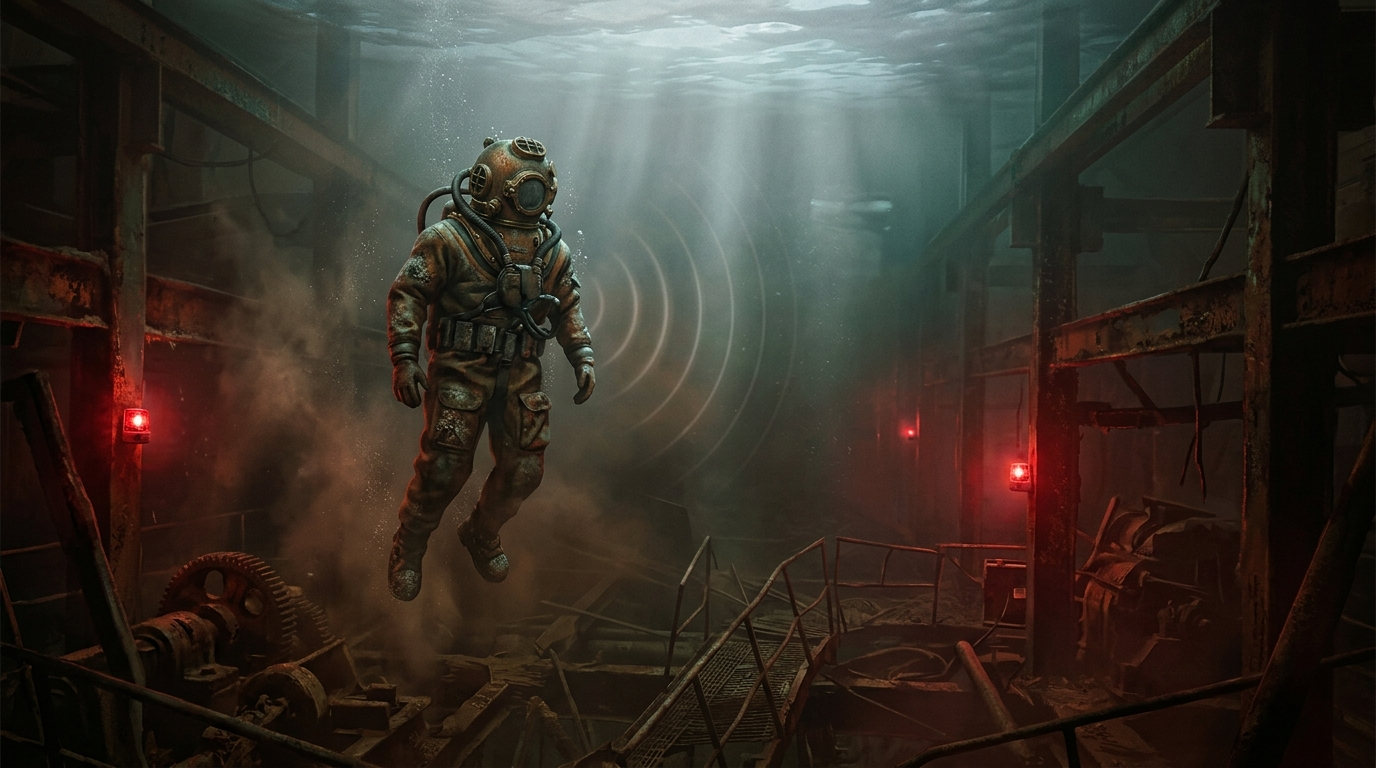
Seismic Signature & Fauna Events — Every active extractor adds to the zone's Seismic Signature score. Exceed the threshold and the zone enters Disruption: bioluminescent megafauna (six distinct creature types, each with different movement patterns) emerge and begin physically colliding with infrastructure. There is no combat. Mitigation options: install vibration dampeners on extractors (costs power, reduces output by 20 %), temporarily shut down part of the zone, or route conveyors around the fauna's patrol paths using the zone map. Fauna retreat when the Signature drops below the threshold. Managing Signature rather than fighting enemies is the game's primary "crisis" mechanic.
Surface Riser Network — All processed material must travel up vertical risers to a surface hub. Each riser has a bandwidth limit (conveyor slots per second). Multiple risers can be built but each requires a surface platform slot (limited). Riser congestion creates backpressure that slows the entire downstream pipeline, not just the riser — so building more factory in a depth band without expanding riser capacity eventually stalls the whole zone. The Riser Management panel becomes the critical dashboard in mid- and late-game.
Autonomous Survey Drones — The map is not revealed by default. You deploy survey drones (built in-factory from processed copper and polymer) that return after a depth-dependent timer with partial seabed maps. Deep drones take longer and risk loss if they enter an active Disruption zone. Speed-running research into better drones is a viable playstyle; so is conservative survey-then-build sequencing.
Maintenance Decay — Equipment degrades on a slow timer. Degraded equipment first loses efficiency, then goes offline. You must produce Maintenance Kits within your factory (alloy + polymer → assembly line → kits) and dispatch Repair Crawlers to carry them to the failing component. A factory that cannot supply its own maintenance eventually fragments. This creates an internal demand loop: the factory must produce for itself before it can produce for the surface hub.
Contractor Orders — The surface company sends periodic orders: deliver X tonnes of processed nickel by in-game day 30, or maintain slurry output above Y for 10 consecutive minutes. Completing orders unlocks new component tiers and depth-band access. Failing an order incurs a budget penalty (fewer drone units available next cycle). Orders pace the progression without imposing a hard linear campaign — you can defer one order and accept the penalty if another zone demands attention.
Progression
Early game starts on the Photic shelf with a single extractor, a short belt run, and one riser. The first Contractor Order forces expansion to a second resource node. Mid-game unlocks Bathyal access — the first time the player must think about slurry pipes, pressure ratings, and Phase Separators. The first major Fauna Event usually hits here, teaching Seismic Signature management. Late game opens the Hadal band, where dissolved-compound logistics demand a complete redesign of how output reaches the surface. Endgame milestone: the Deep Hub — a Bathyal-depth autonomous station that manages its own repair Crawler dispatch and reroutes around fauna without player input. Reaching this milestone transitions the player from planner to strategist: you issue targets, the factory executes.
World & setting
The year is 2187. Ocean-floor mineral rights became the dominant geopolitical currency after terrestrial deposits were exhausted. You manage Site 7-Delta, a mid-tier extraction lease on the Mid-Atlantic Ridge, operated by Helical Seabed Ltd. — a company that sends supply pods and terse emails but never people. The surface world is implied, not shown. Down here it is dark, pressured, and strangely alive.
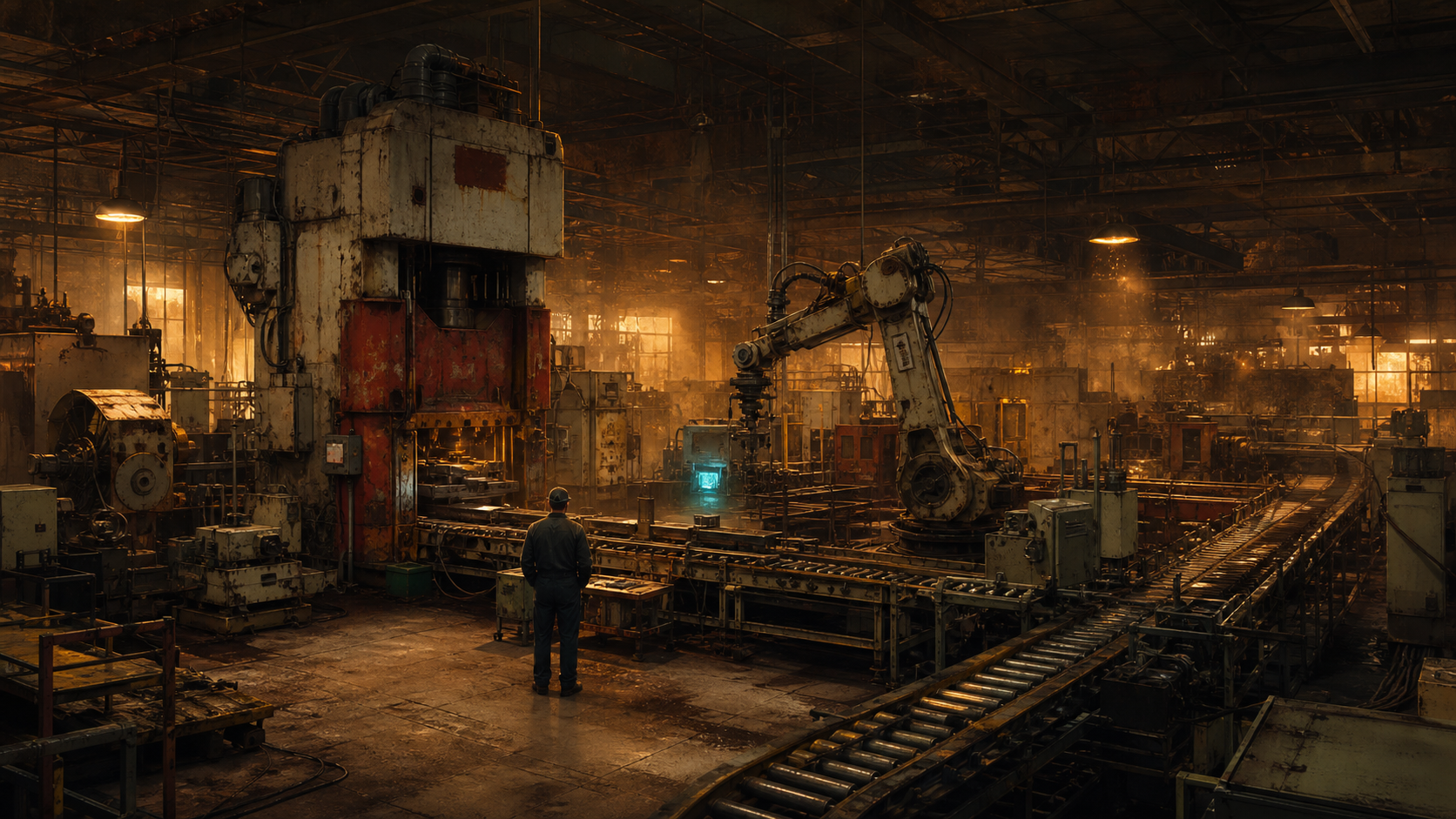
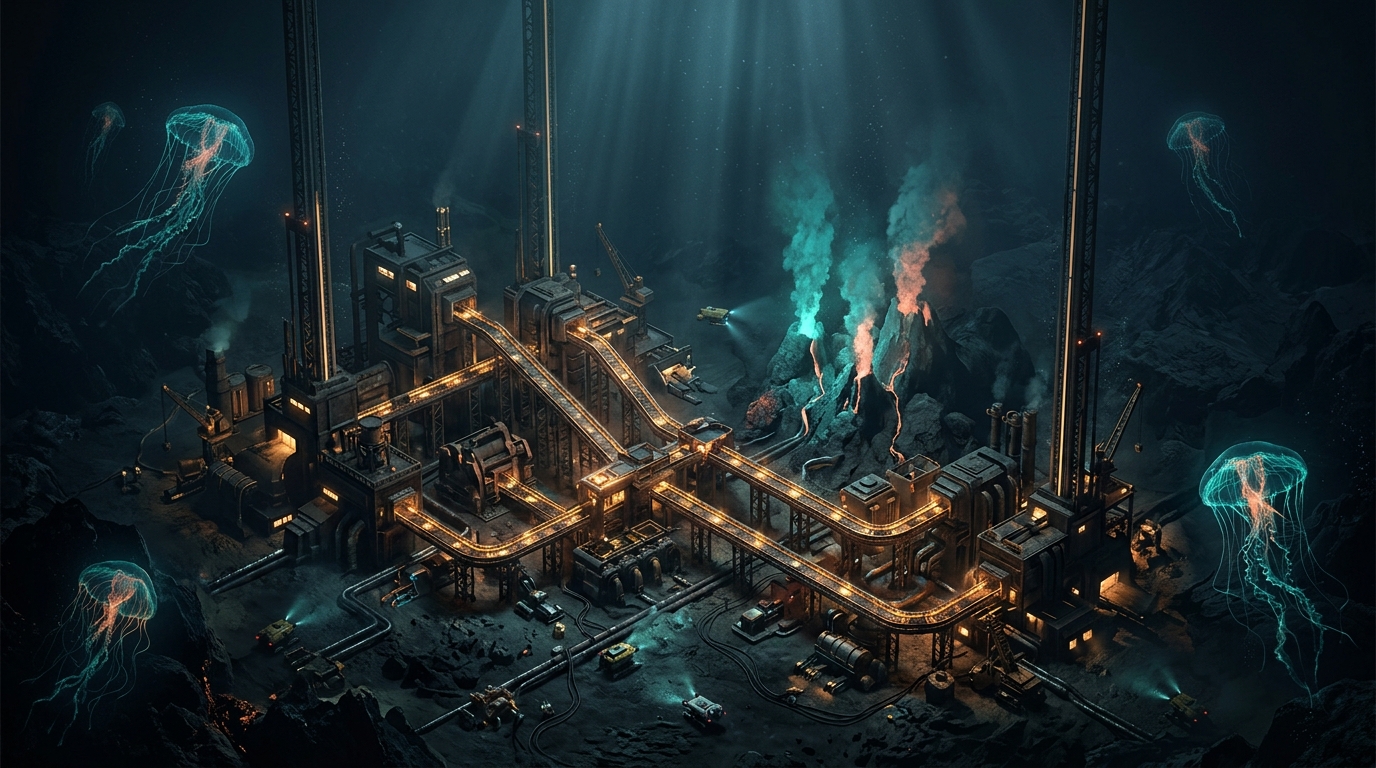
The art direction is industrial brutalism submerged: near-black water, conveyor belts lit faint amber, processing buildings with glowing status panels. Bioluminescent vents in coral-orange and deep-teal provide ambient light and hint at the ecosystem being disturbed. Fauna are stylized but reference real abyssal life — siphonophores, giant isopods, oarfish-like megacreatures. The UI is HUD-minimal, using diegetic status lights on buildings and a wrist-mounted tablet for dashboards. The overall mood is quiet dread made purposeful: you are the sole intelligence keeping this system running, and the ocean has opinions about that.
Differentiators
- Pressure as a first-class design constraint: Depth bands require genuinely different component sets — not just tier upgrades — forcing a full pipeline redesign each time you go deeper rather than just swapping in stronger versions of existing parts.
- Current-aware logistics: The directional current field is a live throughput modifier. Designing belt arteries with the current instead of against it is a meaningful skill expression that no other factory sim currently offers.
- No combat; fauna events as noise management: Instead of building turrets and defending a perimeter, you manage your factory's acoustic and seismic footprint. Stealth-through-efficiency is a new mechanic vocabulary for the genre.
- Vertical chokepoint constraint: All output must rise through limited riser bandwidth — a hard bottleneck that shapes every factory decision from placement to scaling, in contrast to the genre's typical "bigger is always better" ethos.
- Incomplete information + survey risk: You build under partial information, and the scouts you deploy to fill that information can be lost. It's the only factory sim where "going in blind" has real mechanical consequences.
Monetization notes
Premium PC release at $24.99, with a 12-month Early Access period before 1.0. EA roadmap: Photic + Bathyal bands in launch build; Hadal band, Deep Hub endgame, and fauna variety in 1.0. Post-1.0 paid DLC: "Hydrothermal Expansion" adds volcanic vent zones with temperature-rating constraints (a fourth engineering axis) and new mineral types. No cosmetics or battle passes — the player base for serious factory sims expects complete content, not drip-feed. Market opportunity is genuine: the underwater setting is unoccupied in the factory-automation subgenre, and Subnautica's long-tail audience (~4 M owners on Steam as of early 2026) is an accessible conversion target.
Accessibility notes
- Fully remappable keyboard and mouse bindings; gamepad support (controller-first UI overlay available).
- Colorblind modes: Deuteranopia, Protanopia, Tritanopia presets that recolor depth-band indicators, flow-type status, and Seismic Signature meters independently.
- Scalable UI from 75 % to 175 % in 25 % steps; all dashboard text in a high-contrast font stack.
- Pause-and-plan mode available at any time — no real-time penalty for pausing to think through a layout.
- Speed controls: 0.5×, 1×, 2×, 4× simulation speed. A "Crisis Pause" auto-pause option triggers on Fauna Event onset and on riser congestion.
- Subtitles and closed captions for all contractor message audio logs.
- Photosensitivity mode: disables the bioluminescent pulse animations on Fauna Events (replaces with a solid highlight).
- Onboarding: a guided Photic-shelf scenario lasting ~45 minutes before the open world unlocks. Optional, skippable after completion.
Risks
- Scope creep on the physics simulation: Simulating current vectors and pressure-loss calculations per pipe segment could become a performance sink on large factories. Mitigation: abstract both to per-zone modifiers rather than per-tile simulation; reserve full simulation for the player-visible Current Overlay only.
- Tutorial complexity: Three-phase flow + pressure ratings + current grids hitting players simultaneously is a lot. Mitigation: gate each system behind successive Contractor Orders so players internalize one axis before the next is introduced.
- Visual readability underwater: Dark environments with bioluminescent accents can obscure conveyor routing status. Mitigation: each conveyor belt has a persistent color-coded flow-type stripe visible through the ambient dark; diegetic building lights duplicate all status information so the HUD can be minimized.
- Fauna event frustration: If megafauna events feel unfair (arriving before the player has dampeners), they will trigger refund reviews. Mitigation: Seismic Signature has a very clear visual meter, a 60-second warning zone before Disruption onset, and a Tutorial tip the first time the meter enters the yellow band.
- Market positioning against Subnautica: Risk of being described as "Factorio in Subnautica's world" dismissively. Mitigation: lean into this description in marketing; it is accurate and communicates the value proposition efficiently to both audiences.
6-week prototype plan
- Week 1: Implement the basic grid, belt placement, and a single ore extractor with a riser endpoint. Target deliverable: a working one-zone belt loop that delivers ore to a surface counter.
- Week 2: Add the Photic and Bathyal depth bands; implement Pressure Rating validation and the Phase Separator for slurry pipes. Target deliverable: a cross-band circuit where ore is extracted at Bathyal depth, separated into slurry, and pumped to a Photic riser.
- Week 3: Implement the Current Grid modifier (simple per-zone directional vector, no per-tile simulation). Add the Current Overlay toggle. Target deliverable: a zone where belts running against the current visibly underperform; player must reroute to hit a throughput target.
- Week 4: Implement Seismic Signature meter and a single megafauna type (patrol path only, collision damage on contact). Add vibration dampeners. Target deliverable: a Fauna Event that the player can resolve by installing dampeners or throttling extractors.
- Week 5: Implement Maintenance Decay and Repair Crawlers. Add the Contractor Order system with two orders. Target deliverable: a 20-minute play session where the player must balance expansion with maintenance supply production to complete an order on time.
- Week 6: Vertical-slice playtest milestone — integrate all Week 1–5 systems, add two Contractor Orders that gate Bathyal access, and run a 60-minute external playtest. Measure: do testers understand all three flow phases before the 30-minute mark? Can they recover from a Fauna Event without quitting? Record pain points for sprint 2 priorities.
Genre references
- Belts of Iron (Builderment LLC) — https://store.steampowered.com/app/3427850/Belts_of_Iron/ — Open-world factory with base defense and procedural worlds (May 2026 EA); validates that "factory + environmental threat" resonates but shows the combat-free gap Pressure Lines occupies.
- shapez 2 — Factory (tobspr Games) — https://store.steampowered.com/app/2162800/ — Geometric factory sim that added 3D multi-layer construction in a major 2025 update; confirms the vertical-building trend and informs Pressure Lines' depth-band stacking concept.
- Modulus: Factory Automation — https://store.steampowered.com/app/2779120/Modulus_Factory_Automation/ — Sky-island factory with real spatial constraints and a relaxed tone; validates that "logistics with physical constraints" is a differentiated and appreciated play pattern.
- Automation Games Explained 2026 (Game Foundry) — https://gamefoundry.games/blog/automation-games-explained-2026 — Genre analysis confirming players prize "predictable complexity" and that hybrid mechanics (automation + survival, automation + strategy) are the growth direction; shapes Pressure Lines' Seismic Signature / fauna hybrid.
- Aquatico (Digital Reef Games) — https://store.steampowered.com/app/1812300/Aquatico/ — The most prominent underwater city-builder on Steam; confirms the underwater setting has player appetite but is currently served only by colony/city-builder mechanics, not factory automation — the niche Pressure Lines targets.