The Last Toss
The keys came in a padded envelope with a Post-it stuck to them that said GARBAGE MAN COMES TUES, which was the most Nora's father had told her about his own father in a month.
Synopsis
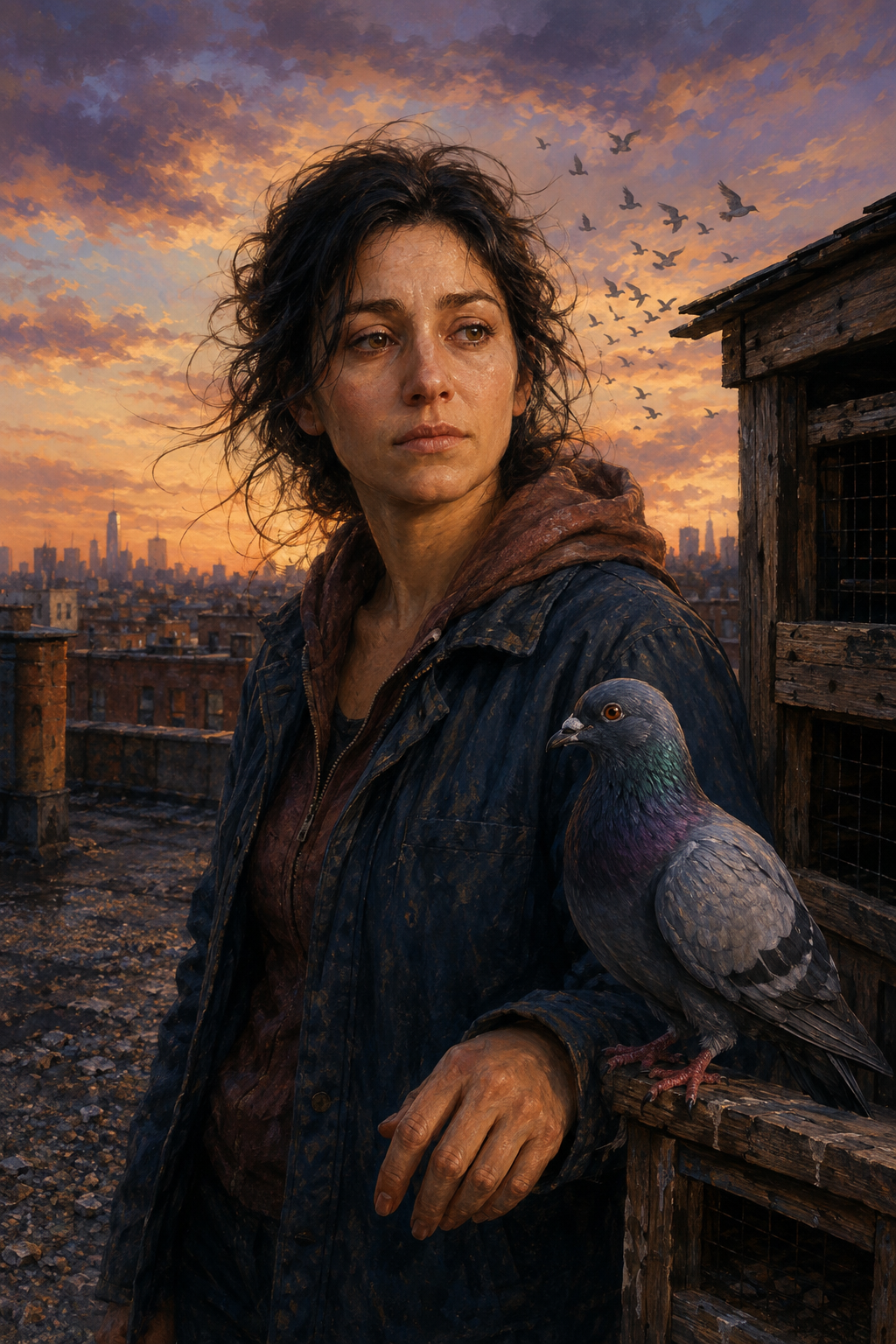
When her estranged grandfather Aldo dies, Nora Ferro, a Brooklyn insurance-claims adjuster who reduces every ruined thing to a dollar amount, climbs to his Bushwick roof to appraise and sell his estate and finds fifty flying pigeons she can't put a number on. Someone has been keeping the flock alive since the funeral, and birds keep vanishing off the coop each evening. Nora blames the prickly old rival across the airshaft, Izzy Colón, who "catches" the strays that drift into his own flock, until she learns the truth: Izzy has been climbing up twice a day to feed Aldo's birds and catching the strays to save them from the hawk, because a flock left unflown scatters and dies. He and Aldo spent forty years pretending to feud so neither would be alone on the roof, and the one hen that won't stay caught is a slate-blue bird Aldo named Lucia, after Nora's grandmother, who used to watch the flock fly from her deathbed. To keep the birds together, and to grieve, Nora lets Izzy teach her to fly them, and one dusk she puts the whole kit up beside his, learning in her aching arm what her family had never been able to say out loud.
The Last Toss
Story
The keys came in a padded envelope with a Post-it stuck to them that said GARBAGE MAN COMES TUES, which was the most Nora's father had told her about his own father in a month. She turned the envelope over on the F train, looking for the rest of it. There wasn't a rest of it. That was Richie Ferro's version of a eulogy: a reminder about the trash.
The apartment was on Grove, half a block off Wilson, two flights up over what used to be a shoe repair and was now a place that sold seventeen kinds of natural wine. Nora let herself in and stood in the doorway with her tote bag and her clipboard and did the thing she did at work, which was to walk into a room somebody had lost and start putting numbers on it. She adjusted claims for a living. She was good at looking at a kitchen fire or a burst pipe and seeing, underneath the ruin, the dollar amount that would make it go away.
Her grandfather's kitchen would not resolve into a number. There was a percolator on the stove with coffee still in it, gone to tar. There was a calendar from a funeral home, which struck her as a bad advertisement, open to April even though it was September. There was the smell, under the coffee and the dust, of something she couldn't place until she did: grain, and feathers, and the particular ammoniac sweetness of birds.
She had forgotten about the birds. She had been eleven the last time she was up here, and she had spent that whole visit terrified of the roof.
Now she found the ladder in the back bedroom, bolted to the wall under a hatch, and she thought: I will look, I will count it, I will put it in the estate, and I will go home. She climbed.
The hatch came up hard and then all at once, and the sky fell on her.
That was how it felt. She had lived her whole life at street level, in the part of the city that was walls, and she had forgotten the city had a top to it. Up here it went on. Water towers stood around on their stilts like patient animals. To the west the towers of glass she'd watched go up her whole life threw back the four o'clock sun, so that a whole cliff of Bushwick was on fire without burning. And in front of her, taking up half the roof, was a structure her grandfather had built out of scrap lumber and chicken wire and a storm door and what looked like the side of a refrigerator, and inside it, forty or fifty pigeons turned their heads to look at her all at once.
They were not the gray garbage birds of the sidewalk. Some were white, some were the blue of a gun barrel, some were a brown-red she didn't have a word for, checkered along the wing. They made a sound she felt in her sternum, low and rolling, a sound like a pot about to boil forever. When she took a step they lifted and resettled, all together, one animal made of fifty smaller ones.
"You feed them yet."
Nora turned. On the next roof over, a roof that sat lower than her grandfather's so that the man standing on it came up to about her waist, was an old man in a Members Only jacket and a Mets cap gone the pink of old blood. He was holding a bamboo pole longer than he was tall with a black plastic bag knotted to the end of it. He was not asking a question. He was informing her of a failure.
"They ate," Nora said. "There's food in there."
"There's food in there because I put food in there." He said it the way you'd tell a child the stove was hot. "Every morning, every night, five weeks. You think they feed theirselves? You think Aldo comes down from the sky and fills the can?"
"I'm sorry, who are you?"
The old man looked at her for a long moment, and something in his face closed like a shop at the end of the day.
"I'm the fool been keeping your family's birds alive," he said, and he turned his back on her and lifted his pole and began, slowly, to wave it at his own sky, though his sky was empty. "Lock the coop when you leave. Hawk got two off the Delgados' roof Sunday. Cooper's hawk. It'll take these too, they get the chance."
His name was Isidoro Colón, Izzy, and by the third day Nora had heard four different versions of who he was to her grandfather, none of them from him.
The natural wine man, who turned out to be named Brody and to have opinions, said the two old men had "beef, like, historic beef." The woman who ran the bodega on the corner, ringing up Nora's coffee, said they'd been at it since before she was born, two crazy old men and their birds, calling the cops on each other, throwing rocks, one time the fire department. She said her mother used to watch them from this very window like it was the stories on TV. The super from the building on the corner, a Guyanese guy named Rennie who'd known everybody for thirty years, said, and here he lowered his voice like he was passing state secrets, that Colón had been "stealing off Ferro for years. Catching his birds. Man's a pirate."
"Catching them how," Nora said.
Rennie looked at her the way people looked at her when she asked what a roof was worth. Like the question itself was the sad part.
"You don't know how it works," he said. It wasn't unkind. "Your granddad never showed you."
He had tried to, once. She remembered it now the way you remember something you'd folded up small and sat on. She'd been eleven, on this roof, and he'd wanted her to hold the pole, and she'd been so afraid of the edge, of the drop into the airshaft, that she'd cried, and he'd gotten that flat disappointed quiet that the men in her family all had, the one her father mailed her in Post-it form, and he'd never asked again. Her father had driven them home to Jersey that night and said, in the car, that his father cared more about those rats with wings than about people, and Nora, eleven, wanting to be on the right team, had agreed.
Now she stood on the roof at dusk with Rennie's word in her head, pirate, and she counted the birds. Forty-one. She wrote it on her clipboard because writing things down was the only prayer she knew.
The next evening there were thirty-nine.
She thought she'd miscounted. She counted twice. Thirty-nine. And across the airshaft, on the low roof, Izzy Colón was up with his pole, waving his own flock into the pinking sky, forty, fifty birds turning together, tilting, going from dark to bright to dark as they banked, and Nora watched two birds peel off her grandfather's coop, her grandfather's roof, and climb, and join them.
Just like that. They rose to the older man's flock and folded into it and were gone, one flock now, wheeling over Wilson Avenue, and she couldn't have told you anymore which two had been hers.
She went over there the next morning ready to have it out.
Getting to his roof meant going down her stairs and up his, past a landing that smelled like sofrito and a door with three saints taped to it, and out a hatch that was the twin of her grandfather's. Izzy was already up, sitting on an overturned milk crate, doing something with his hands to a bird held gently against his stomach. He didn't look up.
"You're taking them," Nora said. "The birds. Two more yesterday. I counted."
"I'm not taking nothing." He turned the bird over. It lay in his hands like it had decided to. "They come to me. There's a difference, and it's the whole difference." He set the bird down and it strutted off, offended, dignified. "You fly a kit, some fly off, some fly over, some don't come home. Bird lands on my coop, mixes in my flock, I close the trap, that bird's mine. That's the rule. Been the rule a hundred years. You want it back, you buy it back, or you catch one of mine and we're square." He finally looked at her. "Your granddad and me, we been square and not square for forty years. Some seasons he was up two birds. Some seasons me. Nobody keeps a real count."
"You keep a count."
The corner of his mouth moved. "I keep a count."
"So buy them back from me," Nora said. "The ones you caught. I'm settling his estate. Everything gets a number, everything gets sold. You want his birds, make me an offer, we're done."
She'd said it to be hard, to be a Ferro, to win. She watched it land on him and she watched, for the first time, the old man look old. Not the performance of old he'd given her the first day, the pole and the wisdom. The actual thing. His hands went still on his knees.
"Sold," he said. "To who. For what. You know what a flight's worth? To somebody who don't fly?" He laughed, a dry cough of a laugh. "Nothing. They're worth nothing. That's the joke of it. Sixty years that man put into that loft, bred them from his father's stock that came over on the boat, and now you'll get, what. A guy comes with a van, takes them for the meat, or lets them go at the Barclay's Center for a wedding, watch them get ate by hawks by Tuesday." He said the word Tuesday like it tasted bad, and Nora thought of the Post-it, and something turned over in her chest. "That's your number. Zero. Put it on your paper."
She didn't put it on her paper. She went back up to her grandfather's roof and sat down on his milk crate, which she now understood every flyer had, a milk crate, the throne of the kingdom of the roofs, and she looked at his forty-some birds and tried to feel the zero and couldn't.
There was a hen in there she'd started to notice. A blue one, blue-barred they called it, she'd learned that much, but darker than the others, almost slate, with a way of holding herself apart. When Nora scattered feed the hen ate last and watched the door. Every evening around the time the light went long, the hen would leave the coop and fly, alone, a wide loose circle over the two roofs, and land not in the coop but on top of it, on the ridge of the storm-door roof, and sit there facing east, toward nothing, toward Queens, and stay until dark.
On the fourth evening Nora was up there when the hen did it, and Izzy was up on his roof, and he called across the shaft, not unfriendly now, just tired.
"That's Lucia," he said. "That one. Don't try to sell that one, they won't take her anyway. She won't stay caught."
"Lucia."
"He named her." Izzy leaned on his pole. "Named all his best hens Lucia. Forty years of Lucias. That was his wife. You knew that? Your grandmother. Lucia."
Nora had not known that. She knew her grandmother had died before she was born, that there was a black-and-white photo of a laughing young woman on Aldo's dresser that she'd walked past two hundred times as a kid without asking about. She looked at the hen on the ridge, facing east, and she felt the whole shape of a thing she couldn't see the edges of.
"She flies to me sometimes," Izzy said. "Lands in my flock. I catch her, I got no choice, she's in the trap. And then next morning I let her go and she comes right back here. To this. To an empty man's roof." He shook his head. "I stopped trying to keep her. She's not mine to keep. She's not yours neither. She belongs to a man that's not here."
The sun went down behind the glass cliffs and lit them all up orange and then let them go dark, and the hen sat on the ridge, and neither person said anything for a while, which Nora was learning was most of what happened up here.
The condo board sent a letter. It came to the apartment, addressed to THE ESTATE OF A. FERRO, and it was very polite and it used the phrase "quality of life" twice and "livestock" once and it referenced a bylaw and a health code and it requested that the rooftop structure and its "occupants" be removed within thirty days of the unit's transfer. Brody the wine man had signed it. So had a couple named the Hshiehs and somebody in 4R. Nora read it standing in the stairwell and felt her adjuster's brain kick in, the part that could make anything go away, that knew a bylaw was just a number wearing a costume.
She could sell in a week. The market was insane. A young couple would pay too much to live over a natural wine store and they would never know that the roof had ever been anything but a place to put a folding chair and an unused kettlebell. The birds would go in the van. Zero. Clean. She could be back in her own life by the weekend, the one that was quiet in a way she had recently stopped being able to describe as peaceful.
She called her father instead. She hadn't planned to.
"Dad. Did you know Nonna's name is on the birds?"
A silence on the line, Jersey and forty years of it.
"He named them after her," Nora said. "The good ones. All of them, Lucia. Did you know that?"
"He did a lot of things," Richie said, and she could hear him deciding whether to be angry, which in her family was the same as deciding whether to be sad. "I'll tell you what I know. I know when Ma was sick, the last year, he was up on that roof every night same as always. Same exact time. Waving that stupid flag." His voice did something she'd never heard it do. "And I hated him for it. I thought, your wife is dying in the back room and you're up there with the birds. Took me thirty years to figure out he was up there because she could see them. From the bed. The window looked up at the roof and she'd watch them fly and he'd keep them up longer than he needed to, an hour sometimes, my arm would fall off, waving, so she could watch." He stopped. "So. I don't know what you're asking me. Sell it, Nora. I can't go back there. Just, whatever it's worth, sell it."
"It's not worth anything," Nora said. "That's the thing. It's worth nothing."
"Yeah," her father said. "That was always the problem with it."
She went to Izzy's roof at six the next morning, before work, in her work clothes, and she said, "Teach me to fly them."
He looked at her a long time. He was a man who did most of his talking by how long he looked at you first.
"You got shoes on for it?"
"No."
"Course not." He got up off his crate. "Come on. Not to buy them, not to sell them. You want to put them up, you put them up right, or you leave them alone. A flock's not a flock in a box. It's only a flock in the air. You understand what I'm telling you? On the ground they're just birds. You gotta throw them at the sky to see what they are."
He walked her back to her grandfather's roof and he showed her. How to go into the coop slow so they didn't panic and hurt themselves against the wire. How the whole flock would come off the boards at once if you clapped, a sound like a hundred hands. How to hold the pole, which was heavier than it looked and got heavier every minute, and wave it, not wild, just enough, a slow figure in the air that told them stay up, not yet, keep flying, so the flock climbed and opened and balled and banked, dark-bright-dark, higher than she thought a roof could reach.
"You feel that?" Izzy said. He was on his own roof now, his flock up too, and the two clouds of birds turned separately in the same enormous evening. "That's it. That's the whole thing. That's what he had and I had and nobody else in this whole city knows about, all these people down there paying a fortune to live under it, they got no idea it's even up here."
"When do they come down?"
"When you bring them. Not before." He grinned at her across the shaft, a young man's grin in a wrecked old face. "Now the hard part. You gotta read them. When they're tired, when they want it. You bring them too soon they fight you. Too late you lose one to the dark or the hawk. You watch. You'll know it in your arm before you know it in your head."
She waved the pole until her shoulder was a bright bar of pain, until the light went and the glass towers lit up and let go, and somewhere in there she stopped counting, stopped adjusting, stopped putting numbers on it, and just held the sky up over Bushwick on the end of a bamboo pole because an old man told her to and a dead man had done it for sixty years and a dead woman had watched it from a bed.
And then she felt it. In her arm before her head, exactly like he said. The flock wanting down.
She lowered the pole. Izzy tossed a couple of birds up onto her coop, keep birds, droppers, she'd know the names later, birds that fluttered white and said here, home, food, safe, and her grandfather's flock tilted and dropped and poured down out of the last light onto the roof, onto the boards, forty birds and then more than forty, because Izzy's flock had come with them, mixed in over the shaft the way they always did, and now the two flocks were down together on Aldo Ferro's roof, milling, cooing, sorting themselves out, and among them, walking with the rest and not apart from them for once, was the slate-blue hen.
"Well," Izzy said quietly. He'd come across somehow, he was standing at the low parapet between the roofs, watching. "Look at that. She flew the kit tonight. First time since April." He didn't wipe his eyes because men of his make didn't, but he stood there and let the wind do whatever it wanted to his face. "Forty years I tried to beat that man. Every night. You know why? Not to win. So he'd come out. So there'd be somebody up here in the sky with me. He was the only one left who knew what it was." He looked at Nora. "Then he wasn't up here anymore. And I still went up. Fed his birds. Kept them. Caught the strays so the hawk wouldn't get them. Because a flock's gotta be flown or it dies, and I couldn't watch his die." His voice went rough and he let it. "I wasn't stealing from you, girl. I was holding it. Until somebody came."
The hen picked her way across the boards and up onto the ridge, but she didn't face east this time. She faced them.
Nora looked at the two flocks on her grandfather's roof, all those birds worth nothing, and she thought about the letter, and the van, and the number she could make everything into, and she understood that she was not going to do it, and that she did not entirely know what she was going to do instead, and that this was, for the first time in a long time, a good kind of not-knowing.
"The condo people want them gone," she said. "There's a bylaw."
Izzy waved his hand, a small gesture that dismissed the entire concept of bylaws, of vans, of quality of life.
"There's always a bylaw," he said. "There's been a bylaw since 1968. The birds are still here." He looked up, though the sky was empty now and going navy. "You gonna come up tomorrow?"
Nora bent and picked up the pole. It was hers now, she supposed. It had always been going to be hers; she'd just spent thirty years afraid of the edge.
"Morning and night," she said. "Somebody's gotta feed them."
Izzy Colón laughed, the dry cough of it, and turned to climb back down to his own roof, to his own crate, his own throne, and over his shoulder, as if it were nothing, as if it were the trash schedule, he gave her the only inheritance that had ever meant anything in her family.
"Six o'clock," he said. "Don't be late. The good light don't wait for you."
She wasn't late. Not the next morning, not the one after. She got to where she could hold the pole for an hour, and then longer, and there were evenings that whole autumn when the people down on Wilson Avenue, if they had ever once looked up from their phones and their wine, might have seen two flocks braiding together over the rooftops in the long gold light, one flown by an old man and one by a woman who used to be afraid of heights, both of them turning their birds against the sky for no reason anybody down there could have put a number on, keeping them up, keeping them up, long after there was any need.
More from Short Stories