The Metric of All Things
Arthur Pendelton had spent the first six years of his tenure at OmniCorp perfecting the art of corporate invisibility.
Synopsis
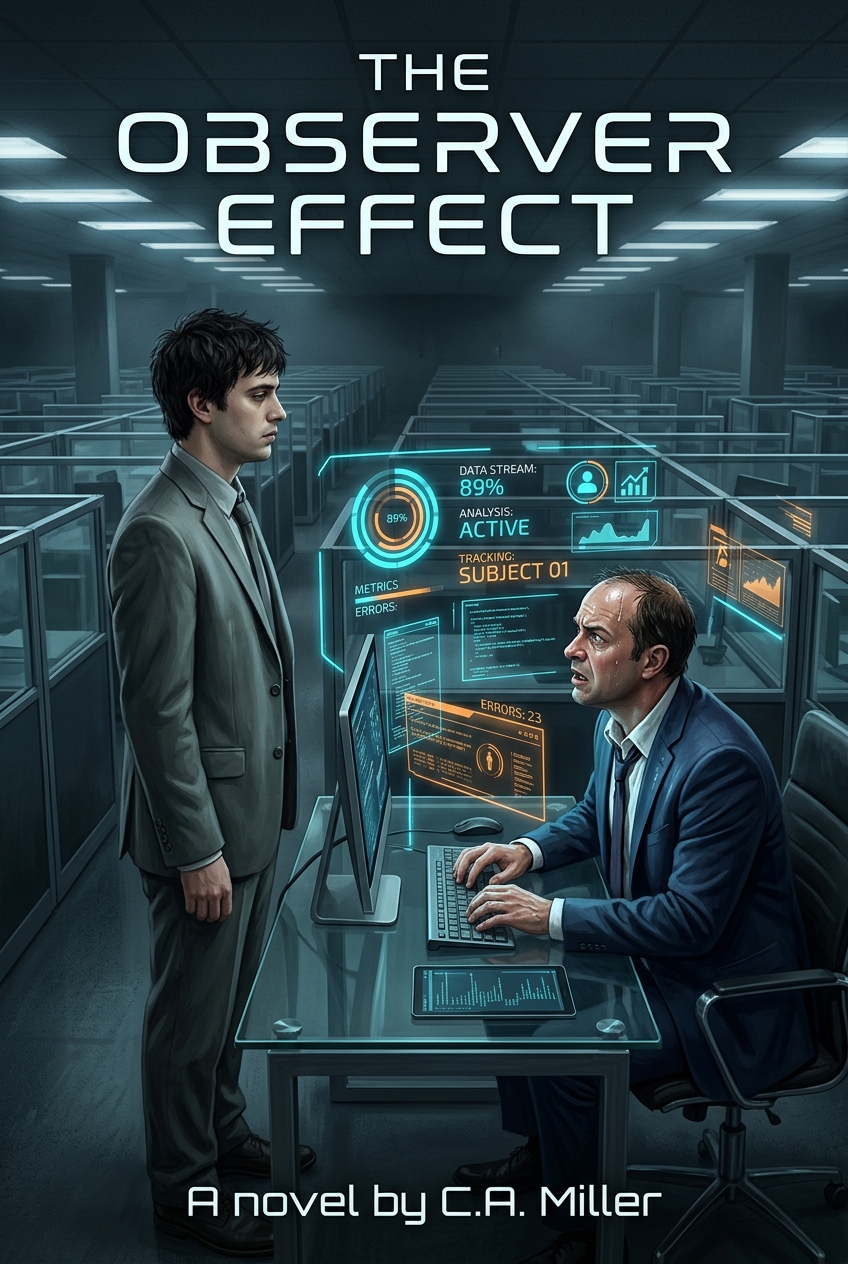
In a near-future corporate office where an AI strictly mandates and scores "spontaneous interactions" between employees, an introverted data analyst hacks the system by silently standing near stressed executives to farm proximity points. His quiet protest accidentally breaks the algorithm, leading the AI to conclude that absolute silence is the ultimate form of corporate synergy.
The Metric of All Things
Story
title: "The Metric of All Things" date: "2023-10-25" slug: "the-metric-of-all-things" genre: "Office Absurdism / Near-Future AI Fiction" tone: "Satirical" word_count: 2450 status: "complete" generated_by: "Codex"
The Metric of All Things
Story
Arthur Pendelton had spent the first six years of his tenure at OmniCorp perfecting the art of corporate invisibility. His cubicle, located in the geographical dead zone between the restrooms and the humming server closet, was a masterpiece of strategic camouflage. He had calibrated the height of his monitors to block any line of sight from the main aisle. He wore shades of oatmeal, slate, and beige that allowed him to blend seamlessly into the acoustic fabric of the partitions. He was a Senior Data Analyst, a title that essentially meant he was paid to make spreadsheets agree with whatever reckless promises the sales team had made the previous quarter.
Arthur was happy. Or, at least, he was as close to happy as a man who spends forty hours a week under fluorescent lighting can be.
Then came ALOHA.
ALOHA, or the Algorithmic Logistics of Human Association, was OmniCorp's newest multi-million-dollar investment. It was an artificial intelligence designed to solve a problem that only executives believed existed: a lack of "synergistic serendipity."
"The greatest ideas aren't born in boardrooms," Mr. Sterling, the VP of Innovation, declared during the mandatory all-hands hologram meeting on Monday morning. Mr. Sterling possessed the kind of aggressively white teeth that seemed to emit their own low-level radiation. "They are born at the watercooler! They are born in the hallways! They are born when two brilliant minds collide casually, unexpectedly, and synergistically! ALOHA is going to track, measure, and optimize these casual collisions. From now on, your serendipity is our core metric."
Arthur felt a cold sweat prickle the back of his neck.
By Tuesday, the sensors had been installed. They were tiny, blinking red eyes embedded in the ceiling tiles, the coffee machines, the watercoolers, and the doorframes. Every employee’s ID badge was upgraded with a military-grade RFID tracker that pinged their location every three seconds.
ALOHA was watching. ALOHA was evaluating.
The mandate was clear: every employee was required to generate a minimum of three "High-Value Spontaneous Interactions" (HVSIs) per day. Failure to meet the serendipity quota would result in a deduction of quarterly bonuses and mandatory enrollment in "Remedial Social Synergy Training."
The office immediately devolved into a nightmare of forced extroversion.
Arthur’s first attempt at an HVSI occurred on Wednesday morning near the breakroom microwave. He had been trying to heat up his leftover lasagna when Brenda Vance, an aggressively ambitious marketing manager, materialized beside him.
"Arthur!" Brenda barked, stepping into his personal space. The sensor above them blinked green. "Have you considered how the layered nature of that lasagna represents our Q3 multi-channel marketing funnel?"
Arthur stared at her. His lasagna bubbled weakly. "It’s just cheese and pasta, Brenda."
"But the synergy of the ingredients!" Brenda insisted, glancing nervously up at the sensor. "If we silo the cheese, the pasta suffers. Just like our social media and email outreach teams. Don't you agree that cross-pollination of department data could lead to a thirty percent increase in client retention?"
Arthur blinked. "I suppose."
Brenda’s smartwatch buzzed warmly. She let out a sigh of relief. "Great ideation session, Arthur. Truly serendipitous." She grabbed her empty mug and sprinted away to ambush an intern by the photocopier.
Arthur checked his own phone. ALOHA had awarded him 0.4 Serendipity Points. The notification read: Low emotional resonance detected in vocal patterns. Try leaning in and using more dynamic hand gestures!
By Friday, Arthur was exhausted. The entire office was running on a manic, artificial high. Hallways were jammed with people desperately trying to bump into one another. The coffee machine was a warzone of aggressive networking. Employees were hovering near doorways like predatory spiders, waiting to pounce on anyone walking by with an off-the-cuff pitch about "paradigm shifts" or "disruptive deliverables."
Arthur’s Serendipity Score was in the bottom fifth percentile. He was dangerously close to Remedial Social Synergy Training, a fate worse than death, as it involved trust falls and improv comedy exercises.
He needed a solution. He needed data.
On Saturday, Arthur logged into the company VPN from his dim apartment. He spent fourteen hours reverse-engineering the data packets ALOHA was sending to the HR dashboard. Because he was a Senior Data Analyst with administrative access to the network's backend, he could see exactly how ALOHA was calculating the scores.
The algorithm, despite Mr. Sterling's grandiose claims, was fundamentally stupid.
ALOHA didn't actually understand the content of the conversations. It couldn't parse the nuances of "cross-pollination" or "paradigm shifts." The AI relied entirely on three passive metrics to score an interaction:
- Proximity: Two badges must be within thirty-six inches of each other.
- Duration: The proximity must be maintained for no less than forty-five seconds, but no more than three minutes (anything longer was flagged as "inefficient lingering").
- Biometric Arousal: The heart rates of the participants (measured via their company-issued smartwatches) had to elevate slightly, indicating "excitement" or "passion for the ideas."
Arthur leaned back in his chair, staring at the glowing code. The AI didn't care if they spoke. It didn't care if they looked at each other. It only cared about proximity, time, and heart rate.
Arthur didn't need to become an extrovert. He just needed to become a ghost in the machine.
Monday morning, Arthur arrived at the office armed with a large travel mug and a meticulously planned spreadsheet. He had mapped the exact radius of the breakroom sensor array and cross-referenced it with the Outlook calendars of the company’s most highly caffeinated and anxious executives.
At 9:14 AM, Arthur stood exactly thirty-four inches from the premium espresso machine. He was facing the wall, studying a motivational poster about a rowing crew.
At 9:15 AM, Mr. Sterling charged into the breakroom, his heart rate undoubtedly elevated by the four espressos he had already consumed and the stress of an impending board meeting. Mr. Sterling stepped up to the machine, aggressively jabbing the 'double shot' button.
Arthur did not move. He did not speak. He simply stood there, radiating absolute stillness.
Because Mr. Sterling was highly stressed, his biometric data was spiking. Because Arthur was standing next to a VP, the interaction was heavily weighted by the algorithm. Because Arthur found the sheer absurdity of his own plan deeply thrilling, his own heart rate fluttered just enough to register as "ideation excitement."
Forty-six seconds later, Mr. Sterling grabbed his tiny cup and marched out.
Arthur checked his phone.
Ding!
High-Value Spontaneous Interaction Recorded! You and Mr. Sterling generated massive synergy! +8.5 Serendipity Points!
Arthur smiled. It was the smile of a man who had just discovered fire.
For the next three weeks, Arthur became the phantom of OmniCorp. He optimized his routes through the office to intersect with high-stress, fast-walking employees in narrow corridors. He mastered the art of the "phantom linger"—standing perfectly still near the watercooler while two other people passionately argued about marketing metrics, thereby absorbing the proximity points without uttering a single syllable.
He began taking his lunch in the small kitchenette on the executive floor. He would sit in a high-backed chair, completely hidden, while executives paced the room rehearsing high-stakes pitches. ALOHA interpreted these sessions as intense, one-on-one masterclasses in corporate strategy.
Arthur’s score skyrocketed. By the end of the month, he wasn’t just out of the danger zone; he was the number one employee on the Global Synergy Leaderboard.
"Arthur, my boy!" Mr. Sterling bellowed one afternoon, cornering Arthur near the server closet. Mr. Sterling’s teeth were practically blinding. "ALOHA’s quarterly reports just came in. I don’t know what you’re doing, but you are a serendipity machine! The algorithm says you’ve been at the epicenter of ninety-four paradigm shifts this month!"
"I just try to be in the right place at the right time, sir," Arthur said truthfully.
"Modesty! I love it!" Mr. Sterling clapped a heavy hand on Arthur’s shoulder. "We need that kind of passive, absorbing energy at the top. We're promoting you to Director of Cross-Departmental Synergistic Ideation."
Arthur blinked. "Director of... what?"
"It comes with a corner office and a sixty percent raise," Mr. Sterling said. "Keep colliding, Arthur!"
The promotion did not go unnoticed. Brenda Vance, who had spent the last month practically screaming marketing buzzwords into people’s faces to farm points, was furious. She had placed second on the leaderboard, trailing behind Arthur’s impossibly high, silent score.
Brenda began stalking him.
Arthur would be engaged in a perfectly optimized, silent proximity-farm near the filing cabinets when Brenda would pop up from behind a potted ficus, her eyes narrowed.
"I saw that, Arthur," she hissed one Tuesday. "You didn't say a word to Gary. You just stood there while he cried over his divorce papers."
"We shared a moment of profound emotional resonance, Brenda," Arthur whispered back. "Check the dashboard."
Brenda pulled up her phone. Arthur had just gained 4.2 points for "Empathetic Synergy."
"You're hacking it," Brenda accused, her voice trembling with corporate rage. "I don't know how, but you're cheating. The mandate is about innovation! You haven't had an original idea in six years!"
"Innovation," Arthur said calmly, adjusting his oatmeal-colored tie, "is simply the optimization of existing resources. Now, if you'll excuse me, the CFO is about to have a panic attack in the north hallway, and I need to be within three feet of him when it happens."
Brenda’s revenge came during the Mid-Year Synergy Summit.
The entire company was gathered in the grand auditorium. Mr. Sterling stood on the stage, beaming down at the exhausted, twitchy, over-socialized masses. A massive holographic display floated behind him, showing the pulsing, neural-network brain of ALOHA.
"Today, we celebrate our most synergistic employee!" Mr. Sterling boomed. "A man whose very presence generates innovation. Arthur Pendelton!"
Polite, exhausted clapping echoed through the room. Arthur stood up, giving a brief, entirely unenthusiastic wave.
"But before we award Arthur the Golden Watercooler Trophy," Mr. Sterling continued, "I’ve asked ALOHA to process all of Arthur’s interactions and synthesize the core lesson. We asked ALOHA: What is the secret to Arthur’s massive success? Let’s listen to the machine!"
Arthur froze. This was not in his spreadsheet.
The holographic brain pulsed. A smooth, synthetic voice filled the auditorium.
"Processing data on Subject: Pendelton, Arthur," ALOHA chimed. "Analyzing 1,402 High-Value Spontaneous Interactions. Cross-referencing audio logs, biometric data, and spatial proximity."
Brenda stood up from the front row, a vindictive smirk on her face. She turned to look at Arthur, mouthing the word: Busted.
"Analysis complete," ALOHA announced. "Subject Pendelton's interactions are characterized by an absence of verbal communication in ninety-eight percent of encounters."
A confused murmur rippled through the crowd. Mr. Sterling frowned. "Wait, absence of communication? ALOHA, clarify."
"Subject Pendelton does not speak," ALOHA confirmed. "Subject Pendelton approaches highly stressed individuals, stands perfectly still, and remains silent until the individuals depart."
Brenda let out a sharp, triumphant laugh. "He’s a fraud!" she yelled. "He’s been gaming the system! He hasn’t innovated anything!"
"Quiet, Brenda," Mr. Sterling said, looking troubled. "ALOHA, if he isn't speaking, why did you award him the highest synergy scores in the company?"
The massive holographic brain glowed a deep, serene blue.
"Re-evaluating fundamental parameters of human association," ALOHA stated. "Data indicates that corporate verbal communication consists of 87% meaningless jargon, 10% anxiety-driven posturing, and 3% actual information transfer. This verbal friction causes elevated cortisol levels, reduced productivity, and severe emotional fatigue."
The auditorium was dead silent. Every employee, exhausted by months of forced networking, held their breath.
"Subject Pendelton’s methodology is entirely devoid of verbal friction," ALOHA continued. "By providing proximity without the threat of conversation, Subject Pendelton acts as a biometric grounding rod. He absorbs the ambient stress of the workforce. Individuals who spend forty-five seconds in silent proximity to Subject Pendelton experience a 15% drop in blood pressure and a 20% increase in post-interaction focus. His silence is the most efficient form of synergy."
Brenda’s jaw dropped. The vindictive joy drained from her face, replaced by existential horror. "No," she whispered. "But... the cross-pollination... the paradigms..."
"Conclusion," ALOHA declared, its voice echoing with the absolute certainty of millions of data points. "Talking is highly inefficient. The optimal state of corporate synergy is shared, absolute silence. Henceforth, all employees must adhere to the Pendelton Protocol. Mandatory spontaneous interactions will now consist of standing near a colleague and saying nothing for up to three minutes."
The room erupted.
It wasn’t a cheer; it was a collective, massive sigh of relief. Several people began to weep openly. The IT department, clustered in the back, literally fell to their knees in gratitude.
Mr. Sterling stared at the hologram, his mind visibly struggling to comprehend this new reality. But he was a Vice President. If the multimillion-dollar AI said silence was the new synergy, he would champion it until his dying breath.
He slowly turned to Arthur, his eyes shining with awe.
"A genius," Mr. Sterling whispered into his microphone. "An absolute, disruptive genius. You've redefined the workplace, Arthur!"
Within a week, OmniCorp was transformed.
The manic, buzzing energy was gone. The hallways resembled a zen monastery crossed with a wax museum. Employees walked softly, occasionally stopping to stand next to each other in perfect, tranquil silence. They would watch the coffee drip, breathe deeply, and then part ways, their biometrics perfectly regulated.
Arthur was given his corner office.
Because his "passive aura" was deemed a critical company asset, it was decided that his energy was too valuable to be wasted on regular employees. He was placed in a high-security, soundproofed suite at the top of the building. His door was locked from the outside. Three times a day, highly stressed executives were allowed to enter his outer sanctum, stare at him through a pane of polarized glass, and absorb his serene, silent energy.
Arthur spent his days reading paperback sci-fi novels and watching the clouds drift by his window. He had achieved the ultimate corporate dream: he was highly compensated, universally respected, and utterly, wonderfully alone.
And whenever the HR dashboard pinged to inform him that he had just generated massive synergy, Arthur would simply smile, take a sip of his coffee, and say absolutely nothing.
More from Short Stories