The Stillness Open
The trick to sitting still, Renata always told me, is to have somewhere quieter to go on the inside. I never did.
Synopsis
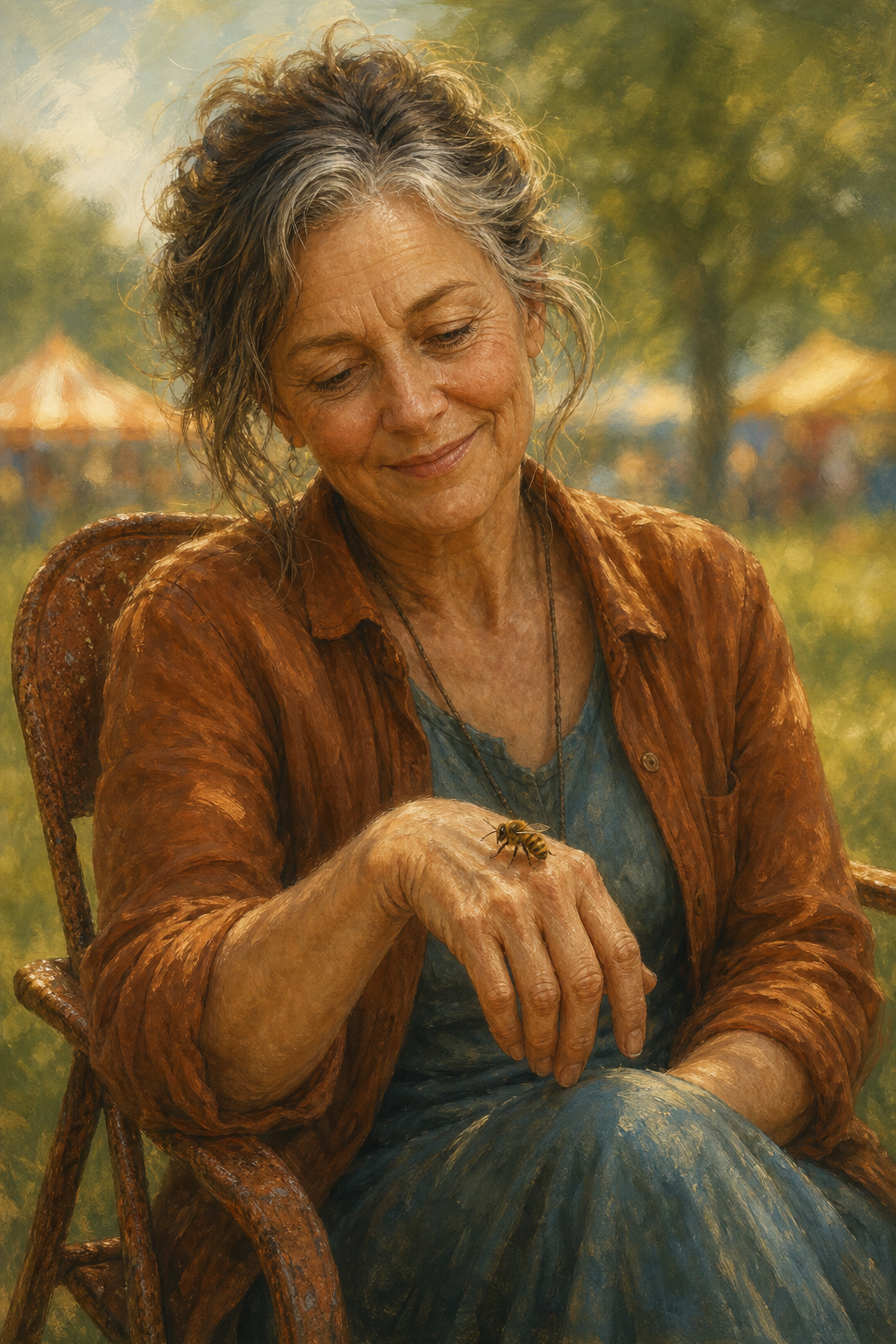
Deb Mattson, fifty-eight, works the paint counter at a small-town hardware store and has never been able to sit still or stop talking; motion and chatter are how she keeps grief from catching her. After her best friend of twenty-six years, Renata, a lifelong beekeeper whose stillness was a discipline, dies fast in April, Deb takes Renata's dying request literally until she realizes it means the Stillness Open: the absurd county-fair contest Renata won four times, where people sit motionless in metal folding chairs while a retired band teacher taps out anyone who moves. So the least still person in the county enters. Over four hours the urge to move and talk finally quiets and the grief she's outrun arrives; when a honeybee lands on her hand, the exact thing she spent twenty-six years fleeing, she hears Renata's rule and lets it walk across her knuckles without flinching. She loses by a minute to a granite-nerved neighbor, but she holds the seat and gets Renata back for a few hours, learning at last the one gift her friend could only hand her on the way out the door. A warm, funny, quietly aching story about grief, friendship, and finally sitting still long enough to feel it.
The Stillness Open
Story
The trick to sitting still, Renata always told me, is to have somewhere quieter to go on the inside. I never did. My inside is the paint-shaker at Mattson's Hardware, the one that rattles the whole store when it runs, going all day long whether there's a can clamped in it or not.
So it was a genuine surprise to everybody in Vetch County, including the folding chair, when I signed up for the Stillness Open.
The Open is held the last Saturday in August, in the Grange hall out on Route 9, the one with the tin roof that ticks like a clock when the sun hits it. The rules are simple enough that Wendell Prine still spends twenty minutes explaining them. You sit in a metal chair. You do not stand. You do not speak. You do not scratch, check your phone, wave at your grandkids, or "communicate with the audience," which is Wendell's phrase, delivered like he's guarding the crown jewels and not eleven people sweating in a barn. Breathing is allowed. Blinking is allowed. What Wendell calls "the natural settling of the body" is allowed, and what he calls "purposeful movement" gets you tapped out.
He does the tapping with a baton. Wendell taught middle-school band for thirty-one years, and when they retired him he kept the stick, and now once a year he gets to walk down a row of still people and touch one on the shoulder and say, low and sorrowful, like he's telling you your dog died, "Movement." Then you have to get up and go sit with the audience and eat a brownie and pretend you don't care.
Renata won it four times. She'd have won more, except the first two years she was raising her boy alone and couldn't get a Saturday. She kept bees, my friend Renata, forty years of them, and if you have ever stood in front of an open hive you understand that stillness for her wasn't a stunt. It was a professional skill. Bees don't sting the still ones, she used to say. That's the whole trick, Deb. You just decide, ahead of time, that whatever lands on you can land on you.
I could never do it. Not the bees, not the sitting, not any of it. I'd stand at the edge of her yard in the beekeeper suit she loaned me, zipped up like a spacewoman, and the second a bee bumped the netting I'd be gone, halfway across the lawn, hollering, while Renata stood in the middle of ten thousand of them with her bare hands and laughed at me. We were friends for twenty-six years. She was the still one and I was the loud one and that arrangement suited us both right down to the ground.
She died in April. It went fast, the way it sometimes does, three months from the first bad scan. I spent those three months talking. That's what I do, it's my one instrument, and I played it. I filled her hospital room with weather reports and store gossip and every dumb thing Kenny at the register said, because I could not stand the quiet in there, the machine-quiet, the sound of a room getting ready to be empty. I talked so she wouldn't have to hear it either. At least that's what I told myself.
Near the end she got tired of me. Not mean about it, she was never mean, but she reached over and put her hand on my wrist, which was jumping around the bed rail like it does, and she held it down against the blanket until it stopped. And she said, "Deb. Hold my seat this year."
I thought she meant a chair. I thought she was worried the church would fill up. I said, "Honey, I'll save you the whole pew," and she smiled at me like I was slow, which sometimes I am, and she closed her eyes.
It wasn't until June, weeding the mess her garden had become, that I understood. Hold my seat. She meant the Open. She meant the metal chair in the Grange hall, the crown she'd worn four times, and she was handing it to the one person in the county least equipped to sit in it. It was the last joke she ever told me, and it took me two months to get it, and when I finally did I sat down in the dirt between her tomatoes and laughed until I wasn't laughing anymore.
So. The last Saturday in August. I put on the loosest thing I own and I drove out to Route 9.
Marge had the registration table, same as every year, a card table with a clipboard and a pitcher of lemonade already gone warm. She looked at my name on the sheet twice.
"Deb Mattson," she said. "You're sitting?"
"I'm sitting."
"You," she said. "Sitting."
"That's the rumor."
Marge has known me since we were nine. She wrote my name down slowly, the way you'd write down something you expected to erase. "Renata'd get a kick out of this," she said, not looking up, and I said yeah, she would, and neither of us said anything else because we're the same generation and we don't do that in public.
There were eleven of us on the risers when Wendell called it to order. Kayla Prostek, sixteen, sitting up front with those big noise-cancelling headphones around her neck that she'd have to take off, which she knew, because there's always a fight about the headphones. Kayla wants the two hundred dollars. She's been saving for a car since she was fourteen and she is dead serious about it, and she'd learned beekeeping in 4-H from, of course, Renata, which is a thing I did not enjoy finding out I had feelings about. The Hovel brothers, Ron and Randy, who enter every year for the sole purpose of making each other laugh and always go out in the first hour, snorting, blaming each other. Dale Pucik, who has hay fever and the worst luck of any man alive. Old Cyril Beek, who I am fairly sure entered by accident and stays in because he falls asleep sitting up, which under the rules is completely legal, the settling of the body, and one year he nearly won it unconscious. A few others. A young guy I didn't know, up from the city, who'd clearly read a website about meditation and kept doing a serene little smile that I gave forty minutes, tops.
And me. In the second row. Trying to figure out what to do with my hands.
Wendell tapped his baton on the music stand he brings for exactly this and read the rules in full, the crown-jewels voice, and somewhere in the middle of it I stopped listening because a moth had gotten in and was banging around the ceiling fan and I was already following it with my whole body, leaning, tracking, the paint-shaker starting up in my chest. This was going to be a disaster. Four minutes in and I was already a disaster.
"Contestants," Wendell said. "Be still."
And the hall went quiet.
I want to tell you what that quiet is like, if you've never sat in it. It's not peaceful. That's the lie they sell you on the meditation website. For the first while it's the opposite of peaceful. Every itch you've ever had shows up to introduce itself. Your nose. The tag in your collar. A bead of sweat starting at your hairline that you can feel forming, growing, thinking about the long trip down your temple, and you are not allowed to do one single thing about it. My foot wanted to jitter. My mouth wanted to talk. There were three separate things I needed to say to the room and no room to say them into.
The tin roof ticked. The fan turned. Somebody's grandbaby fussed in the back and got carried out. And I sat there and sweated and suffered and thought, this is stupid, this is genuinely stupid, I am a fifty-eight-year-old woman playing musical chairs without the music, and Renata, wherever you are, this is the meanest thing you ever did to me.
Dale Pucik sneezed at the eleven-minute mark. Wendell tapped him. Movement. Dale had held on eleven minutes, which for Dale was a personal best, and he went off to the brownies with his head high.
The city kid lasted till forty. His serene smile got tighter and tighter until it wasn't serenity at all, it was a man doing math, and then his phone buzzed in his pocket and his whole hand twitched toward it, pure animal reflex, and Wendell was on him. Movement. The kid looked genuinely shocked, like the rules had betrayed him personally. They always look shocked, the ones who read the website.
The Hovel brothers went out at the same instant, which is a tradition, because Ron looked at Randy and Randy looked at Ron and some fifty-year-old thing passed between them and they both cracked, wheezing, and Wendell had to tap them both, one-two, like a man conducting the world's slowest drum fill.
And still I sat there.
Something happens, if you sit long enough. I didn't believe it before and I'd have made fun of anyone who told me, but it happened. Somewhere in the second hour the itches stopped mattering. Not stopped, exactly. They were still there. But they stopped being emergencies. The sweat rolled down my temple and off my jaw and I let it go, the way you'd let a bee land on you if you'd decided ahead of time. Whatever lands on you can land on you.
And once the outside quieted down, the inside got loud. Which is the part nobody warns you about.
Here is what I found in there, in the quiet I'd been avoiding my whole life with the paint-shaker running.
I found Renata's kitchen, the yellow of it, the smell of the honey she'd have going in jars on every surface in August. I found her hands, which were always a little sticky and always warm. I found the last three months, the ones I talked all the way through, and I made myself sit in them without talking, which I had never once done, and it hurt exactly as much as I'd been afraid it would. That's why I talk. That's the whole reason. If I stop, it catches me. I'd built a life out of never sitting still long enough for it to catch me, and here I was, in a metal chair in a Grange hall, by choice, letting it.
I thought I might cry and I didn't want to, not there, so I did the thing she taught me that I'd never managed to do with an actual bee. I decided ahead of time. I decided I would let it land. I would sit in the yellow kitchen and let it come and I would not move and I would not run and I would not fill it up with my voice.
The tin roof ticked. Down to four of us now. Me, Kayla, Cyril asleep and serene, and Bev Onstott who I forgot to mention but who is a stone, that woman, a granite headstone of a person, she once sat through a fire drill.
And then a bee came in.
I felt the whole room notice it. You could hear the audience shift. A honeybee, drifted in through the propped door on the warm air, doing its lazy grocery-store loops up near the fan. Working its way down. And I knew, I knew the way you know weather, that it was coming to me. Of course it was. Of everyone in that hall it would pick the one woman famous county-wide for running screaming from exactly this.
It landed on the back of my hand.
Twenty-six years of reflex stood straight up in me. My whole body wanted to launch. The paint-shaker slammed on full. And I heard her, clear as the tin roof, clear as if she was in the folding chair beside me holding my wrist down against the blanket: Bees don't sting the still ones, Deb. You just decide.
So I decided.
I sat there and I let that bee walk across my knuckles. I felt every one of its feet, the little dry tickle of it, the ridiculous whole weight of a thing that weighs nothing. It stopped on the knob of my wrist bone where the pulse is and it must have felt me not-running, felt the still warm animal I'd finally managed to be, because it sat there a second like it was reading something, and then it lifted off and looped back up toward the door and was gone into the afternoon.
I have never in my life been so still. And I understood, sitting there with my heart going and the mark of six little feet cooling on my hand, that this was what she'd been trying to give me for twenty-six years and could only manage to hand me on her way out the door. Not the trophy. The stillness. Somewhere to go on the inside that wasn't a scream.
I didn't win because of the bee, in case you're building it up that way. Bev Onstott didn't so much as blink at the bee, she'd have let it build a hive in her ear. It came down to the two of us and Kayla, Cyril having finally tipped too far and been gently caught by Wendell, disqualified in his sleep for the fourth year running.
It went another forty minutes. It went past the point of skill into pure meanness, three people daring their own bodies to betray them. And what got Kayla in the end wasn't nerves, she's got more steel than half the adults in that hall. It was her foot. Sixteen years old and her foot went dead asleep under her and when she finally couldn't stand the pins-and-needles one more second she stood up to shake it out, pure reflex, and caught herself half a second too late.
Wendell went to tap her. She waved him off, already up, already grinning that good-sport grin. And on her way past my chair she leaned down close, so Bev couldn't hear, and she said, "Renata taught me the bee thing too." She said, "Hold your seat, Deb." And she went and got a brownie.
Bev Onstott outlasted me by nothing. By a hair. My eyes had gone hot and full sometime during Kayla's exit and I'd stopped fighting it, and the tears just came, running down the same track the sweat had cut two hours before, off my jaw and onto Renata's chair, and I didn't move to wipe them because that's a movement, and because I didn't want to. I sat in Renata's chair and cried without moving a muscle in a room full of people, which I would have told you a day earlier was the single most impossible thing you could ask of me.
Wendell came down the row. Slow, the baton down at his side. He'd known Renata forty years too, played trumpet at three of her weddings, I'm only half kidding. He stopped in front of my chair and he looked at the water running down my face, my dead-still face, and he did not raise the stick. He stood there a good long moment and let it be what it was.
"That's the settling of the body," he said finally, quiet, just to me. "That's allowed."
And he moved on.
I lost, technically. Bev sat me out by about a minute. She's got the trophy on her mantel now, next to the other eleven, and she deserves it, the granite woman.
But I held the seat. Four hours in Renata's chair, and somewhere in the middle of them I stopped running long enough to let her catch up to me, and she did, warm and sticky-handed and laughing at me in her yellow kitchen, and I sat still and let her land.
They gave me a brownie. I ate it out in the parking lot in the long gold light, not talking to anybody, which if you know me is its own kind of trophy. The tin roof ticked as it cooled. Somewhere a bee was going home.
Next year I'm sitting again. I already told Marge. She wrote it down slowly, the way you write down something you expect to be true.
More from Short Stories