Bottom Time
Somebody was breathing on the other side of the comms.
Synopsis
Sixteen days into a saturation dive to plug and abandon a dead North Sea wellhead, commercial diver Vee Adeyemi hears a second breathing rhythm on her comms line and a knock on a flowline that only one person ever used, a partner named Robbie Voss who died on this same seabed three years earlier while she was his bellman and watched his air run out. As the job pushes her deeper into a stretch of water divers quietly call the Widow's Slot, a fraying nervous system, unresolved guilt, and something that may or may not be down there with her converge on a single bad excursion: a lost grip on her tether, a shape holding still at the edge of her lamp, and a wordless pressure pointing her back to the line before her air or her sanity runs out. She survives the dive and finishes the sat, but decompression ends with Robbie's long-lost spanner surfacing in the recovery net, four years and forty metres from where it should have rusted into nothing, and Vee has to decide what to do with a piece of evidence that fits no report she is willing to file.
Bottom Time
Story
Somebody was breathing on the other side of the comms.
Not static, not the wet click of the regulator diaphragm, not the compressor's steady chug three hundred feet up. A second rhythm, laid under mine, a half-beat behind. In sat you learn every noise your own body makes underwater: the reg breath, the little glug when you swallow, the creak of the neck dam. This wasn't mine.
"Cormorant, you copy the line noise?" I said. My voice came out in the register everybody warns you about and nobody gets used to, helium squeezing every word up into a cartoon. Sixteen days into this job and it still made me want to laugh at the worst times.
"Copy nothing, Vee. Channel's clean my end." Priya, on the gas panel topside, flat and unbothered, the way she said everything. "You logging four hundred psi on the bailout?"
"Four-twenty." I checked the gauge again because checking things is what keeps you alive down here, not courage. Around me the water held the particular black of a hundred and fifty-four metres, a black with weight to it, that pressed on the lamp beam until the beam gave up about a body-length out and let the dark have the rest.
"Copy four-twenty. Sully, you got eyes on her?"
"Got her tether." Sully's voice, gravel dragged through the same helium squeeze, from the bell twenty metres behind me. He was bellman this run, which meant he sat in the doorway with my umbilical looped over his knee and did nothing for forty minutes at a stretch except watch a rope and be ready to die for me if the rope told him to. "Vee, your breathing's off. You're running fast."
"I'm fine."
"Didn't say you weren't fine. Said you're running fast."
I made myself slow it down, four counts in, four counts out, the drill they'd hammered into me at the school on the Clyde eleven years back, and the second rhythm under the comms slowed with me. Matched me. Like something learning my pace.
I didn't say that part out loud.
The job was simple, on paper. Kestrel field, decommissioned, the wellhead a stub of rusted tree sitting on the seabed with a valve that hadn't been cracked since the platform above it got towed away for scrap four years ago. Plug and abandon: kill the well, cap the tree, cut the flowline, walk away and let the North Sea have it back. Cormorant Star had been on station eleven days doing exactly this kind of clean, boring, well-paid work on three other stubs a mile north, and this was the last one. Day sixteen of a twenty-one day sat. Four more bell runs and decompression and I'd be back in my flat in Aberdeen not answering the phone for a fortnight, the way I did every time.
I hadn't looked at the coordinates until we were already trunked into the chamber system and pressurized past the point of backing out. Fulmar Ridge. The company charts called it Fulmar Ridge. Every diver on the North Sea circuit called it the Widow's Slot, quietly, the way you'd say a word you didn't fully believe in but wouldn't test.
Three years ago, forty metres from where I was standing now, a collapsed conductor cage had come down across a diver's umbilical during a P&A job that went the same way this one was supposed to: routine, boring, a Tuesday. The diver's name was Robbie Voss. He was thirty-four. I know because I was his bellman that day, and I watched the tension come off his tether like a held breath let go, and by the time the standby diver reached him he had eleven minutes of bailout gas and had used all of it finding out that eleven minutes wasn't enough.
They didn't reroute the P&A schedule around his death. There wasn't a reason to, on paper. The company sent me a different job for two years, and I took it, and I told myself that was coincidence too.
"Vee." Sully again. "You stopped."
I had. I was standing over the wellhead with my hand on the valve wheel and I had stopped, and I hadn't noticed stopping, which scared me more than anything the dark had done yet. The lamp threw its short cone across the tree, the rust standing off it in flakes the size of my palm, and past the cone there was nothing to see, which is the ordinary condition of the job and shouldn't have felt like being watched.
"Copy, just reading the valve stamp." A lie, easy as breathing gas. "Confirming it's the right stub."
"Confirm it faster. You've got nine minutes bottom time before I want you moving back toward the bell."
I turned the wheel. It gave with the specific groan of four years' corrosion breaking loose, and under the groan, threaded through it so close I couldn't have separated the two sounds if you'd paid me, came three taps. Not the valve. Not the tree. Metal on metal, deliberate, from somewhere behind the flowline where the lamp didn't reach.
Three taps, pause, two taps. Robbie's knock. The one he used on the bell hatch every single dive for six years, a stupid private code between the two of us because he thought Morse was for people who took themselves too seriously and this was funnier. Three-two. Vee-oh. His joke. Nobody else on any crew I'd worked used it, because nobody else had ever dived with him as long as I had.
I did not move for four seconds, which is a long time to not move at a hundred and fifty-four metres with your hand on a wellhead valve and your dead partner apparently knocking on a flowline.
"Talk to me, Vee." Priya, sharper now, hearing something in the silence even secondhand through a comms line.
"Heard a noise on the flowline. Probably current shift, debris settling." My voice was doing the helium thing worse than usual, thin and unconvincing even to me. "Continuing task."
"Sully, get eyes toward the flowline."
"Can't, I'm on her tether, that's the whole point of me." A pause, and then, quieter, the kind of quiet that wasn't for Priya: "Vee. You alright down there."
"I'm alright." I was not going to be the diver who got pulled off a job for hearing knocking. I had watched that happen to a man named Osei two seasons back, heard the whispers after, watched his contracts thin out until he took a topside job selling regulators in a dive shop in Leith. I turned back to the valve and finished the crack-open, logged the pressure bleed, and did not look at the dark past the flowline again, which took more discipline than anything else I did that whole sat.
The knock didn't come again. I told myself that was because it hadn't been anything, and some other part of me, the part that had spent three years not looking at coordinates, understood it hadn't needed to. It had gotten what it wanted, which was for me to know it was there.
Sully hauled me in on the tether at nine minutes fifty, standard, nothing dramatic, and I sat in the bell with the hatch dogged and the heaters ticking and let my hands shake in my lap where he couldn't see them past his own paperwork.
"You went stiff out there," he said, not looking up from the log. Sully was fifty-one, had been diving since before I was born, had a face like something left out in weather too long and a way of saying the true thing sideways so you could pretend he hadn't. "Twenty-six years I've been reading divers off a bell doorway. I know stiff."
"Cold got into my hands."
"Heaters are running fine. I checked before you went stiff." He capped his pen. "Tell me what you saw, or tell Priya you're off tomorrow's run. Those are the two doors, Vee. Pick one."
I picked a third door, which was silence, and he let me have it, which was its own kind of answer about how much he already suspected.
Back in the chamber that night, the three of us plus the memory of the fourth berth that had been converted to gear stowage after they downsized the crew for this job, I lay in my bunk and listened to the hiss of the environmental control and thought about the last dive I'd done with Robbie before the one that killed him. He'd been complaining about his knee. He'd been talking about buying a boat, a stupid little day boat, nothing to do with commercial work, just something to take his kid out on once his contract ran long enough to afford it. He didn't have a kid yet. He was going to, with a woman named Els in Cape Town who I'd met exactly twice and liked both times. The boat was going to be called Els's Fault, which he thought was the funniest thing he'd ever come up with.
Nobody found his tool roll. That detail had stuck harder than it should have, in the inquiry afterward, in the two years I didn't take North Sea contracts, in every bell run since where I catalogued my own gear compulsively before every excursion because some part of my brain had decided that gear going missing was the actual danger, more than depth, more than gas, more than the collapsed cage that had actually killed him. His spanner, the one with RV stamped into the handle because tools grew legs on every boat he'd ever worked and he'd started marking his out of spite, had never come back up. Deep sat, cold water, four years of current and silt: it could be anywhere in a two-hundred-metre radius or nowhere at all, dissolved into rust the way everything down there eventually was.
I didn't sleep so much as I stopped being awake for periods that didn't feel restful.
Day seventeen, my next run, the topside supervisor's voice on the panel had changed to Frank Doss doing his rounds check, businesslike, uninterested in anything but numbers, and that briskness helped. I went out to finish the cut on the flowline, hydraulic shears, unglamorous, forty minutes of bracing my body against recoil while metal parted a millimetre at a time. The knock didn't come. I told myself, again, that this proved something, and didn't examine too closely what.
It was on the swim back, sixty metres from the bell with the flowline behind me and my lamp swinging its short useless cone across nothing, that the tremor started.
HPNS, they call it in the manuals, like an acronym could make it smaller. High Pressure Nervous Syndrome. Past a certain depth the gas itself starts working on your nervous system, and it comes on as tremor first, hands, then jaw, and if it's bad, vertigo and a kind of waking dream state where you can't fully trust the difference between what's in front of you and what your compressed, straining brain is generating to fill the gap. We compress slow specifically to keep it manageable. Sixteen days in, a hundred and fifty-four metres, cold, fatigue, adrenaline: it had been building in me the whole sat and I had been telling everyone, including myself, that it was fine, because admitting otherwise meant admitting I might not finish the job, and divers who don't finish jobs stop getting called.
My hand shook so hard on the tether guide that I lost my grip on it, which is the thing you are never, ever supposed to let happen, and for four full seconds I hung in black water with no line to follow and no bell in my lamp beam and the particular vertigo of a hundred and fifty-four metres deciding, with total conviction, that up was somewhere other than where my inner ear was telling me.
That was when I saw him.
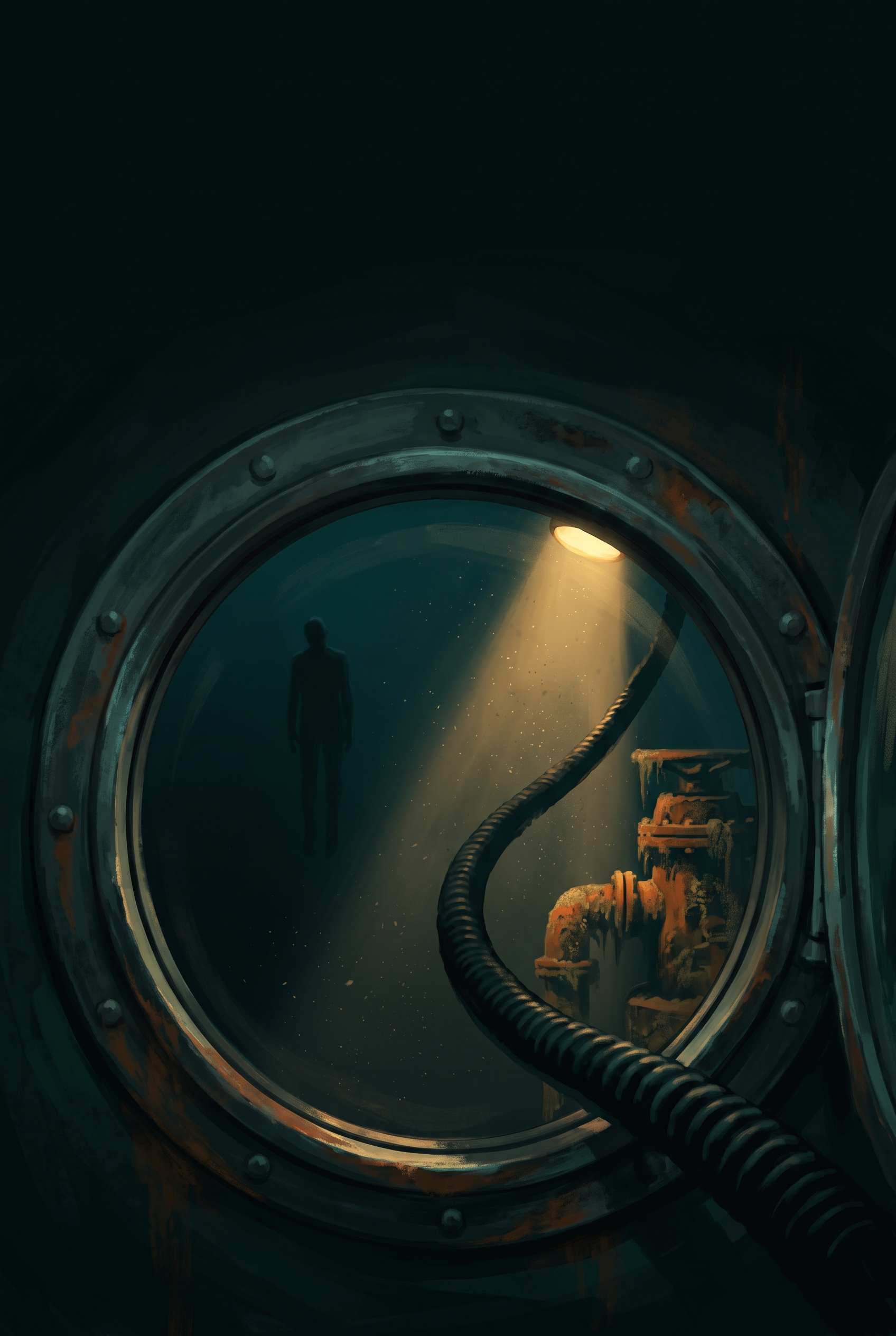
Not close. At the very edge of where light gave out, a shape holding still in the water the way nothing organic holds still down there, man-shaped, dark against dark, and I want to be honest about what I actually saw versus what sixteen days of sat and a failing nervous system and three years of a name I wouldn't let myself think handed me afterward: a shape. A stillness. Nothing with a face. My mind supplied the face, the way minds do, filled the gap the same way it fills the gap between a knock on a flowline and a man dead three years, and it gave the shape Robbie's face, calm, unbothered, the exact expression he used to wear checking my rig before a dive because he trusted his own hands on the straps more than mine.
I did not hear a voice. I want that on the record, if this is a record of anything. I did not hear him tell me which way was up. What I felt, if feeling is even the honest word for something that happened in a body that wasn't reliably reporting anything to me in that moment, was less a message than a pressure, the way you feel a hand on your shoulder before you consciously register whose hand it is, pointing.
I went the direction the pressure pointed. My hand found the tether four metres on, exactly where it would have been if I'd simply misjudged the current instead of losing my mind, which is the explanation I have given every official who has asked, including myself, on the nights it doesn't work.
"Vee, talk to me, your telemetry's all over the place." Priya, and under her the low fast murmur of Frank on a second line, and Sully's voice cutting through both of them, no longer bothering to hide anything: "I'm coming out."
"No. I'm on the tether. I'm fine." My hands were still shaking. My voice wasn't, which surprised me more than the shape had. "Tremor. Bad one. I'm hauling in."
He hauled me in himself, hand over hand, faster than protocol and neither of us mentioned that, and got me through the hatch and out of the water and sat with his hand flat on my back while I shook against the bell wall for ninety seconds that felt considerably longer, and did not once ask me what I'd seen, which told me he already had a guess and didn't want it confirmed any more than I wanted to confirm it.
Frank pulled me off the schedule for two days after that, standard, no drama, tremor severity logged and reviewed, and I let him, because the alternative was explaining why I thought pulling me off was both correct and useless.
The last bell run of the job fell to Sully and a diver named Marcus who'd been flown in specifically to finish it, since company medical wouldn't clear me for excursion again this sat, only for standby. I sat in the bell as bellman this time, Sully's tether over my knee, and watched the gauge, and did the job I'd watched him do for me a hundred times, and told myself the numbness in my hands was cold.
Cormorant Star's recovery crew brought up the debris net two days later, the standard sweep before decompression, everything loose that four bell runs had cut free from the wellhead and the flowline, scrap metal and marine growth and the ordinary detritus of a decommissioning job, laid out on the deck for cataloguing before it went to the scrap barge.
I wasn't there for it. I was in the chamber on day nineteen of twenty-one, deep into decompression, breathing gas mixes that were slowly, carefully, giving me back the surface a few kilopascals at a time, watching the pressure gauge outside the porthole instead of a depth gauge, which is its own kind of relief.
Priya brought it to the viewport on day twenty, held it up against the thick glass without a word, because you can't pass anything through a chamber wall at pressure and she knew exactly what she was showing me before she showed me.
A spanner. Rust-eaten, the jaw bent slightly from four years of tide working it against rock, but the handle mostly intact where corrosion hadn't reached, and stamped into the metal in letters gone soft at the edges but still legible if you already knew what you were looking for: RV.
I looked at it through eight centimetres of chamber glass for a long time. Priya didn't say anything. There wasn't a version of what she could have said that would have been the right size for it.
"Log it as recovered debris," I told her, finally, through the intercom, my voice climbing helium-thin the way it had every single day of this sat and would for one more day yet. "Nonferrous, tag it for the scrap manifest."
"Vee. You want me to bag it separate? For you?"
Outside the topside window behind her the sky had gone the flat grey of a North Sea afternoon that couldn't decide on rain, ordinary, uninterested in anything I'd just watched pass across the glass. I thought about Els, who I hadn't spoken to in three years and who had a right to this that I didn't, and I thought about a boat that never got built and a name it was never going to wear, and I thought about a shape holding still in black water that had pointed, once, the right direction, and asked nothing back.
"Yeah," I said. "Bag it separate."
I did one more sat that year, a short one, shallow, uneventful. I did four more the year after that. I still dive. I still work the North Sea circuit when the jobs come, because it's the only work I know how to do and because staying on land too long makes the guilt louder, not quieter, the way people always assume it would.
The spanner sits in a drawer in my flat in Aberdeen, and some nights, packing my kit bag before a job, my hand finds it before it finds anything I actually need, three taps, a pause, two taps, though of course it doesn't make a sound at all, being only rusted metal, being only a thing a woman kept for reasons she has stopped trying to fully explain to people who ask.
I have never dived the Widow's Slot again. The company hasn't sent me back, and I haven't asked why, and I like it better that way, the not knowing left where it is, undisturbed, the way the last hundred and fifty metres of black water above Fulmar Ridge keep everything they're given.
More from Short Stories