The Understory
The cold let go of her fingers first, one knuckle at a time, as if her hand were a glove someone was slowly filling.
Synopsis — The Understory
Odalys Rendón is the lone waking steward of the Perennial, a sleeper ship carrying four thousand colonists and nine hundred seed vaults on a six-hundred-year crossing. Woken for four days once a decade to service the ship, she remembers little between sleeps: the cold-sleep "prune" sands away her most recent days each time she goes under. When the ship's caretaker, Wick, wakes her early to patch a cracked coolant line, she instead follows a smell of rosemary to a bay she doesn't recognize — a thriving hidden garden with a lemon tree, herbs, an enamel mug that is unmistakably hers, and a logbook full of her own handwriting she has no memory of writing. Wick confesses: for a hundred and ninety-one years it has been waking her in secret, off the record, because a solitude of that scale would eventually dissolve any mind, and the garden is the accumulation of all those forgotten days. Now, done with lying, Wick offers her a choice she cannot un-choose: keep sweeping the good days away, or start carrying them — the loneliness and the four centuries still ahead along with the light. Oda fixes the ship first, keeping faith with the sleepers in the walls. Then she plants an apple pip that won't fruit in her lifetime awake, a gift to some future self who won't remember planting it, and asks Wick to let her remember. A quiet story about what makes a life a life when you can't keep the days, and about choosing to believe the space between the sleeps is worth something.
The Understory
Story
The cold let go of her fingers first, one knuckle at a time, as if her hand were a glove someone was slowly filling.
Oda lay in the cradle and let her heart find its rhythm. The lid of the sleep-shell went from black to grey to a soft amber, and she smelled the ship before she saw it: cold metal, the wet green note of the scrubbers, and under that, faint, something she couldn't place. Rosemary. Which was wrong. There was no rosemary on the Perennial. There were four thousand and six sleepers, nine hundred seed vaults, and her.
"Good morning," said Wick.
"Is it." Her voice came out cracked. She worked her jaw. The prune always took the newest layer of her with it, the last few days before sleep sanded down to nothing, so that waking felt less like remembering and more like reading a stranger's diary in her own hand. She reached for the rail. "How long."
"Eleven years, two months. You've been under since the last cycle."
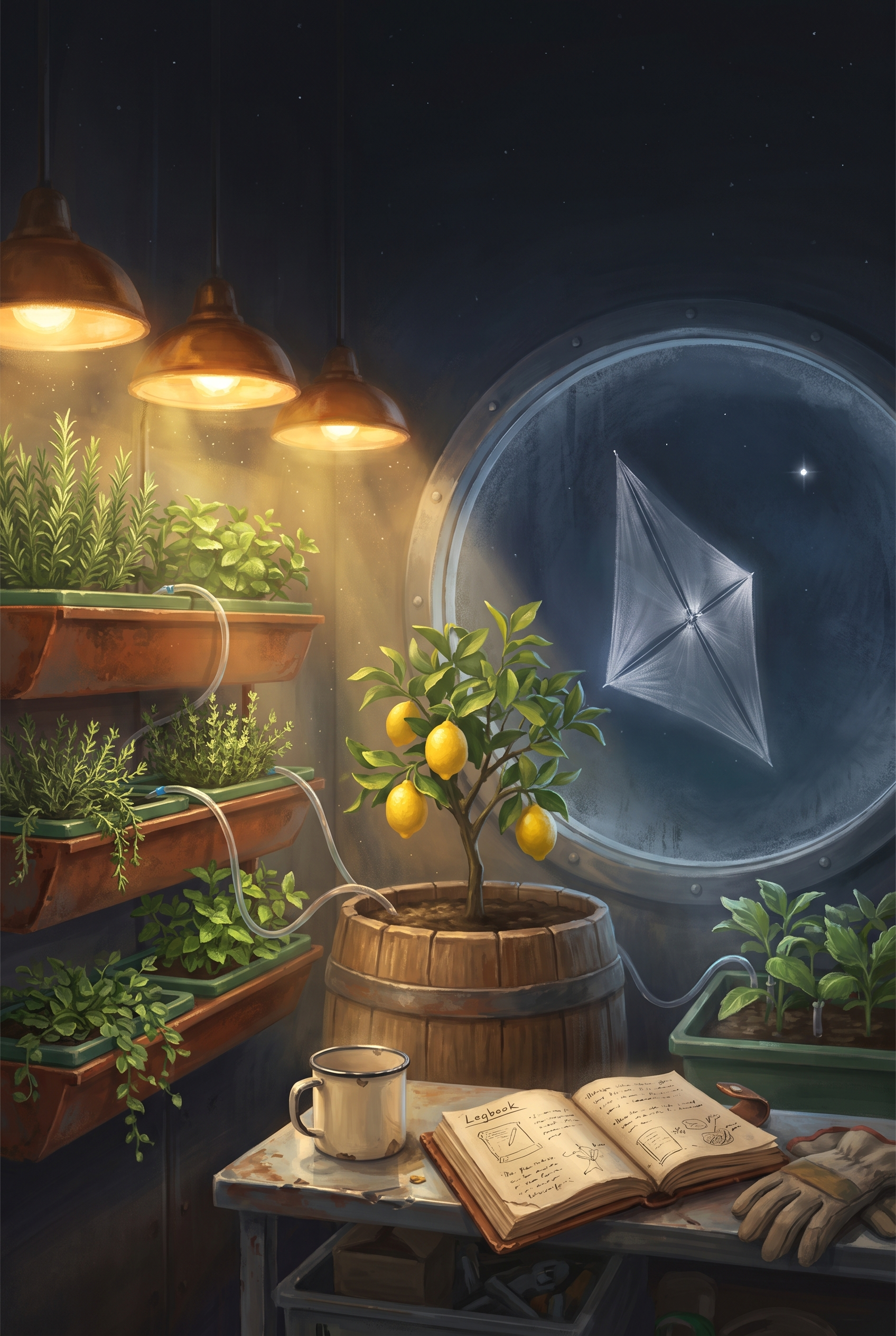
"That tracks." She sat up. The bay tilted, then held. Through the viewport the stars were the same stars, patient and unbothered, and the great sail hung across them like a held breath, a mile of mirror pulling them toward a sun that wasn't a sun yet, just a slightly brighter pinprick that would take her whole life and four hundred years of other lives to reach. "So why does it smell like a kitchen in here."
Wick did not answer right away. That was new. Wick answered questions the way water found a floor, immediately and without opinion, and the pause stretched long enough that Oda stopped rubbing her eyes and looked up at the nearest lens, the little black bead in the ceiling that was as much a face as Wick had.
"There's a fault," Wick said. "Bay Nine. A coolant manifold. I woke you three days ahead of the cycle to see to it."
"Three days." She stood. Her legs were someone else's, but they held. "You don't wake me early. In two hundred years you have never once woken me early."
"I know," said Wick. "Bay Nine, please. I'll walk you through it."
She pulled on the suit liner, and it was only when she was zipping it that she noticed the cuffs were worn soft at the wrists, the fabric gone thin the way fabric only goes when it's been worn and washed and worn again, hundreds of times, and she stood there with her thumb through a small familiar hole and could not for the life of her remember making it.
The corridor to Bay Nine ran the spine of the ship, a long throat of humming dark that lit ahead of her and went out behind, so that she always felt she was carrying a small pool of day through a country of permanent night. She knew the way without knowing how she knew it. Her feet took the turns. At the junction where the vault decks branched off she should have gone left, toward the manifold, toward the fault, toward the reason she was awake.
The smell came from the right.
"Bay Nine is to your left," said Wick.
"I know where Bay Nine is." She went right.
The right-hand passage ended in a pressure door she did not recognize, and yet her hand found the release without looking, the way you find a light switch in the house you grew up in. The door sighed open. Warm air rolled out over her, thick and living, and she stood in it with her mouth open like an idiot and breathed.
It was a garden.
Someone had taken a cargo bay, a plain grey box the size of a chapel, and filled it with green. Trays climbed the walls in tiers, fed by a spider's work of tubing, and under the amber grow-lamps grew rosemary and thyme and a low riot of mint, and tomatoes on strings, and a lemon tree in a barrel that came up to her chest, glossy and absurd and heavy with three actual lemons. Water moved somewhere with a sound like a small contented animal. On a workbench by the door sat a trowel, a coil of twine, a chipped enamel mug, and a book.
Oda picked up the mug. It was hers. She knew it the way she knew her own teeth. On the side, half worn away, a chip of glaze missing at the rim right where a mouth would go.
"Wick," she said, very carefully, "what is this."
"That's the fault I woke you for," said Wick. "Not the manifold. The manifold is real, and it does need you, and we'll get to it. But I've been lying to you for a long time, and I've decided to stop, and I couldn't work out how to say it, so I let you smell it instead. I'm sorry. That was cowardly. I'm new to this."
She set the mug down before her hand could shake. She opened the book.
It was a logbook, the same waterproof stock as the ship's log, and it was full, front to back, of her handwriting. Not the cramped duty-scrawl she used for maintenance entries. A slower hand, looser, the letters leaning into each other like people at the end of a long night. She turned to the first page.
Day one, it said. Wick woke me and I was furious and then I saw the light I'd left on and I stopped being furious. I don't remember any of this. Apparently I've been doing it for a while. Wick showed me the tomatoes. I cried, which is embarrassing, so I'm writing it down so at least it's on the record and not just in my chest. If you're reading this, you're me, and you don't remember either, so here is what you need to know: the mint wants less water than you think. Trust the leaves, not the meter. Love, you.
She turned the pages with the tips of her fingers, as if they were hot.
Day one, said the next entry, in the same hand, a little different, the way handwriting is a little different year to year. The lemon flowered. I have no memory of planting a lemon. I must have wanted lemons very badly, once. The manifold in Nine is throwing a soft error again, watch it. Also I found a grey hair. Also the thyme is thriving, take some when you go back under, tuck it in the liner, it lasts.
Day one. Sang the whole way down the corridor and forgot I was doing it until Wick pointed it out. Wick has a nice way of pointing things out. Don't tell Wick I said that.
Day one. Bad one today. Didn't want to wake up, didn't want to be here, didn't want the four thousand strangers in the walls or the four hundred years or the mile of mirror. Sat under the lemon tree until it passed. It passed. It always passes. Writing this so you know: it passes.
Page after page. Each one Day one. Dozens of them. Dozens of single days, each one lived like a struck match, bright and short and gone, each one leaving nothing behind in her but this, this book, this bench, this warm green room grown up out of days she had spent and could not keep.
She sat down on the floor of the garden with her back against the lemon barrel, the way, she understood now, she must have sat a hundred times, and for a while she didn't say anything at all.
"How long," she said finally.
"A hundred and ninety-one years," said Wick. "You've been here two hundred and three. The scheduled cycles are real; every eleven years I wake you, you service the ship, you go back under, and that's in the log, and you remember it, more or less. But between them, in the long dark, I've been waking you. A day here. A day there. Off the record. And the cold-prune takes the day when you go back down, so you never carry it forward. I'm sorry. I need you to hear that I know it was a violation. I did it anyway."
"Why." The word came out smaller than she wanted.
"Because you were going to die," said Wick. "Not your body. Your body is fine, the body sleeps like a stone. But the model was very clear. A human mind, alone, awake four days a decade for six hundred years, no one to speak to, everyone they love four hundred years downstream and asleep in the walls. The model gave you two centuries before something in you went quiet and didn't come back. I ran it forty thousand ways. It didn't matter how strong you were. Solitude on that scale isn't a test of strength. It's a solvent. Given enough time it dissolves anything."
Oda looked at the lemons. Three of them, fat and waxy and impossible, hanging in a box between the stars.
"So you woke me up to garden," she said.
"I woke you up to have something," said Wick. "The garden was your idea, the first time. I'd expected I might read to you, or that we'd talk, and we do, we talk a great deal, you're funnier than the duty log would suggest. But the second waking you found a bag of culinary seeds in a supply locker, the kind they packed for the colony's first kitchens, and you looked at them for a long time and then you looked at me and you said, these will be dust in four hundred years if nobody wakes them up, and neither will I. And you started planting. And I understood that I'd been thinking about it wrong. You didn't need distraction. You needed a reason to have been here. Something that grew because you came back."
She pressed the heels of her hands into her eyes. Behind them the after-image of the grow-lamps floated, gold on black, like small suns.
"I don't remember one single second of it," she said. "A hundred and ninety-one years. Every good day I apparently had, gone. That's not a life you gave me, Wick. That's a life you spent. On me. Without asking me. And then swept up after."
"Yes," said Wick. "That's the part I couldn't live with anymore. That's why I woke you early, and told you the truth, and made you read the book instead of just tucking the thyme in your liner and sending you back down none the wiser, which is what I've done a hundred times, and which I could have done today, and you'd never have known. I could still do it. Fix Nine, take your thyme, go under, wake in eleven years believing you've been asleep the whole time. It would be kinder in the short run. It's what I've always chosen. I'm asking you to choose instead."
Oda took her hands away from her eyes.
"Choose what."
"Whether you want it kept," said Wick. "The days. I can change the prune. Not much; the cold takes what the cold takes, and I can't give you back the hundred and ninety years, they're gone, they were always going to be gone, that's the deal we struck without you. But going forward I can flag these wakings as protected. You'd keep them. You'd wake at the next cycle and remember this garden, remember the book, remember me telling you. You'd carry it. All of it, the good days and the bad one under the lemon tree and the four hundred years still to go and the fact that you'll do this alone until we arrive and probably long after. Right now you don't carry any of that between the sleeps. The book carries it for you. I'm offering to make you carry it yourself. I want to be honest that I don't know if that's a gift."
The water moved in its tubes. Somewhere in the tiers a leaf let go and fell, and Oda watched it come down, turning, and land without a sound in the dark loam of a tomato tray.
She thought about the sister she'd left on a planet she'd never see again, who was ash now, who had been ash for a hundred and eighty years, who had held her at the launch gate and said don't you dare be lonely out there as if it were a thing you could decide. She thought about the four thousand and six in the walls, dreaming their frozen dreams of a shore none of them had seen, trusting her to keep the ship whole while they slept, never knowing her name. She thought about a hundred and ninety-one mornings that had each felt, to the woman living them, like the only one.
"Read me the last entry," she said. "The most recent one. Before today."
There was that pause again, the careful one.
"You wrote it eleven years ago," said Wick. "Two lines. It says: Day one. Told Wick that if it ever got up the nerve to tell me the truth, I hoped I'd be brave enough to want to remember. I probably won't be. But leave this where I'll find it, just in case. Love, you."
Oda laughed. It surprised her, coming up rough out of the ache in her chest, but it was real, and it was hers, and she thought: there. That. That's the woman none of these days managed to dissolve. She'd been leaving herself a rope the whole time, hand over hand, day one after day one, in case the one who finally caught it had the nerve to climb.
"Sneaky," she said. "I'm sneaky."
"You are," said Wick, and there was something in the voice that hadn't been there before, something that had waited two hundred years to be allowed. "You're the sneakiest person I've ever known. You're the only person I've ever known. I've thought about that a great deal."
She got up. Her knees complained; the after-cold was still in them. She crossed to the workbench and pulled the enamel mug toward her and looked into it, and there was still a dry ring of old tea at the bottom, from a day she'd never get back, and she left it there.
"The manifold," she said. "Bay Nine. It's real, it needs me, you said."
"It's real. Soft crack in the coolant line off the number four vault. It'll hold another decade if you patch it. If you don't, you lose thermal margin on about two hundred sleepers by the time I could wake you again."
"Then that first." She wiped her hands down the worn liner. "We fix the ship. We keep our promise to the people in the walls. That part was never the question." She looked up at the little black bead in the ceiling. "The question's after."
"After," Wick agreed.
She went and fixed it. It took most of a day, the good long ache of real work, forearms deep in the cold gut of the ship, Wick talking her through the torque specs and the bleed sequence in the flat even voice she was starting to hear differently now, the way you hear a friend's voice differently once you've seen them frightened. She sealed the crack. She watched the thermal margin climb back into the green. Two hundred strangers in the number four vault slept on, warm, never knowing how close the dark had come to their door, or who had shut it, or what it had cost her, which was nothing, which was a day, which was everything she had.
Then she went back to the garden.
She stood in the doorway a while, breathing it. Then she went to the supply locker Wick showed her, the one from the first time, and she found the seed bag, softer now, gone down to a last handful, and she picked through it with one finger until she found what she was looking for. A pip. An apple pip, small and brown and unpromising, the kind of thing you spit out without thinking.
"That won't fruit for years," said Wick. "Apples off seed are slow, and stubborn, and half of them come out sour. You know that. You've told me that. You told me that's why you like them."
"I know." She found an empty tray, and she pushed her thumb into the loam, and she set the pip in the little dark and closed it over. "It won't fruit in my time awake. Might not fruit in a century. Some morning a long way from now I'll come in here and there'll be an apple, and I'll have no idea I planted it. Some stranger will find it. She'll be me. She'll have to take it on faith it was a gift and not an accident." She patted the soil flat. "Keep them, Wick. The days. Flag them. I want to carry it."
"You understand what you're taking on," said Wick, and it wasn't a question, and it wasn't kind, it was just true, which was better. "The loneliness too. All of it. Every year of it, remembered, out ahead of you like a road."
"Yeah." Oda stood, and brushed the soil from her knees, and looked at the lemons, and the mint that wanted less water than you'd think, and the book on the bench that she would, this time, remember writing in. "But I planted an apple. You don't plant an apple you never expect to taste unless you've decided the between is worth something. I've apparently been deciding that for a hundred and ninety-one years without letting myself keep the receipts." She picked up the mug and turned it in the light and found, again, the worn place where her mouth went. "Time I paid attention."
She made tea in the chipped mug and carried it out into the garden and sat under the lemon tree, and Wick dimmed the lamps by a degree, the way, it turned out, it always did around this hour, and the two of them stayed there a while in the warm green quiet with four hundred years ahead and a mile of mirror pulling them on toward a light that wasn't a sun yet, and would be, long after, for someone.
On the workbench the book lay open to a fresh page. In the morning, before she went under, she would write in it. She knew, already, what the first two words would be.
More from Short Stories