Dead Air
The box in my skull was empty the night I walked into Prosper's, which meant I could hear everything, which meant I could hear him lying before he opened his mouth.
Dead Air — Synopsis
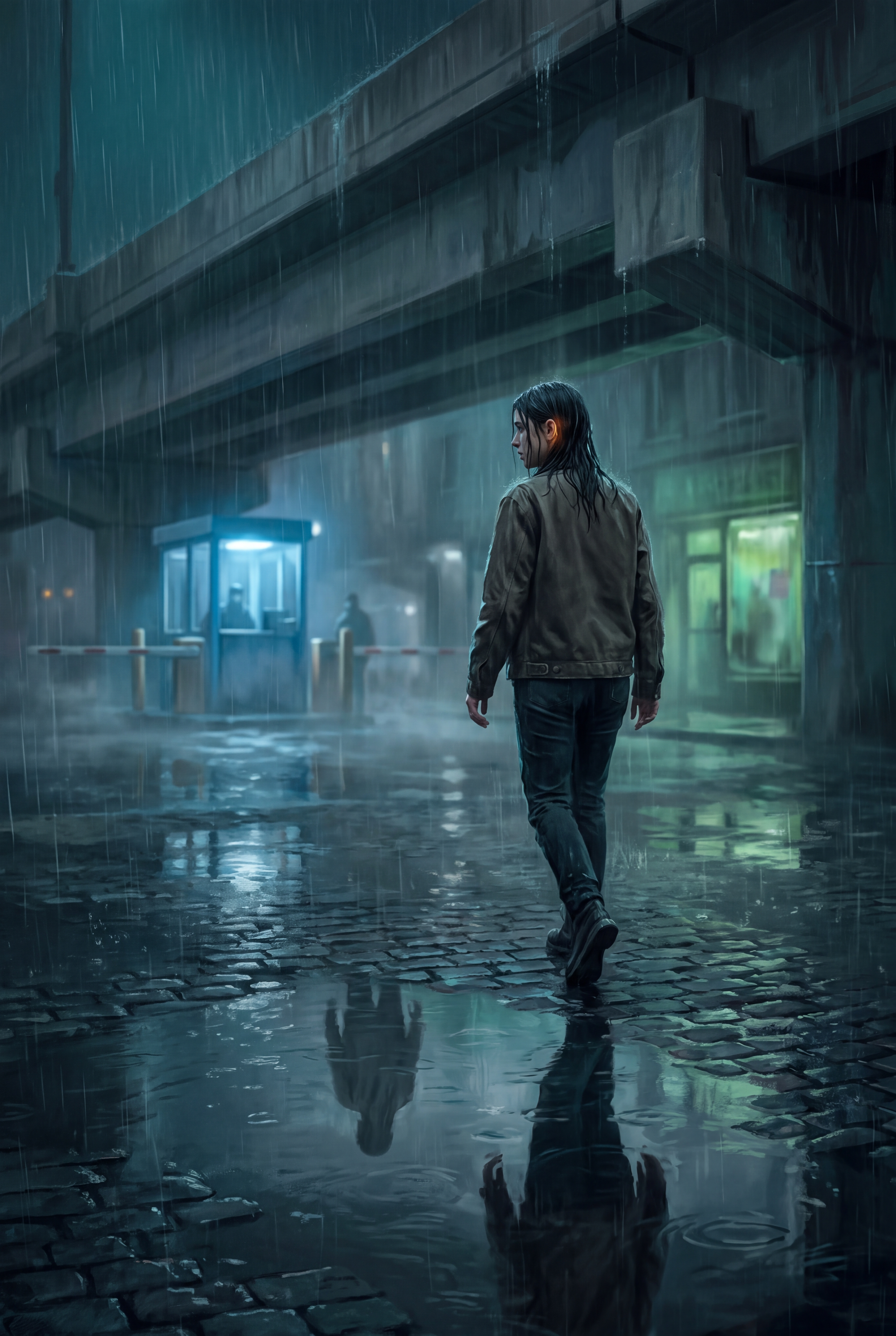
In a drowned undercity beneath a transit line, Wren is a "carrier": a human data-smuggler with a jailbroken cochlear vault in her skull that stores audio as cargo, going deaf and running "dark" while she carries. When her fixer offers a fifty-one-hour job that pays enough to buy the implant back and never smuggle again, there's a catch: the payload won't fit unless she wipes the only thing she keeps for herself, ninety-four seconds of her dead little sister Del humming off-key. Breaking her own rule, Wren looks at the manifest and finds the cargo is the last surviving recordings of the Sifter Nine, workers killed behind a locked fire door whose voices Coract has been quietly buying up and erasing so the record shows a clean floor. Rather than choose between her sister and the dead strangers, Wren threads the fifty-one hours into the silences and dead air inside Del's file, braiding the two so tightly that the checkpoint scanners read only a grieving girl "under tolerance" and wave her through. She carries everyone past the machines built to make them disappear and delivers them to Sefa, a mother who hears her lost son's bedtime voice rise out of a stranger's sister's humming. Wren takes the money, buys her freedom, and keeps one thing: ninety-four seconds in the back of the vault, with nine erased people still riding quiet in the gaps.
Dead Air
Story
The box in my skull was empty the night I walked into Prosper's, which meant I could hear everything, which meant I could hear him lying before he opened his mouth.
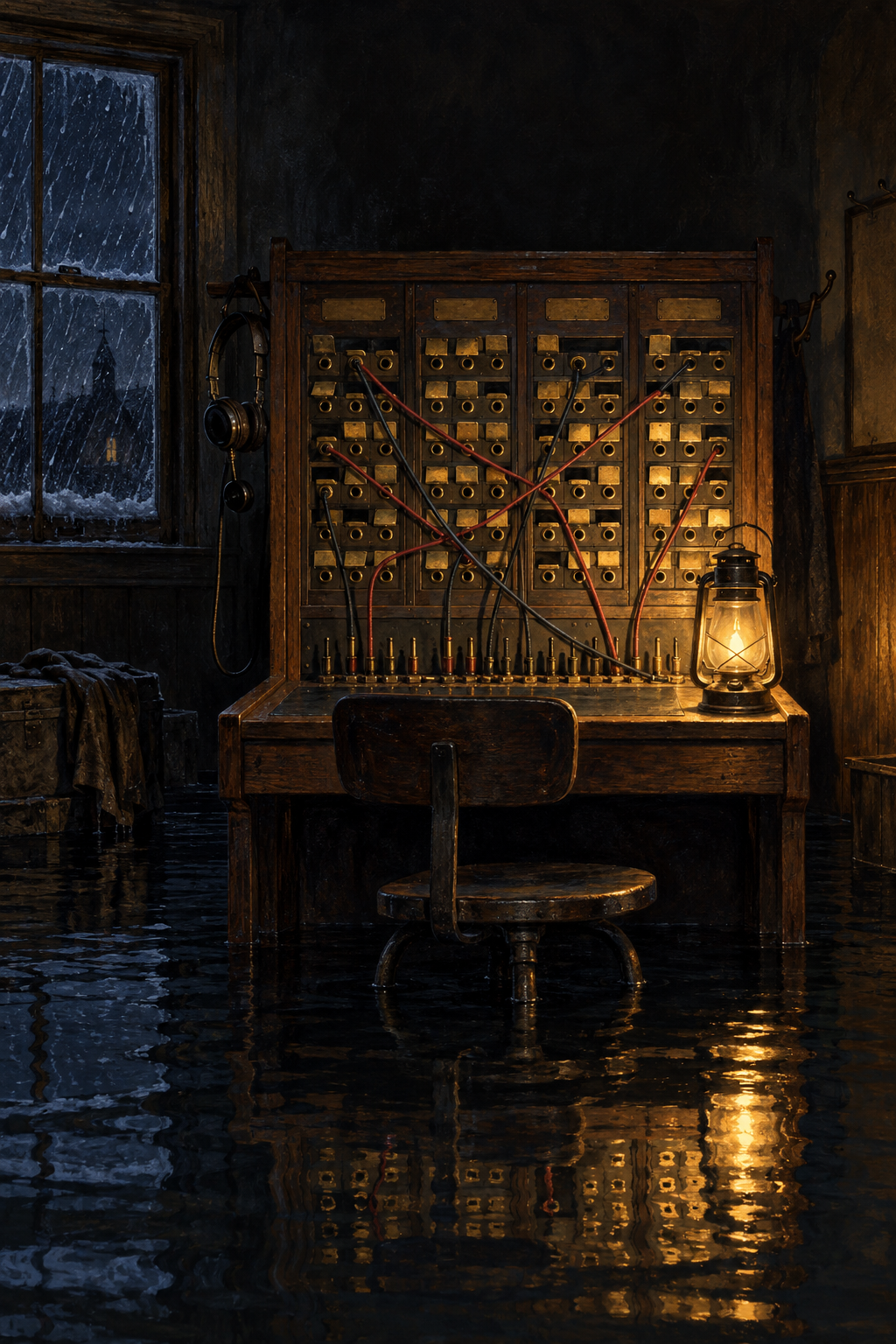
He was wiping a glass he'd already wiped. Prosper's had been a karaoke place before the transit line went up and cut the district off from the sky, and he'd never taken the machine out, so there was still a screen behind the bar cycling lyrics for songs nobody would ever sing again. Green words falling up. The rain came down hard on the tin awnings of the Underline and I stood there dripping and listened to it, because in three days I wouldn't be able to.
"You look like a drowned thing," Prosper said.
"I look like a woman who walked here. What's the job."
He set the glass down. That was the tell. Prosper only stopped wiping when the number was big enough to be a problem.
"Long carry," he said. "Fifty-one hours."
I did the arithmetic before I could stop myself, the way you flinch before a slap. My box held forty. Forty hours of clean audio, packed and sealed and riding in the bone behind my ear where the surgeons used to put a cochlear implant back when people still paid to hear. Mine was jailbroken. Mine was a vault. Forty hours was the ceiling, and he knew it, and he'd said fifty-one anyway.
"That doesn't fit," I said.
"It fits if you make room."
Outside, a train went over and the whole bar hummed in its bones, the glasses singing on the shelf, the karaoke screen stuttering. When it passed I said, "How much."
He told me.
It was enough. That's the thing I need you to understand about the number. It was enough to buy the box back from the shop that owned it, enough to pay the surgeon to unbreak it, to turn it from a smuggler's vault into a plain ordinary ear again. Enough to never run dark. Enough that I could go the rest of my life hearing the rain instead of choosing between the rain and the rent.
Enough that I said yes before I asked what I'd have to erase.
Which was stupid, because I already knew.
Everybody who carries has a thing they keep in the box. You're not supposed to. The vault is for the client's cargo and nothing else, that's the whole discipline, you carry other people's secrets and you don't get sentimental about the storage. But forty hours is a lot of empty, and empty is loud, and every carrier I've ever known kept a little something riding in the back of it where the payload never reaches.
Mine was ninety-four seconds.
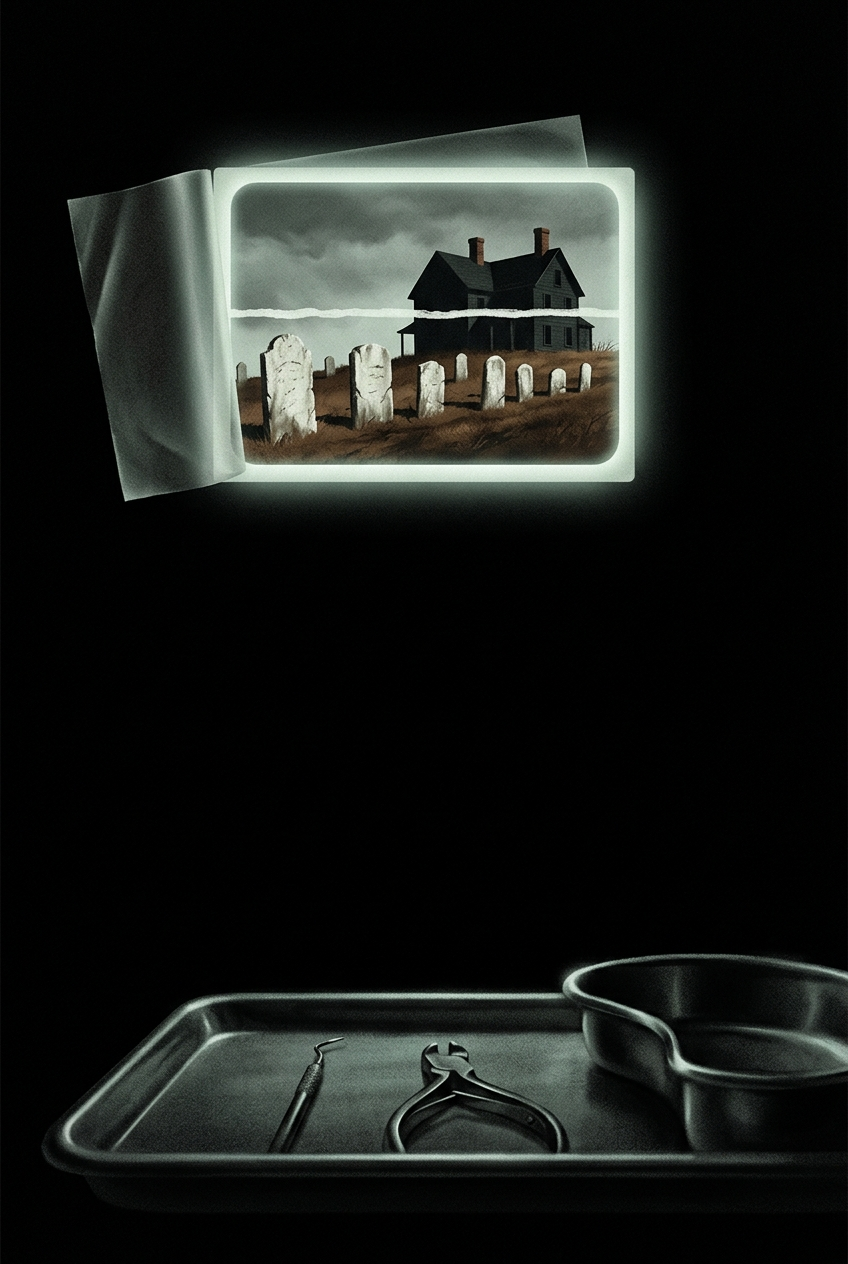
My sister Del, eleven years old, humming. She couldn't sing to save her life. She'd hum through the gaps where the words should go and then land hard and flat on the one note in the chorus she was sure of, wrong every time, and grin like she'd nailed it. I'd recorded it on a cheap slate the winter before the rustlung took her lungs apart, back when we still thought the coughing was nothing, back when Coract still ran the promo boards that said the air down here was WITHIN TOLERANCE in letters the color of a sunrise none of us could see.
Ninety-four seconds. Two silences in it where she forgot the tune, a door slamming somewhere in the background, and at the end her saying my name, Wren, like a question, like she was checking I was still recording, still there.
That was what I'd have to wipe to make fifty-one fit.
I stood in Prosper's telling myself it was only sound. I'd built a whole life on sound being only sound, on the idea that a voice is data and data is weight and weight is money. It's a good idea. It kept me fed. It just had this one flaw, which was that I didn't believe it, and never had, and the not-believing was the only thing of Del's I had left besides the ninety-four seconds themselves.
"You in or out," Prosper said, gentle, which from him was almost unbearable.
"Load it," I said. "But I want to see the manifest first."
"You never want the manifest."
"I do tonight."
You're not supposed to look at the cargo either. That's the second rule, the real one, the one that keeps you alive: a carrier who doesn't know what she's carrying can't sell it, can't be sweated for it, can't be turned. You go dark, you deliver, you forget. I'd forgotten a hundred payloads. I'd carried confessions and account keys and the recorded last words of people I'd never meet, and I'd let all of it wash straight through me like water through a fish.
But I wasn't going to burn Del for something I couldn't look at.
Prosper didn't want to. I made him. He plugged the slate into the counter jack and turned the screen so I could see, and the manifest opened, and the two of us stood there in the green karaoke light and read it.
It wasn't account keys.
It was the Sifter Nine.
You maybe heard about it, up top, for a day. Nine people on the reclamation floor at the Coract sift-house, sorting the city's dead electronics for the rare metals, when a fire started in the insulation and the door to the yard was locked because management had lost too much copper to walk-offs. Nine people at a door that wouldn't open. Coract called it an electrical event and paid the district a settlement with a nondisclosure stapled to it and started, very quietly, buying up every recording that had a Sifter voice in it. Phone logs. Doorway cameras. The kids' school slates. Anything with the sound of them still on it. You can't sue a company for killing people who, as far as the record shows, were never quite alive enough to leave a trace.
What was in my manifest was the last of it. The final backup. Fifty-one hours of the Sifter Nine talking, laughing, arguing about nothing, singing off-key at somebody's birthday, one of them reading a bedtime story down a phone line to a kid who couldn't sleep. Every scrap the families had managed to hide, pulled together into one file, headed for somewhere Coract's buyers couldn't reach it.
Fifty-one hours of the dead, and it wouldn't fit unless I killed ninety-four seconds of mine.
"I didn't know it was that," Prosper said. "I swear to you, Wren, when I took it I didn't know whose it was."
"Now you do."
"Now I do." He rubbed his face. "You can walk. Nobody'd blame you. You want a normal job, I got a normal job, forty hours of some landlord's tax lies, pays a tenth, fits with room to spare, and you keep your—" He stopped. He'd heard Del hum. Years ago, once, I'd let him. "You keep your sister."
I looked at the karaoke screen. The words kept falling up into a song nobody would sing. And I thought about how the whole trick Coract was running came down to storage. That was all. They weren't burning the Sifters. They were just making sure there was nowhere left to keep them. Erase the copies faster than the grief could copy them again, and eventually the ninth funeral has nothing to bury, and the record shows a clean floor and a good year and an electrical event.
Storage. My entire miserable trade was storage.
"Load it," I said. "And give me two hours before the run. I need to do something to the box first."
Here is what I actually did, in the back room of Prosper's with a solder pen and a cracked diagnostic slate and my own skull open on a jack like a busted radio, and I'm telling you because somebody should know it's possible.
The confessors, the Coract listening posts at every checkpoint, don't read the cargo. They can't. It's sealed. What they read is the shape of you: a full vault leaks. Pack forty hours into a box that size and the whole thing sits at a hum, a subharmonic pressure, a fullness that a good confessor can feel from across a plaza the way you can feel someone standing behind you. That hum is what gets carriers pulled out of line. Not the secret. The weight of the secret.
But a personal file doesn't hum like that. A personal file is small and it's ragged, full of dead air, silences where nobody thought to keep talking. When the confessors read a box with Del in it they read ninety-four seconds of a kid humming with two gaps in the middle, and they wave you through, because grief isn't contraband. Grief is under tolerance. Grief is the color of a sunrise on a promo board. Nobody's ever locked a door on grief because it's already the thing they're counting on you not to be able to prove.
So I didn't wipe her.
I hid the Sifters inside her.
I took the fifty-one hours and I threaded them into the dead air. Under the humming, in the two silences where Del forgot the tune, in the empty half-second after the door slammed, in the breath before she said my name, I laid the Nine down quiet, riding the gaps, a whole floor of the dead sheltering in the spaces where my sister couldn't remember the words. To the confessors it would read as one file. One ragged personal recording, ninety-four seconds long, a girl humming. Under tolerance. Wave her through.
To erase one you'd have to erase both. You couldn't kill the Sifters without killing Del, and you couldn't kill Del without killing the Sifters, and I sat in the back of a dead karaoke bar and understood that this was not a compromise. This was the truest thing I would ever do with the ugly machine in my head. This was what the box was for. Not carrying secrets. Carrying each other's dead when there was nowhere left to keep them.
Then I sealed it, and I ran dark.
Running dark is exactly what it sounds like. The box needs the bandwidth, so it takes your hearing to get it. The moment I sealed the file the world went to felt instead of sound. I could feel the train come through the platform grating up into my teeth. I could feel Prosper say be careful against my cheek, the shape of the words without the words. I stepped out into the Underline and the rain was a thing that happened to my skin and to my eyes and to nothing else, silent, the awnings drumming a beat I could only see, water jumping off the tin in little dead frames.
You forget how much of the city is sound until you're carrying instead of hearing it. I went up the Halvory stair with fifty-one hours of the dead in my skull and the ninety-four seconds of my sister wrapped around them, and I couldn't hear my own feet, and it was the loudest I have ever been in my life.
The first checkpoint was the transit gate at Wren-and-Fourth, which is a joke I've stopped finding funny, my name on a street where they scan you. The confessor booth glowed its soft chapel blue. I put myself in the line and I did the thing you do, which is think about anything that isn't the box. I thought about the rent. I thought about the surgeon. I did not think about the fact that I was about to walk fifty-one hours of the disappeared past the machine built to make sure they stayed disappeared.
The confessor read me. I felt it as a pressure at the base of my skull, a hand cupped over the back of my head, patient. Somewhere a screen was drawing the shape of what I carried. Ninety-four seconds. Two silences. A girl. Under tolerance.
The gate went green. I felt it go green in the loosening of the guard's shoulders, in the way the line breathed and moved. I walked through Wren-and-Fourth carrying everything, and the machine called me empty, and for once the lie was mine.
There was a second checkpoint and a third. There was a stretch on the Sift-house Road, of all the roads, where a Coract sweeper drone tracked me for two blocks with its ring of blue eyes, close enough that I could feel the wind off its fans on the wet back of my neck, and I made myself walk like a tired woman going home, because I was a tired woman going home, and it lost interest, because tired women going home are under tolerance too. That's the secret they don't know they've told you. They built a whole city that can't see the people it's already decided don't count. You just have to be willing to be one of them all the way to the door.
The door was a laundry in the Ninth Terrace that hadn't washed anything in years, and behind it, a woman waiting.
Her name was Sefa. I found that out later. That night she was just a face in a doorway with the particular stillness of someone who has trained herself not to hope in front of couriers, because couriers lose things, couriers get pulled, couriers are the last fragile link in a chain that has broken on her before.
I couldn't hear her. I was still dark. She saw that, saw the flatness in how I watched her mouth, and she didn't waste words I couldn't catch. She just brought me inside, out of the silent rain, and sat me down at a folding table with a jack in the middle of it, and waited while I found the seam in my own skull and opened it and let the sound come back.
It came back the way feeling comes back to a numb hand, in pins, in a rush, too much of it. The buzz of a bad light. Rain. Her breathing. My own, ragged, louder than I wanted.
"You have them," she said. Not a question. She'd seen my face.
"I have them," I said. My voice sounded strange to me after three days of not hearing it. "There's a thing I have to tell you first. About how they're stored."
I told her. I told her about Del, and the ninety-four seconds, and the dead air, and how I'd laid the Nine down inside the silences because it was the only shape the machines would let past. I told her that to play her son, she'd have to play my sister too, that the two files were braided now and couldn't be pulled apart without losing both, and that I hadn't asked anyone's permission and if she wanted I'd find a way to strip mine out and she'd never have to hear a stranger's kid humming over the top of hers.
Sefa listened to all of it. Then she reached across the folding table and plugged the slate into the jack and pulled up the file, and pressed her thumb to it, and the laundry filled up with the sound of a girl who couldn't sing, humming, landing flat on the one note she was sure of.
And under it, riding in the gaps, a man's voice came up out of the dead air, patient and warm and reading a bedtime story down a phone line to a kid who couldn't sleep. Her kid. The one whose bed she still hadn't been able to give away.
Sefa put both hands over her mouth. I looked at the wall. There are moments you don't get to watch, and that was hers, and I'd carried it fifty-one hours to give her the privacy of it.
When the ninety-four seconds ran out, Del said my name at the end, like a question, Wren, checking I was still there. And in the silence after, before the file looped, Sefa said, to the machine, to the dead air, to a girl she'd never meet, "He's still there. They're both still there."
I got paid. I want to be clear that I got paid, because it matters that this isn't a story about a woman who found something purer than money. I took the number Prosper promised and I gave half of it back to Sefa's people for the copying, because that's the whole game now, you copy faster than they can erase, you put the Sifters in a hundred boxes and a hundred slates and the humming of a hundred kids until there's no floor big enough to lock all the doors. I kept the other half. I bought the box back. I've got a surgeon booked for the spring who's going to unbreak my skull and give me back a plain ordinary ear, and I'll never run dark again, and I'll be able to hear the rain for the rest of my life.
Except I told him to leave one thing.
Ninety-four seconds, in the back of the vault, in the bone behind my ear where the payload never reaches. Two silences in the middle. A door slamming. A girl landing flat on the one note she was sure of, and at the end, checking. And riding in the dead air under all of it, so quiet you'd have to know to listen, nine people who were never quite alive enough to leave a trace, laughing, arguing about nothing, reading somebody to sleep.
Under tolerance. The machines will always wave me through.
Let them. I'm carrying everybody.
More from Short Stories